
Trust & transparency
Evidence & disclosures
Evidence basis: Researched analysis. The article compares public evidence and does not claim hands-on testing unless a section says otherwise.
Based on current U.S. DOT refund rules, the Federal Register, and complaint guidance; individual eligibility still depends on the itinerary and airline action.
Sources checked: Aug 20, 2026
Linked references: 4 explicit sources in the article.
When I'd Ask for an Airline Refund Instead of Taking the Travel Credit
The flight is canceled, the family group chat is on fire, and the airline app puts a nice, easy travel credit button in front of you.
That is exactly when I would slow down.
A credit might be useful. A new flight might save the trip. But if the airline canceled the flight or made a significant change and I no longer wanted to travel, I would check whether a refund to the original form of payment was available before accepting anything else.
The button that is easiest to tap is not automatically the best deal.
This is a plain-English guide based on the current U.S. Department of Transportation refund page. It is written for regular travelers, especially families, students, and anyone trying to protect a real travel budget. It is not legal advice, and airline-specific processes, international rules, and unusual itineraries can vary.
TLDR
- If the airline cancels your flight and you choose not to travel, you are entitled to a refund under DOT rules, regardless of why the airline canceled it.
- A significant delay or schedule change can also qualify if you choose not to travel or accept the airline's alternatives.
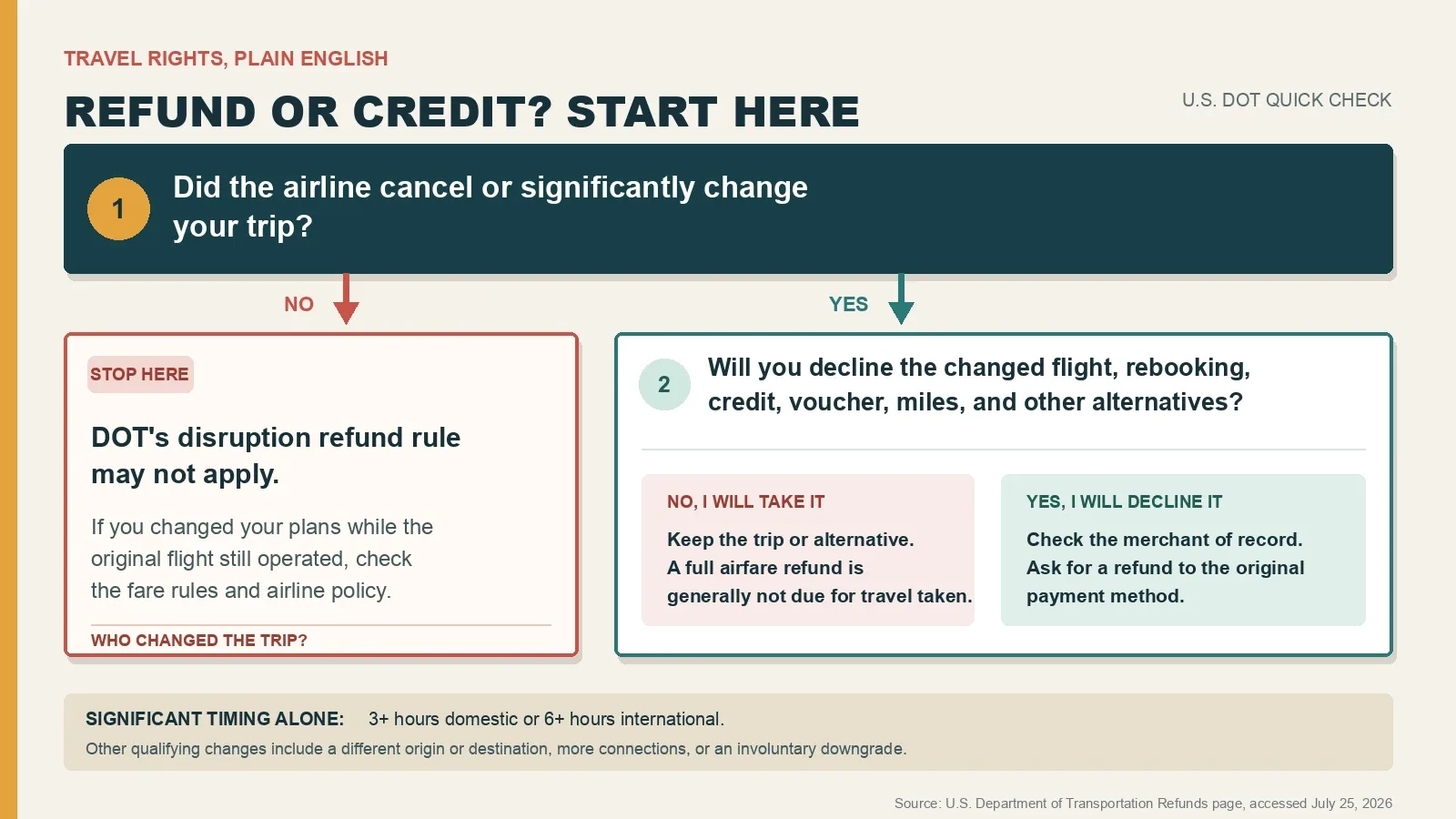
- For domestic itineraries, arriving at least 3 hours late or departing at least 3 hours early meets DOT's significant-change threshold. For international itineraries, the threshold is 6 hours.
- A different origin or destination airport, an added connection, or an involuntary downgrade can also count as a significant change.
- Do not accept a travel credit, voucher, rebooked flight, or other compensation until you decide which option actually works for you.
- A refund is supposed to go back to the original form of payment, not become airline money you have to remember to use later.
- Save the original itinerary, the change notice, receipts, and your response before anything disappears from the app.
The 30-Second Refund Check
Before I accepted a replacement flight or travel credit, I would answer four questions:
- Did the airline cancel the flight or significantly change the itinerary?
- Am I choosing not to take the changed flight or another flight the airline offered?
- Have I avoided accepting a credit, voucher, miles, or other alternative compensation?
- Do I know who actually charged me for the ticket?
If the first three answers are yes, there may be a DOT refund right. The fourth answer tells you whether the airline or a ticket agent is likely responsible for issuing it.
If I changed my mind while the original flight still operated as scheduled, that is different. A nonrefundable ticket generally does not become refundable just because the trip no longer works for me.
The useful question is not simply, "Is my ticket nonrefundable?"
It is, "Who changed the trip?"
What DOT Calls a Significant Change
The phrase significant change sounds vague. The current DOT page gives it actual boundaries.
For a domestic itinerary, a change is significant when the new schedule has you:
- Departing 3 hours or more earlier than originally scheduled.
- Arriving 3 hours or more later than originally scheduled.
For an international itinerary, those timing thresholds are 6 hours.
DOT also lists these changes:
- The airline changes your origin airport.
- The airline changes your destination airport.
- The new itinerary has more connections than the original.
- The airline involuntarily moves you to a lower class of service.
- For a traveler with a disability, the airline changes a connecting airport or substitutes an aircraft in a way covered by DOT's accessibility criteria.
That matters because a change does not need to say CANCELED in giant red letters to wreck the trip.
A family might still have a flight, technically, but the replacement could arrive after a wedding, school move-in appointment, cruise departure, or prepaid event. An added connection could turn a manageable trip with children into an all-day obstacle course. A new airport could create a rental-car or pickup problem nobody budgeted for.
The itinerary is not just a collection of flight numbers. It is attached to the rest of the trip.
A Simple Family Example
Imagine a family of four spent $1,600 on flights for a long weekend.
The airline cancels the outbound flight and offers seats the next evening. The replacement would miss the event that justified the trip. The app also offers a $1,600 travel credit.
The credit may look generous because the number is the same. Financially, it is not the same thing.
The refund returns the money to the original form of payment. The credit keeps the money inside the airline and asks the family to create another trip around its rules.
Now imagine the family has a different situation. The replacement flight leaves two hours later, everyone can still attend the event, and the airline rebooks all four travelers together at no added cost. In that case, keeping the trip may be more valuable than undoing it.
The right choice depends on the actual job the trip needed to do.
When I Would Ask for the Refund
I would lean toward a refund when:
- The airline canceled the flight and the trip no longer makes sense.
- The replacement arrives too late for the reason I was traveling.
- The new airport, connection, or schedule creates costs I do not want to absorb.
- I am not confident I will fly that airline again.
- The credit has booking restrictions that make it less useful.
- I need the money back in the family budget more than I need a future trip.
- I would have to spend more money just to use the credit.
A credit can preserve the face value while quietly changing the value to me.
Maybe it expires before the next school break. Maybe it belongs only to the original passenger. Maybe the next fare costs more. Maybe four family credits cannot be combined the way I expect. Maybe I forget about it until it becomes another item in the digital junk drawer.
DOT says credits, vouchers, or other compensation offered instead of a refund must be valid for at least five years, and the airline must disclose material restrictions, limitations, and conditions. That is useful protection, but five years does not make a credit identical to cash.
When I Might Keep the Rebooking or Credit
I would consider the airline's alternative when:
- The trip still matters and the replacement gets everyone there in time.
- The replacement is genuinely convenient.
- I know I will use the airline again.
- The credit's restrictions are clear and workable.
- The airline adds enough real value to make the trade worthwhile.
- Keeping the group together is more important than restarting the booking process.
The point is not that credits are bad.
The point is that accepting one should be a decision, not a reflex.
Before choosing a credit, I would ask:
- Who can use it?
- Can several credits be combined on one booking?
- Is the deadline based on the booking date or the travel date?
- Can it be used for taxes, fees, bags, and seat assignments?
- What happens if the next ticket costs less?
- What happens if the next ticket costs more?
- Does accepting it end my right to a refund for this disruption?
I would screenshot the answers.
Refunds Are Not the Same as Meals, Hotels, or Extra Cash
This is where airline problems become a word salad.
A ticket refund answers one question: if the airline canceled or significantly changed the flight and I choose not to take the alternative, do I get my ticket money back?
Meals, hotel rooms, ground transportation, rebooking help, miles, and other compensation answer different questions.
DOT says the refund right applies when the airline cancels or significantly changes the flight, regardless of the reason, if the traveler declines the alternative.
Extra amenities often depend on whether the disruption was within the airline's control and what the airline promised in its customer service plan. DOT maintains an Airline Cancellation and Delay Dashboard for those commitments.
Weather can affect the meal or hotel conversation. It does not erase the refund question when the airline cancels the flight and I decide not to travel.
Keeping those two questions separate makes the conversation much easier:
- Question one: Am I taking the trip or asking to unwind the ticket?
- Question two: If I am still traveling, what rebooking help or amenities has this airline promised?
What "Automatic Refund" Means
For tickets purchased directly from an airline, DOT says a refund should be automatic when the airline cancels or significantly delays or changes the flight and the traveler does not accept the changed flight, a rebooked flight, a travel credit, or other alternative compensation.
The detailed DOT guidance says the refund is due:
- Within 7 business days for a ticket purchased by credit card.
- Within 20 calendar days for another form of payment, such as cash or check.
The refund should return to the original form of payment.
Automatic does not mean I would ignore the situation.
Airlines can set a deadline for accepting a replacement flight. If I wanted the replacement, I would accept it before the deadline. If I wanted the refund, I would clearly reject the alternative and keep the confirmation.
I would save:
- The original itinerary and receipt.
- The cancellation or schedule-change notice.
- The alternative flight or credit offer.
- My written rejection of the alternative.
- Any refund confirmation or case number.
- The card statement showing the original charge.
That little folder is much more useful than trying to reconstruct everything from memory three weeks later.
Who Owes the Refund?
Look at the charge on the credit-card or bank statement.
DOT calls the company shown there the merchant of record. If a ticket agent or online travel agency is the merchant of record for a flight to, from, or within the United States, that ticket agent is responsible for a proper airfare refund when the airline cancels or significantly changes the flight.
If the airline appears on the statement, start with the airline.
If an online travel agency appears, start with the agency and include the airline's change notice.
Optional service fees are different. DOT says ticket agents are not responsible for refunding fees for airline services that were not provided, including certain baggage fees. Those requests go to the airline.
A Refund Request I Would Send
I would keep the message short, factual, and easy to forward:
Subject: Refund request for canceled or significantly changed flight My original itinerary for confirmation [CONFIRMATION CODE] was canceled or significantly changed by the airline. I do not accept the changed itinerary, rebooked flight, travel credit, voucher, miles, or other alternative compensation, and I will not travel on the alternative flight. Please issue the refund to the original form of payment and confirm the refund amount and processing date in writing. Original flight: [FLIGHT NUMBER AND DATE] Passenger name(s): [NAMES] Thank you.
I would not post the confirmation code or full passenger information on social media. Use the airline's private support form, chat, email, or phone channel.
If the Refund Does Not Appear
First, give the airline or ticket agent a clear chance to fix it.
Send the request in writing when possible. Keep the case number. If you call, write down the date, time, department, and what the representative said.
If the business does not resolve a refund you believe is due, DOT provides an online consumer complaint process. DOT says airlines must acknowledge consumer complaints within 30 days and send a written response addressing the complaint within 60 days.
That does not mean every complaint will be individually investigated. DOT explains that non-civil-rights service complaints may be used for targeted or sample compliance reviews. The complaint still creates a record and requires the airline or ticket agent to respond.
Two Useful Refund Rules People Forget
The 24-Hour Booking Rule
For airline tickets purchased at least seven days before departure, airlines must either let consumers cancel for a full refund within 24 hours or hold the reservation at the quoted price for 24 hours without payment.
Airlines do not have to offer both options.
That federal requirement applies to airlines, not automatically to online travel agencies or other ticket agents. A third-party seller may offer a similar policy, but I would check before paying.
Fees for Services You Did Not Receive
DOT says travelers are entitled to refunds for optional airline services that were unavailable through no fault of the traveler. Examples can include paid seat selection, Wi-Fi, lounge access, or another ancillary service the airline did not provide.
Checked-bag fee rules have their own timing and reporting requirements. If a bag does not arrive, file the mishandled-baggage report promptly instead of assuming the ticket-refund process covers it.
My Before-I-Tap Checklist
Before accepting anything after a cancellation or major schedule change, I would check:
- Did the airline cancel or significantly change the trip?
- Does the new itinerary still accomplish the purpose of the trip?
- Am I willing to take the replacement flight?
- Do I want cash returned to the original payment method or airline-only value?
- What restrictions apply to the credit?
- Who is the merchant of record?
- Have I saved the original itinerary and every offer?
- Am I looking at a ticket refund, extra travel assistance, or both?
- Does an international segment or third-party booking create another set of rules?
Then I would make the choice on purpose.
The Calm Version
Air travel disruptions create fake urgency. There is a line at the counter, a timer in the app, children asking what happens next, and a bright button promising to make the problem disappear.
Sometimes the rebooked flight is the right answer.
Sometimes the travel credit is perfectly useful.
And sometimes the best answer is, "No, this trip no longer works. Please put the money back where it came from."
The important part is knowing that those are separate choices before one tap makes the choice for you.
Sources
- U.S. Department of Transportation: Refunds, last updated November 7, 2025; accessed July 25, 2026.
- U.S. Department of Transportation final rule: Refunds and Other Consumer Protections, published April 26, 2024; accessed July 25, 2026.
- U.S. Department of Transportation: Airline Cancellation and Delay Dashboard, last updated September 11, 2025; accessed July 25, 2026.
- U.S. Department of Transportation: File a Consumer Complaint, last updated August 1, 2025; accessed July 25, 2026.
Rules, airline procedures, and international requirements can change. Confirm the current DOT page, the airline's customer service plan, the ticket agent's terms, and the details of your own itinerary before making a decision.