
Trust & transparency
Evidence & disclosures
Evidence basis: Mixed evidence. The article combines more than one evidence type; the evidence summary identifies which claims come from which basis.
Colin’s first-person experience with physician membership transitions and specialist scheduling, combined with current CMS, OECD, AMN, AMA, KFF, RAND, CBO, Health Affairs, and Commonwealth Fund evidence. Personal billing details remain deliberately general because no statement classification was supplied.
Sources checked: Aug 15, 2026
Linked references: 13 explicit sources in the article.
Relationship disclosure: No doctor, hospital, insurer, policy organization, photographer, or video provider paid for placement. No affiliate relationship is claimed. Stock images use the recorded Unsplash or Mixkit licenses.
AI assistance: AI assistance was used to refresh source checks, restructure the article, create canonical CMS blocks, and prepare media derivatives. Colin’s personal experiences, opinion, supplied article direction, and final publication decision remain his.
Synthetic media: No AI-generated documentary imagery is used in the finished package. Inline photographs are licensed stock or licensed stock-video frames, and the billing-flow graphic is a deterministic original illustration. Native charts render directly from the cited data.
Latest substantive update: Rebuilt as a multimedia video-companion feature with eight licensed inline photographs, one process graphic, native stats and accessible comparison charts, source-adjacent citations, a save-worthy voter scorecard, and a non-sensitive policy poll.
I already had insurance. What I was being asked to buy back was time, familiarity, and the chance to keep seeing a doctor who knew what had happened to me.
When did health care stop being about healing and start being about access?
After open-heart surgery and a year filled with specialists, appointments, and recovery, I needed something pretty basic: doctors who knew me, knew what had happened, and would still be there for the next part.

Instead, two of my doctors moved toward a concierge or membership model. Once the polite language was removed, the choice felt simple: pay an additional annual fee or start over with someone else. One doctor urged me to stay while saying the decision was out of his hands. I believe he cared. I also believe the patient being asked to pay more has less leverage than the physician delivering the message.
Another specialist’s calendar was so full that an appointment could be made six months ahead, life could change during those six months, and moving the date could mean waiting close to another year. That is not continuity of care. That is a reservation system with medical consequences.

Then a short visit can be followed by a charge large enough to make you wonder whether you accidentally financed a new wing of the building. I am frustrated, but I do not want to turn that frustration into an easy villain.
This is a mixed first-person and research-based article. The personal experiences are mine. The national comparisons come from linked public sources checked August 15, 2026. I am not claiming that every doctor, insurer, hospital, or membership practice behaves the same way, and nobody paid for placement.
TLDR
- Two physician relationships changed when their practices moved toward membership access, while another specialist became extremely difficult to reschedule.
- The United States spent $5.3 trillion on health care in 2024—$15,474 per person and 18% of the economy.
- In the OECD’s comparable figures, the U.S. spent about 2.5 times the average per person while having fewer practicing doctors per 1,000 people.
- Insurance companies add complexity and can deny or restrict care, but premiums also reflect unusually high provider prices, hospital market power, drug costs, and administration.
- RAND found private plans paid hospitals 254% of Medicare prices for the same services at the same facilities in 2022.
- Other countries use different public and private mixes, but they generally establish basic coverage, stronger price rules, simpler administration, and public responsibility for affordability.
- My conclusion is not that one slogan fixes everything. It is that time, trust, and ordinary access should not be premium upgrades.
Watch the video if you don't feel like reading:
The Worst Part Is Starting Over
The financial side makes me angry, but the relationship is the part that stays with me. A good doctor knows the strange detail from six months ago, the medication that caused a problem, the question I forgot to ask, and the difference between my normal worry and the look on my face when something really feels wrong.

That history matters after major surgery. It matters when several specialists are involved. When a practice changes models, the paperwork may call it a transition. The patient experiences it as a loss. I can transfer my records. I cannot transfer years of familiarity in a PDF.
Concierge medicine offers something people clearly want: longer appointments, faster responses, and a physician with a smaller patient list. I understand why a burned-out doctor might want to practice that way, and why a patient with the money might gladly pay. Direct primary care can be different again, often operating outside insurance and sometimes offering a simpler lower-cost arrangement. The models should not be mashed together and declared equally bad.
If an additional membership fee buys the time and attention that good medicine requires, what exactly is everyone else’s insurance buying?
My Experience Is Personal. The Pattern Is Not.
The 2025 AMN Healthcare survey reported an average 31-day new-patient wait across 15 large metro areas and six specialties. That was 19% longer than in 2022 and 48% longer than in 2004. My near-year rescheduling problem is not the national average, and I am not presenting it as one.
Different studies measure different parts of the system; together they show longer waits, growing membership-practice capacity, and declining physician-owned practice.
A Health Affairs study of concierge and direct-primary-care practices identified 1,658 practice sites in 2018 and 3,036 in 2023—an 83% increase. The number of clinicians in the combined models rose 78%. Growth does not prove exploitation. It does show that doctors and patients are trying to escape limits in ordinary practice.
The AMA’s 2024 Physician Practice Benchmark Survey found only 42.2% of physicians were in private practice, down 18 percentage points from 2012. Payment pressure, bureaucracy, resources, technology, compliance, and payer rules make “just open your own practice” much easier to say than to do.
We Spend Enough. More Than Enough.
Here is the number that should end the argument that America simply needs to spend more.
Historical 2024 National Health Expenditure figures from the Centers for Medicare & Medicaid Services.
The CMS National Health Expenditure Fact Sheet also reports $1.110 trillion for physician and clinical services, $467 billion for prescription drugs, and $1.645 trillion financed through private health insurance. That last number is spending paid through private plans—not insurer profit.

The OECD’s latest comparable figures put U.S. health spending at $14,885 per person after purchasing-power adjustment. The OECD average was $5,967.
Purchasing-power-adjusted U.S. dollars; this is the internationally comparable OECD measure, not the CMS national-account figure.
We are paying the luxury price. The workforce comparison makes the access problem even harder to explain.
Practicing physician density from OECD Health Statistics 2025.
Health outcomes are affected by much more than hospitals and insurance: housing, violence, addiction, poverty, food, education, and personal choices all matter. An international comparison cannot explain one person’s result. It can still show that the return on $5.3 trillion deserves much harder questions.
So Are Insurance Companies Jacking Up the Price?
Yes—and no—and the honest answer is more useful than the satisfying one. Insurers negotiate prices, design networks, write prior-authorization rules, manage formularies, process claims, deny some claims, and add complexity between patients and care. They are not innocent bystanders. But the entire premium is not insurer profit.
KFF Employer Health Benefits Survey; premiums do not include most deductibles, copays, or coinsurance.
The 2025 KFF employer survey found family premiums 53% higher than in 2015. Employers pay most of the family premium, but that money is still part of the cost of employing people—not a free pile of cash that appears beside the copier.
Under the Affordable Care Act’s medical loss ratio rule, insurers generally must spend at least 80% or 85% of premium dollars on medical care and quality improvement, or issue rebates. That limits how much can go to administration and profit. It does not make the medical prices underneath the premium reasonable.
The Congressional Budget Office found that faster growth in the prices commercial insurers pay providers—not faster growth in the amount of care used—has been the main reason their per-person hospital and physician spending grew faster than Medicare’s. A dominant hospital system may be too important for an insurer to exclude, leaving two giant organizations negotiating with money that eventually comes from workers, employers, patients, and taxpayers.
What Is a Medical Service Actually Supposed to Cost?
A medical bill may contain a list price that almost nobody pays, an insurer-negotiated allowed amount, a plan payment, a deductible or coinsurance amount assigned to the patient, and sometimes a facility fee because a hospital owns the room. The patient’s bill is not the physician’s take-home pay, and the first number printed on the statement is not necessarily revenue.
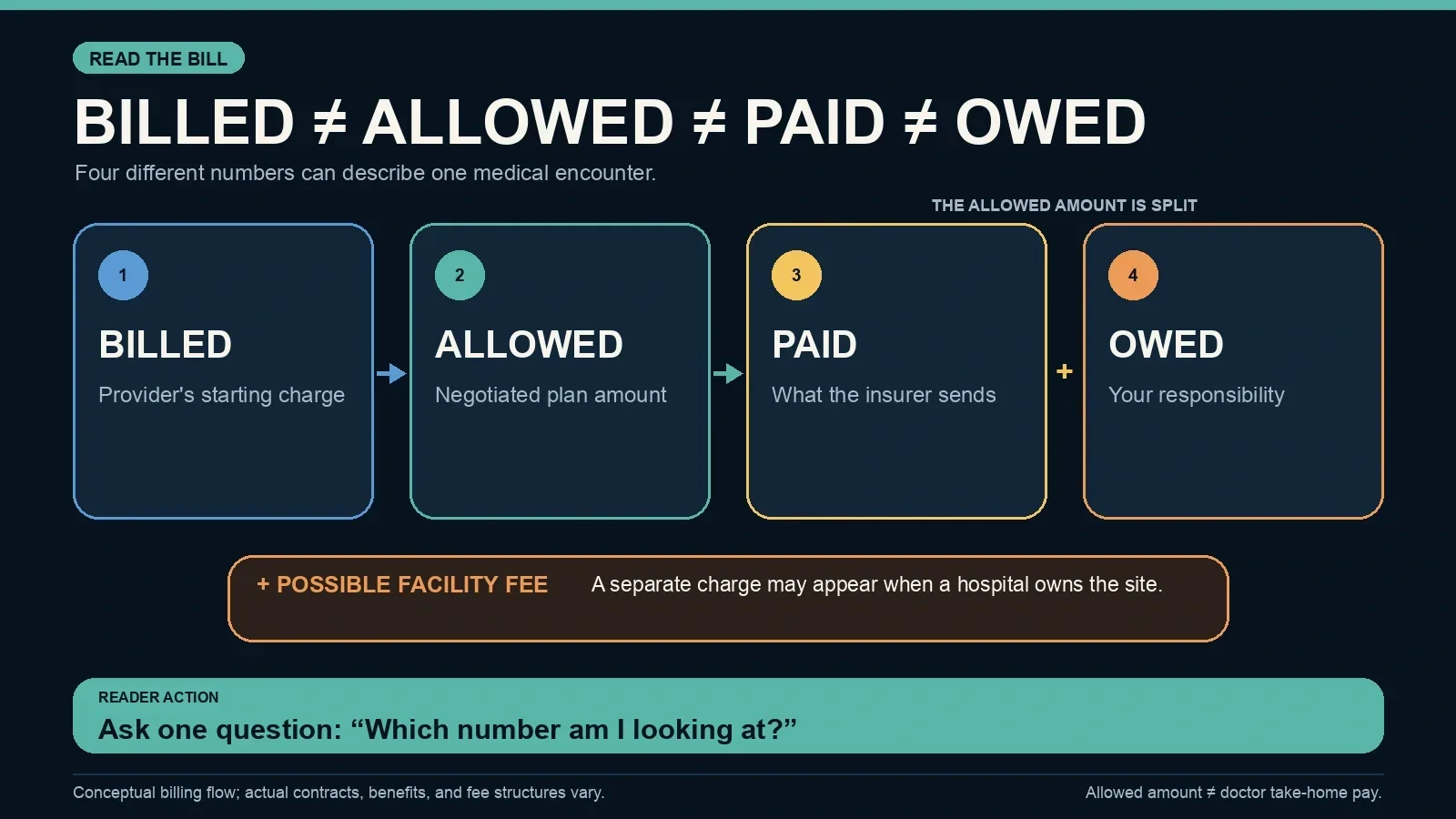
Medicare is useful because its rates are public, standardized, and adjusted for geography and service complexity. It is not a perfect definition of economic cost. Rural hospitals, trauma centers, teaching programs, and unusually complex patients can require thoughtful adjustments. A public benchmark still lets us ask a better question: why did a private plan pay two, three, or four times that rate for the same service?

RAND compared actual private-plan payments with what Medicare would have paid for the same services at the same hospitals. In 2022, employers and private insurers paid an average 254% of Medicare. State averages ranged from below 170% in Arkansas to above 335% in Florida and West Virginia.
2022 relative prices for the same services at the same facilities. Medicare is the 100% benchmark, not a claim that every hospital should receive exactly that rate.
The gap has continued to widen. A KFF analysis of Bureau of Labor Statistics producer-price data found private-insurance hospital prices rose 30% from April 2019 through April 2026, while Medicare rates rose 21%.
Cumulative price change by payer; this is price growth, not total-spending growth.
A fair price should cover efficient care, local labor and supply costs, emergency and teaching capacity, and a reasonable margin. It should not depend mainly on how much market power one hospital system can bring to the table.
Where Does the Rest of the Money Go?

Some of the money goes exactly where we would expect: nurses, doctors, technicians, medicines, buildings, equipment, laboratories, cybersecurity, emergency capacity, and care for people who cannot pay. American clinicians are also paid more than many peers, and medical training can leave people with enormous debt.
A Commonwealth Fund evidence review estimated that administrative complexity accounted for about 30% of the excess U.S. spending it could identify relative to peer countries—roughly half in insurance administration and half inside provider organizations.
An underlying international comparison used in the Commonwealth Fund review; amounts are per person.
That is not a bedside procedure. It is the machinery used to decide who pays, which code is accepted, which form is missing, and whether the same evidence needs to be submitted again. Higher drug prices and clinician compensation explain additional shares. The review did not find strong comparative evidence that fraud or low-value care is more common in the United States than in peer nations, so neither is an honest explanation for the entire gap.
Other Countries Are Not Magic. They Made Different Rules.
Every health system has shortages, waits, taxes, budgets, coverage decisions, and mistakes. The useful question is not whether another country found perfection. It is how that country sets prices, builds primary care, assigns financial risk, and keeps people connected to the system when they get sick.
The Commonwealth Fund’s 2026 comparison and its current country profiles show several workable public-private mixes. They are examples, not a performance ranking.
These countries do not use one identical system. Their common ground is more revealing than the labels:
- Everyone has a basic path into the system.
- Prices are negotiated or constrained with public authority behind the rules.
- Primary care is treated as infrastructure rather than a luxury upgrade.
- Coverage and billing rules are more standardized.
- Government remains accountable for whether the whole system is affordable, even when private companies participate.
We do not need to copy one country. We do need to admit that other arrangements exist—and that our rules are choices too.
What Would a Better American Deal Look Like?
I am not a health economist. I am a patient who got angry enough to read the reports. These are the reforms that look practical enough to measure and important enough to demand real answers about.
1. Put a Real Limit on Extreme Prices
Price transparency is useful, but a posted price does not create competition when a patient is unconscious, one hospital owns most of the local system, or the specialist has no alternative opening. The Congressional Budget Office estimated that transparency alone would produce only a very small reduction in commercial provider prices.
Policy families are not additive, and these are assessed price effects rather than guaranteed savings.
A cap can use a multiple of Medicare while allowing thoughtful adjustments for rural hospitals, teaching programs, trauma services, and genuinely unusual costs. Oregon has applied a 200%-of-Medicare cap to hospitals in its state employee plan since 2019, and Indiana enacted a future cap for nonprofit hospitals. The design matters because blunt cuts can damage access just as surely as uncontrolled prices can.
2. Pay the Same Reasonable Price for the Same Service
A routine visit should not become dramatically more expensive because a hospital bought the practice and attached a facility fee. Site-neutral payment would reduce the incentive to acquire ordinary offices only to bill them like hospital departments. When a service truly needs hospital resources, pay for those resources. When it is the same visit under a new logo, the patient should not finance the acquisition strategy.
3. Treat Primary Care and Continuity as Infrastructure
The OECD reports fewer practicing doctors per person in the U.S. than its average, and the 2026 Commonwealth Fund comparison found the U.S. had the fewest primary care physicians per person among the countries it examined. We can expand training capacity, support independent and community practices, build well-designed teams, use appropriate telehealth, and pay for coordination—not only procedures.
We can also require meaningful continuity plans when a practice closes, is sold, or converts to membership care: clear notice, active transfer help, protected prescription and follow-up windows, and a real handoff for medically complex patients. No rule can force a doctor to practice forever. It can stop the patient from being treated like an email list that needs to be migrated.
4. Simplify the Insurance Machinery
A common set of electronic claim and prior-authorization rules would not solve everything. It would be better than making every clinic learn a different portal, form, documentation standard, and appeal clock. Urgent decisions should be fast, denial and appeal data should be public, and repeatedly approved evidence-based care should not require the same ritual every few months.
5. Stop Rewarding Consolidation
Hospital, insurer, pharmacy-benefit-manager, and physician-practice acquisitions need tougher review and clearer public ownership records. Competition is not a cure-all. Allowing every independent practice to be absorbed and then acting surprised when prices rise is not a strategy either.
6. Guarantee a Basic Floor of Coverage
Countries disagree about whether government or regulated private plans should deliver coverage. Nearly all of our peers agree that illness should not erase the basic ability to receive care. America can debate the mechanism. We should stop pretending financial ruin is a useful form of patient responsibility.
Six Questions I Want Answered Before I Vote
I used to think health care voting meant choosing between giant slogans. Now I would rather bring a notebook and ask for a benchmark, a number, and a date.
- "Will you support limits on extreme hospital and specialist prices, and what benchmark will you use?"
- "Will you support site-neutral payment so the same service does not cost more only because a hospital owns the office?"
- "What will you do to reduce prior authorization, billing, and claim-processing work that does not improve care?"
- "How will you protect continuity when a practice closes, is sold, or converts to a membership model?"
- "How will you increase primary-care capacity and support independent, rural, and community practices?"
- "What public measurements will prove your plan lowered prices, reduced waits, and improved outcomes—and by what date?"

Which measurable health-care promise should lawmakers have to answer for first?
Choose the result you most want attached to a public number and deadline. This asks about policy priorities, not anyone’s diagnosis, insurance status, or political identity.
- A limit on extreme prices
- Shorter waits and stronger access
- Less billing and authorization work
- More primary-care capacity
I Still Believe in the People Doing the Work
Some of the best care I have received came from people working inside this system. Nurses calmed me down. Doctors made decisions that gave me more life to complain about doctors. Office staff squeezed me into schedules they did not create. People answered messages after hours and did more than a billing code required.
Good people can work inside a bad design. A physician can care about me and still join a model I cannot afford. An insurance employee can follow the rules and still deny something I need. A hospital can save my life and still send a bill nobody can explain. I do not want to destroy American medicine. I want the medical part to have a fighting chance against the business machinery wrapped around it.

The hopeful lesson from other countries is not that they found perfection. It is that they made choices. They built a basic path to care, gave price negotiation rules stronger than one patient’s bargaining power, treated primary care as something worth building, and changed their systems when the first version did not work.
I do not expect health care to be free, instant, or flawless. I expect it to be understandable. I expect insurance to buy access, not only a card for my wallet. I expect a medical relationship to mean more than a subscription opportunity. After spending $5.3 trillion in one year, “the system is too complicated to fix” is not an acceptable answer.
Getting sick should not turn time, trust, and ordinary access into premium upgrades. Healing should not be pay-to-play. It should still feel like health care.
I am not a doctor, health economist, lawyer, or insurance adviser. This is a personal opinion based on my experience and the cited sources—not medical, legal, insurance, or financial advice. Confirm symptoms, treatment decisions, billing questions, appeals, and coverage rules with qualified professionals and your own care team.