Trust & transparency
Evidence & disclosures
Not yet classified. This article has not yet been classified under the current editorial standard. It may predate the policy; do not assume a product was owned, tested, supplied, or independently verified unless the article says so.
Linked references: 12 explicit sources in the article.
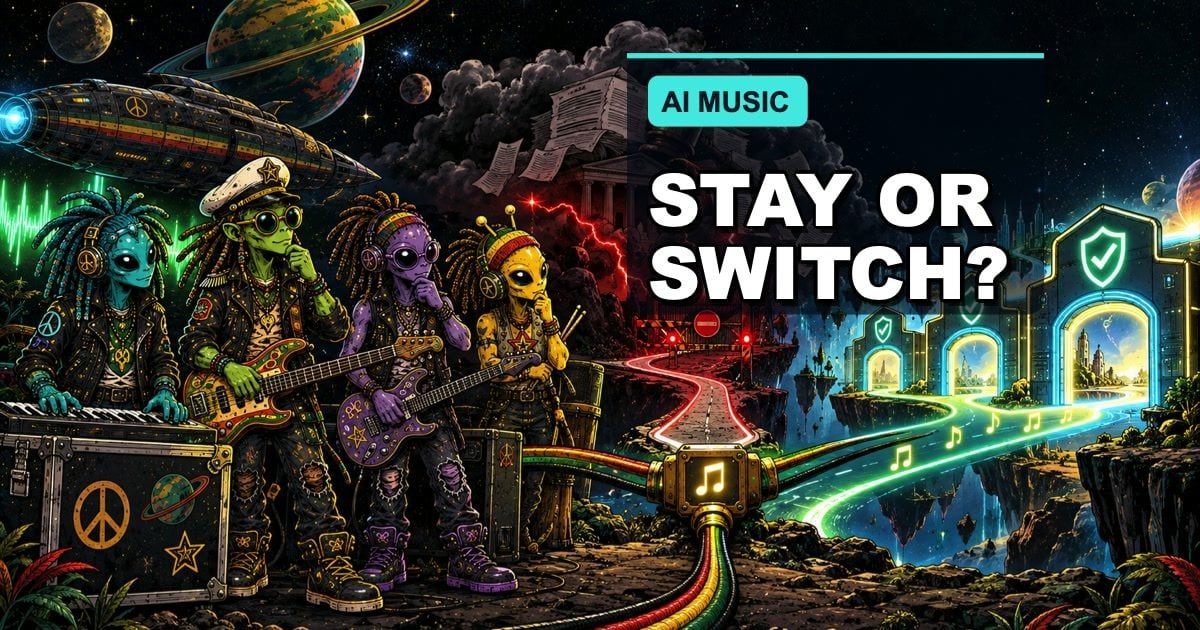
I use DistroKid to distribute the Dreadnauts.
That was not a random late-night decision made after clicking the first ad that promised to put my music everywhere. Other people in the music industry recommended the service to me. I had also heard concerns about how DistroKid operated, but the professional recommendations carried weight.
Then Universal Music Group sued DistroKid.
The headline version is that UMG says DistroKid has become a pipeline for AI-generated “slop” and copyright infringement. That is dramatic language, especially for somebody who has an AI-assisted virtual band sitting in the middle of the conversation.
The useful version is more complicated.
The lawsuit does not say every AI-assisted artist is a thief. It does not accuse the Dreadnauts of infringement. It does not prove that DistroKid broke the law. It is a complaint filed by one side on September 15, 2026, and DistroKid strongly denies the allegations.
Still, it raises a question I cannot shrug off: if I am going to keep building original digital artists, who should I trust to carry that work into the streaming world?
The Short Version
- UMG, Capitol Records, and Capitol CMG filed a 52-page federal complaint against DistroKid and related companies in Delaware.
- The five claims cover alleged deceptive trade practices, direct and vicarious copyright infringement, and parallel claims for pre-1972 recordings.
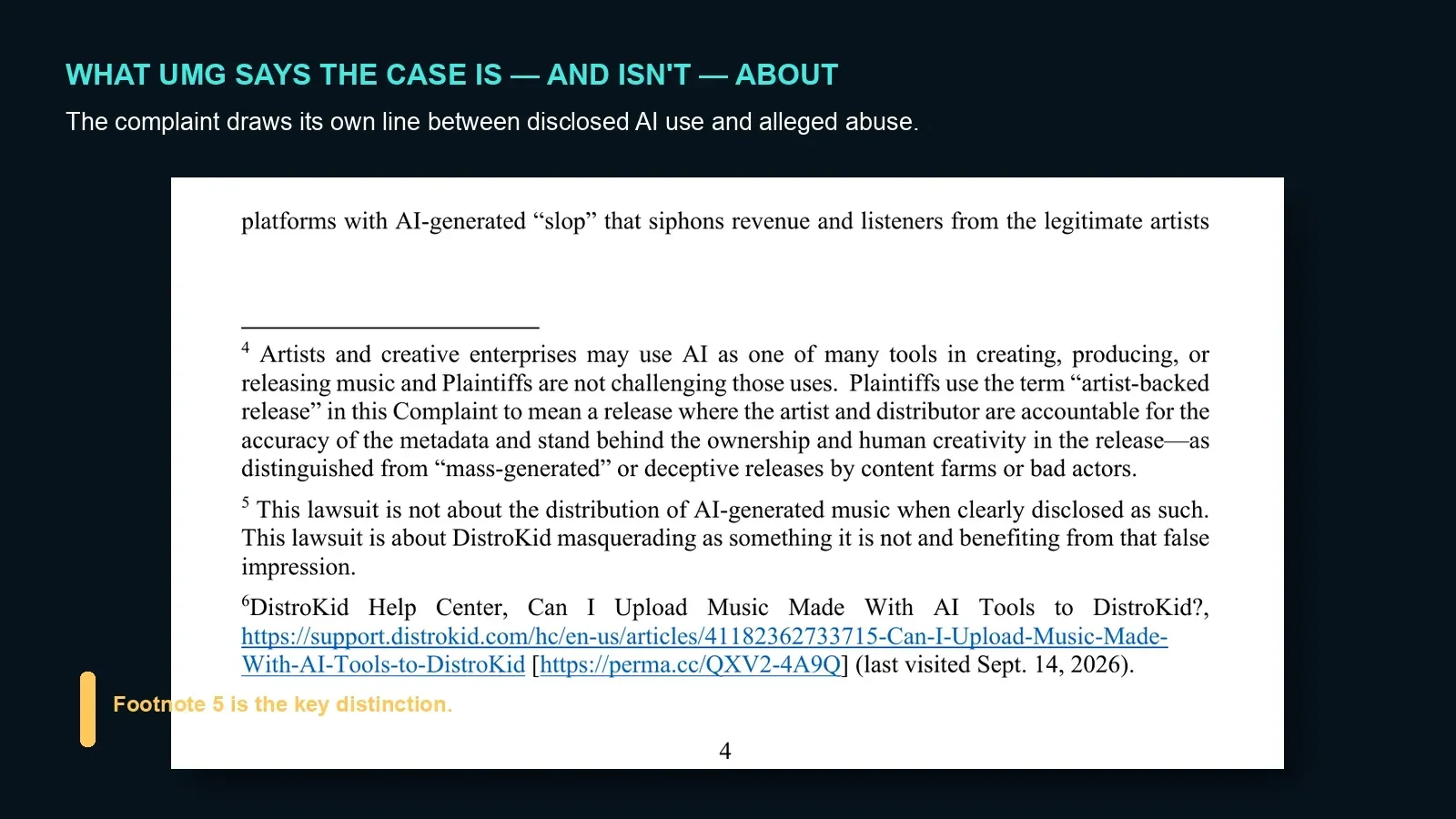
- UMG says the case is not about clearly disclosed AI music by itself. Its stated targets are misleading mass uploads, direct copying, unauthorized remixes, ISRC abuse, and allegedly continuing to distribute disputed tracks after receiving notice.
- DistroKid says it takes copyright and fraud prevention seriously, disagrees with the allegations, and will defend itself.
- I am not pulling the Dreadnauts catalog in a panic. I am preserving the catalog records, tightening my rights documentation, and comparing alternatives before the next release.
- My strongest current test candidates are LANDR and UnitedMasters, with Amuse as a serious human-reviewed option. Every one of them has tradeoffs for AI music.
What UMG Actually Filed
The plaintiffs are UMG Recordings, Capitol Records, and Capitol CMG. The defendants are DistroKid, Kid Distro Holdings, and DK Holdco. The case was filed in the U.S. District Court for the District of Delaware and is indexed as 1:26-cv-01156.
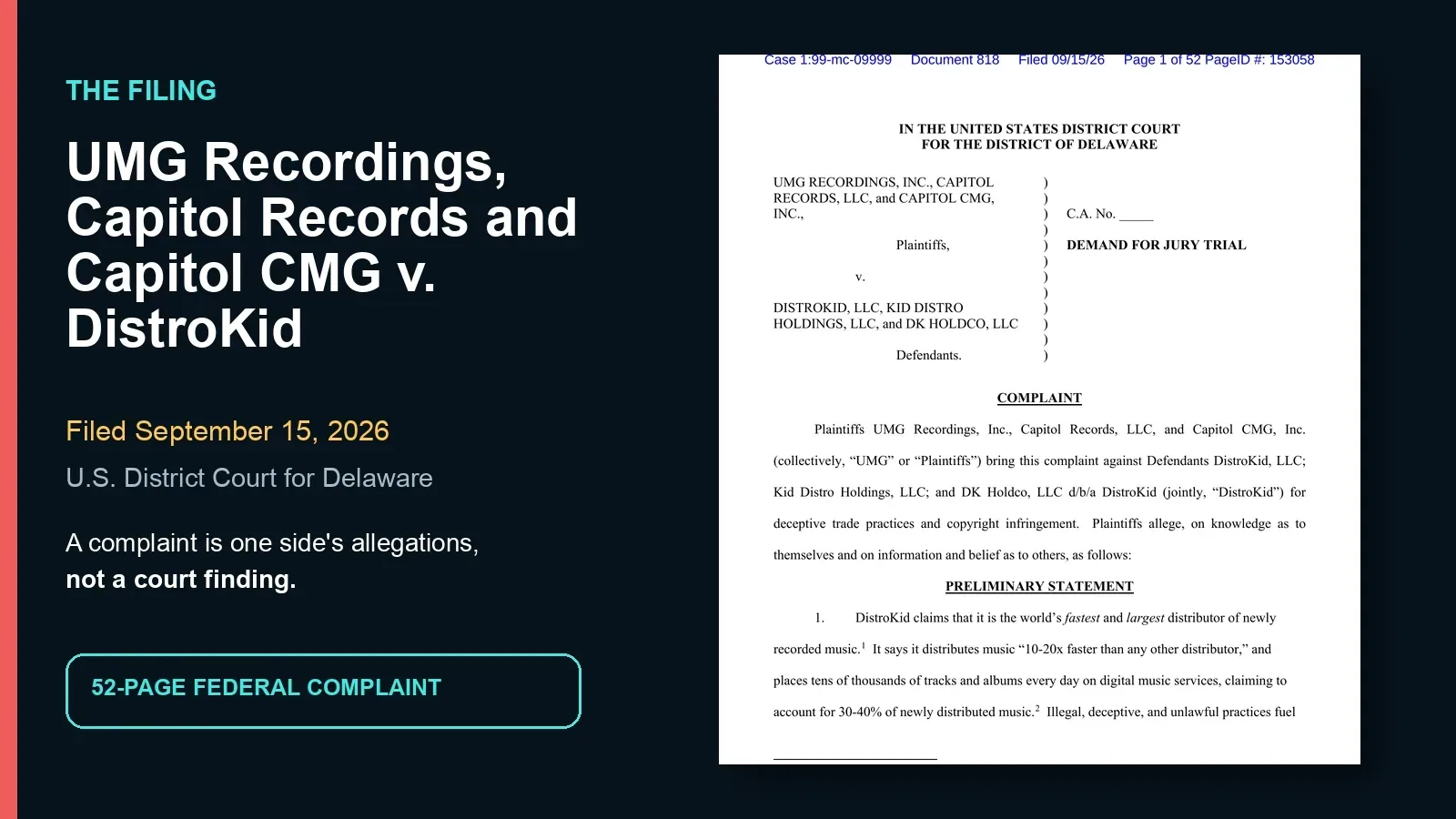
UMG brings five legal claims:
- deceptive trade practices under Delaware law;
- direct copyright infringement of post-1972 recordings;
- vicarious copyright infringement of those recordings, as an alternative theory;
- direct infringement of protected pre-1972 recordings; and
- vicarious infringement of pre-1972 recordings, again as an alternative theory.
In plain English, UMG is making two broad arguments.
First, it says DistroKid presents itself as a legitimate, artist-focused distributor that follows streaming-service rules and fights fraud, while allegedly allowing anonymous content farms, mass-generated AI catalogs, and previously flagged accounts into the system.
Second, it says DistroKid did more than pass files from point A to point B. UMG argues that DistroKid copied, reformatted, delivered, hosted, and sometimes publicly performed allegedly infringing recordings, while also having the ability to review or remove them.
Those are allegations. A court has not decided whether they are true.
The Numbers That Made Me Stop Scrolling
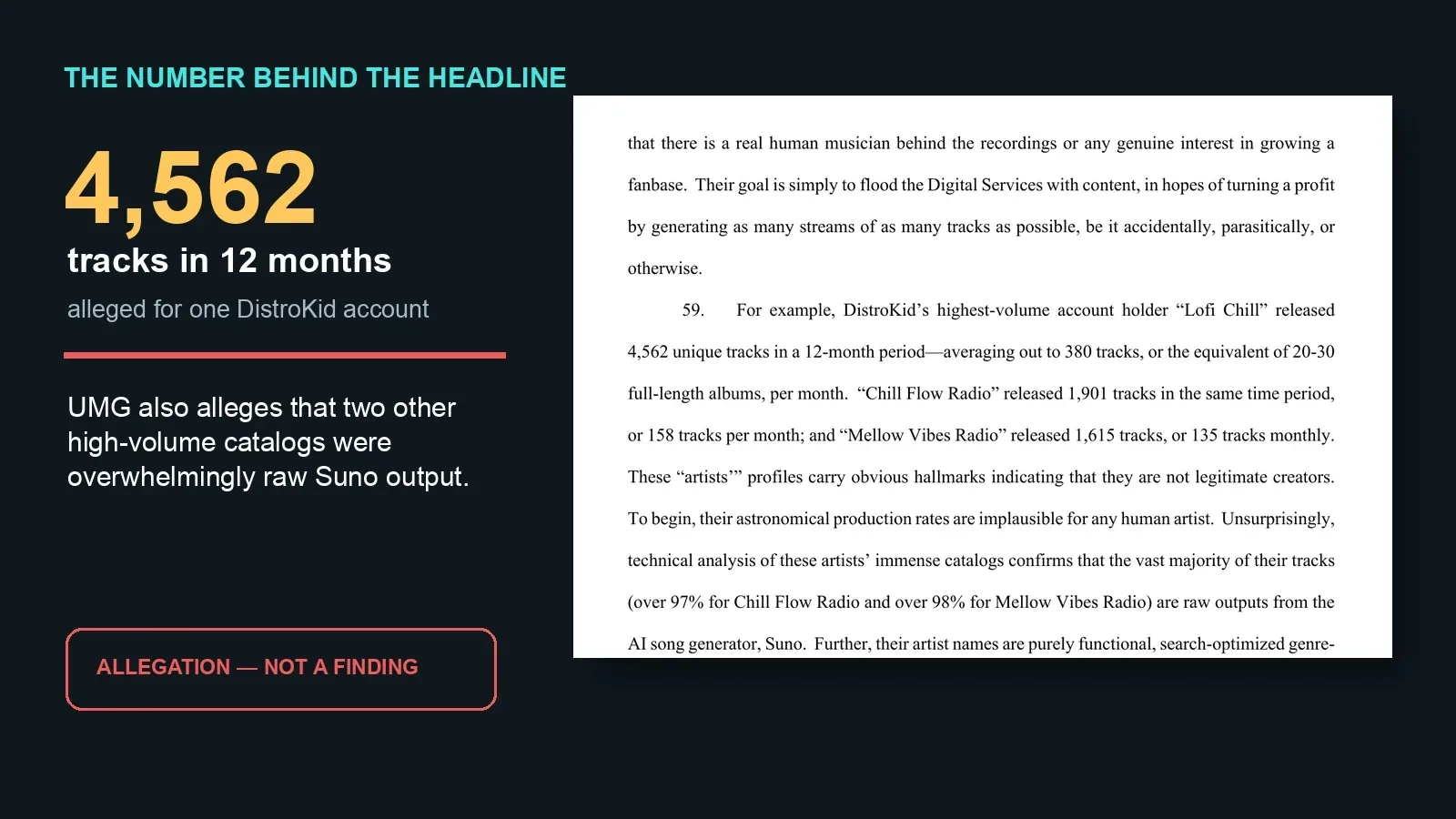
The complaint is full of very large numbers, but a few are worth separating from the legal thunder.
UMG alleges that one DistroKid account called “Lofi Chill” released 4,562 tracks in twelve months. It says “Chill Flow Radio” released 1,901 and “Mellow Vibes Radio” released 1,615 during the same period. According to the complaint, technical analysis found that more than 97% and 98% of the latter two catalogs were raw Suno outputs.
It also alleges that DistroKid delivered nearly 12 million tracks in six months to one unnamed digital service and accounted for more than half of that service's weekly track deliveries.
That is not what I am doing with the Dreadnauts.
I built a four-member fictional band, a connected story, original lyrics, a nine-track album, artwork, videos, a website, and the Project Sequencer workflow around it. Suno was part of the music-production process, but this was never a plan to generate 4,000 anonymous tracks and hope an algorithm tripped over a few of them.
That distinction matters. “AI music” is too broad a label to explain the difference between a deliberate creative project and an automated content farm.
The Copyright Allegations Go Beyond AI
The complaint's sharpest allegations are not simply “this song used AI.” UMG says its investigation identified nearly 2,000 allegedly infringing DistroKid-distributed recordings and lists 1,000 examples in exhibits.
It describes:
- slowed, sped-up, or remixed versions of protected recordings;
- long mixes containing chunks of known songs;
- artwork and metadata that allegedly copy or trade on existing releases;
- accounts using the same ISRC as a legitimate recording; and
- tracks that allegedly stayed live on other services after a rights conflict was resolved against the DistroKid account on one platform.
One example involves a DistroKid-distributed track titled “Juice Newton” by an account styled as “Candy DuIfer,” using an uppercase “I” where the real artist Candy Dulfer's name uses a lowercase “l.” UMG says that track used the same ISRC as Juice Newton's “Angel of the Morning,” creating a conflicting ownership claim.
If proven, that is not an artistic debate about whether computers can make music. That is an argument about copying, misleading metadata, ownership conflicts, and who is responsible for stopping them.
What UMG Wants the Court to Do
UMG asks for more than a check.
The requested relief includes an order restricting allegedly misleading statements about DistroKid's catalog and compliance, removing infringing tracks, terminating repeat infringers, impounding and destroying infringing copies, and awarding legal fees and costs.
The complaint also seeks statutory damages up to the legal maximum per infringed work, or actual damages and DistroKid's profits. It repeatedly requests up to $150,000 per work for willful infringement. That number is a requested statutory maximum, not an automatic award.
DistroKid's Side of the Story
DistroKid says it is proud to serve millions of independent artists, takes copyright protection and fraud prevention seriously, invests in safeguards, and works with streaming platforms and rightsholders. It says these are industry-wide challenges.
The company also says it strongly disagrees with UMG's allegations and plans to defend itself.
Its public AI policy still says AI-created music is allowed when the uploader owns the rights, does not impersonate somebody else, does not mass-upload generic spam, and does not infringe. DistroKid also says it does not take ownership of an artist's music.
Here is the uncomfortable part: a distributor can say artists keep 100% ownership while also requiring artists to carry 100% of the risk that they had the rights in the first place.
For traditional music, that responsibility is already complicated. For AI-generated material, it gets stranger.
Commercial Rights Are Not the Same as Copyright
Suno can grant a paid subscriber commercial-use rights under its contract. That permission can be important. It is not the same thing as the U.S. government saying every part of the output is protected by copyright.
The U.S. Copyright Office says human-authored expression can be protected even when AI is used as a tool. Human-written lyrics, creative arrangement, selection, and sufficiently original modification may qualify. Purely AI-generated material, or material without enough human control over the expressive elements, does not receive copyright protection under current guidance. Prompts alone generally are not enough.
That creates a sentence every AI artist should remember:
Permission to sell something is not automatically proof that you can stop everybody else from copying it.
It also means “you keep 100% of your copyright” can be less comforting than it sounds if part of the work is not copyrightable to begin with.
I am not a lawyer, and this is not legal advice. It is the practical line I am using to organize my own work.
The Alternatives I Would Actually Consider
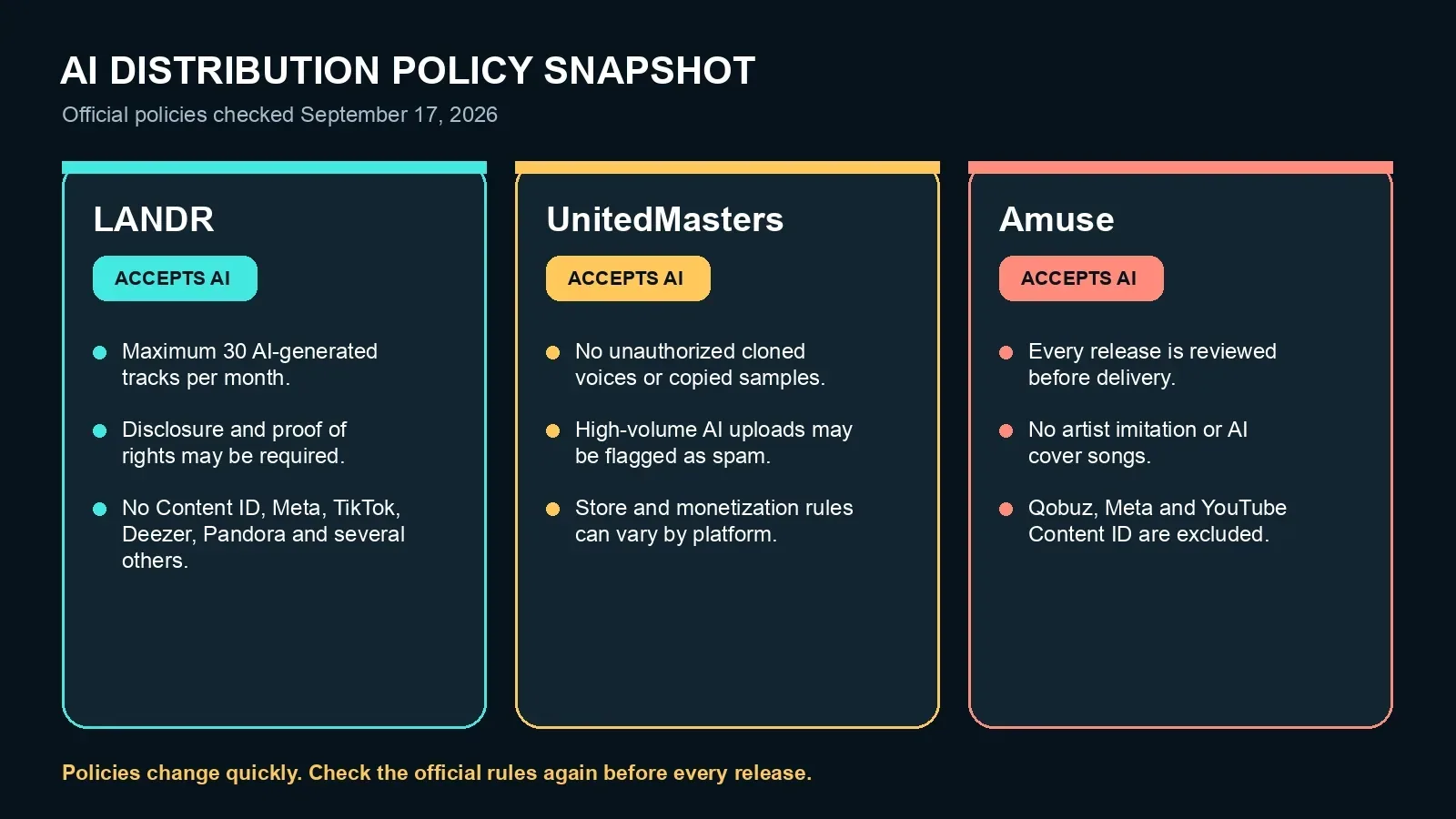
I reviewed current official policies instead of relying on affiliate listicles. These policies were refreshed on September 17, 2026, and they can change quickly.
LANDR
Current AI position: Accepts AI-assisted music with disclosure, rights ownership, no impersonation, and a current limit of 30 AI-generated tracks per month. Important catch: AI releases are currently excluded from YouTube Content ID, Meta, TikTok, Deezer, Lissen, Pandora, and Tencent.
Amuse
Current AI position: Accepts AI-generated music, reviews every release, requires cleared rights, and rejects impersonation and AI covers. Important catch: AI material is currently excluded from Qobuz, Meta, and YouTube Content ID.
UnitedMasters
Current AI position: Allows AI-created or AI-assisted music that follows its terms; bans unauthorized famous voices and copied samples; flags mass submissions. Important catch: Fully AI-generated vocals or instrumentals can be ineligible for some fingerprinting and social monetization programs.
Ditto Music
Current AI position: Accepts AI music when the artist holds full rights, avoids voice cloning, and does not bulk spam. Important catch: Ditto warns that fully AI releases may be rejected by Apple Music/iTunes and several other services.
Too Lost
Current AI position: Accepts non-infringing AI music and offers a place to attach supporting documentation. Important catch: Fully AI-generated releases face quality-control review and store availability is not guaranteed.
RouteNote
Current AI position: Accepts some AI content, asks for ethical tools and provenance, and performs moderation. Important catch: AI releases are excluded from content-recognition destinations, Amazon, and several Korean services.
TuneCore
Current AI position: Accepts GenAI music only when the underlying model uses fully licensed datasets. Important catch: This is a strong principle but a narrow gate. An older catalog needs proof that its model qualifies.
CD Baby
Current AI position: Does not currently accept AI-generated content. Important catch: It is not a Dreadnauts option under its present policy.
My Current Shortlist
1. LANDR: the clearest first test
LANDR has the clearest combination of public rules, ownership language, pricing, and a submission limit that fits a deliberate album rather than a content farm. Its current Basic plan is $24 per year and Pro is $45. It says artists keep ownership and master royalties, and releases remain live after cancellation.
The problem is reach. The current AI policy blocks several destinations, including TikTok, Meta, Deezer, Pandora, and YouTube Content ID. That may be acceptable for one release and unacceptable for another.
For the nine-track Dreadnauts album, the 30-track monthly limit is not a problem. Losing certain discovery and social destinations could be.
2. UnitedMasters: flexible, but read the monetization rules
UnitedMasters currently allows AI-assisted and AI-created music as long as it is original, non-impersonating, and not mass spam. That makes it a realistic test candidate.
The catch is that “distributed” and “eligible for every fingerprinting or monetization program” are not the same thing. A release can reach listeners while still being excluded from Content ID or social rights-management tools.
3. Amuse: a serious human-reviewed option
Amuse explicitly says every release is reviewed before delivery. That does not guarantee legal safety, but it is a meaningful signal when the alternative is a purely high-speed upload pipe.
Its store exclusions matter for me because the Dreadnauts already have a Qobuz destination. A move should preserve reach, not quietly cut holes in it.
The services I would treat as situational
Ditto, Too Lost, and RouteNote are legitimate options with published AI rules, but their store exclusions or review uncertainty make them second-round tests for this project.
TuneCore may become one of the best choices for future music made entirely with a model it recognizes as trained on fully licensed data. I would not assume an older Suno-made master qualifies without written confirmation.
CD Baby is easy to rule out today because it says it does not accept AI-generated material at all.
No Distributor Can Make a Track Copyright-Safe
A distributor is a gatekeeper and delivery service. It is not a legal car wash.
If a track contains an unauthorized sample, clones a real singer, copies a protected melody, uses artwork you do not own, or was generated under a license that forbids commercial distribution, acceptance by a distributor does not fix any of that.
For every future Dreadnauts release, I want one folder that can answer the questions a reviewer, store, collaborator, or lawyer might ask:
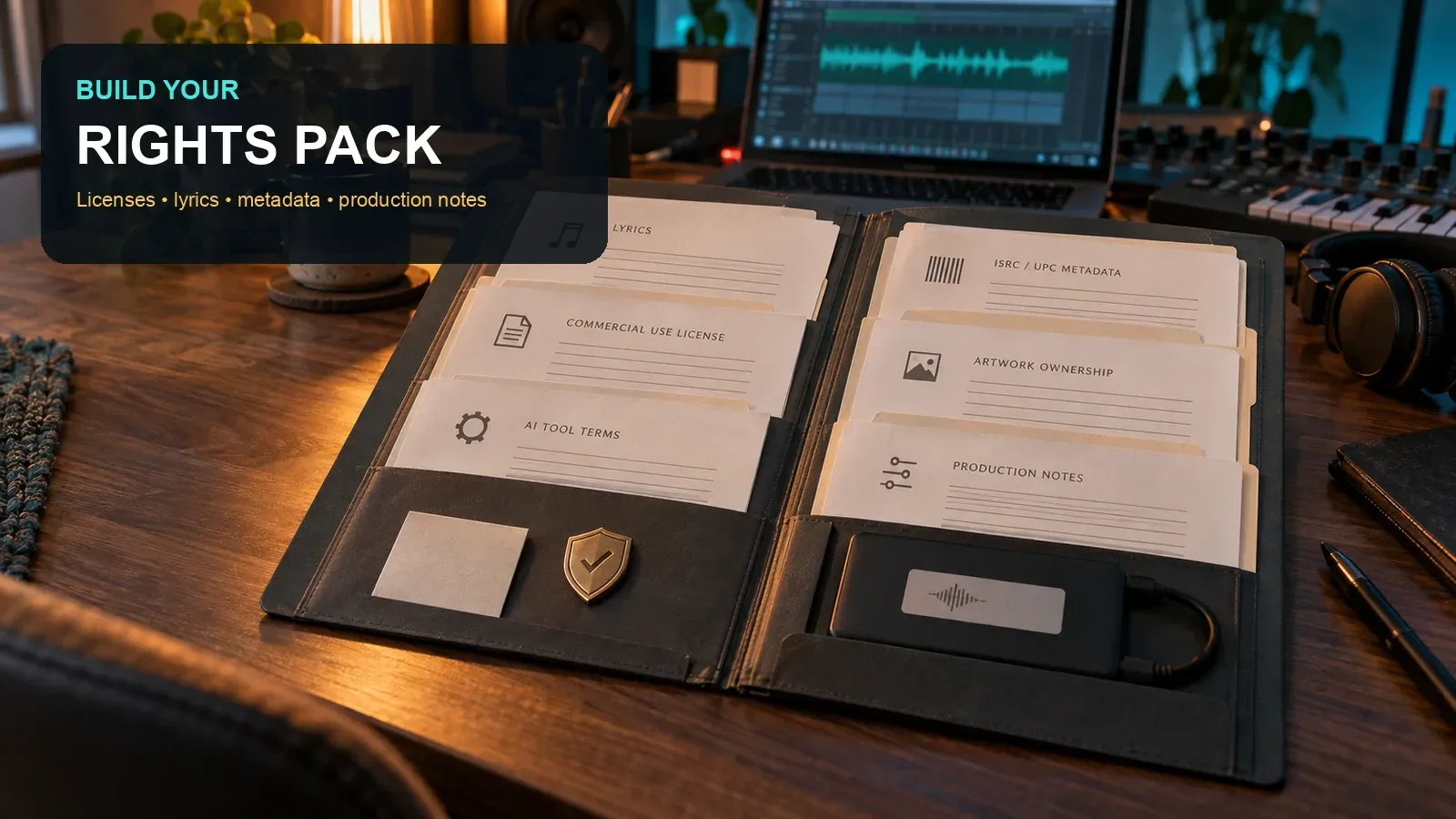
- What AI tool and model were used?
- Was the account on a commercial plan when the audio was created?
- What did the tool's terms say on that date?
- Who wrote the lyrics?
- Were any human performances, samples, loops, or third-party stems used?
- What did I select, rearrange, edit, replace, mix, master, or add?
- Are the artist name, character designs, cover art, and metadata original?
- Is this an original master or a migration of an identical master?
- Which ISRC and UPC belong to it?
- Which stores are allowed to fingerprint it?
That folder is not glamorous. Neither is a smoke detector, but I still want one in the house.
How I Would Test a New Distributor Without Breaking the Album
I would not start by deleting the Dreadnauts from DistroKid.
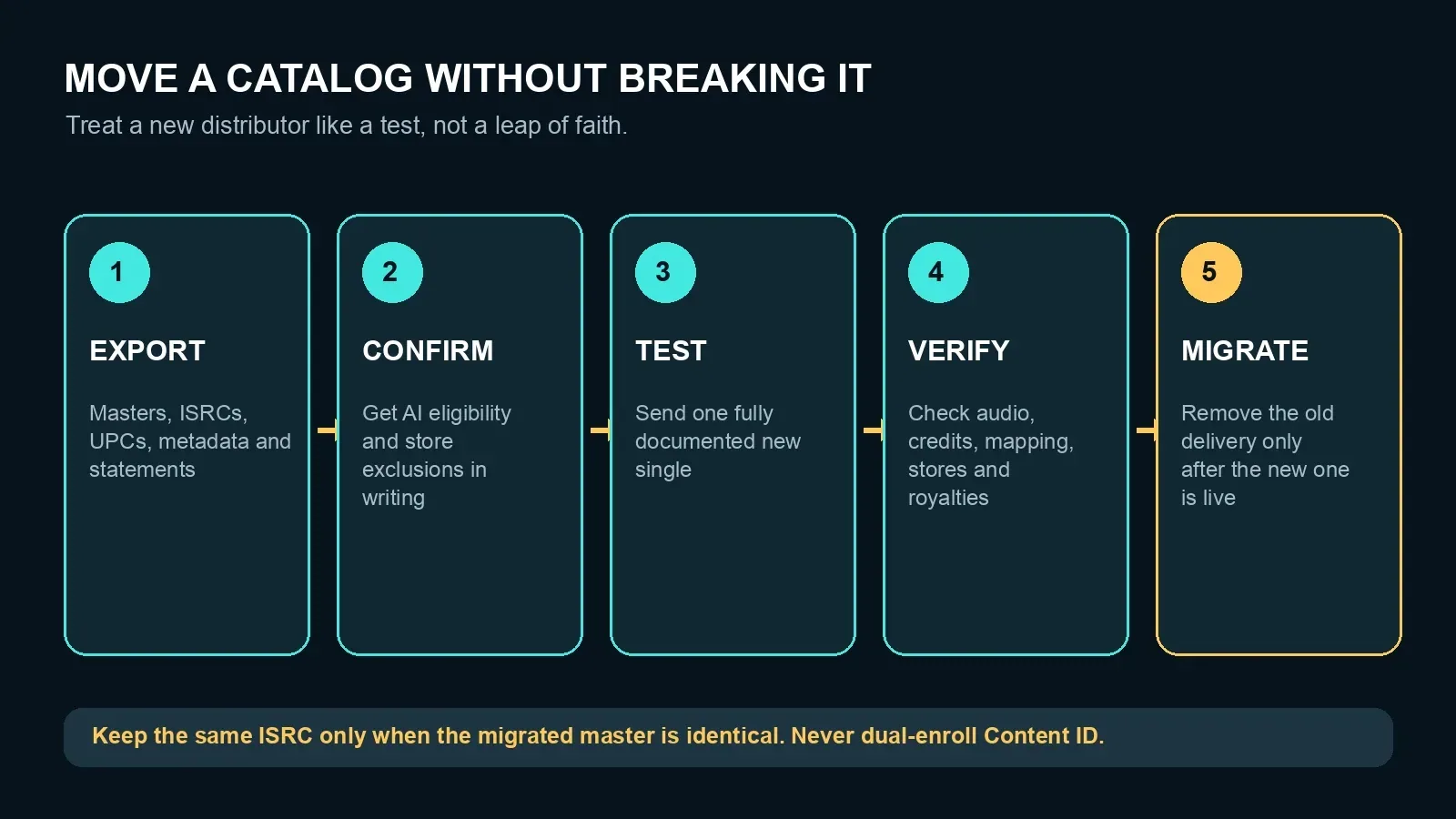
I would start with a controlled test:
- Export every current Dreadnauts ISRC, UPC, store URL, metadata field, royalty statement, lyric file, artwork file, and final master.
- Ask LANDR and UnitedMasters—in writing—whether a release made with the documented Suno workflow is eligible and which exact stores would be excluded.
- Submit one new, fully documented single to the best candidate.
- Do not enroll the same master in two distributors' Content ID or social fingerprinting systems.
- Check the live artist mapping, credits, release date, audio, artwork, and royalties before considering a catalog move.
- If moving an existing master, reuse its existing ISRC and preserve identical audio and metadata so stores can match it correctly.
- Remove the old delivery only after the replacement is verified live where it needs to be.
The first decision is not “Which company gets my whole catalog?”
It is “Which company earns the right to handle one carefully documented release?”
A Word About UMG's Position
Universal is not a neutral referee descending from the clouds with a perfect record. Major labels are also making AI licensing deals, and musicians are challenging some of those arrangements over compensation.
That does not make the DistroKid allegations false. It means the music industry's AI fight is also a fight over who controls the catalog, who grants permission, who gets paid, and who carries the risk.
I support the part that should be easy: do not steal recordings, do not clone somebody's voice without permission, do not hijack metadata, and do not flood the system with anonymous junk designed to skim fractions of pennies away from real work.
I also refuse to pretend that every artist who uses an AI tool belongs in that same bucket.
Final Thought
The Dreadnauts are not 4,562 anonymous mood tracks. They are a creative world I have spent real time writing, revising, organizing, designing, and building.
That does not place the project above scrutiny. It makes good documentation more important.
I am not pulling the catalog because one side filed a lawsuit yesterday. I am also not going to treat a familiar upload button as a lifetime promise. For now, I am preserving the evidence behind the work, testing alternatives one release at a time, and expecting any distributor I pay to explain how it protects legitimate artists without treating every AI-assisted artist like a spammer.
Trust is not a yearly subscription. It has to be earned with every release.
Sources and Further Reading
- UMG v. DistroKid stamped complaint
- DistroKid's response and case coverage
- DistroKid policy for music made with AI tools
- U.S. Copyright Office: Copyright and Artificial Intelligence
- LANDR AI distribution policy
- Amuse content and AI policy
- UnitedMasters AI distribution policy
- Ditto Music AI distribution policy
- Too Lost AI distribution policy
- RouteNote AI release policy
- TuneCore's GenAI framework
- CD Baby's current AI-content rule
Research originally checked September 16, 2026, with distributor policies refreshed September 17, 2026. This post is an unpublished draft and is not legal advice.