
Trust & transparency
Evidence & disclosures
Not yet classified. This article has not yet been classified under the current editorial standard. It may predate the policy; do not assume a product was owned, tested, supplied, or independently verified unless the article says so.
Linked references: 15 explicit sources in the article.
We missed a couple of weeks. Let’s catch up on the tools worth trying and the decisions that still belong to us.
We missed a couple of weeks of posts, and apparently nobody told the AI industry to wait for us. Very considerate of them.
So this is a catch-up edition: the changes worth understanding before you open another model picker, buy another subscription, or let an assistant loose in your files. The story is bigger than a new chatbot getting a higher score. Companies are trying to turn AI into something that produces finished work and keeps working after you close the laptop.
That could be useful. It also gives us a better question than “Which model won this week?” Try: “What can this tool do for me, what can it touch, and how will I know it got the job right?”
Coverage: Friday, September 25 through Monday, October 12, 2026, America/New_York, through the source check for this draft. This extended issue closes the gap after our September 18–24 edition; it includes the two missed full weekly windows and the current partial week. It is a selected catch-up, not a claim to list every release.
Sources and credit: Future Tools, curated by Matt Wolfe and team, helped surface candidates. The release details below were checked against company announcements and model documentation. Company performance claims remain company claims. This issue does not claim hands-on testing of the new products.
TLDR: What You Actually Missed
- Claude Sonnet 5.5 and GPT-6.1 Sol arrived for everyday work and coding. The interesting competition is useful work per dollar, rather than one universal winner.
- Claude Haiku 5.5 brings a much cheaper option for smaller, repetitive tasks, with an important longer-prompt pricing caveat.
- Microsoft added streaming transcription and multilingual voice models for developers building spoken assistants.
- ChatGPT began rolling out interactive answers, while Claude expanded tools for documents, dashboards, and animations.
- OpenAI and Google are pushing agents that handle ongoing work. Access, permissions, and review matter as much as the demo.
- Meta announced Muse Wonder models on October 12, with developer and coding access now and broader app experiences still forthcoming.
- New research and security announcements show why an AI output needs an evidence trail, whether it is a proof, a sky map, or a proposed bug fix.
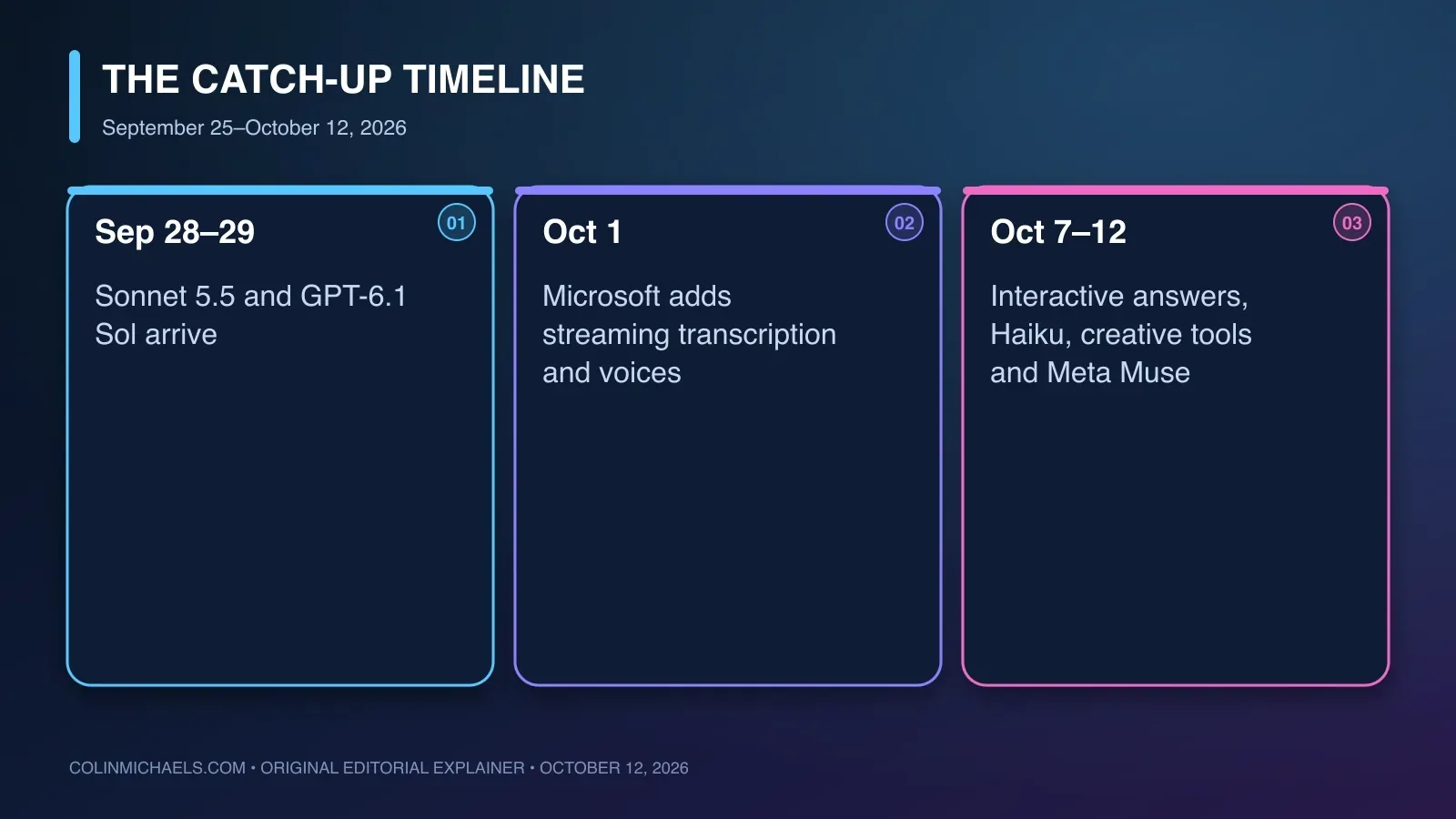
New Models: Choose the Job Before the Brand
Everyday work and coding: Claude Sonnet 5.5
Anthropic released Sonnet 5.5 on September 28. It positions the model for tasks such as fixing bugs and producing documents, slides, and spreadsheets, while keeping Opus for more demanding work. Sonnet is available through the Claude Platform and major cloud providers.
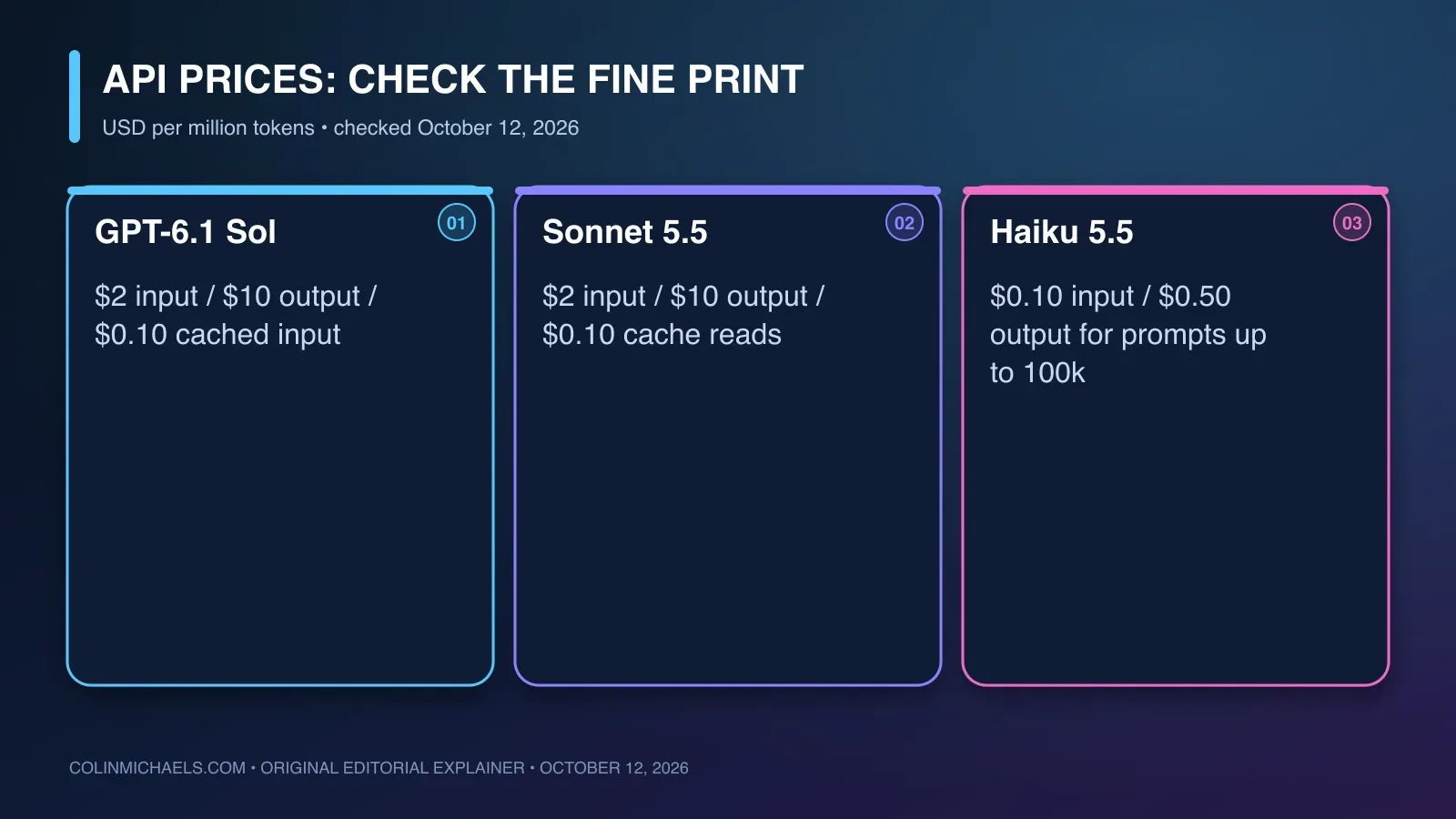
Its standard API rates are $2 per million input tokens and $10 per million output tokens. Anthropic's October 7 update lowered cache reads to $0.10 per million tokens, so the older launch-page cache price is already out of date. Claims about speed and savings per completed task come from Anthropic's evaluations, not a test I ran. Sonnet announcement, later cache-price update.
My takeaway: test a familiar task where you already know what good work looks like. A prettier answer is not much of an upgrade if you spend the afternoon correcting it.
Work and computer tasks: GPT-6.1 Sol
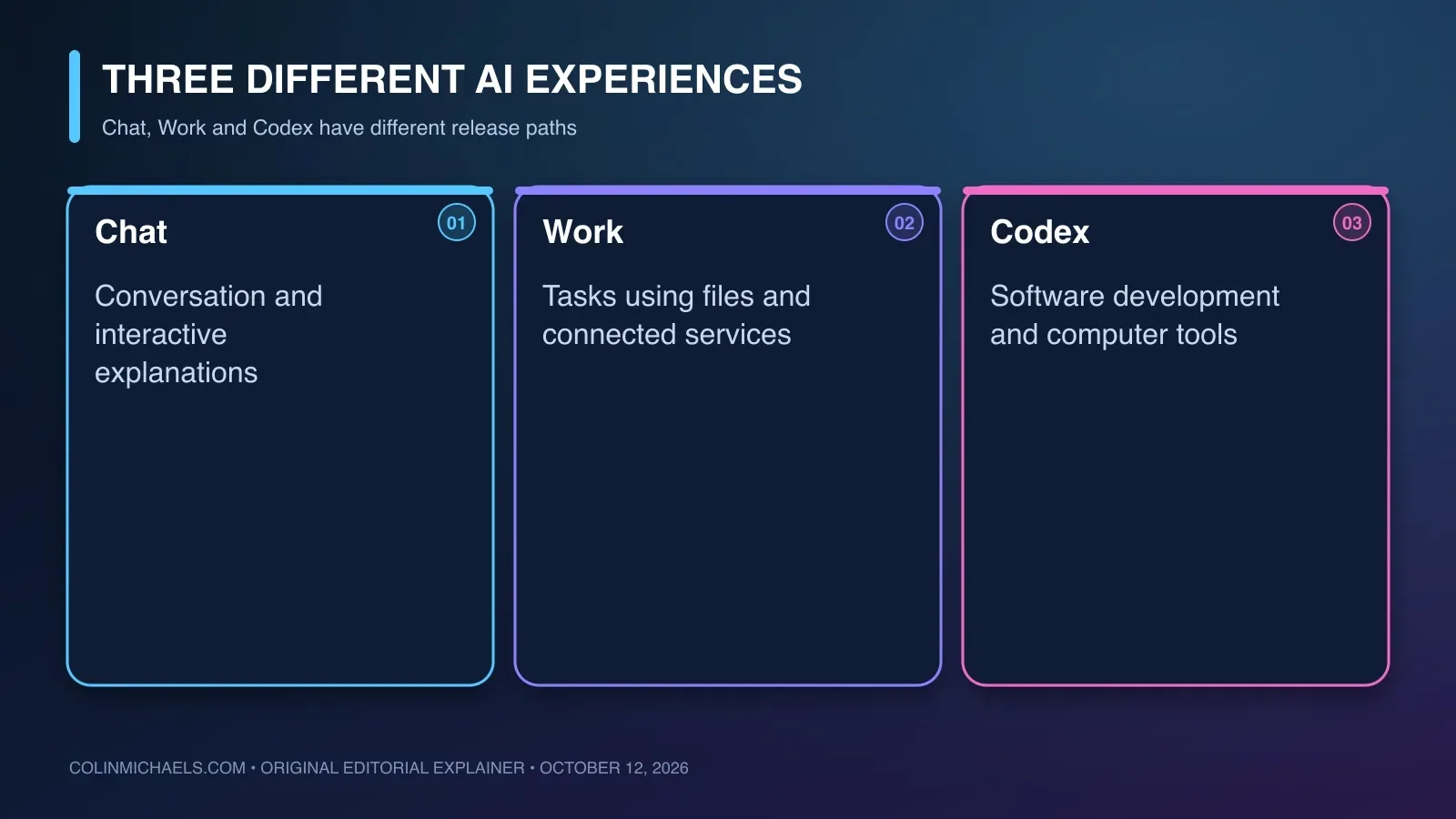
OpenAI introduced GPT-6.1 Sol at its September 29 DevDay. It is available in the API, ChatGPT Work, and Codex for the stated paid audiences. Its launch page explicitly distinguishes those surfaces from Chat.
Standard API pricing is $2 per million input tokens, $10 per million output tokens, and $0.10 per million cached input tokens. OpenAI describes performance approaching Astra on selected work tasks at lower cost. That is a vendor comparison, not proof it will match Astra on your hardest problem. GPT-6.1 Sol announcement, dated DevDay recap.
For ordinary readers, the practical distinction is the workspace. A model that can work with tools and files is useful only if the surrounding product supports your task. Check the model and the place you are using it.
Smaller, repeated tasks: Claude Haiku 5.5
Haiku 5.5 launched October 7 for high-volume jobs such as summaries, classification, and narrower assistant tasks. Anthropic lists availability through its platform and major cloud providers.
For prompts up to 100,000 tokens, input is $0.10 and output $0.50 per million tokens. Above that prompt threshold, the listed rates are $0.50 and $2.50. That caveat belongs beside any “cheap model” headline. Haiku release and pricing.
A small task does not automatically need the most expensive model. But “cheap enough to run all day” becomes less exciting if it creates a queue of mistakes for you to fix.
Voice applications: Microsoft’s new audio models
On October 1, Microsoft announced MAI-Transcribe-2-Streaming, MAI-Voice-2.1, and MAI-Voice-2.1-Flash. The transcription model supports 60 languages; the voice models support 23 languages and 26 locales. These are developer building blocks, not an automatic upgrade to every Windows microphone.
Microsoft lists the streaming transcription introduction at $0.54 per audio hour through year-end, and the voice models at $22 and $15 per million characters respectively. The announcement names Microsoft Foundry among the access routes. Accuracy and latency comparisons are Microsoft's claims. Microsoft audio announcement.
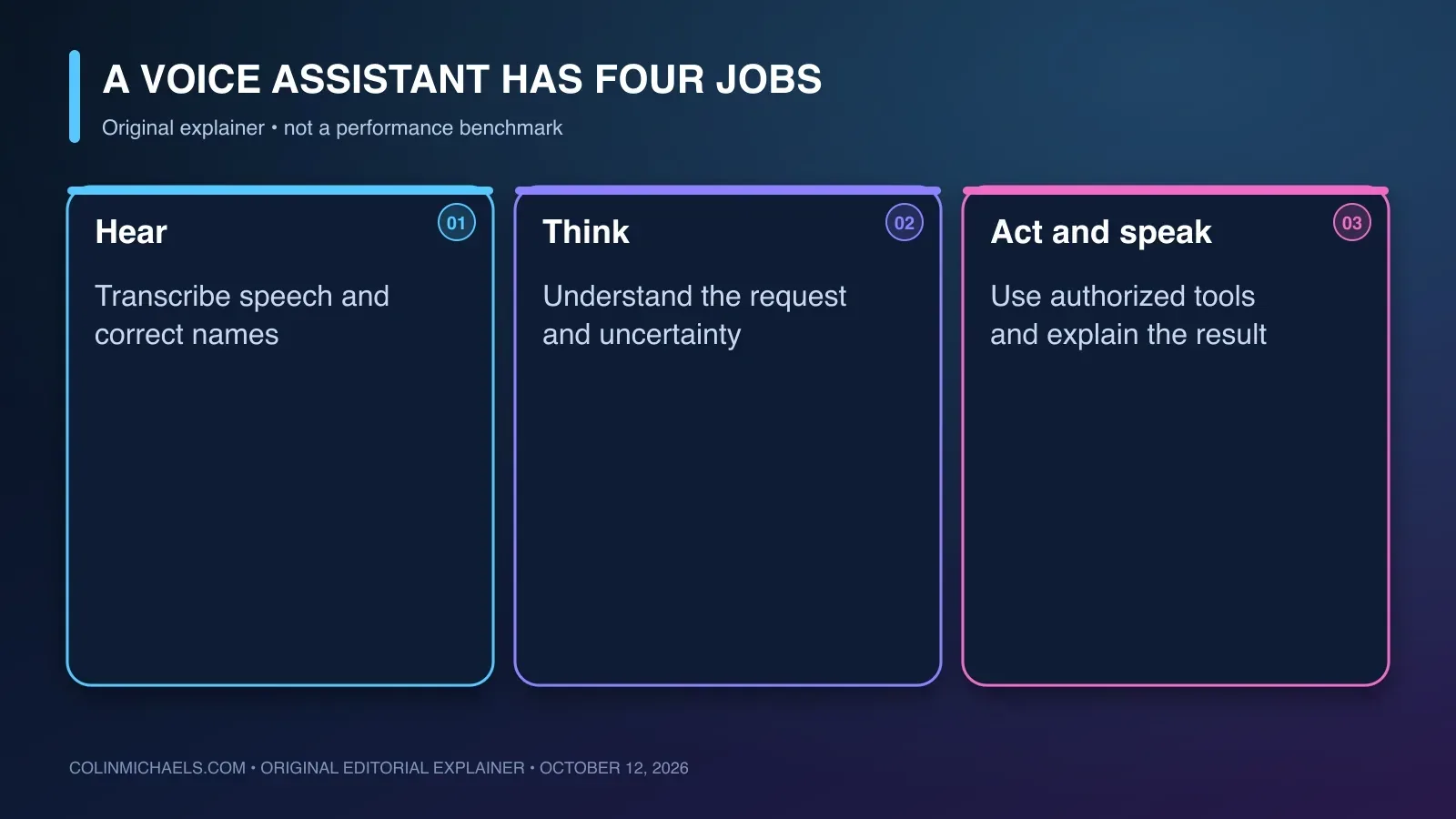
A spoken assistant has to get the names, dates, and requested action right. Smooth speech can make an incorrect answer feel reassuring. When testing one, deliberately include an unusual name and a correction halfway through.
Images: Midjourney is testing, not declaring victory
Midjourney announced a Thinking Mode test on October 8 on its Alpha website. The stated entry point is “Rerun (Thinking)” in a job's lightbox. The company says its tests show improvements in prompt accuracy, typography, and coherence, and it is requesting feedback. Broader availability is described as a possibility. Midjourney test announcement.
Treat it as an experiment. Try the same difficult prompt with and without it, then count missing objects, spelling errors, and contradictory details. One attractive example is not enough to establish a reliable workflow.
Just announced October 12: Meta’s Muse Wonder models
Meta introduced Muse Wonder and Muse Wonder Full today, aimed at agent tasks and coding. Its announcement lists Wonder through the Meta Model API and Muse Code, and Wonder Full for Muse Code subscribers. Broader Muse experiences are described as coming later, starting with subscribers. Meta’s announcement.
That makes it a release with specific access routes, not a promise that every Meta app has gained the same capabilities today. Claims of leading performance are Meta's claims. I would put it through the same bounded-task check as the other models before drawing conclusions.
Five Stories That Matter Beyond the Model Picker
1. ChatGPT answers are becoming things you can use
OpenAI's October 7 announcement introduced GPT-6 with Intelligent UI in ChatGPT's Chat tab: responses can include interactive diagrams, controls, charts, and small tools. The rollout began with paid tiers and was scheduled to expand to Free and Go the next day. Enterprise access depends on admin settings.
The company identifies Sol for the listed paid Chat tiers and Luna for Free and Go. It also says this particular update does not change the models powering Work and Codex. ChatGPT rollout announcement.
I like the direction for explaining something complicated. Moving a slider can teach you more than another paragraph. But a working interface can still contain a wrong assumption. Check what the tool is calculating before trusting what it displays.
2. Claude is moving from a draft to a deliverable
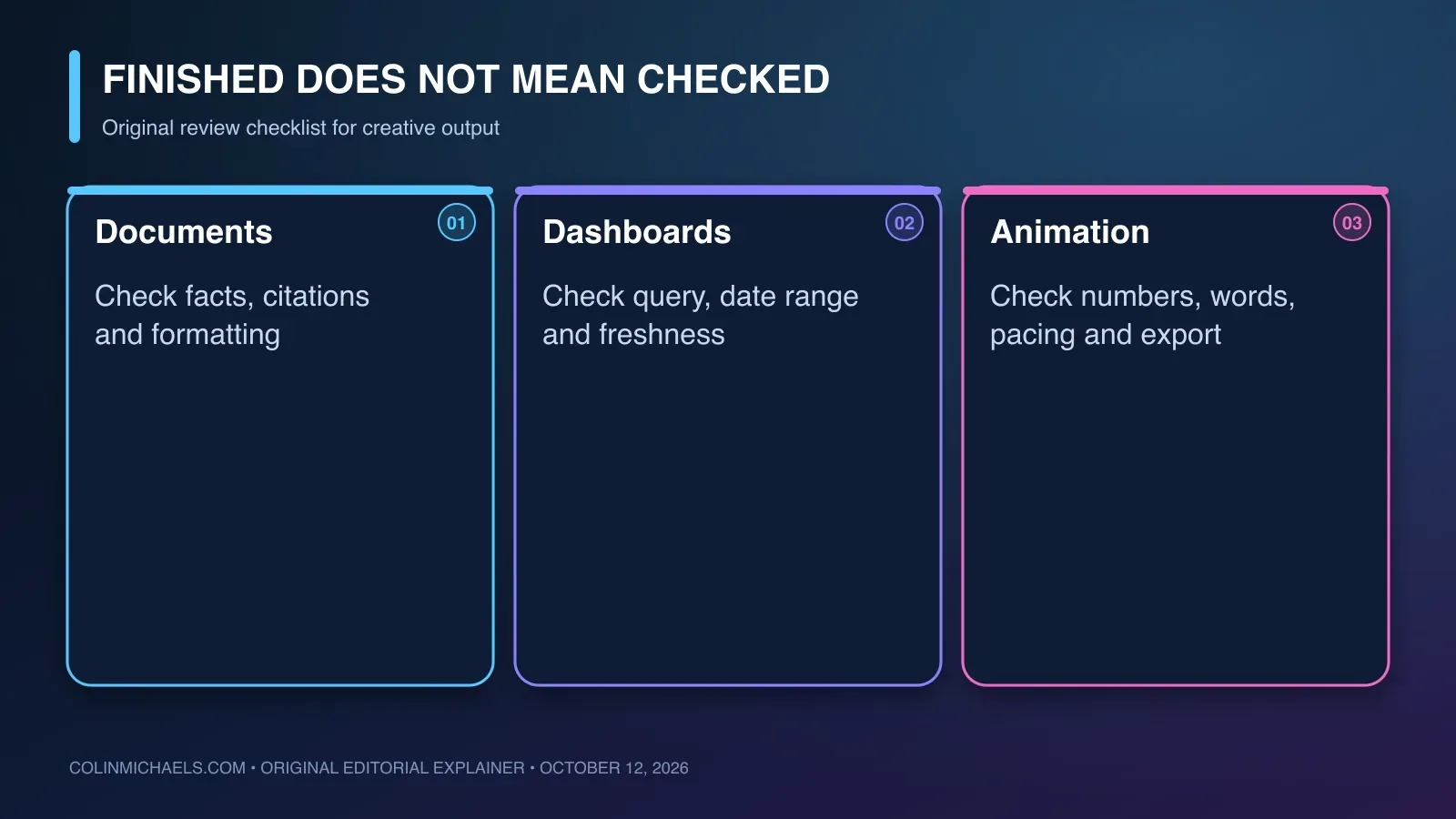
On October 8, Anthropic announced Claude Dashboards in beta on paid plans and Claude Motion in beta on Team and Enterprise. Docs, Slides, and Design exited beta and became available across plans, including Free. Enterprise admins still control availability.
Dashboards can expose the query behind a chart and show refresh timing. Motion creates editable code-based animations and exports MP4; it is not a generated-footage system. Claude tools announcement.
For creators, this is an interesting distinction. An editable animated chart and a synthetic movie clip solve different problems. For business users, seeing the query is valuable because a confident chart can be wrong before a single pixel is drawn: the wrong date range, duplicated records, or missing rows can spoil the whole result.
3. The agent pitch is becoming “come back to finished work”
At September 29 DevDay, OpenAI introduced Dots as always-on agents for ongoing responsibilities. Its recap lists Pro and Business Premium access in eligible markets, plus admin-enabled beta access for Enterprise, Edu, and Healthcare. That is not universal access for every account. DevDay recap.
Google's October 8 Gemini at Work announcement describes a unified agent connected to business systems, with persistent cloud execution, Workspace integration, and administration and cost controls. This is an enterprise announcement; verify the specific feature's access and rollout in your organization. Google's Gemini agent announcement.
The appeal is obvious: less babysitting. The missing question in many demos is what happens when the task is ambiguous.
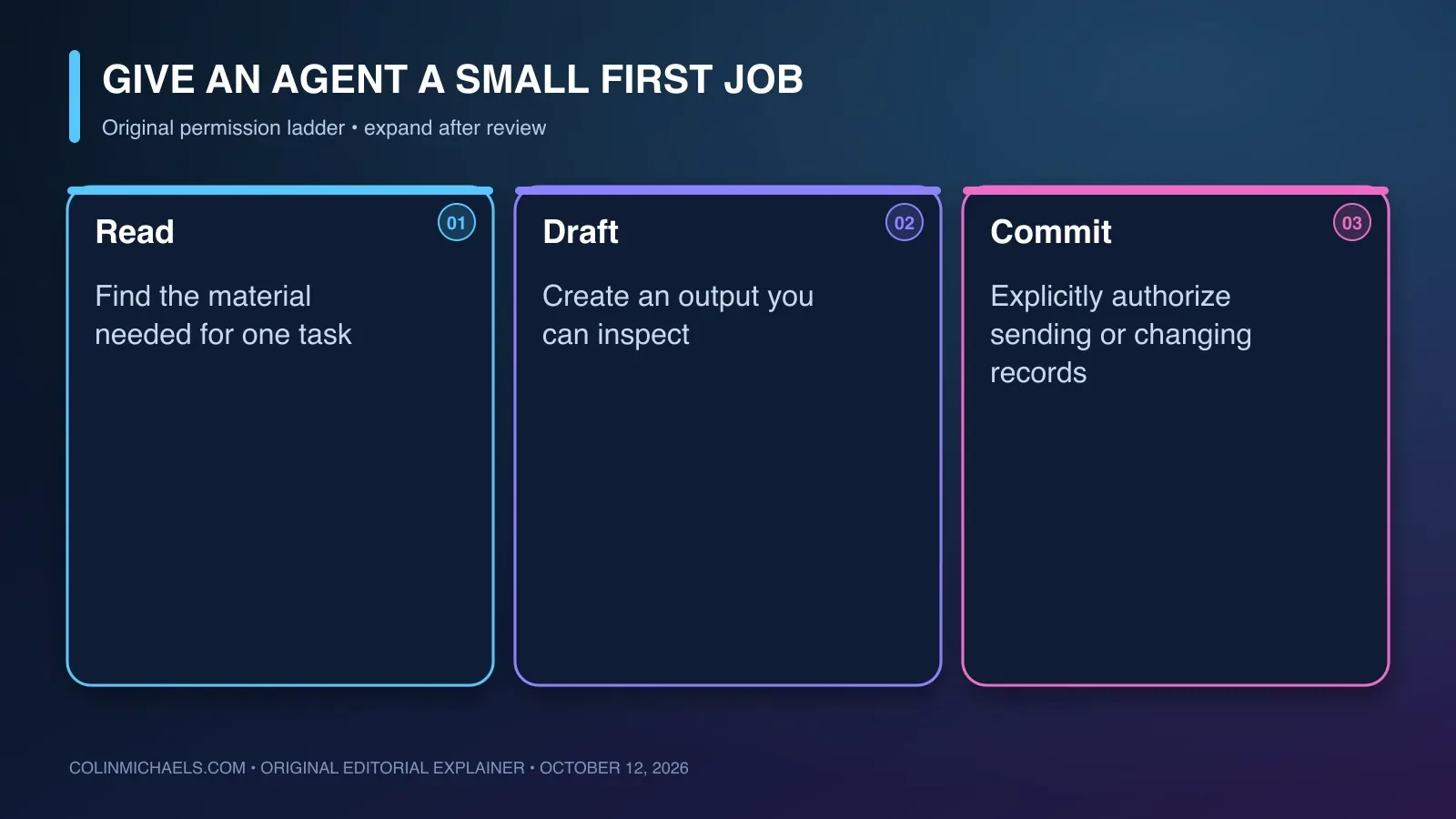
My starting point would be one bounded job: read a particular folder and produce a draft report. Then inspect what it used, what it changed, and whether it stopped where asked. Give it a definition of finished that you can verify. “Handle my business” is a pitch; “draft a comparison using these three files and show your sources” is a task.
4. AI science needs more than a spectacular headline
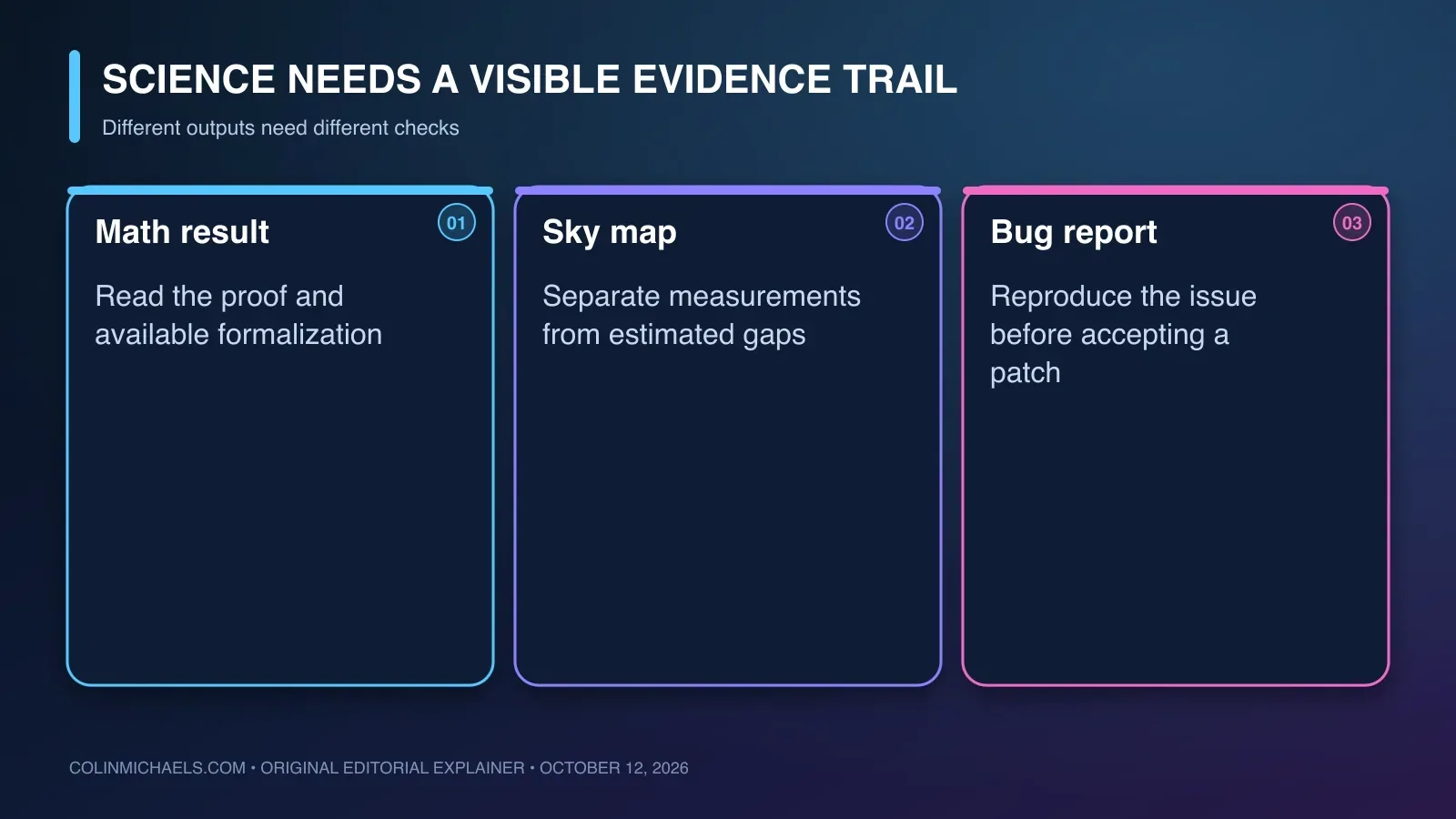
On October 6, OpenAI published mathematical results from an internal frontier model, with a GitHub repository and Lean formalizations for many proofs. Its announcement says work toward releasing the underlying model continues. Published results are not the same thing as a newly available consumer model. OpenAI mathematics release.
On October 8, Anthropic described work with Claude Science to create a complete ultraviolet sky map. The account includes filling gaps in observed coverage with estimates. A complete-looking map should not be read as every location having been directly measured. Anthropic sky-map account.
Both are worth following. The useful questions are what experts can inspect, which parts have been checked, and what remains inferred. A mathematical proof and an estimated patch of sky need different kinds of verification.
5. Security progress still needs people to verify it
Anthropic launched OSS Scanner on October 8 as a free, opt-in service for eligible open-source projects. Reports include evidence and proposed fixes, but the company explicitly says outputs arrive without human review or triage and may be incorrect. Its accumulated candidate-finding count is not a count of confirmed vulnerabilities. OSS Scanner announcement.
Separately, OpenAI's October 8 report describes two disrupted influence operations using false-front identities and its models alongside traditional methods. The company says some content reached real media outlets. This is OpenAI's account of detected activity, not proof that all persuasive articles are AI campaigns. OpenAI influence-operation report.
These stories meet at the same practical habit: inspect the evidence. Reproduce a software issue before applying a patch. Trace a startling news claim back to its original source before passing it along.
What Changed During the Gap
My read of these announcements is that the competition is moving into the workflow around the model. Can the tool find the right file, build the output, let you inspect it, and hand it off in a useful format?
That changes how I would evaluate an upgrade. The unit that matters is a correct, usable result. A lower token rate helps developers, but people doing everyday work also pay in correction time, attention, and the friction of moving between applications.
It also means the model name is only part of the answer. The same model inside a product with file access, useful exports, and clear permissions can behave very differently from a bare chat box.
There is no reason to collect every new subscription just to feel caught up. Pick the change that addresses an annoyance you already have. Keep the receipt, figuratively or literally: what did you ask for, what did you get, and how much work remained?
Your 15-Minute AI Reality Check
Choose one task you already do: turn your own notes into a summary, compare three public specifications, or make a simple chart from sample data. Use material you are comfortable supplying to the tool.
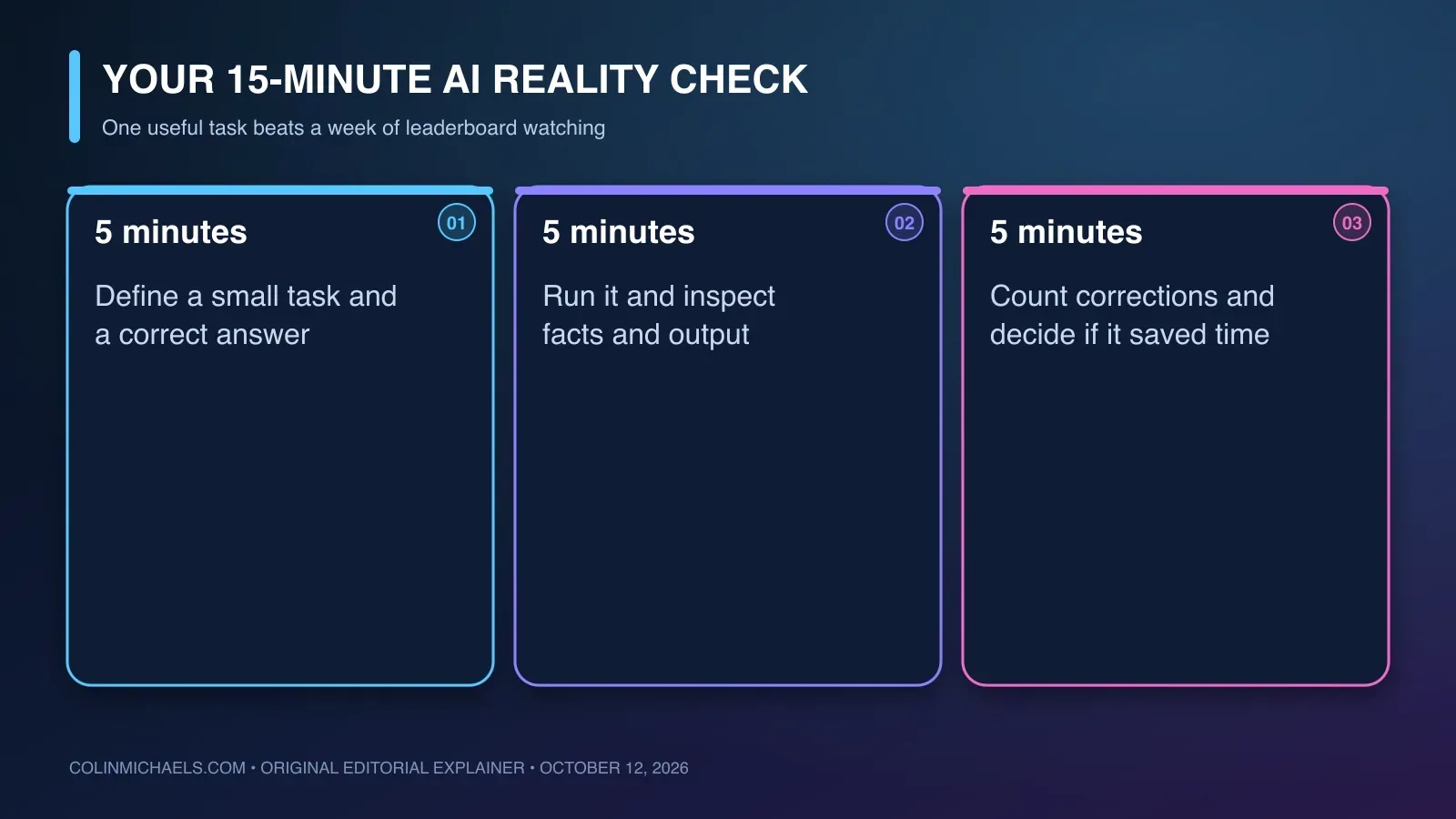
- First five minutes: define success. Write down the expected facts, the desired format, and what the tool may do. For an agent, make the first run a draft and specify the files or sources it may use.
- Next five minutes: run and inspect. Check the answer against the source. Open the exported file. If it makes a chart, examine the labels and date range. If it makes an interactive tool, try an obvious input whose answer you know.
- Last five minutes: count the cleanup. Record factual mistakes, edits, elapsed time, and any available usage cost. Ask whether you would willingly use this result after review.
Score it on four simple questions: Were the facts correct? Did it follow the limits? Was the output usable? Did it save time after corrections?
Four yes answers are a reason to try a slightly bigger job. Mixed answers tell you where the tool fits. A failed test is useful too: you learned something before handing it an important task.
Final Thought
Catching up does not have to mean memorizing every model name. I would rather find one tool that removes a real nuisance than win a trivia contest about the latest leaderboard.
This stretch brought useful options: smaller models for smaller jobs, interfaces that can help explain things, and tools that can turn an idea into a file you can actually use. The bigger agent promises deserve a little patience and a clear first assignment.
Try one thing. Check it. Keep what helps. That is a perfectly respectable way to stay current without making AI news your second full-time job.
Next issue: Return to the regular Friday–Thursday format, with October 9–15 as the current weekly window. Stories from October 9–12 already covered here should only return if something substantive changes. This is editorial guidance, not a scheduled publication.
Sources and Availability Note
Sources were accessed October 12, 2026. Prices and access are a dated snapshot. API prices differ from subscription charges; workplace settings and regional rollouts can affect what an individual account sees.
Discovery credit: Future Tools AI News — Matt Wolfe and team. Verification: the official announcements linked beside each item. Original reporting and model cards were also searched for candidates, but an undated update, rumor, or inaccessible story was not enough to count a new release.
This edition does not repeat the September 22 GPT-6 Sol/Luna or Opus 5.5 launches as new. It also does not turn the earlier Sanders–Casar proposal into a newly enacted law. Those belong to the previous issue's context.