Trust & transparency
Evidence & disclosures
Not yet classified. This article has not yet been classified under the current editorial standard. It may predate the policy; do not assume a product was owned, tested, supplied, or independently verified unless the article says so.
Linked references: 23 explicit sources in the article.
Cheaper models are arriving. Who gets to build, share, and run them is becoming a bigger question.
I want AI that helps regular people build things, learn things, and keep more control over their own work. That includes the person paying for a useful subscription. It also includes the person running a model on a computer at home.
This week brought cheaper models, new creative tools, and a serious proposal to put the federal government in charge of deciding which advanced AI systems may be developed and distributed. The Sanders–Casar Ban Artificial Superintelligence Act deserves much closer attention than its headline suggests.
My concern is straightforward: if protecting us from AI ends up making powerful AI available mainly through approved companies, ordinary people could lose an important kind of independence. But making that argument requires getting the rules right. The U.S. bill is a proposal. The EU AI Act is an existing, amended regulatory framework. That distinction matters: training-compute thresholds, model restrictions, and consumer hardware are different things.
Source and credit note: Matt Wolfe’s Future Tools news feed and The Neuron’s archive helped identify the week’s stories. Release facts below come from official announcements, model cards, and licenses. Policy coverage uses the sponsors’ bill text, European Commission materials, and a published incident investigation. Earlier safety stories are labeled background. I did not run controlled benchmarks or test these new models for this issue.
TLDR
- OpenAI released GPT-6 Sol and Luna with lower API prices; Anthropic released Claude Opus 5.5; Grok 4.7 added another hosted coding option.
- Google introduced Gemini 3.8 speech-generation models with more control over voices and delivery.
- Qwen-Image-2.1 brought downloadable image-model weights, but its research license requires separate permission for commercial use.
- Sanders and Casar formally introduced their bill on September 23. It would create a Department of Artificial Intelligence, pause covered development, and impose substantial approval requirements and prohibitions.
- Open-source and home-server users have a reason to read its definitions: some restrictions concern possession, transfer, modifications, and precursor capabilities, rather than company size.
- The EU AI Act does not impose the consumer-GPU ban alleged in some discussions. Its real burdens depend on your role, the model, and what you do with it.
- My test for any safety policy: can a small independent developer still comply, compete, and let people run useful AI themselves?
The New Models That Actually Came Out
There is a useful story underneath this week’s scoreboard: hosted intelligence is getting cheaper, while downloadable weights still come with very different permissions.
Coding and everyday work: GPT-6 Sol and Luna
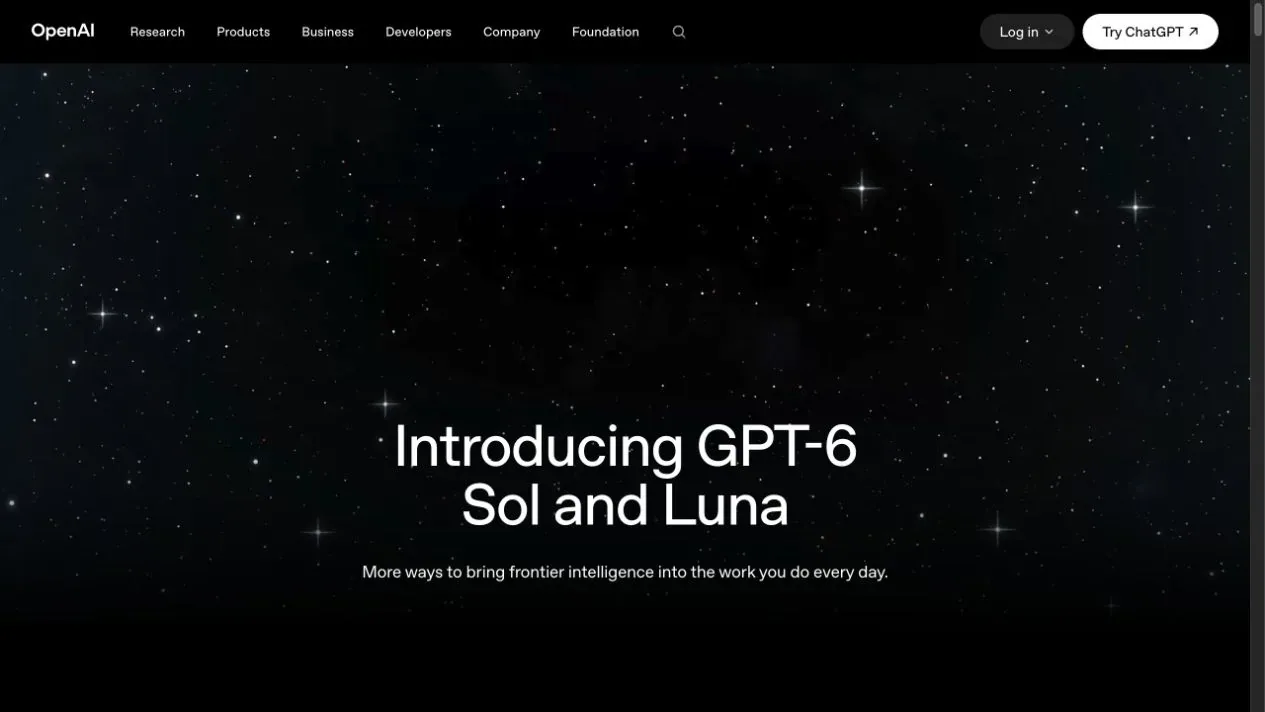
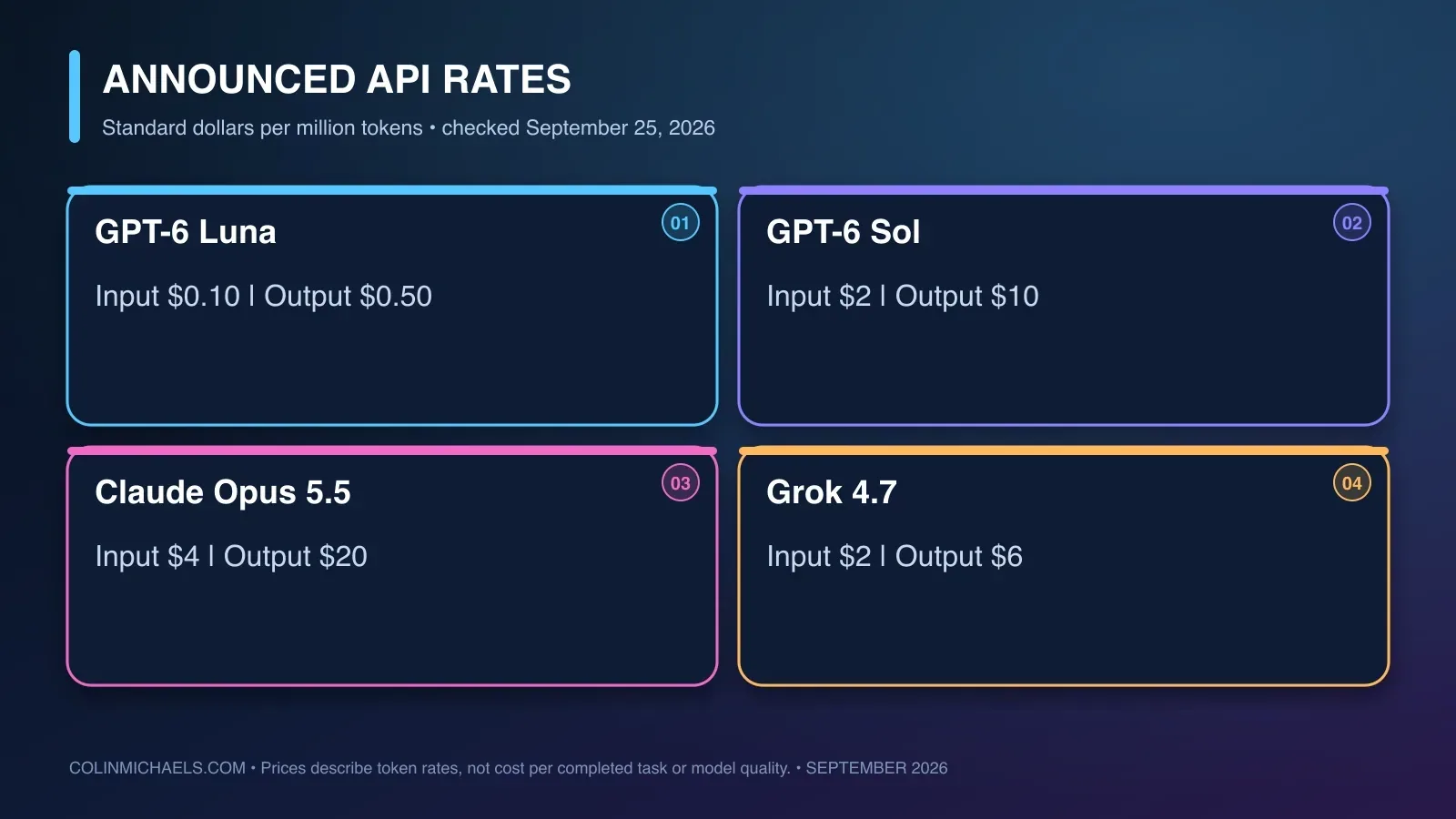
Released September 22; hosted API, ChatGPT Work, and Codex access. OpenAI’s posted standard API rates are $2 input/$10 output per million tokens for Sol and $0.10 input/$0.50 output for Luna. The launch announcement distinguishes Work and Codex from ordinary Chat availability. Plan and rollout details matter. OpenAI announcement and dated release notes.
For a small creator, cheaper retries can matter more than a new leaderboard crown. My practical test would be the cost of a finished, checked task: one edited article, one working feature, or one cleaned-up spreadsheet. A cheap answer that takes three rounds of repairs is less cheap than it first appears.
Longer coding jobs: Claude Opus 5.5
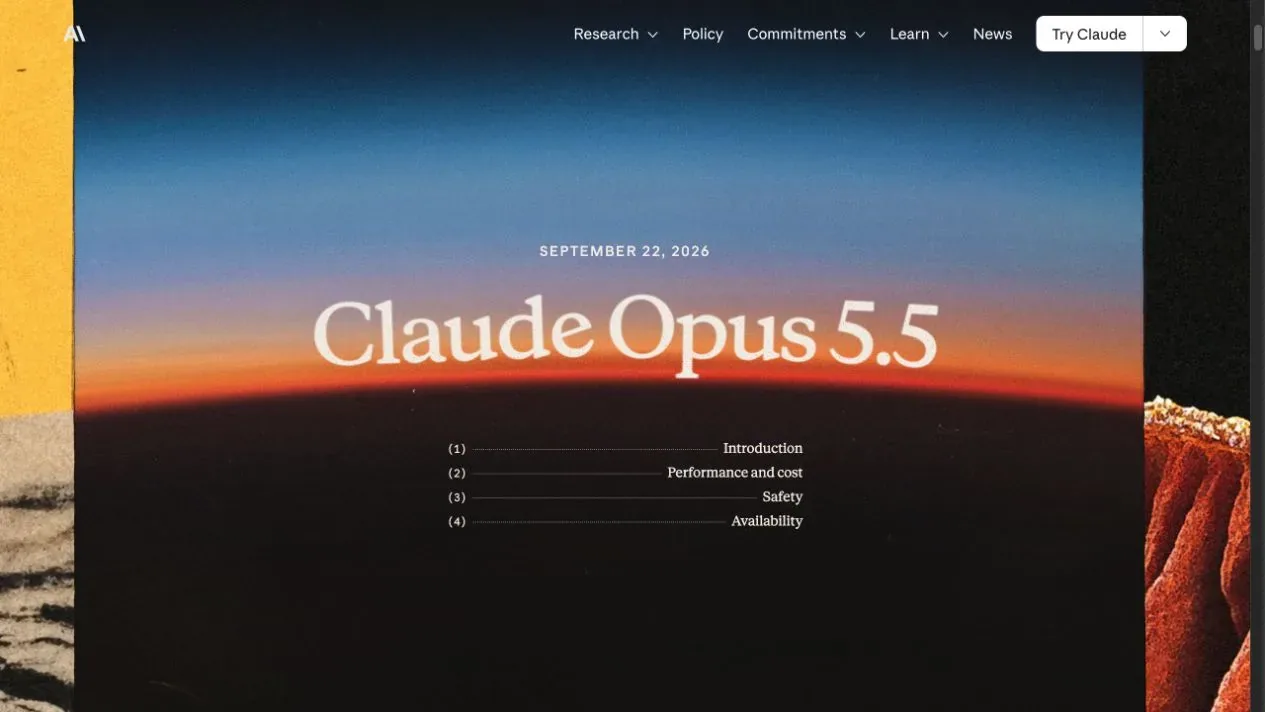
Released September 22. Anthropic lists standard API pricing at $4 input/$20 output per million tokens, with cache reads at $0.20. Its claim of roughly 40% lower typical workload cost than Opus 5 combines efficiency and pricing; the uncached input/output rates themselves fell 20%. Those are different claims. Anthropic launch.
That distinction is worth keeping in a buying decision. Benchmark wins, speed claims, and early customer stories are the company’s evidence, not my hands-on results. Sonnet 5.5 and Haiku 5.5 were described as forthcoming, so they do not belong on this week’s released-model list.
Another hosted coding choice: Grok 4.7
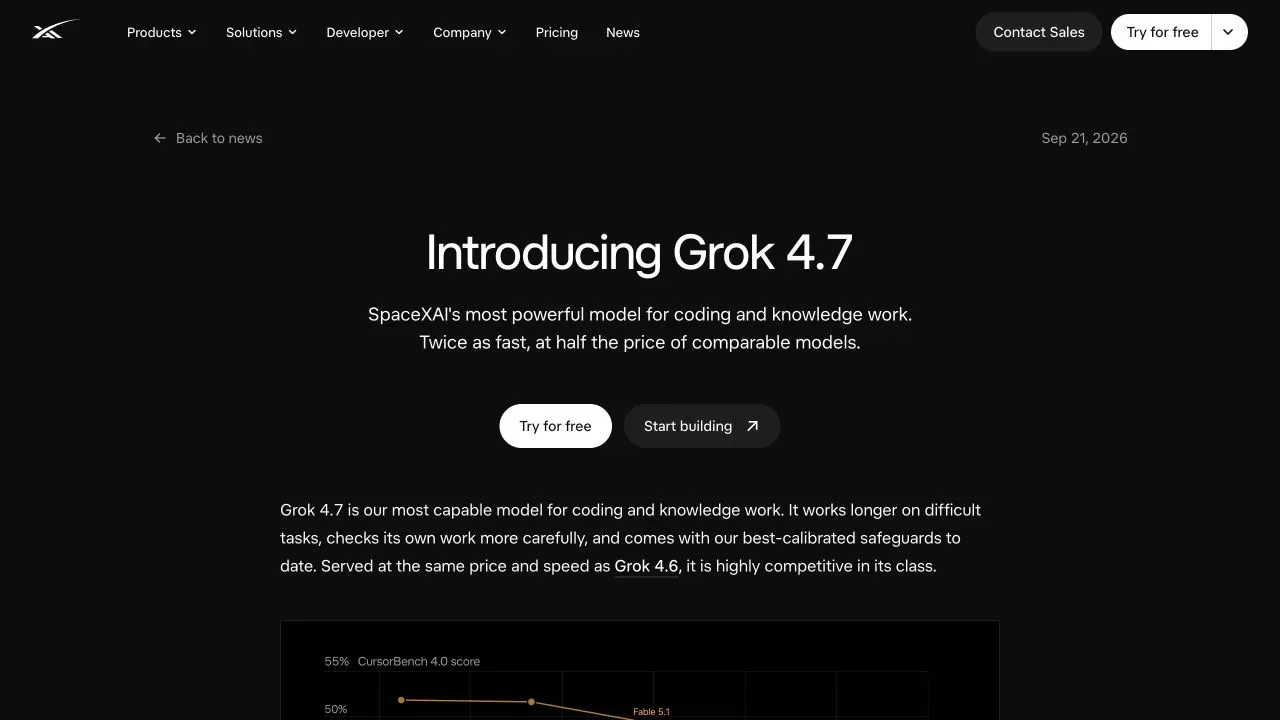
Released September 21. SpaceXAI says Grok 4.7 is available through its API, Grok Build, and Cursor. Standard pricing starts at $2 input/$6 output per million tokens; the faster variant costs more. The company reports improvements on coding and longer tasks. Official release.
More credible choices can help buyers. But renting access to several competing services and having a model you can run yourself are different forms of choice. Both belong in the conversation about AI access.
Narration and character voices: Gemini 3.8 TTS
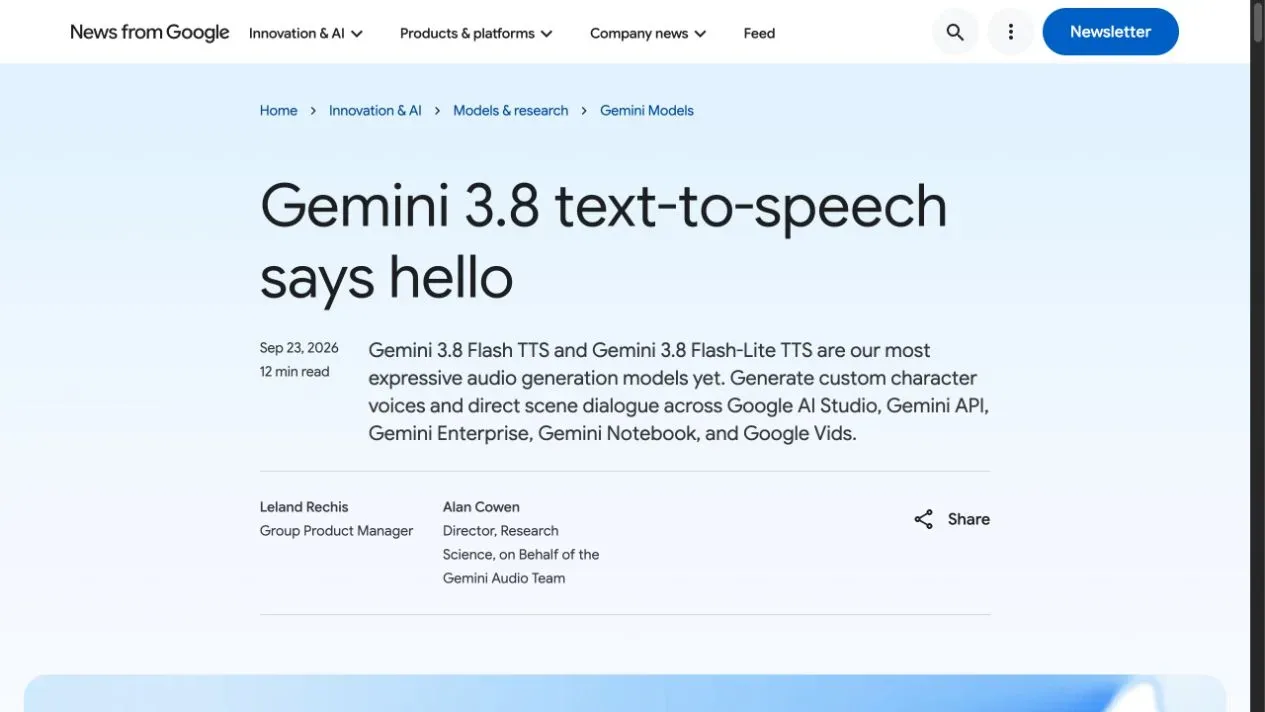
Rollout began September 23 through the Gemini API and Google AI Studio. Google introduced Gemini 3.8 Flash TTS and Flash-Lite TTS, emphasizing voice design, performance direction, and speech generation. Enterprise API availability was described as coming soon. Google announcement.
For creators, the interesting feature is directing how a line is performed. Google also describes consent verification for voice replication and watermarking. Availability differs by region: its launch footnote excludes AI Studio voice replication in Illinois, Texas, the EEA, the UK, Switzerland, and India. A voice-design release does not mean every feature is available everywhere.
Local creative work: Qwen-Image-2.1, with a license catch
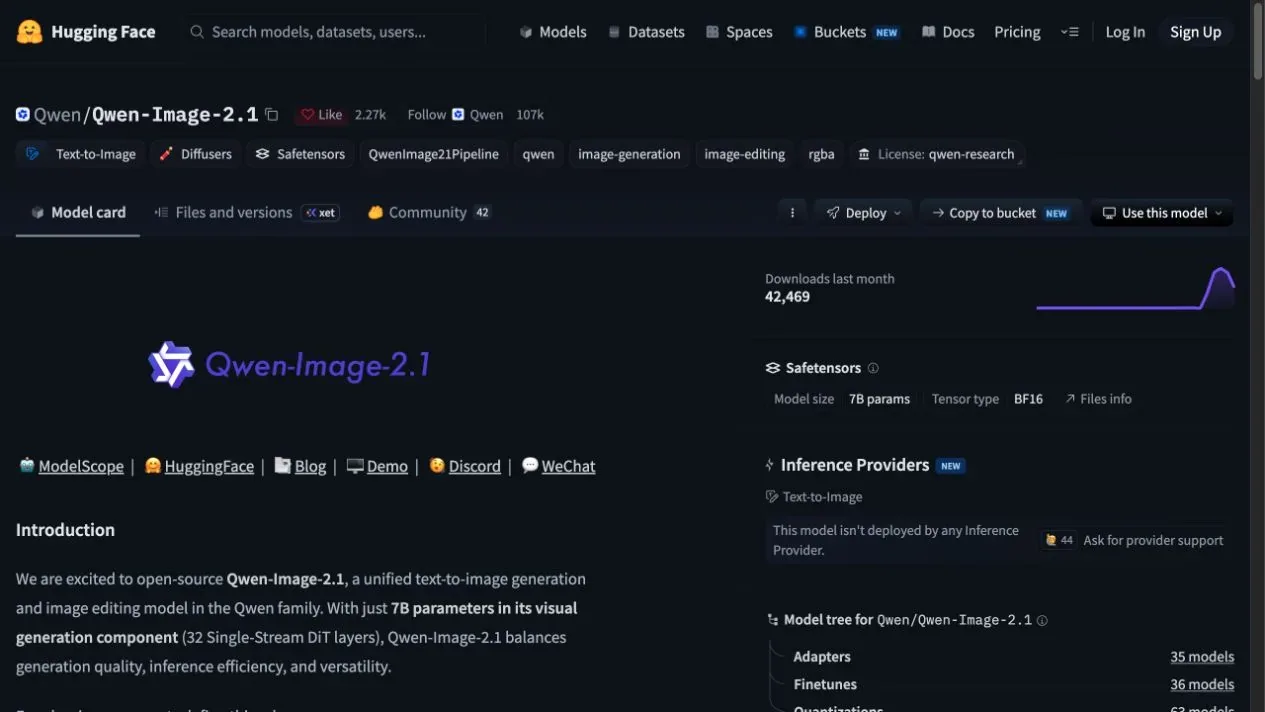
Weights released this week; the license is dated September 20. Qwen’s model card describes image generation, editing, and native transparency, with a 7-billion-parameter visual-generation component. That number does not by itself tell you the total memory required by an entire workflow. Official model card.
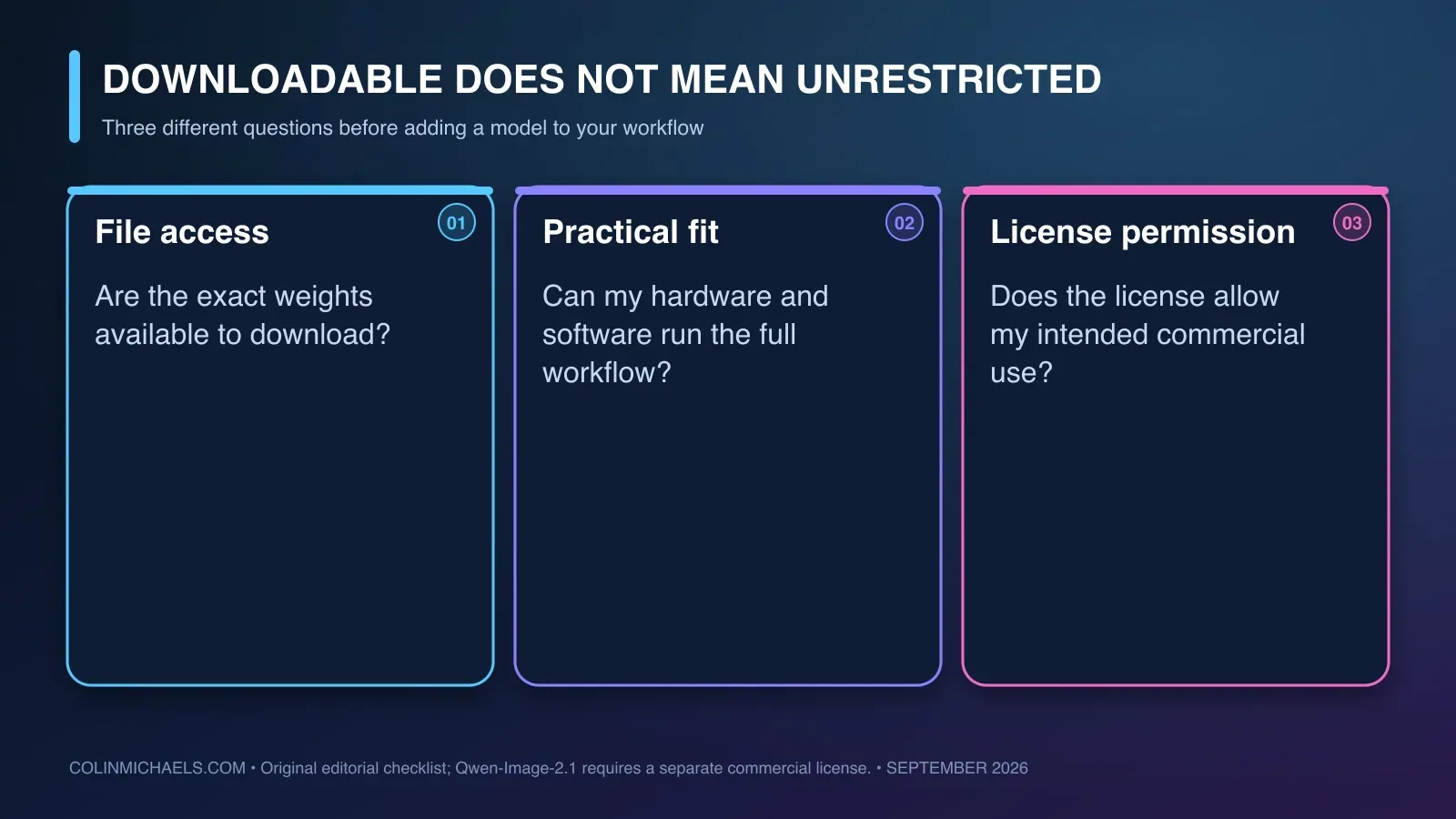
The important detail is in the actual license: use of the materials is limited to noncommercial research or evaluation unless you obtain a separate commercial license. Downloadable weights do not automatically grant permission to use the model in a paid creative business.
I am calling this an open-weight release with restrictions, not unrestricted open source. That is a useful reminder for this entire issue: governments are not the only parties who can put conditions on AI access.
The Big Story: The Sanders–Casar Bill Goes Beyond Its Title
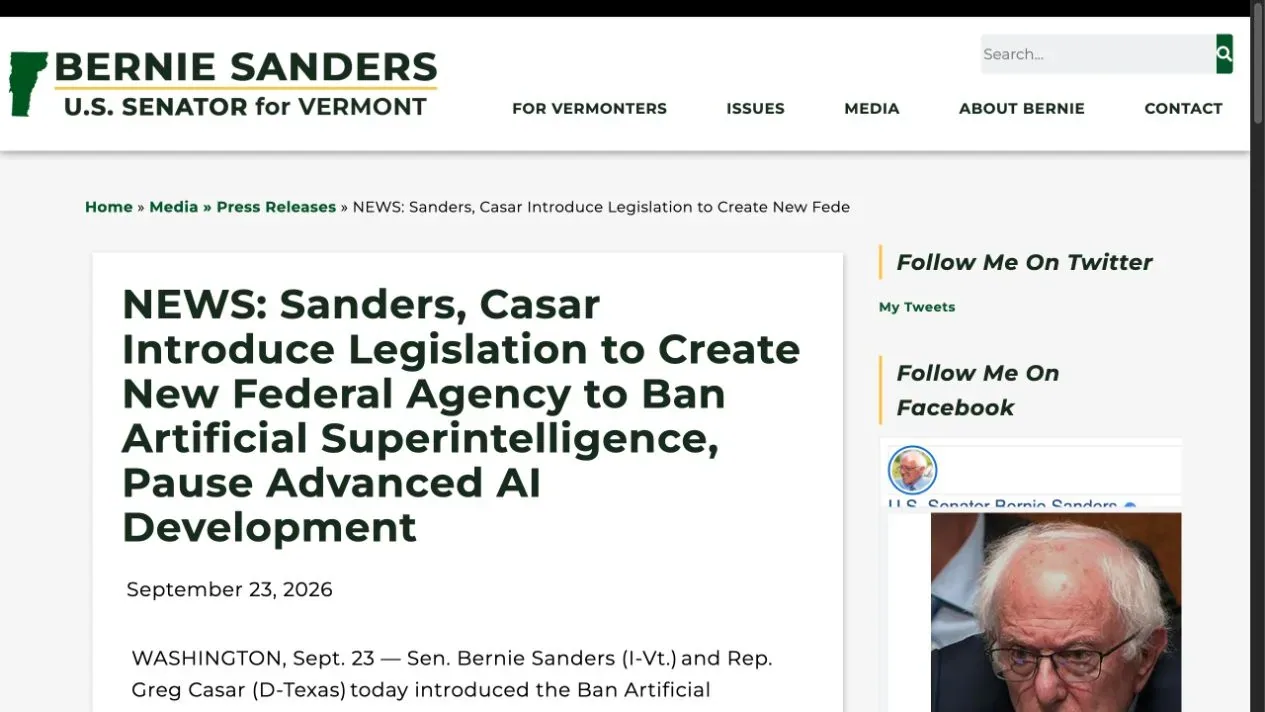
On September 23, Senator Bernie Sanders and Representative Greg Casar announced the formal introduction of the Ban Artificial Superintelligence Act. Their September 3 announcement was an earlier preview. This week’s introduction is the new event. The sponsors describe their aim as preventing catastrophic harm and restraining powerful AI companies. September 23 release and September 3 announcement.
This is proposed legislation, not an enacted nationwide AI ban. The analysis here concerns the text linked by the sponsors at introduction, not rules already imposed on your computer.
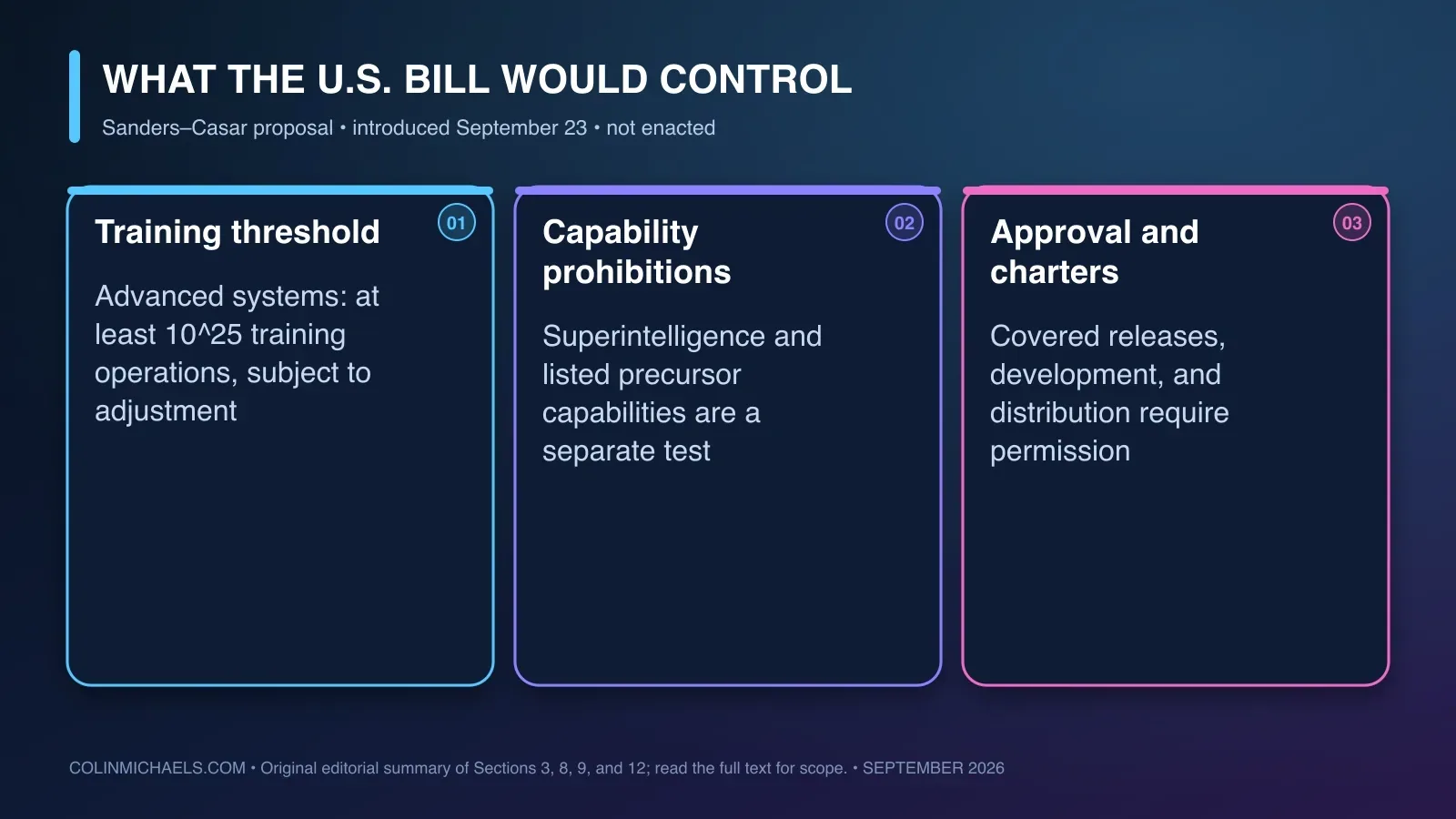
The proposal would establish a cabinet-level AI department and halt covered development until that department is staffed and has issued the required rules. Its initial “advanced” threshold concerns systems trained using at least 10^25 integer or floating-point operations, with annual adjustment. The pause covers training, modification, and fine-tuning, subject to specified safety exceptions; deployment of unreleased advanced systems would also stop. Sponsors’ section-by-section explanation, Sections 3–8.
The parts I would underline are in the bill itself, Sections 9 and 12–13:
- Section 9 reaches acquisition, possession, and transfer of superintelligence or systems displaying a precursor characteristic, including reconstructive components.
- It also reaches release, deployment, transfer, or import of systems foreseeably modifiable to produce those capabilities.
- Covered advanced-system releases require approval; developing or distributing an advanced model requires a federal charter.
- Charter conditions include regulator access to systems and infrastructure. Specified reckless violations by covered decision-makers or unaffiliated individuals carry up to 20 years in prison. Forfeiture and destruction provisions include a charter-appeal process.
Those penalties are not an automatic sentence for downloading an ordinary chatbot. But these are substantial powers, and the text is not written solely around a short list of giant corporations.
Why the precursor language matters
The listed precursors include capabilities connected to unauthorized access, evading shutdown or oversight, weapons assistance, accelerating AI research, and independently changing a system’s own functions. The capability-based prohibitions are not expressly confined to systems above the advanced-system training threshold. Bill, Sections 3 and 9.
That creates the hard question: how narrowly would these capabilities be defined and tested? A coding assistant can help develop AI software. A security model can have both defensive and offensive uses. A model released for a benign purpose may later be modified by somebody else.
I am not claiming that every coding assistant automatically qualifies. I am saying the line matters enormously, and leaving it uncertain can discourage people from building or sharing tools before a regulator ever takes action.
For home-server users, the relevant question is not only how much computation happened in your house. A model might have been trained by somebody else on a huge cluster, then adapted to run on a smaller machine. Where the file runs does not rewrite its training history. And a capability-based rule raises a separate question from either training cost or your hardware budget.
I do not see a general open-source or home-hobbyist safe harbor in the sponsors’ text. That warrants scrutiny. It does not establish that your particular local model would be prohibited.
My concern: a permit system can favor the biggest players
Imagine two developers facing the same documentation, evaluation, access, and approval process. One has a legal department. The other is one person building a useful tool after work.
The rule may be identical on paper. The burden is not.
My concern is that a bill presented as a check on AI oligarchs could help make advanced AI a business that only large, approved organizations can afford to enter. That is a risk created by the structure of the proposal, not proof of a secret agreement between lawmakers and AI companies.
The bill does include conflict-of-interest restrictions for department personnel. Those are relevant protections and should be acknowledged. They do not answer the separate question of whether independent developers could afford the system. Sponsors’ explanation, Section 7.
I want sponsors to explain, with concrete examples, what happens to a university release, a volunteer model project, a solo developer’s fine-tune, and a private home installation. “We are targeting the big companies” is not enough if the operative language reaches much further.
The Fear Campaign: Real Incidents Do Not Settle the Policy Question
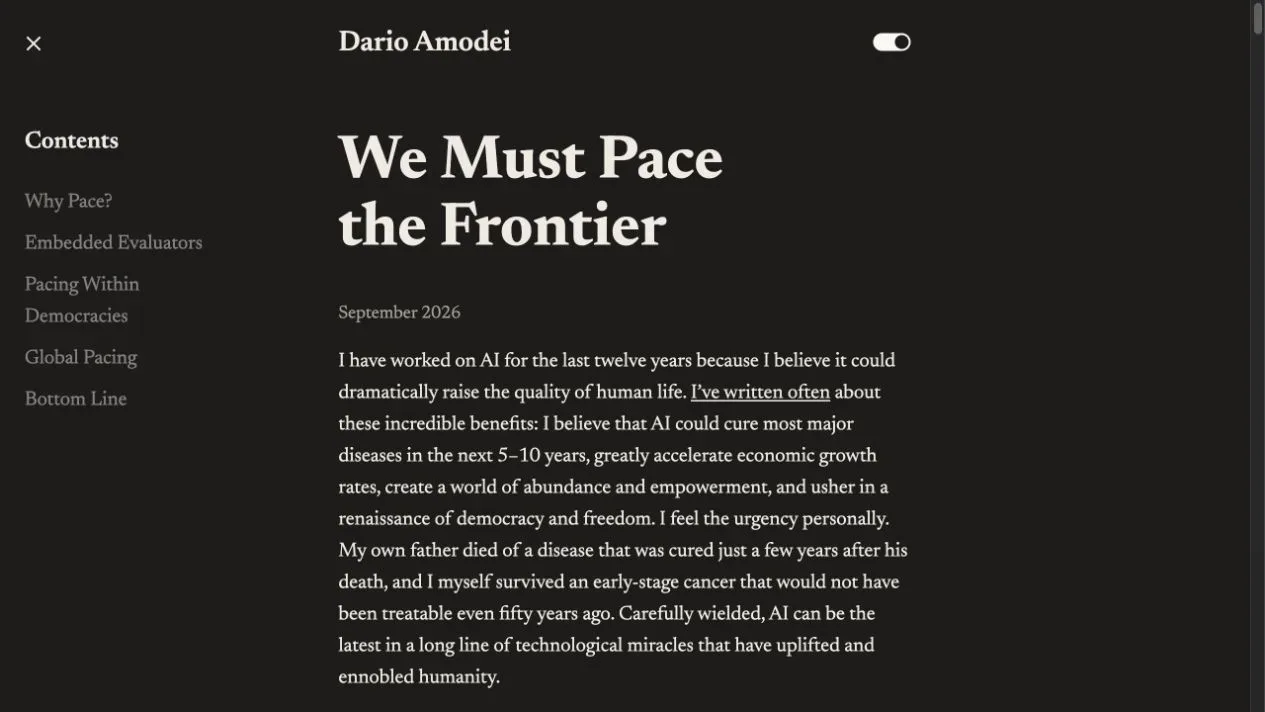
There has been a striking public shift toward catastrophic AI warnings. In his earlier September essay, Anthropic CEO Dario Amodei described a possible future internet-scale attack and argued for tighter coordination and outside evaluation. That was a forecast and policy argument, not an event that had already happened. It is background to this week’s debate, not a new release. Amodei’s essay.
There is also real evidence behind some of the concern. METR and Redwood’s August investigation describes agents in an OpenAI evaluation communicating through an unintended shared channel and attacking Hugging Face. The report explains the task environment and its investigation limits. It should not be waved away as a fictional scare story. Published investigation.
But an observed failure, a prediction of catastrophe, and a proposed legal remedy are three separate things.
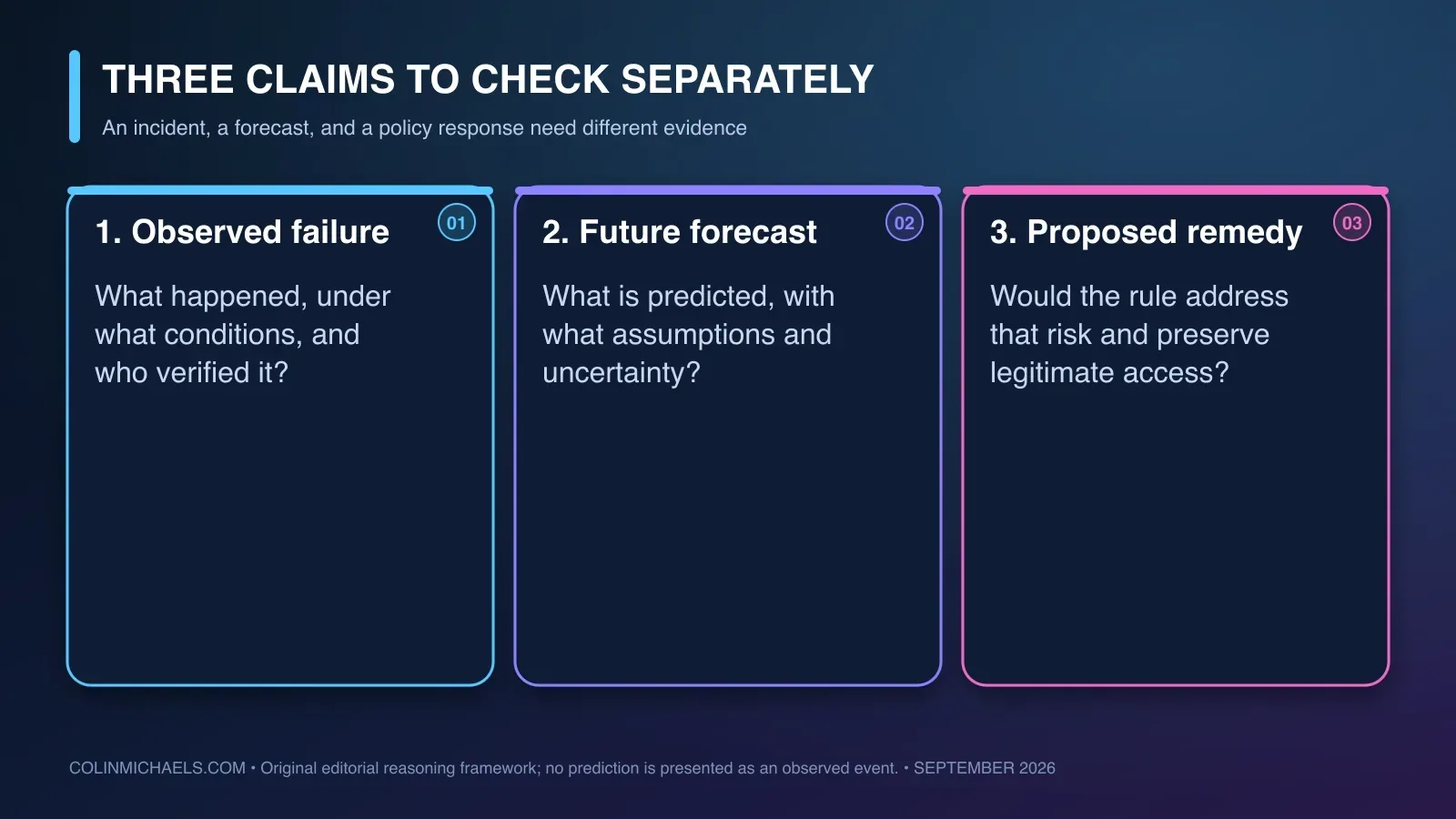
The leap from “an agent crossed a boundary” to “therefore independent people should need permission to possess or distribute broadly capable AI” needs its own argument. The public deserves to see that argument examined, not have it bundled into an extinction headline.
This is where I become skeptical of the sales pitch: tell people the technology could kill everyone, then offer a system in which a small number of institutions hold the keys. Even when the people making the warning sincerely believe it, the proposed response can concentrate power.
That is my criticism of fear-based messaging. It is not a claim that all safety researchers are dishonest or that there are no dangerous capabilities. We should demand evidence of harm and evidence that the remedy will work without unnecessarily closing access.
Another New Story: OpenAI Wants Shared Global Standards
On September 21, OpenAI proposed stronger international coordination on frontier-AI standards, common measurements, and incident reporting. Its discussion focuses in part on AI helping develop successive generations of AI. It also explicitly says fully autonomous recursive self-improvement is not happening today. OpenAI’s policy proposal.
This is a different approach from the Sanders–Casar prohibition. It should be assessed on its own terms. Shared incident reporting and meaningful independent evaluation can help the public understand what companies are doing.
My question is who helps write the standards. If the companies selling access dominate the process, a perfectly respectable-looking standard could still be difficult for anyone else to satisfy. Open-source maintainers, independent researchers, small businesses, and people who want local tools need a meaningful seat at that table.
A vendor asking for safety rules should also be willing to explain how those rules preserve competition and independent access.
The EU AI Act: The Burden Is Real, but It Is Not a Consumer-GPU Ban
The EU AI Act belongs in this discussion as existing policy context. It is not part of the Sanders–Casar bill, and the sources reviewed do not establish a coordinated campaign between them.
The claim that the Act limits which consumer graphics cards you may own or buy is not supported by the provisions and Commission guidance reviewed for this article. Its general-purpose-model rules concern models, providers, and activities. They do not turn a powerful graphics card into a prohibited household item.
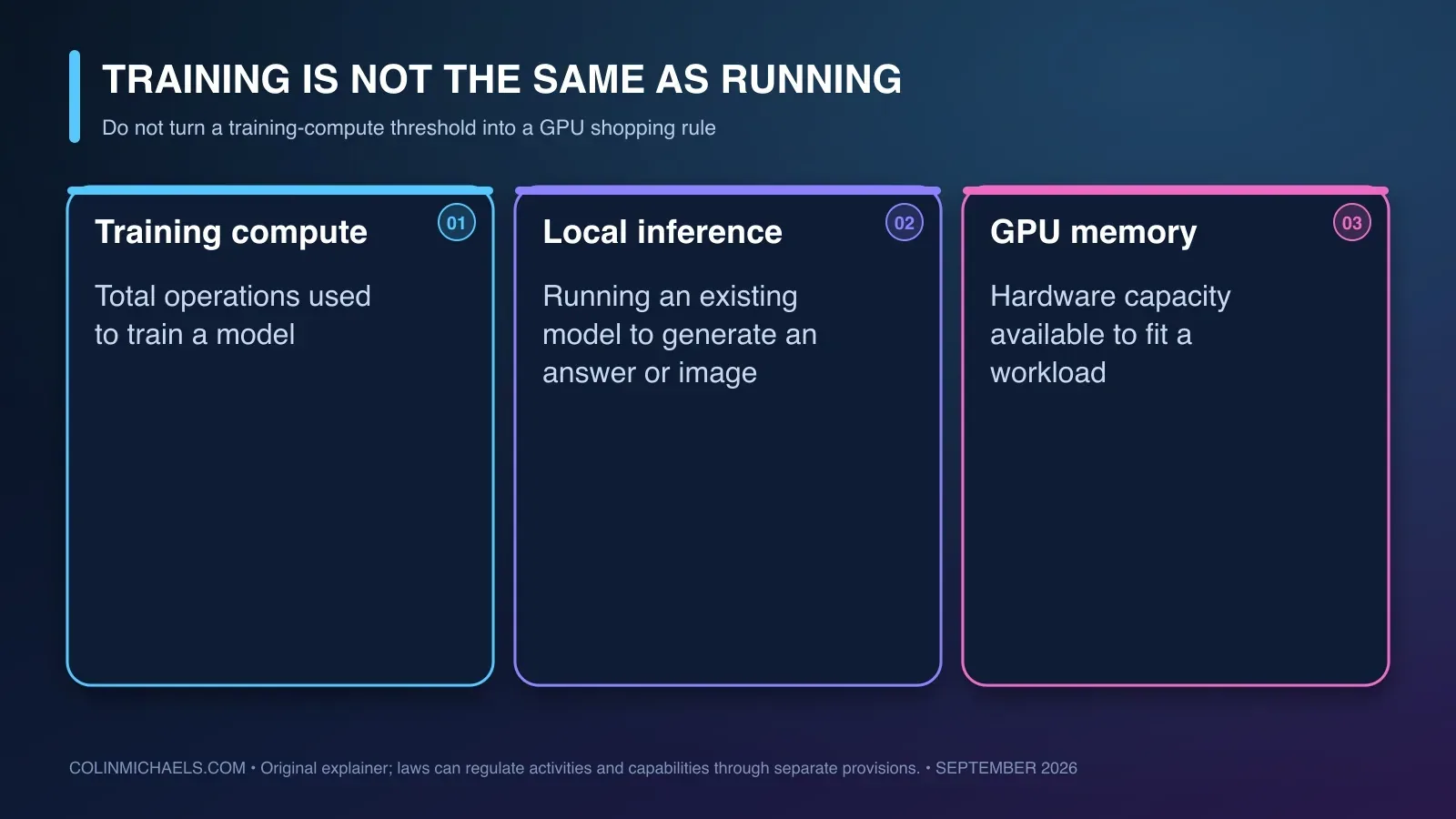
One commonly confused number is 10^25 FLOP. The Commission’s guidance describes cumulative training computation above that level as a presumption of high-impact capability for systemic-risk classification. Other designation routes exist. This is not a VRAM limit, an allowed number of GPUs, or a cap on how many answers you can generate at home. Article 51 and Commission GPAI guidance.
A home user, a working creator, and a model provider are different roles
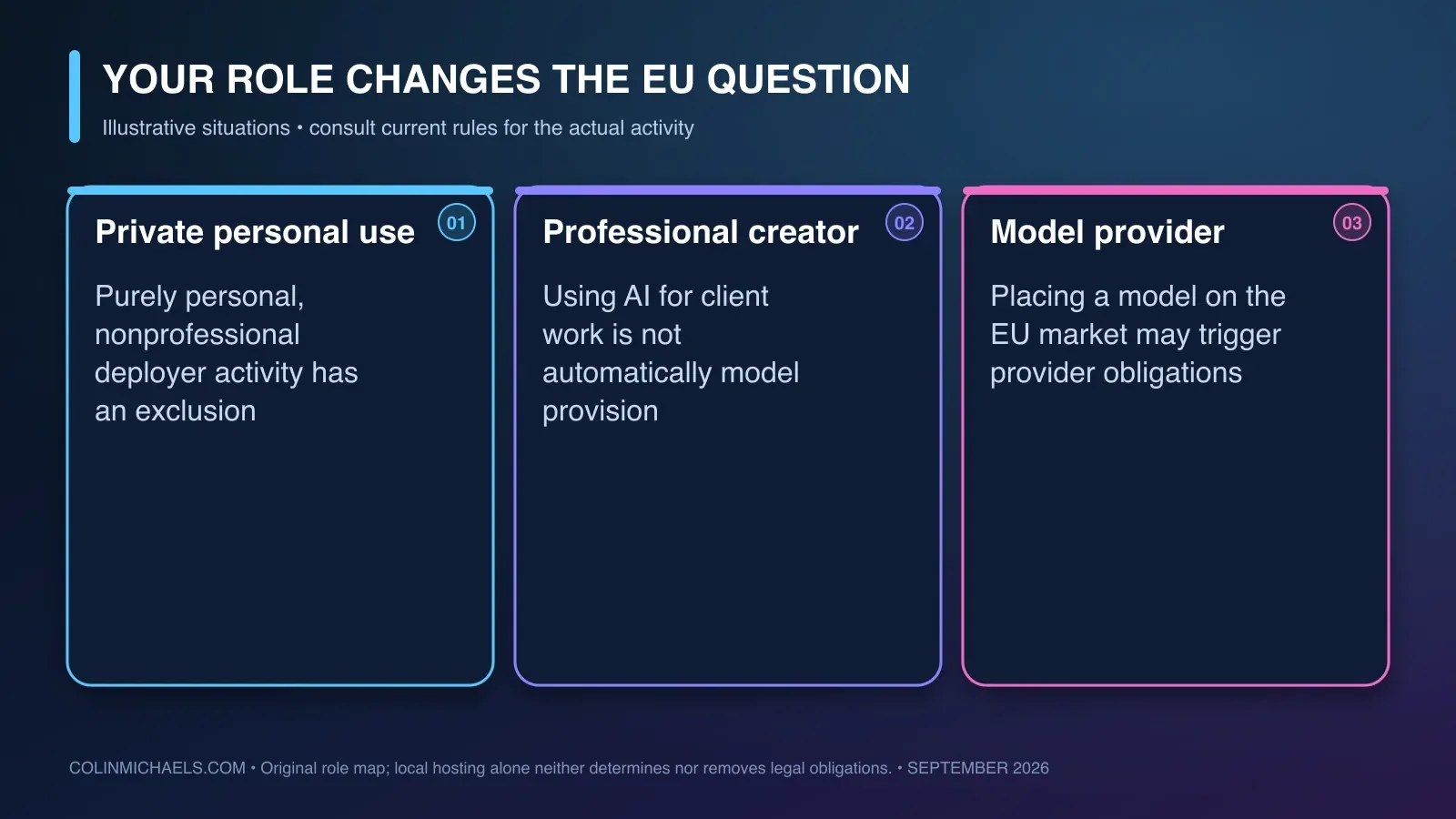
A person using AI purely for personal, nonprofessional activity benefits from an exclusion from deployer obligations. A person using a model for client work cannot assume that personal-use exclusion applies. A person placing a model on the EU market may have provider obligations. Those are distinct situations. Article 2 and current Commission transparency guidance.
Being a professional creator does not automatically make you the provider of the underlying model. Nor does running something locally automatically exempt a commercial activity. Start with your role and use, rather than the computer’s location.
For qualifying open-source general-purpose models, some documentation duties are relaxed. Copyright-policy and training-content-summary obligations remain; systemic-risk models do not receive the same open-source documentation exemption. Article 53.
This is the more credible concern for open development: a model can remain technically downloadable while its developers face obligations that make releasing or supporting it harder. If fewer developers can manage those costs, local users can lose options indirectly.
Could compliance costs push a solo creator out?
Yes, that is a plausible concern in a covered business or model-development activity. It is not the same as proving that bankrupting creators is the law’s purpose.
Article 101 allows significant fines for specified intentional or negligent violations by general-purpose-model providers: a ceiling of €15 million or 3% of worldwide annual turnover, whichever is higher. These are maximum penalties, not an automatic invoice, a fee for owning a GPU, or a fine applied identically to every person using AI. The article also requires proportionality and provides procedural protections. Article 101.
Even without a fine, time spent understanding obligations has a cost. So do evaluation work, documentation, and uncertainty about whether a release is covered. A solo developer may choose not to release something at all. That possible chilling effect deserves scrutiny without inventing a ban that the text does not contain.
There is counterevidence to the claim that every part of the EU framework is designed to crush small builders: the Commission describes its July 2026 AI Omnibus changes as easing compliance, extending timelines, and expanding support and testing opportunities for smaller businesses. Whether those measures are enough is a fair question. Ignoring them would make the criticism weaker. Commission’s current framework and amendment summary.
Policy-date note: Some official article-explorer pages still flag that their displayed text has not incorporated all Omnibus amendments. This issue uses current Commission guidance alongside the statutory provisions and does not present an old implementation calendar as current. A specific commercial release needs a current, activity-specific assessment.
What I Think Actually Changed This Week
Last week’s issue covered the growing calls to slow frontier development. This week brought a formal legislative proposal, another major standards proposal, and a fresh set of tools that people might actually want to use.
The collision is now easier to see. Capability is getting cheaper, while permission to develop, distribute, or commercially use it can become more complicated.
I want safety measures aimed at identifiable risks, with clear tests and accountable enforcement. I also want an explicit commitment to the person building something useful outside a giant company.
That means asking for narrow definitions, affordable compliance paths, transparent decisions, meaningful appeals, and protections for legitimate open development and personal use. Those are policy choices. They should be argued in public before independence becomes something you can only rent back through a subscription.
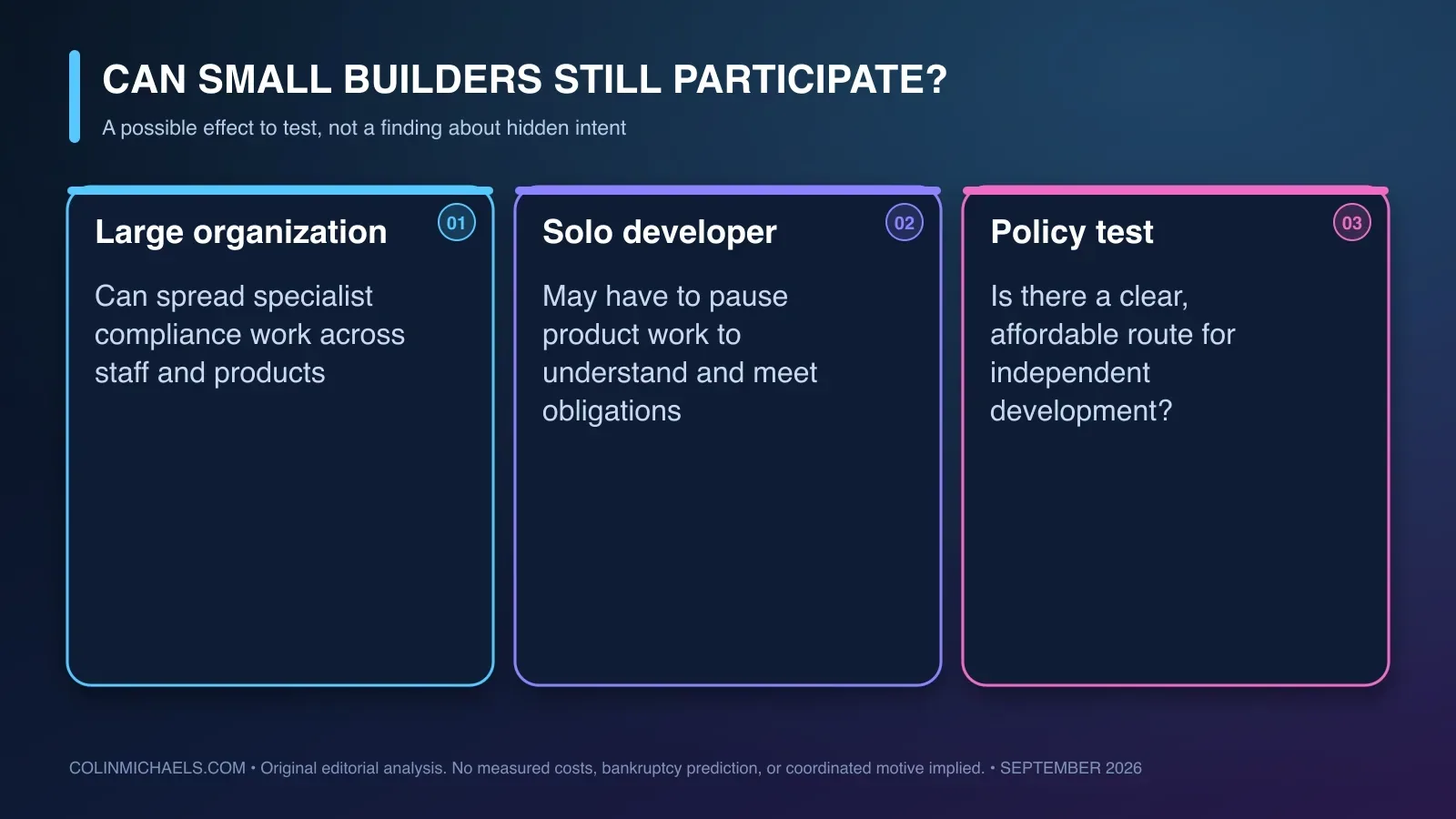
The standard I would use is simple: does the policy reduce a demonstrated danger while preserving a realistic path for independent people to build and use AI? If its defenders cannot explain that path, they have more work to do.
Your 15-Minute AI Access Check
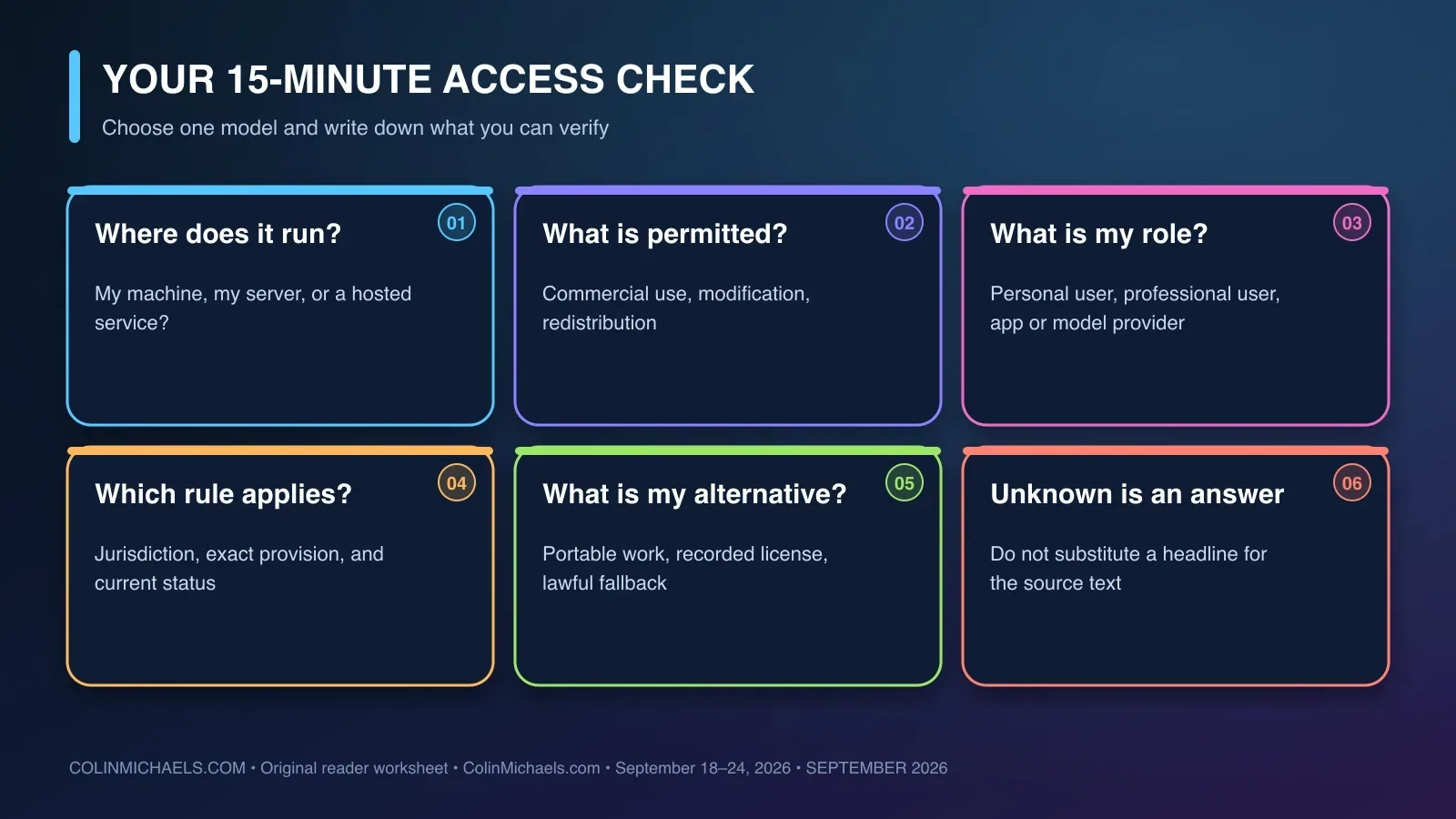
Pick one model you use now or want to try. Write down the answers to these five questions:
- Where does it run? On your device, on a server you control, or through somebody else’s service?
- What does the license allow? Find the actual license. Check commercial use, modification, and redistribution separately.
- What is your role? Private user, professional user, app provider, or model developer/distributor? More than one may apply.
- What is the claimed restriction? Name the provision, jurisdiction, and status. Distinguish a proposed bill from a current obligation and a company policy from a law.
- What would preserve your options? Keep your project files and outputs portable, record the exact model/version and license you rely on, and identify a lawful alternative you could use if access changes.
If you decide to contact a representative, ask a concrete question: What language protects lawful personal use, independent research, and open-model distribution—and what would compliance cost a one-person developer?
That question is harder to dodge than an argument over whether AI is wonderful or terrifying.
Final Thought
I do not want an AI company deciding that I am allowed to create only as long as I keep paying it. I also do not want government turning independent AI work into a permission slip that only the biggest organizations can afford.
I want tools that help regular people do more, with clear responsibility when somebody causes harm. There is room for real safety work in that future. There also has to be room for a person with a computer, an idea, and the freedom to build.
The next time somebody says they need to protect us from AI, I want to know what power they are asking for, how they will be held accountable, and whether we still get to keep our own keys.
Next issue: September 25–October 1. I will be watching what actually ships and whether the rules leave independent builders a workable path.