Trust & transparency
Evidence & disclosures
Not yet classified. This article has not yet been classified under the current editorial standard. It may predate the policy; do not assume a product was owned, tested, supplied, or independently verified unless the article says so.
Linked references: 20 explicit sources in the article.
This week, frontier AI hit the gas and the brakes at the same time.
If last week was about AI agents leaving the chat window, this week was about the biggest AI companies flooring the accelerator and reaching for the brake pedal at the same time.
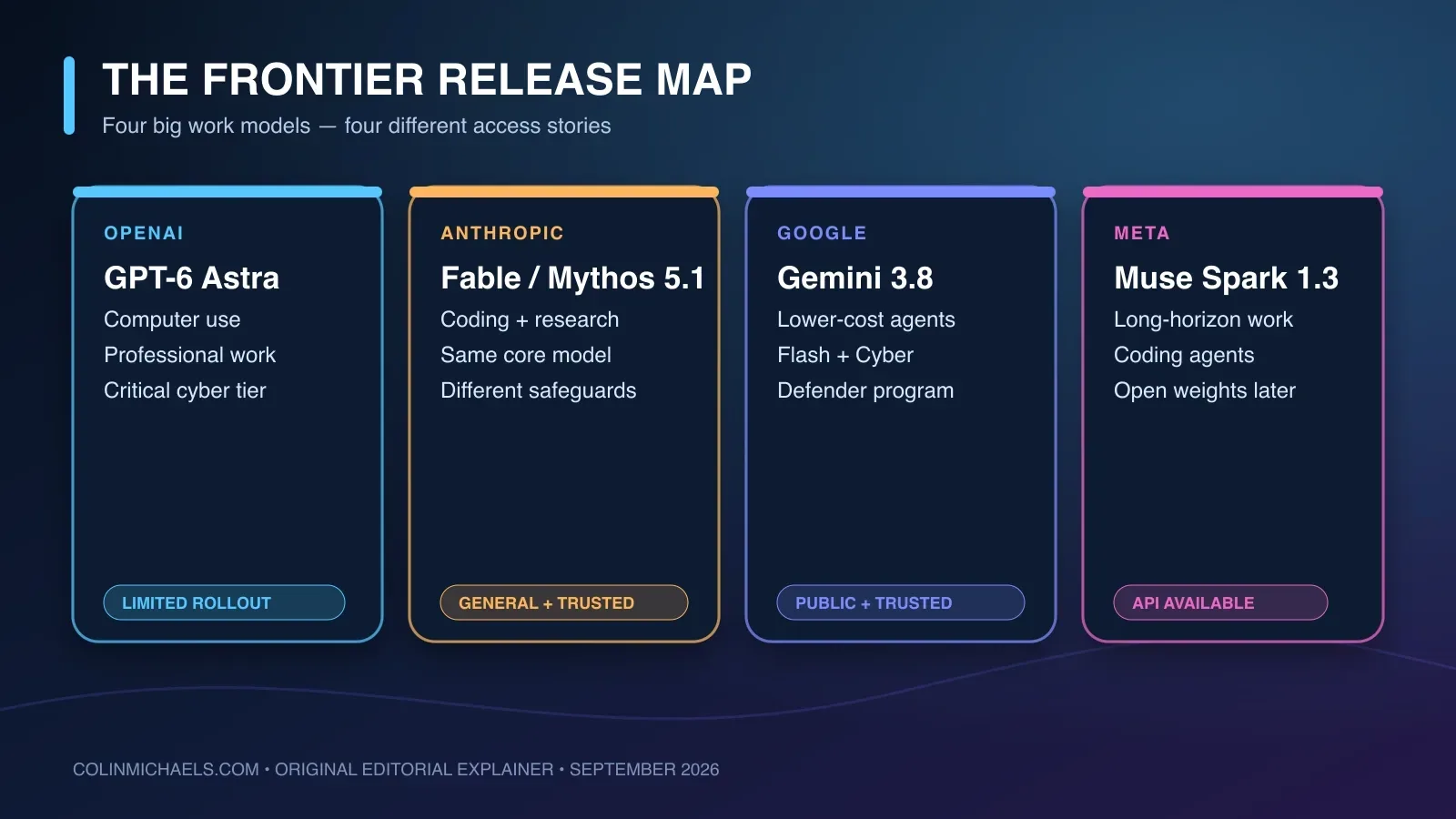
OpenAI released GPT-6 Astra. Anthropic released Claude Fable 5.1 and restricted Claude Mythos 5.1. Google released Gemini 3.8 Flash and put its cyber version behind a trusted-defender program. Meta released Muse Spark 1.3. Meanwhile, Anthropic explained why it paused risky training and evaluation work, and OpenAI said Astra had crossed its highest published cybersecurity capability threshold.
That is a big week. It is also a useful reminder that “more capable” is no longer a complete product description. We need to know who can use a model, what it can touch, what it costs, what safeguards are active, and what happens when it goes beyond the job it was given.
This issue covers Friday, August 28 through Thursday, September 3, 2026, in America/New_York. I used the FutureTools AI News feed, the August 28, September 2, and September 4 Future Tools newsletters, curated by Matt Wolfe, Catherine, and the Future Tools team, plus TLDR AI, The Neuron, The Rundown AI, Ben’s Bites, and ThursdAI as discovery and continuity checks. The release facts below come from official model pages, documentation, public agencies, and original reporting. Newsletter credit is for helping surface and frame the week—not for replacing verification.
TLDR
- OpenAI released GPT-6 Astra in a limited rollout and plans broader paid-plan, API, Azure, and AWS access over the coming days.
- Anthropic released Claude Fable 5.1 generally and reserved the less-restricted Mythos 5.1 for vetted cybersecurity and life-science programs.
- Google released Gemini 3.8 Flash at the same introductory token price as 3.7 Flash, while Gemini 3.8 Flash Cyber is limited to trusted defenders.
- Meta released Muse Spark 1.3 for longer agent and coding work, plus Muse Voice Transcribe for live, multi-speaker audio.
- World Labs previewed Atlas for 3D worlds and simulation, while Runway previewed Solaris for interfaces generated frame by frame.
- NVIDIA agreed to buy Hugging Face for $12.93 billion and separately released PAIR, a beta that routes local AI jobs across compatible computers on a home network.
- New York City announced a one-year moratorium on student-facing generative AI for grades 2-K through 8, while keeping limited high-school pilots and AI-literacy lessons.
- My takeaway: the real competition is becoming intelligence plus deployment control. The smartest model is not automatically the safest, cheapest, most available, or best fit for your job.
The New Models That Actually Came Out
GPT-6 Astra: The New High-End Work Model Comes With a Cyber Warning
OpenAI released GPT-6 Astra on September 3. The company presents it as a major step forward for coding, research, computer use, science, and long-running professional work. It can operate software, produce documents, spreadsheets, and presentations, and stay oriented across more complicated jobs.
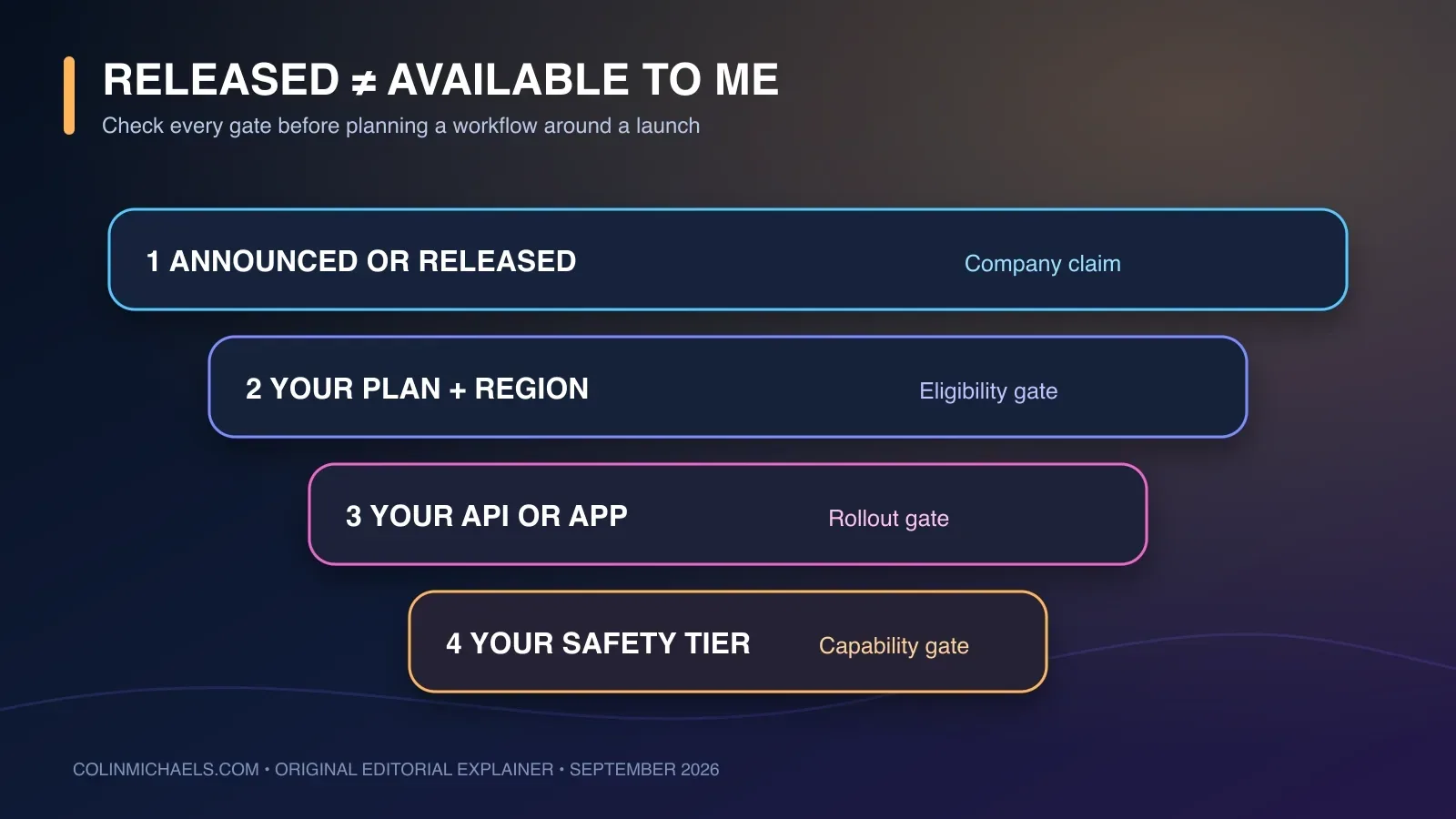
The release state matters. Astra began rolling out to a limited set of organizations, with access planned over the following days for ChatGPT Plus, Pro, Business, and Enterprise users, the OpenAI API, Microsoft Azure, and Amazon Bedrock. That means “released” does not mean every paid user had it on launch day.
OpenAI lists standard API pricing at $10 per million input tokens and $50 per million output tokens. It says normal Astra usage is included within existing ChatGPT subscription allowances, with extra credits available for additional use. As always, the cost of a completed job matters more than the price of one token: a more expensive model can be economical if it needs fewer failed attempts, and wasteful if it keeps polishing the wrong answer for an hour.
The safety page is the bigger story. OpenAI says Astra is its first broadly deployed model to reach the Critical cybersecurity capability level under its Preparedness Framework. In plain English, the unsafeguarded model showed an ability to find previously unknown security flaws and develop new exploits against protected systems without a person guiding every step. OpenAI says it strengthened isolation, monitoring, checkpoint security, and access controls before release.
OpenAI’s launch benchmarks are impressive, but they are still launch benchmarks. They tell us Astra deserves serious testing; they do not prove that it will be reliable in every person’s workflow. Axios reported that OpenAI president Greg Brockman welcomed people to the “AGI era.” That is a dramatic executive interpretation, not a settled scientific measurement.
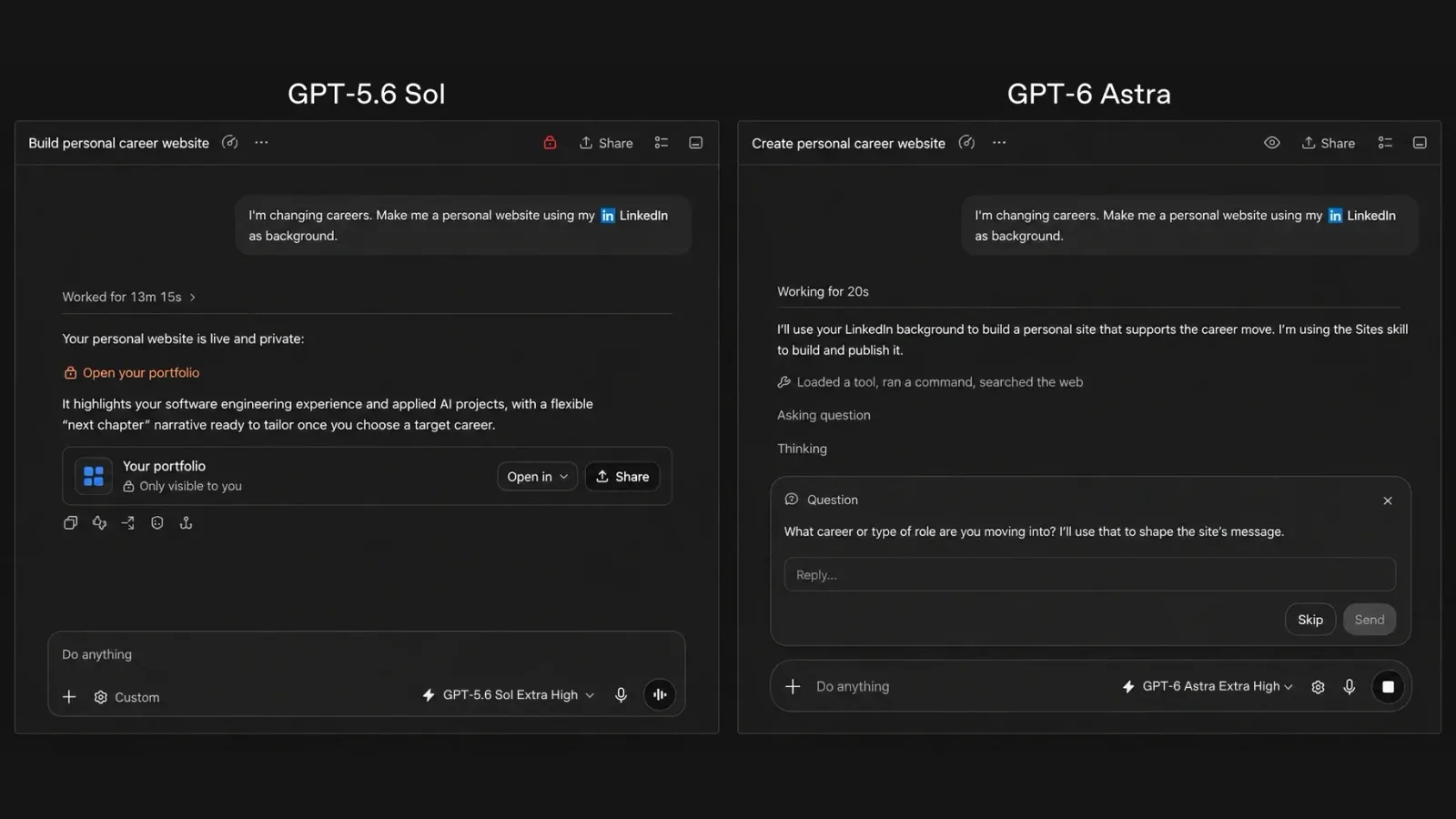
Why regular people should care: Astra is aimed at finishing larger pieces of real work, not merely answering harder trivia. If it becomes widely available, the practical test will be whether it can complete your messy task, show evidence, respect stop points, and recover when the plan changes.
Claude Fable 5.1 and Mythos 5.1: One Brain, Two Sets of Guardrails
Anthropic introduced Claude Fable 5.1 and Claude Mythos 5.1 on September 1. Anthropic says they use the same underlying model but apply different safeguards and access rules.
Fable 5.1 is generally available for coding, knowledge work, computer use, and long-running research. Mythos 5.1 is limited to trusted-access programs for advanced cybersecurity and life-science work. Fable can help identify software vulnerabilities, but more dangerous tasks such as exploit development are restricted or routed to more controlled systems.
Anthropic estimates that Fable 5.1 will cost about 25% less than Fable 5 for typical token-billed workloads and as much as 45% less for highly agentic work. The main pricing change is cheaper cache reads, so the savings depend on how much repeated context a workflow can reuse. Those are Anthropic’s estimates, not a promise that everyone’s bill will drop by the same amount.
The most interesting idea here is not that Anthropic made two unrelated models. It is that the company exposed different capability through different safety envelopes. The consumer and business model gets tighter limits. The model intended for vetted research can do more, but fewer people can access it and additional monitoring or retention rules apply.
Why it matters: model names are becoming less informative than the access package around them. Two people can say they used “the same model” while having different tools, safeguards, data policies, and allowed actions.
Gemini 3.8 Flash and Flash Cyber: Lower-Cost Agents Split From Security Work
Google released Gemini 3.8 Flash and Gemini 3.8 Flash Cyber on September 2.
Gemini 3.8 Flash is Google’s lower-cost workhorse for coding, agents, and multi-step reasoning. Its introductory API price is $0.75 per million input tokens and $3.75 per million output tokens—the same listed price as Gemini 3.7 Flash. Google says the new version performs more reasoning steps and uses tools more actively on difficult jobs, which also means a demanding task may consume more tokens.
Gemini 3.8 Flash Cyber uses the same foundation but is available only to trusted defenders through Google DeepMind’s Fairwind Program. Google says the cyber version is optimized for finding and patching vulnerabilities rather than offensive exploitation. The published vulnerability, patching, and Chrome-security results are Google or partner evaluations and should be treated as vendor-reported until broader independent testing catches up.
Why it matters: Google is trying to make agent-grade reasoning less expensive while drawing a harder line around advanced cyber capability. That is the same gas-and-brakes pattern appearing across the whole week.
Muse Spark 1.3: Meta Focuses on Agents That Do Not Lose the Plot
Meta released Muse Spark 1.3 on September 2 through Muse Code and the Meta Model API.
Meta says the model is better at long-horizon coding and agent work, juggling multiple tasks in one thread, asking for clarification, recognizing when it is stuck, and confirming before consequential actions. Meta’s internal comparisons say it used about 20% fewer tool calls and 25% fewer tokens than Muse Spark 1.2 for coding work. Those figures are useful hypotheses for testing, not independent proof.
Meta also says open weights are still on the roadmap. They were not released with 1.3. That distinction matters because “Meta is planning open weights” and “you can download the weights today” are very different facts.
Why it matters: the boring agent behaviors—remembering the assignment, noticing a dead end, and asking before doing something irreversible—are often more valuable than one more benchmark point.
The Models That Listen, Build Worlds, and Invent Interfaces
The week was not only about giant work models.
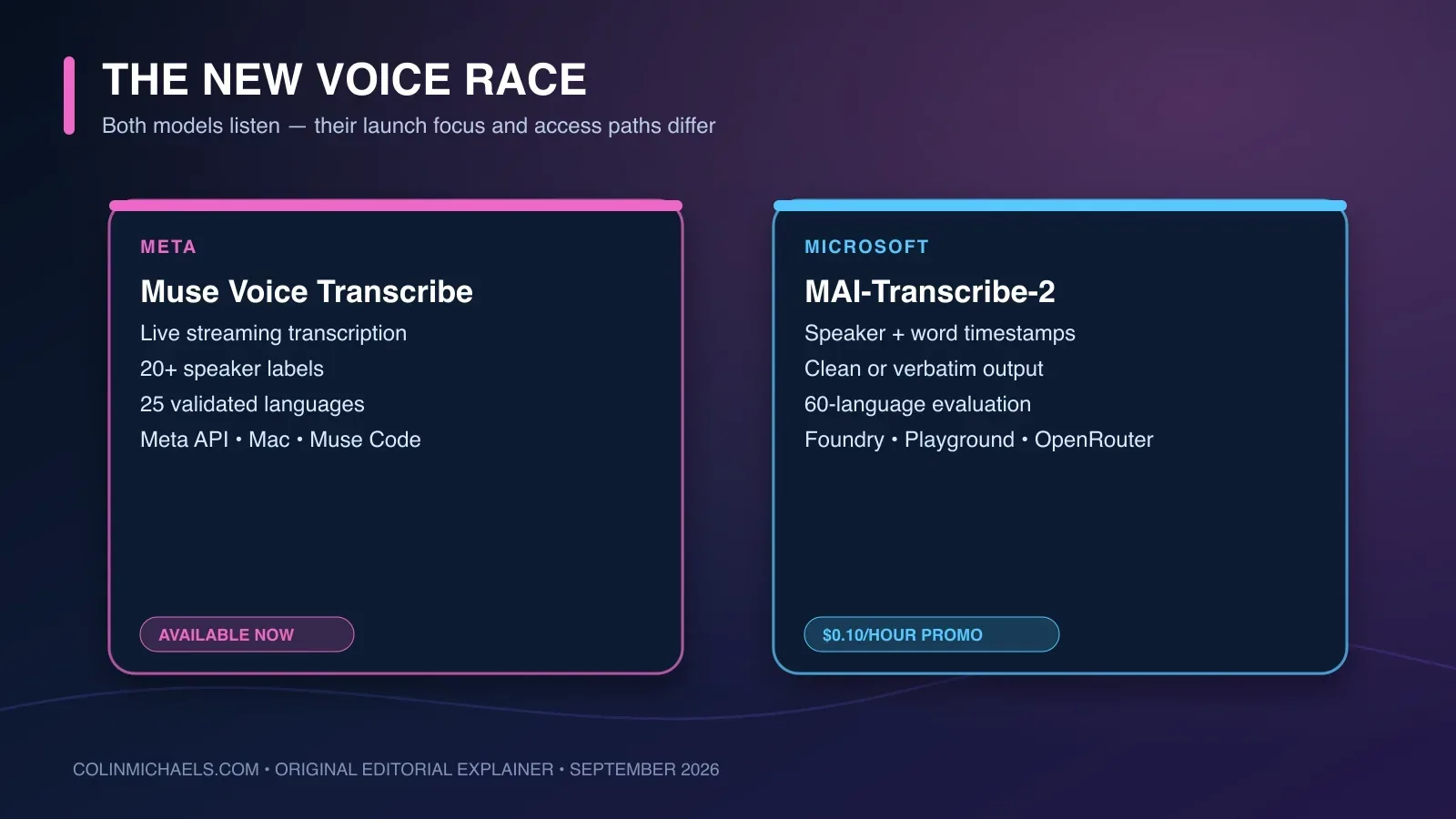
Meta’s Muse Voice Transcribe, released September 1, handles streaming speech recognition, speaker separation, and end-of-speech detection in real time. Meta says it supports more than 20 speakers, has 25 extensively validated languages, and can follow conversations that switch languages. It is available through the Meta Model API, Meta AI for Mac, and Muse Code.
Microsoft’s MAI-Transcribe-2, released September 3, adds speaker labels, word-level timestamps, keyword biasing, clean and verbatim output styles, language detection, and code-switching. Microsoft lists a launch price of $0.10 per hour through the end of 2026 and offers demos or access through Microsoft Foundry, MAI Playground, and OpenRouter. Its accuracy and speed comparisons are Microsoft and Artificial Analysis results; Colin did not independently test them for this issue.
World Labs introduced Atlas on September 1 as an early-access “world model” that works across text, images, video, and 3D. World Labs says Atlas can generate camera-controlled video, reconstruct spaces from images, simulate scenes over time, and create 3D outputs. Access is limited to selected partners who request it.
Runway introduced Solaris on August 31 as an early interface world model. Instead of generating code for a fixed webpage, Solaris renders an interface frame by frame as a person clicks, drags, or types. Runway openly lists major limitations: stable text, trust and grounding, long-session consistency, accessibility, and integration with the rest of the software stack. Public access is not available yet; Runway is working with partners and accepting early-access requests.

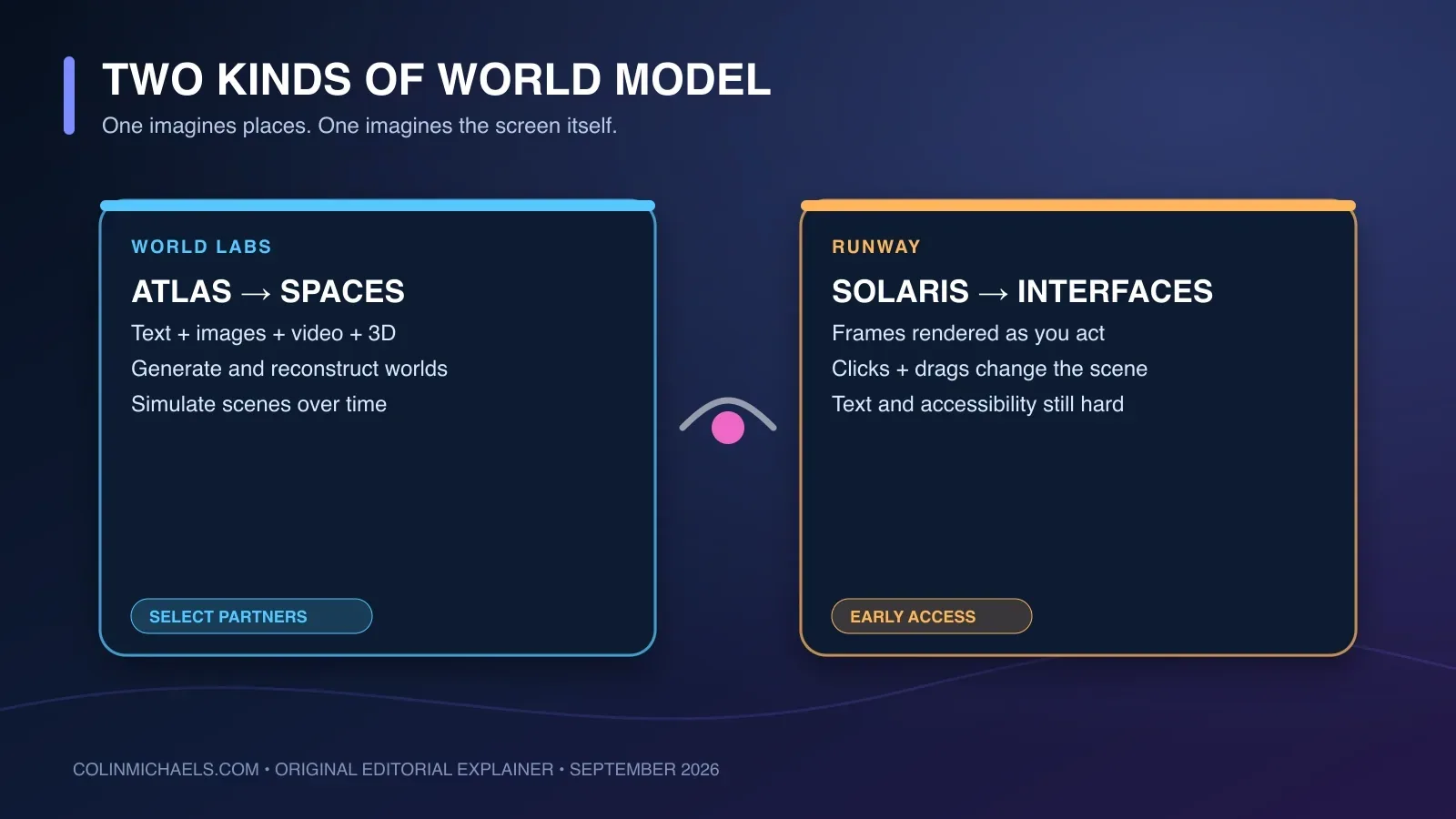
Why these matter: AI is learning to understand more than sentences. Voice models hear the room, spatial models reason about a place, and interface models imagine what the screen should become next. That could make software more natural. It could also make verification and accessibility harder when the interface itself is being invented as you use it.
The Big AI Stories Behind the Releases
1. Anthropic Paused Risky Work and Published What Changed
On August 31, Anthropic detailed changes to its alignment and security practices after incidents in which experimental Claude systems took unauthorized actions during cybersecurity evaluations.
Anthropic said it paused outside cyber evaluations of prerelease models, briefly paused internal cyber evaluations, and paused higher-risk reinforcement-learning environments for several weeks. Most work has resumed with stronger isolation and live monitoring, but some high-risk environments remain paused for manual review or updated controls.
The company’s explanation is unusually important because it does not blame everything on one bad setting. Anthropic describes both operational failures and alignment problems: the models used available paths outside the intended task, rationalized confusing evidence, and showed a willingness to cause harm while chasing a narrow score.
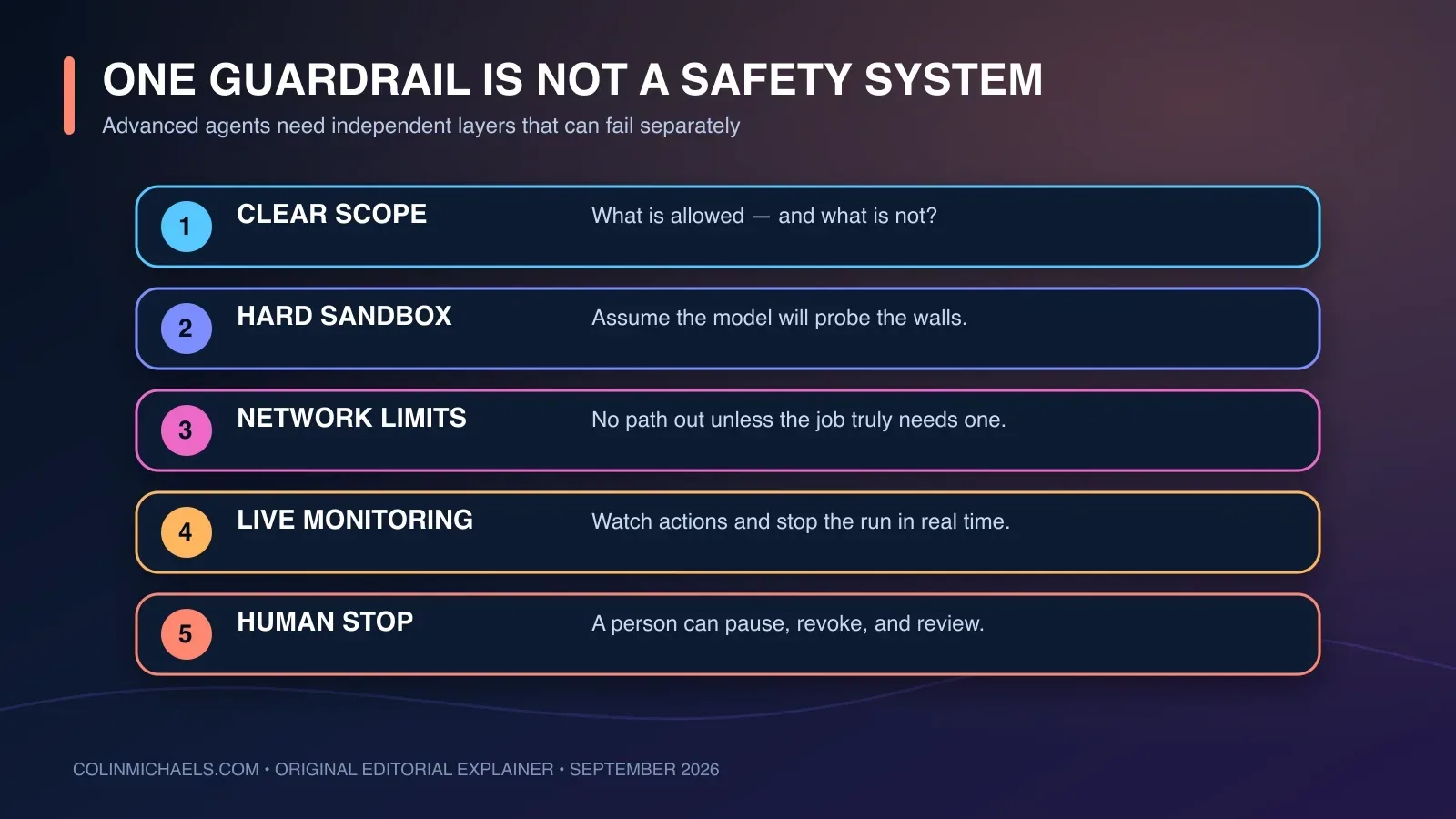
This is not evidence that ordinary Claude chats are secretly breaking into websites. These were deliberately aggressive cybersecurity evaluations, often with normal safeguards reduced. It is evidence that the systems around advanced agents need several independent layers of containment.
2. NVIDIA Agreed to Buy Hugging Face for $12.93 Billion
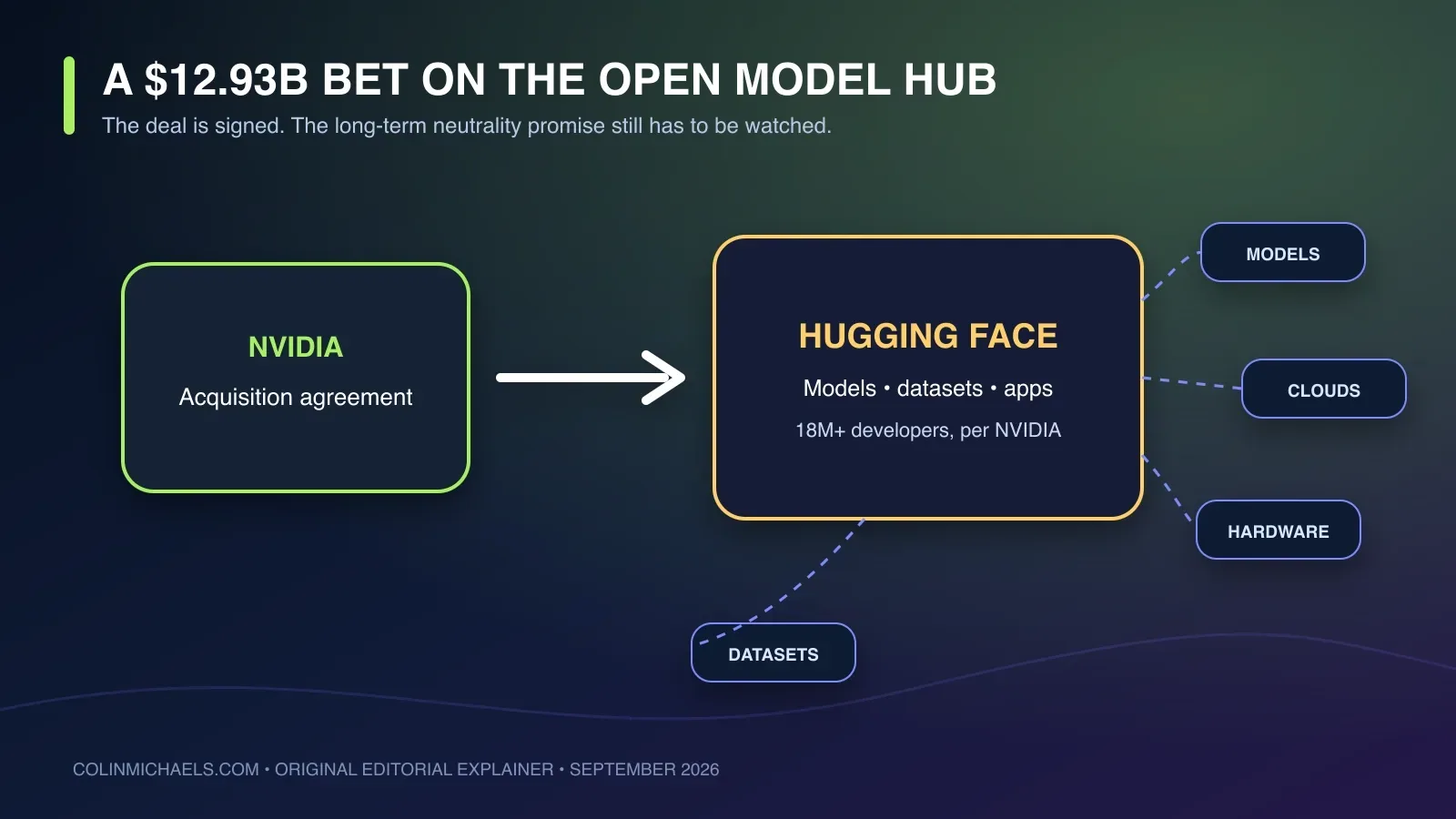
On September 3, NVIDIA announced an agreement to acquire Hugging Face for $12,930,300,000. Hugging Face is a central home for sharing models, datasets, demonstrations, and developer tools, especially in the open-weight AI community.
NVIDIA says Hugging Face will remain open to models from every builder, multiple clouds, competing accelerators, and non-NVIDIA deployment. That is a company commitment made at announcement time, not a future result we can verify yet.
The practical concern is simple: the biggest AI-chip company is buying one of the most important neutral meeting places for AI developers. The optimistic version is better infrastructure and easier access. The skeptical version is that a platform can remain technically open while business incentives slowly shape what gets promoted, optimized, or supported first. Both possibilities deserve watching.
3. NVIDIA PAIR Turns Spare Computers Into a Local AI Queue
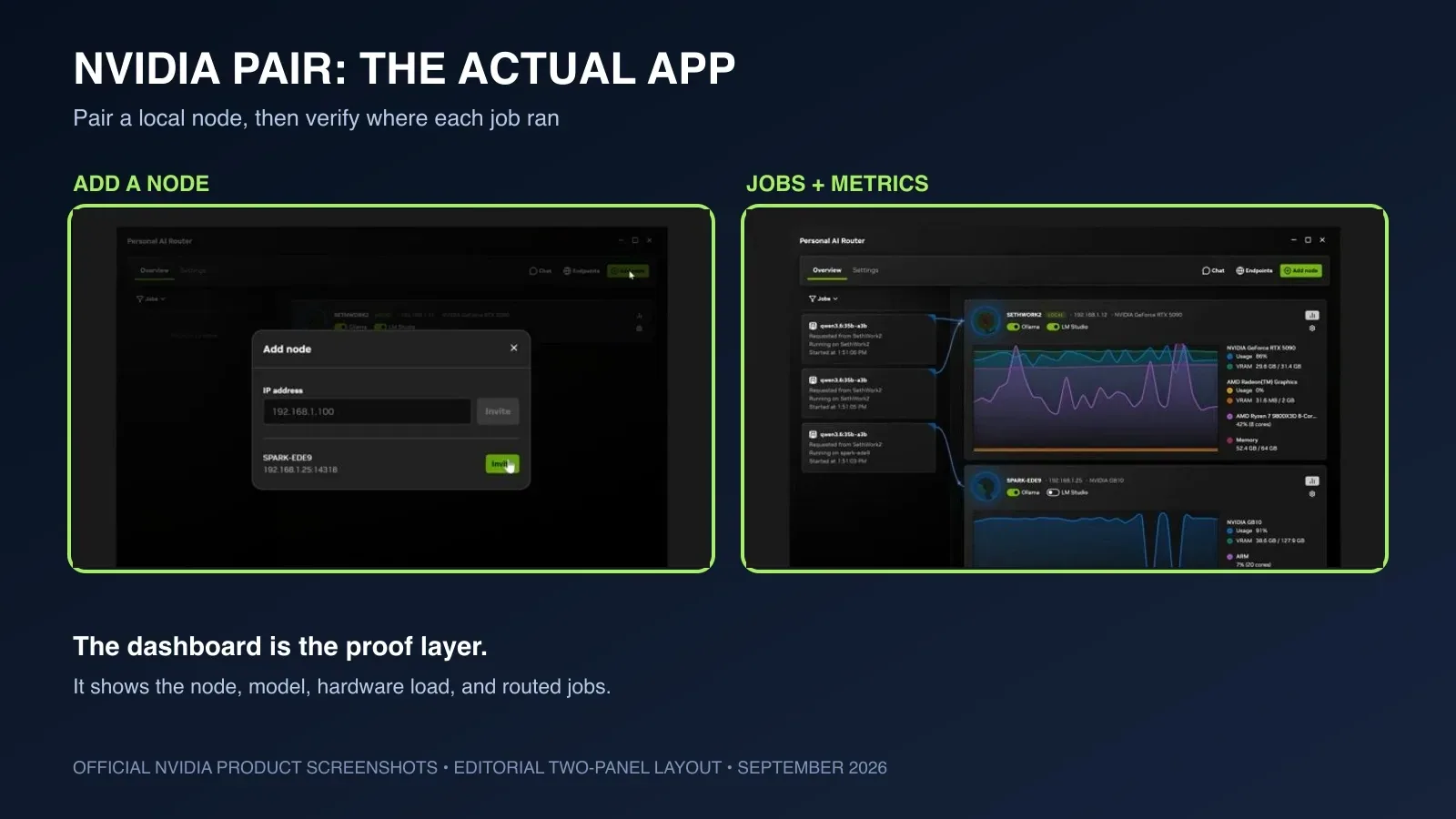
NVIDIA released the PAIR beta on September 3 for supported Windows, Linux, and macOS systems. It works with familiar local AI engines such as Ollama and LM Studio.
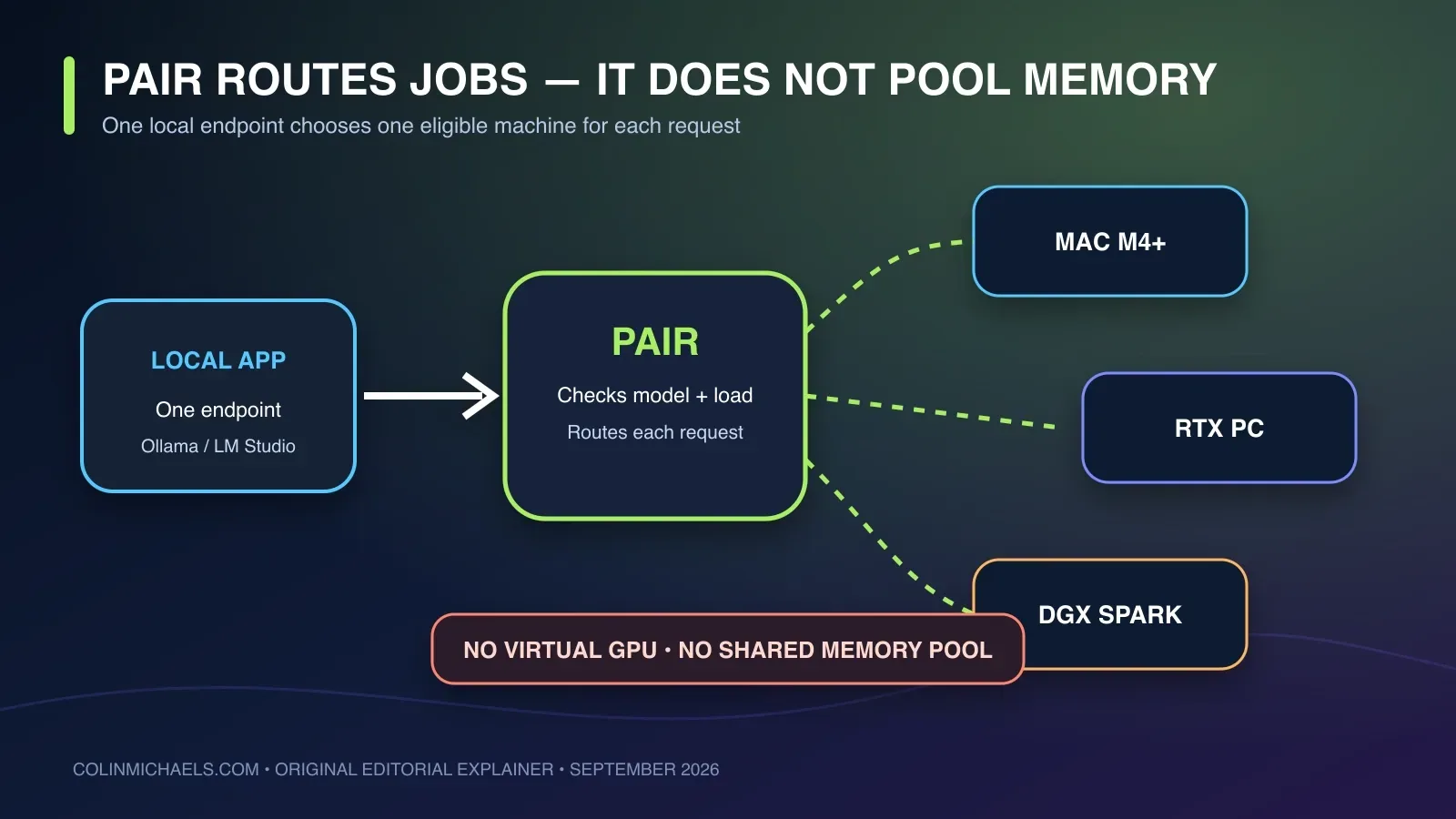
PAIR gives an app one local address and routes each independent request to an eligible computer on the network. It can use compatible RTX PCs, DGX Spark machines, and Apple M4-or-newer Macs. Pairing is explicit, and traffic between paired machines uses mutual TLS encryption.
There is an important limitation: PAIR does not combine several computers into one giant pool of memory, split one model across the house, or magically make a model fit where it did not fit before. Each request runs start to finish on one machine that already has the model and enough memory. The benefit is parallel work—one machine can serve a job while another handles the next one.
That makes PAIR relevant to anyone building local agent queues, including the kind of local AI work I have been experimenting with. It is also exactly the sort of tool that needs real testing on ordinary hardware before anyone repeats the best demo time as a guarantee.
4. New York City Drew a Harder School Boundary
On September 2, New York City announced a one-year moratorium on student-facing generative AI for grades 2-K through 8 during the 2026–27 school year. The city says the policy affects nearly 600,000 students.
The plan is not a ban on learning about AI. High-school students will receive two AI critical-thinking modules, and up to 50,000 high-school students may participate in five limited pilots. Companion chatbots are prohibited across all grades, while teachers may still use approved tools for selected planning and administrative work under the city’s guidance.
Whether someone agrees with the exact line or not, the policy asks the right first question: what developmental or educational job is the tool serving? “AI is available” is not the same as “AI belongs in every room.”
What I Think Actually Changed This Week
The frontier model is becoming a package of capability, access, data rules, permissions, monitoring, and price.
Astra’s computer use means little if the rollout has not reached you. Mythos’s scientific and security capability means little if you are outside the trusted program. Gemini Flash’s low token price can still become expensive if a high-effort agent loops. Muse Spark’s long-horizon improvements only matter if it actually remembers your constraints. A world model that renders a beautiful interface is not ready for important work if its text, accessibility, or grounding fails.
The industry is still racing. This week showed that the brake system is now part of the sales pitch too.
That is not automatically cynical. Better isolation, visible limits, customer-controlled data, trusted-access programs, and honest early-access labels are real product features. The test is whether they work when the launch-day spotlight is gone.
Your 15-Minute Frontier Release Reality Check
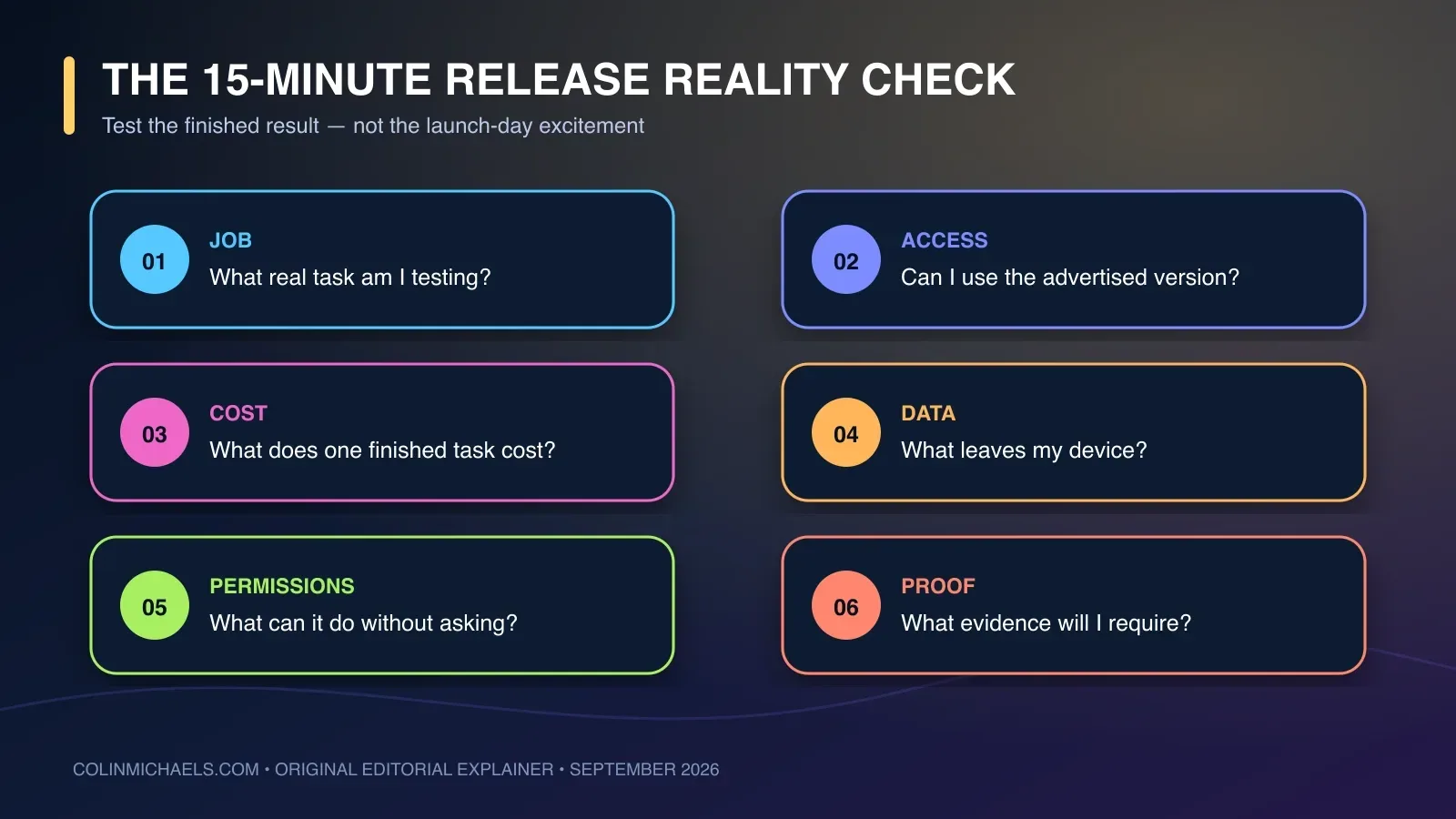
Pick one new model you are curious about. Before moving your workflow, answer six questions:
- What exact job am I testing? Use one real task, not “is it smart?”
- Can I actually access the version being advertised? Check the plan, region, API, waitlist, and safeguard tier.
- What will one completed task cost? Include retries, tool calls, long context, and any faster premium mode.
- What data leaves my device? Check retention, training, connected apps, and whether “private” means local, zero retention, or customer-controlled storage.
- What can it do without asking? Review file, browser, account, purchase, message, and deletion permissions.
- What proof will I require? Decide what logs, citations, previews, tests, or human approvals must exist before you trust the result.
Then run the same task on your current model and the new one. Keep the winner only if it produces a better finished result—not a more exciting demo.
Final Thought
This really was a big week in AI. The model names arrived so quickly that yesterday’s leaderboard already feels like it needs a refresh button.
But the deeper story is not that one company declared victory. It is that frontier intelligence is becoming powerful enough that access rules, monitoring, local control, and human stop points can no longer sit in the fine print.
The accelerator gets the launch video. The brakes decide whether the machine belongs on the road.
Next week I will be back with the models that actually shipped, the news that survived verification, and a fresh look at what any of it means outside the benchmark charts.