Trust & transparency
Evidence & disclosures
Evidence basis: Manufacturer-supplied evidence. Material claims or demonstrations came from the company responsible for the product and are not independent results.
Based on Godox’s product page and manual; I have not handled the C100, so usability and image-quality judgments remain untested.
Sources checked: Aug 20, 2026
Linked references: 2 explicit sources in the article.
I did not know I needed a camera shaped like a little window until Godox made one.
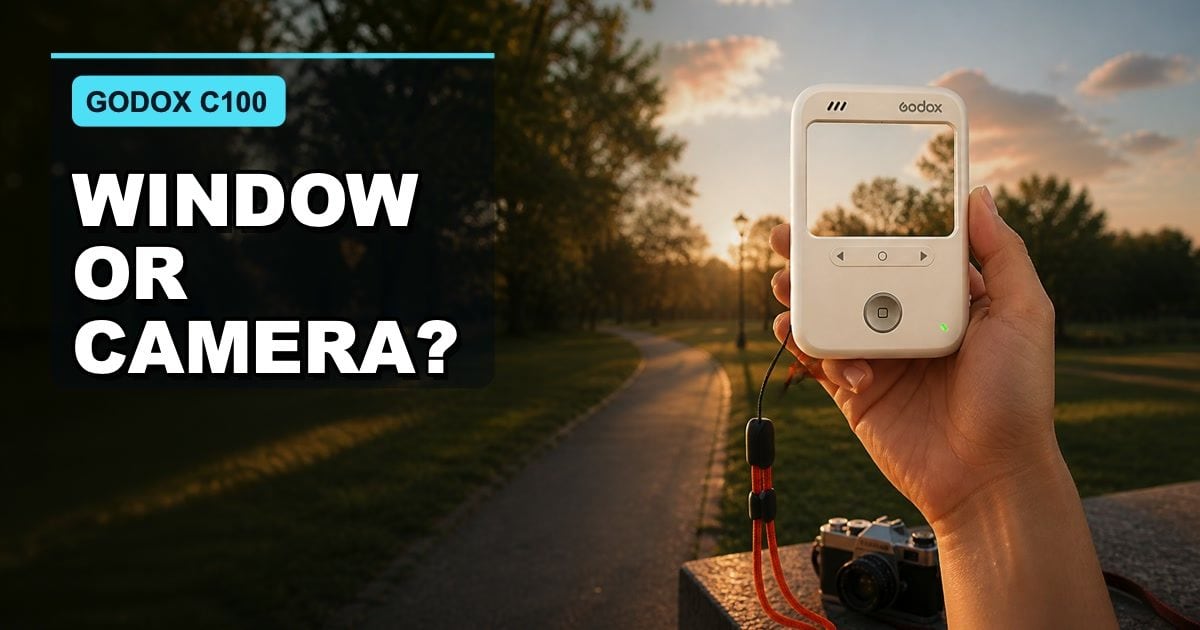
The Godox C100 is a tiny digital camera built around a transparent optical viewfinder. Instead of holding up another glowing screen and watching the world through it, you look through the device at the actual scene. A simple heads-up display puts framing marks, battery status and exposure information over that view.
It looks a little like a toy camera, a light meter and a piece of early-2000s transparent gadget design were all left alone in the same room.
That is why I stopped scrolling.
Before I go any further, this is not a hands-on review. I have not used the C100, Godox did not send me one, and this post is not sponsored. I am sharing it because it is a wonderfully strange gadget with at least two ideas behind it that make more sense than the design first suggests.
TLDR
- The Godox C100 uses a transparent optical viewfinder with a basic data overlay instead of a normal rear preview screen.
- It shoots photos and videos, offers 16:9, 3:2, 4:3 and 1:1 framing guides, and transfers files to a phone or computer over USB-C.
- It also works as a center-weighted light meter, reading roughly the middle 25% of the viewfinder for people using older film cameras.
- Godox lists support for TF cards up to 128GB, a weight of about 65 grams and more than 1.5 hours of continuous-shooting battery life.
- The official English page does not list a U.S. price or clearly confirm regional stock.
- Image quality, viewfinder accuracy and light-meter accuracy still need a real-world test.
The Weird Part Is the Whole Point
Most modern cameras are designed around a display. Phones are basically all display. Even a traditional digital camera encourages you to take a picture, look at the picture, zoom into the picture, question the picture and take six more versions of the picture.
The C100 removes that little review loop.
Godox describes the experience as “blind” shooting because there is no conventional playback screen for checking every frame. The transparent viewfinder still shows useful information, but the thing behind that information is the real world—not a live video feed of the real world.
That difference may sound small. I think it could change the feeling of taking pictures.
You compose, press the shutter and keep walking. You do not immediately begin judging the result. You stay with the person, place or odd-looking cloud that made you reach for the camera in the first place.
Is that partly a gimmick? Absolutely.
But “gimmick” does not automatically mean “useless.” Sometimes a strange design is just a physical reminder to behave differently.
Real Use Number One: A Lower-Pressure Photo Walk
The most interesting promise here is not better image quality. Godox's own product page leans toward fun, spontaneity and what it calls “vibe over pixels.” The company does not list the kind of detailed imaging specifications that would let me compare this with a serious compact camera.
That makes the C100 easier to understand as an experience camera.
It weighs about 65 grams, supports four familiar aspect ratios and lets you move the files later by connecting it to a phone or computer with a USB-C cable. The official manual says a single video can run for up to 20 minutes, but nothing about the design suggests that this is trying to replace a dedicated video camera.
It looks more like something you would take on a walk, hand to a kid under adult supervision, or keep in a jacket pocket for intentionally imperfect snapshots.
There is value in a camera that does not ask you to become a photographer every time you touch it.
Real Use Number Two: It Can Help an Old Film Camera
The second use is the one that moves the C100 beyond pure novelty.
It has a built-in center-weighted light meter. According to the official C100 manual, the meter reads approximately the central 25% of the transparent viewfinder. You set the ISO, point it at the important part of the scene, and the camera can show a matching aperture and shutter-speed combination.
That could be genuinely handy if you are learning to use an old film camera with a dead meter, an unreliable meter or no meter at all.
Instead of carrying a separate phone app, you could carry one tiny device that acts as a meter and also takes its own digital snapshots. The manual lists a metering range of ISO 100-800, apertures from f/1.0 to f/64 and shutter speeds from 1/8000 second to 1 second.
I would still compare its readings with a known meter before trusting an important roll of film. Godox explains how the feature works, but official specifications are not the same thing as an independent accuracy test.
Still, this is a real job the weird little window can do.
What I Would Want to Test
The C100 raises more questions than the official page answers, which is part of why I want to try one.
I would want to know:
- How close is the transparent framing guide to the image the lens actually records?
- What do the photos look like in good light, indoors and near sunset?
- Does the light meter agree with a trusted camera or handheld meter?
- Is file transfer as simple as connecting one USB-C cable?
- Does the light weight feel charming or flimsy?
- Can the battery make it through a normal afternoon of casual shooting?
I would also keep it away from rain. The manual specifically says the camera is not waterproof, which matters for something that looks made for wandering around outside.
The biggest unknown may be the price. As of August 9, 2026, the official English product page does not show a U.S. list price or clearly say where the C100 is in stock. A playful camera can be easy to recommend at one price and hard to explain at another.
The Simple Two-Camera Test
If I get one, my first experiment would be deliberately boring.
I would take the same short walk twice: once with the C100 and once with my phone.
Same route. Same amount of time. Roughly the same number of pictures.
Then I would compare more than the files. I would pay attention to my behavior.
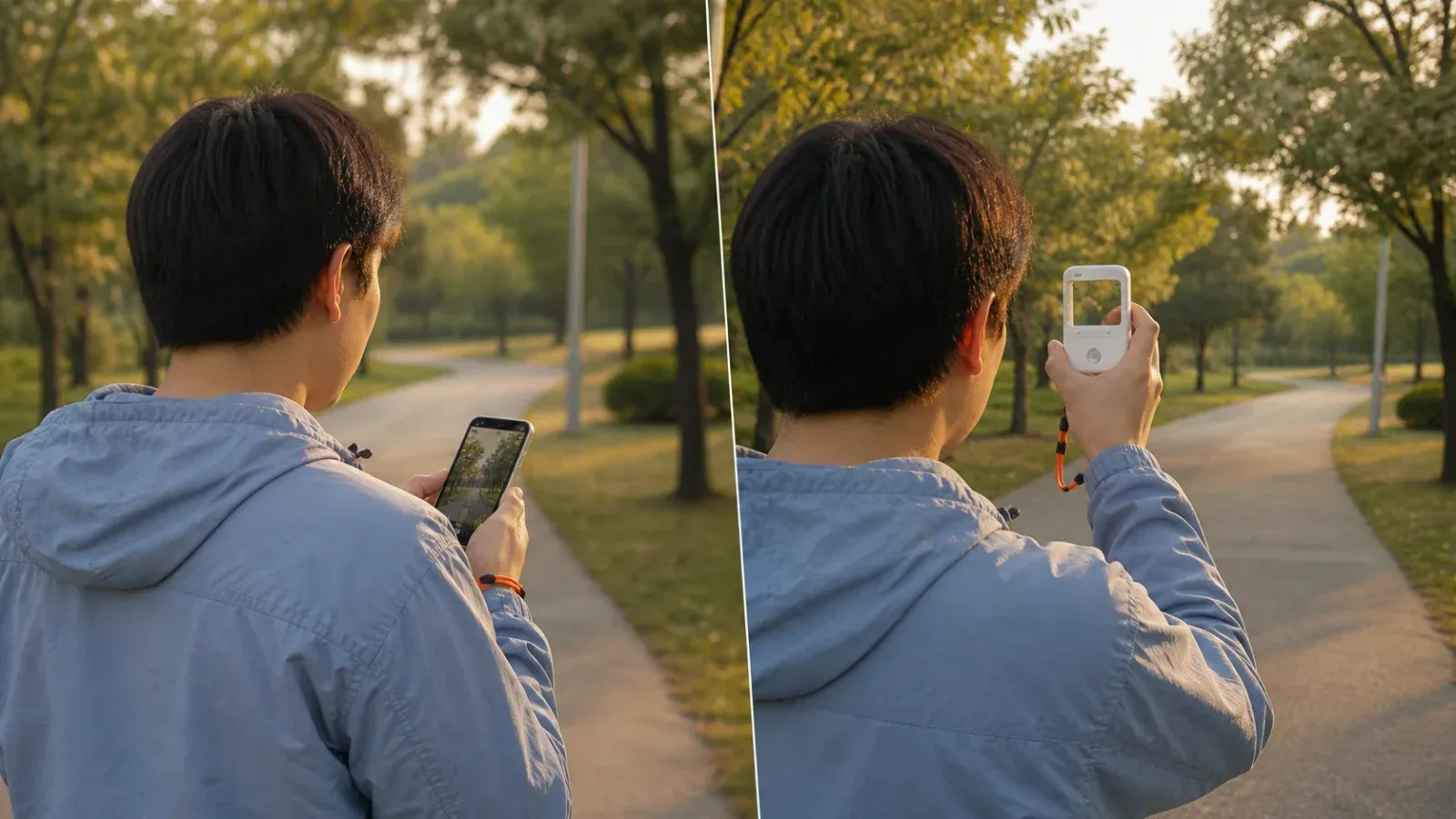
Did I keep looking at the scene? Did I stop reviewing pictures? Did I notice more? Did I take fewer duplicates? Did the uncertainty feel fun, or did it simply become annoying?
That is the fairest test of this camera's main idea. A phone will almost certainly win on convenience and may win easily on image quality. The C100 only needs to make the act of taking pictures feel different enough to justify carrying it.
You could try a version of this without buying anything: turn off image review on a camera you already own, give yourself a 20-photo limit and wait until you get home to look. If that feels refreshing, the C100's strange design may make more sense to you.
Who Is This Actually For?
I can see four groups being interested:
- Curious gadget people who enjoy an object simply because it tries something different.
- Parents looking for a simple, low-pressure camera experience, as long as the price, durability and adult-supervision needs make sense.
- Film-camera beginners who could use a pocketable center-weighted meter.
- Anyone who misses taking snapshots without immediately turning each one into a tiny performance review.
I would not buy it expecting a serious compact-camera replacement. I would not assume it is rugged just because it looks simple. And I would not call the meter dependable until someone compares it carefully with known equipment.
But as a small camera that behaves like a window, delays the review habit and moonlights as a film meter? That is a surprisingly coherent collection of odd ideas.
Final Thought
The Godox C100 may be a gimmick.
I also think that might be the point.
The gadget world has no shortage of devices trying to become more powerful, more connected and more screen-heavy. Here is a tiny camera trying to get the screen out of the way just enough for you to look through it.
Maybe the pictures will be great. Maybe they will look like they came from a toy. Maybe the light meter will become the feature owners use most.
I cannot answer any of that without getting one into my hands. For now, I just appreciate that somebody made a camera weird enough to make me curious about taking pictures differently.
Sometimes a cool gadget is worth sharing before it becomes a buying recommendation.