Trust & transparency
Evidence & disclosures
Evidence basis: Researched analysis. The article compares public evidence and does not claim hands-on testing unless a section says otherwise.
Based on Goonzquad’s published video; I did not inspect or fly the aircraft, and its specifications or regulatory status were not independently verified.
Sources checked: Aug 20, 2026
Linked references: 2 explicit sources in the article.
They Bought a Full-Size Temu Mega Drone. Of Course They Flew It.
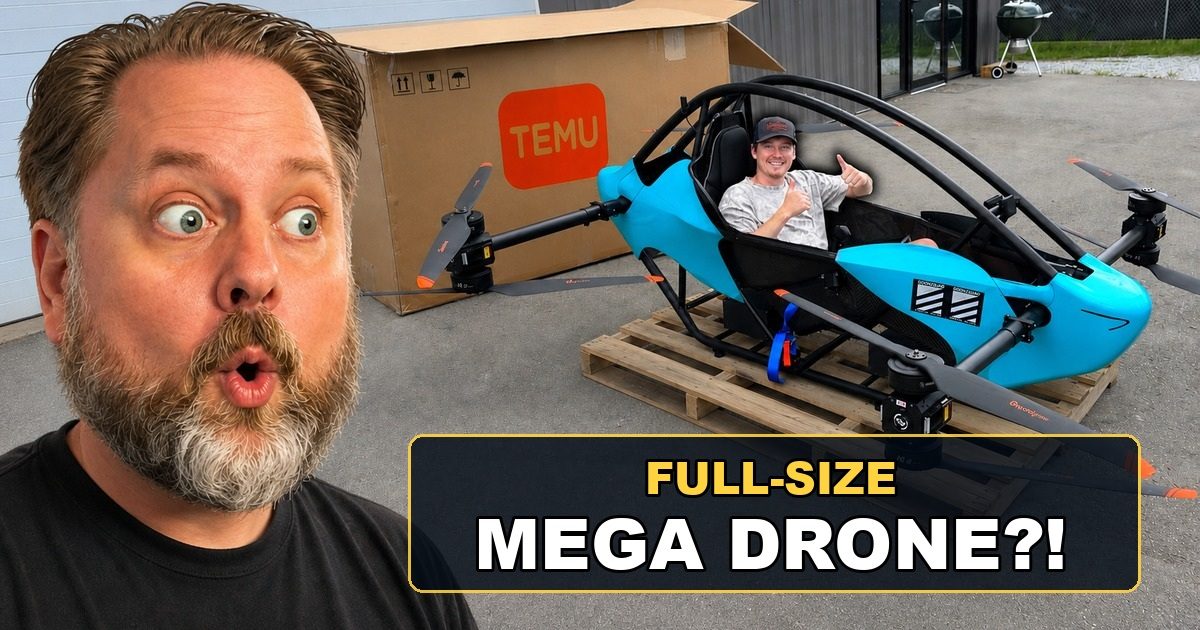
There are normal online purchases, questionable online purchases, and then there is ordering a human-carrying aircraft from Temu.
The guys at Goonzquad apparently looked at the giant orange shopping app—the place most of us visit when we need twelve oddly specific cable clips for $3.47—and said, “Yes, but can it sell us aviation?”
The answer, disturbingly, was yes.
Their video, We Bought Temu’s Craziest Product!!!, follows them unboxing, assembling, configuring, and eventually flying a full-size single-seat multicopter. Calling it a “drone” feels technically correct in the same way calling a monster truck “a vehicle” is technically correct. This thing has a seat, a harness, eight motors, giant carbon-fiber propellers, and enough confidence to make good judgment leave the room.
Naturally, I watched the whole thing.
TLDR
- Goonzquad bought a full-size, human-carrying mega drone through Temu.
- It arrived in multiple crates with a damaged propeller tip, some rust, translated controls, and absolutely no shortage of warning signs.
- They tested it remotely, then put a roughly 180-pound person in the seat and lifted him off the ground.
- The machine actually flew, which somehow made the situation more—not less—unbelievable.
- This may be a glimpse of the future, but apparently the future ships in several boxes and needs help from ChatGPT.
This Is Not the Temu Drone I Had in Mind
When somebody says “Temu drone,” I picture a $19 plastic quadcopter that promises 8K video, obstacle avoidance, GPS, facial recognition, weather control, and emotional support.
What arrives is usually a humming potato with four propellers and a camera apparently borrowed from a 2007 flip phone.
That is not what Goonzquad bought.
They bought what is basically a personal flying platform: a carbon-fiber frame, a real seat, a joystick, batteries heavy enough to make everyone question the laws of physics, and two motors at each corner. The machine looks like somebody crossed a lawn chair with an industrial ceiling fan and then gave it venture capital.
The closest comparison they mention is the Jetson ONE, except their machine came through Temu for a fraction of the price. They do not give a clear final purchase total in the video, which may be for the best. Some numbers are safer when they remain between you, your bank, and the person shipping aircraft parts across the Pacific.
The Warning Signs Arrived First
The unboxing is where a sensible person might have quietly reconsidered the entire project.
One propeller arrived with visible damage near the tip—the part moving fastest when the machine is running. There was a little rust. Some hardware arrived loose in packaging that did not exactly whisper “certified aerospace logistics.” The charger was delayed in customs. The supplier promised to send a replacement propeller.
In other words, the usual experience of assembling discount patio furniture, except the patio furniture wants to carry you into the sky.
To their credit, the guys did notice the damaged part, contacted the supplier, and discussed whether it was safe to use. They also planned to keep the first tests low and use the remote control before anyone climbed aboard.
To their other kind of credit, they still kept assembling it because otherwise there would not be a video.
The Setup Process Was Reassuring in All the Wrong Ways
The controller booted into an interface they had to translate. The supplier was on the other side of a major time-zone difference. At one point, they said the supplier had warned them that an incorrect configuration could make the drone go up and not come back down.
That is a sentence I prefer not to hear while configuring anything with a seat.
Later, they used ChatGPT to help identify some of the controller buttons.
I use ChatGPT constantly. I think it is incredibly useful. I use it to write, code, research ideas, organize projects, and occasionally figure out why software has decided to ruin my afternoon.
But if the machine in front of me has eight giant propellers and the button labels are a mystery, I would like at least one person in the conversation to be wearing a shirt with the word “ENGINEER” embroidered on it.
Instead, the process had the unmistakable energy of three guys assembling the future while the future’s customer-support representative was asleep in another country.
Then the Mega Drone Actually Flew
This is the part where the sarcasm has to pause for a second.
They moved the machine to an open farm, powered it up, tested the motors individually, and flew it with the remote. It lifted, hovered, responded to control, and landed. It was surprisingly quiet. It looked stable. It did not immediately transform itself into a very expensive pile of carbon fiber.
Then somebody got in.
They buckled a roughly 180-pound person into the seat, kept the flight low, and lifted him off the ground under remote control. Not in a product demo. Not in a glossy manufacturer video. On a farm, after an unboxing that included damaged parts, translation software, and the phrase “guinea pig.”
And it worked.
The passenger described it as peaceful. The pilot’s hands were shaking. Everyone immediately started talking about taking turns and flying around together, because the human brain has a fascinating ability to convert “that could have gone terribly” into “I call next.”
This Is Probably the Future, Which Is Slightly Concerning
As ridiculous as the video is, there is something genuinely exciting underneath it.
Personal electric aircraft are moving out of science-fiction artwork and into the awkward early-adopter phase. The machines are getting simpler to control. Electric motors make multicopter layouts possible. Software can handle stabilization that would be impossible for an untrained person to manage manually.
The future may not arrive as a polished flying car with leather seats and a cup holder. It may arrive in several crates, with one missing charger, a translated controller, and a group chat with a supplier named “my dear friend.”
That is how technology often works. The first version is too expensive, too strange, too risky, or too inconvenient. Then somebody builds a cheaper version. Somebody else posts a video. The idea stops looking impossible. Ten years later, we all pretend it was obvious.
I am not saying everyone will commute to work in a giant personal drone next year. I am saying the distance between “wild internet video” and “actual transportation category” suddenly looks a lot shorter than it did.
Would I Fly It?
Absolutely.
After a trained professional inspected it. After the damaged propeller was replaced. After every bolt, motor, battery, controller setting, emergency procedure, operating rule, and weather condition had been checked. After a long remote-testing program. After locating a helmet, a parachute, an aircraft mechanic, three lawyers, and possibly a priest.
So, basically: yes, but not five minutes after opening the box.
This video is entertainment, not an instruction manual. A machine capable of lifting a person deserves more than enthusiasm and a translated menu. The fact that something can take off does not automatically mean it is ready to become your new weekend hobby.
Still, I understand why they did it.
There is a special kind of curiosity that looks at a human-sized drone and needs to know whether it works. That curiosity has built airplanes, rockets, race cars, computers, and a large percentage of the projects that begin with the words, “This is probably a terrible idea, but…”
The Final Verdict
Are these guys crazy?
Yes.
Was buying a full-size Temu mega drone an objectively questionable decision?
Also yes.
Did I enjoy every minute of watching them discover that their internet-purchased flying chair could actually lift a human being?
Unfortunately, yes.
The video ends just as one of the tests produces a fresh round of “oh no” and the wonderfully concise verdict, “we’re cooked.” That is both a cliffhanger and possibly the most accurate product review ever delivered.
This may really be what the future looks like: electric, autonomous, surprisingly accessible, and assembled by people who are far more comfortable with risk than I am.
I just assumed the future would come with better instructions.
Watch the Mega Drone Test
Watch Goonzquad’s full video on YouTube, or jump to the moment-of-truth setup around 14:21.
Please enjoy it from the same safe location I did: sitting down, on the ground, with no Temu aircraft in my shopping cart.