Trust & transparency
Evidence & disclosures
Evidence basis: First-person field notes. The article is based on Colin's own project, flight, recovery experience, media, or documented workflow.
A personal creative-technology essay shaped by my own use of current AI tools; it is opinion, not a comparative benchmark or forecast.
Sources checked: Aug 20, 2026
Linked references: 7 explicit sources in the article.
There was a time when having an idea was only the beginning of a much longer problem.
You could imagine an app, a song, a video, a game, a website, a graphic, a story, or some weird little automation that would make your life easier. But then reality would tap you on the shoulder and ask the annoying questions.
- Do you know how to code that?
- Do you know how to design it?
- Do you know how to edit the video?
- Do you know how to write the copy?
- Do you know how to make the image?
Do you have the time, energy, budget, software, patience, and emotional stability to get through the whole thing without questioning every life choice that led you here?
For most of us, the answer was usually some version of, "Kind of, but not enough to actually finish it."
That has changed.
The Starting Line Moved
AI did not magically remove the need for skill, taste, effort, or good judgment. I think that part gets exaggerated.
But it absolutely moved the starting line.
Now, if you have an idea, you can do something with it almost immediately. You can sketch the concept, write the first draft, generate a visual direction, build a prototype, create the music bed, edit the structure, write the code, test a workflow, or turn a messy voice note into something usable.
That is a big deal.
The barrier is no longer, "Can I even begin?"
A lot of the time, the barrier is now, "What do I actually want to make?"
Which is exciting.
And slightly terrifying.
Anything, Within Reason
I keep coming back to this idea that we now have tools at our fingertips to create basically anything, within reason.
That last part matters.
AI is not a magic wand. It will not make every idea good. It will not care more than you care. It will not automatically know your taste, your standards, your humor, your story, or the weird little detail that makes something feel alive.
But it can help you get moving.
That is where the magic is for me.
Not in replacing the person, but in reducing the friction between the idea and the first real version of it.
- A half-formed thought can become an outline.
- An outline can become a blog post.
- A blog post can become a video script.
- A video script can become a voiceover.
- A voiceover can become a short film.
- A short film can become part of a bigger project.
Suddenly the gap between "I wonder if I could make that" and "here is version one" is a lot smaller.
Imagination Is the New Bottleneck
For a long time, tools were the bottleneck.
Now imagination is.
That does not mean everyone needs to create some giant masterpiece. Sometimes the best use of AI is making one annoying task less annoying. Sometimes it is building a tiny tool for yourself. Sometimes it is turning a personal story into a post that might help one other person feel less alone.
That counts.
Not every idea has to become a startup, brand, product, channel, or "content strategy." Some ideas can just be made because making them feels good.
That is one of the healthier parts of all this, at least when I remember it.
AI gives you permission to play again. To try something before you are sure it is worth trying. To make a rough version without needing the entire plan figured out first.
And honestly, that is where a lot of good stuff starts.
The Tool Still Needs a Human
The catch is that more tools do not automatically mean better work.
You still have to choose.
You still have to edit.
You still have to say, "No, that does not sound like me."
You still have to notice when something is technically impressive but emotionally empty.
That might be the most important part. AI can produce a lot of output, but output is not the same thing as meaning.
The human part is deciding what matters.
The human part is knowing when the first answer is too clean, too generic, too polished, or too far away from the actual point.
The human part is bringing the taste, the memory, the experience, the frustration, the humor, and the reason the thing should exist at all.
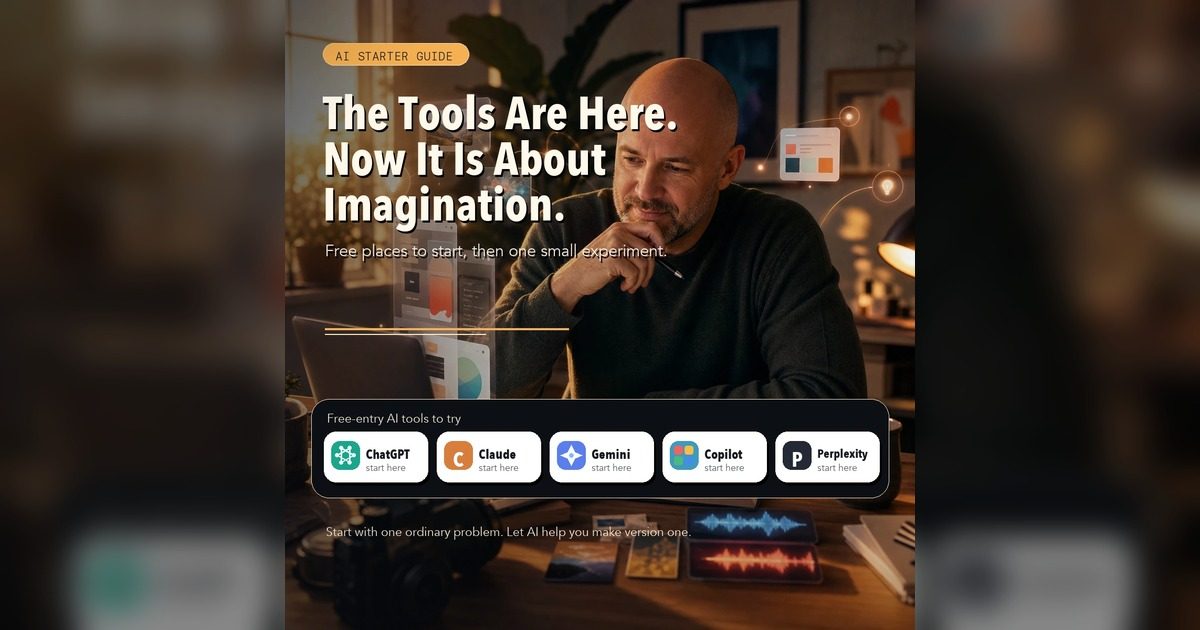
Where To Get Started With AI
If you are reading this and thinking, "This sounds interesting, but I have no idea where I would even use AI," I would start smaller than you think.
Do not start by trying to become an AI expert. Start by bringing AI one ordinary problem you already have.
As of July 2026, these are solid free places to start. The free limits change, and the paid plans will always try to wave from across the room, but you do not need to pay money just to begin.
- ChatGPT - https://chatgpt.com/ - probably the easiest all-purpose first stop. Good for brainstorming, drafting, explaining confusing topics, working with files, creating images, and asking follow-up questions. The free plan is useful, but limited.
- Claude - https://claude.ai/ - very good for writing, editing, long explanations, code, data, and thoughtful back-and-forth. Claude has a free plan, with higher usage and some advanced features behind paid plans.
- Google Gemini - https://gemini.google.com/ - a strong place to start if you already live in Google, Android, Gmail, Docs, or YouTube. Without a paid Google AI plan, Gemini still gives access to Gemini models with standard usage limits.
- Microsoft Copilot - https://copilot.microsoft.com/ - useful if you are already in Windows, Edge, Bing, or Microsoft 365. Good for quick web research, explanations, image ideas, and everyday questions. Copilot has a free baseline experience, with higher limits in paid Microsoft plans.
- Perplexity - https://www.perplexity.ai/ - a helpful option when you want an answer with visible source links. I would use it for research starts, comparison shopping, and "show me where this came from" questions.
- HuggingChat - https://huggingface.co/chat/ - a good playground if you want to try open-source AI models and see that there is more than one flavor of assistant out there.
- Google AI Studio - https://aistudio.google.com/ - the better next step if you are curious about building with AI instead of only chatting with it. It has a free Gemini API tier for developers and small experiments.
I would not sign up for everything at once. Pick one general assistant, maybe ChatGPT or Claude, and one search-style assistant, like Copilot or Perplexity. Use them for a week. See which one feels natural.
A few simple things to try first:
- Ask it to explain something confusing in plain English, then ask for an example from your real life.
- Paste in messy notes, a rough email, or a voice memo transcript and ask for a clean outline.
- Ask for ten ideas for a project, meal plan, trip, budget, workout, caption, gift, or weekend plan.
- Give it a draft before you send it and ask, "What sounds unclear, too harsh, too vague, or too generic?"
- Take a photo of something non-sensitive and ask what it notices, what could be improved, or how to fix it.
- Ask it to make a one-week learning plan for something you have always wanted to understand.
- Have it help you build a tiny prototype: a spreadsheet formula, simple website, automation, checklist, or app idea.
The trick is not to ask, "What can AI do?" That question is too big. Ask, "What is one thing in my life that feels stuck, boring, confusing, repetitive, or slightly out of reach?"
Then give it context. Tell it who you are, what you are trying to do, what you have already tried, what tone you want, and what a good answer would look like. The better the conversation, the better the result.
Also, keep your hands on the wheel. Do not paste private medical, financial, legal, or work information into a tool unless you understand where that data goes. Check anything important. Treat AI like a very useful first draft machine, not a final authority.
A simple first prompt could be:
I am new to AI. Help me find three practical ways I could use it this week based on my life. Ask me five questions first, then suggest simple starting points.
That is enough to begin. Not with a grand transformation, not with a master plan, but with one small experiment. One useful conversation. One version one.
Final Thought
I do not think the future belongs only to the people who know every tool.
The tools are going to keep changing. Fast.
I think the future belongs to people who stay curious enough to experiment, honest enough to revise, and imaginative enough to ask, "What could this become?"
Because now, more than ever, the answer might be:
A lot more than you thought.