Trust & transparency
Evidence & disclosures
Evidence basis: Researched analysis. The article compares public evidence and does not claim hands-on testing unless a section says otherwise.
This is a researched first look and personal buying reflection, not a hands-on product review. I have not bought, borrowed, auditioned, or tested the SL-1500CS. Product specifications, pricing, and historical milestones were checked against Technics product, launch, and heritage pages. Independent listening findings are attributed to Sound Advice, while DJ and hip-hop history was cross-checked with the Recording Academy and Smithsonian. Manufacturer performance claims remain attributed, and the $1,799.99 U.S. price is an August 20, 2026 snapshot that may change.
Sources checked: Aug 20, 2026
Linked references: 7 explicit sources in the article.
Relationship disclosure: No sponsorship, affiliate relationship, free product, product loan, dealer arrangement, or manufacturer relationship was involved. I have not purchased the SL-1500CS and received no compensation for covering it. The article expresses my genuine interest in possibly buying one. Its links are editorial source links, not affiliate links.
AI assistance: AI tools materially assisted with research organization, source comparison, drafting, editing, metadata, Editor.js packaging, visual planning, and explanatory graphics. I supplied the editorial direction, personal viewpoint, buying interest, and cultural-credit boundaries, then reviewed and approved the article. AI assistance did not include hands-on product testing, listening impressions, or independent audio measurements.
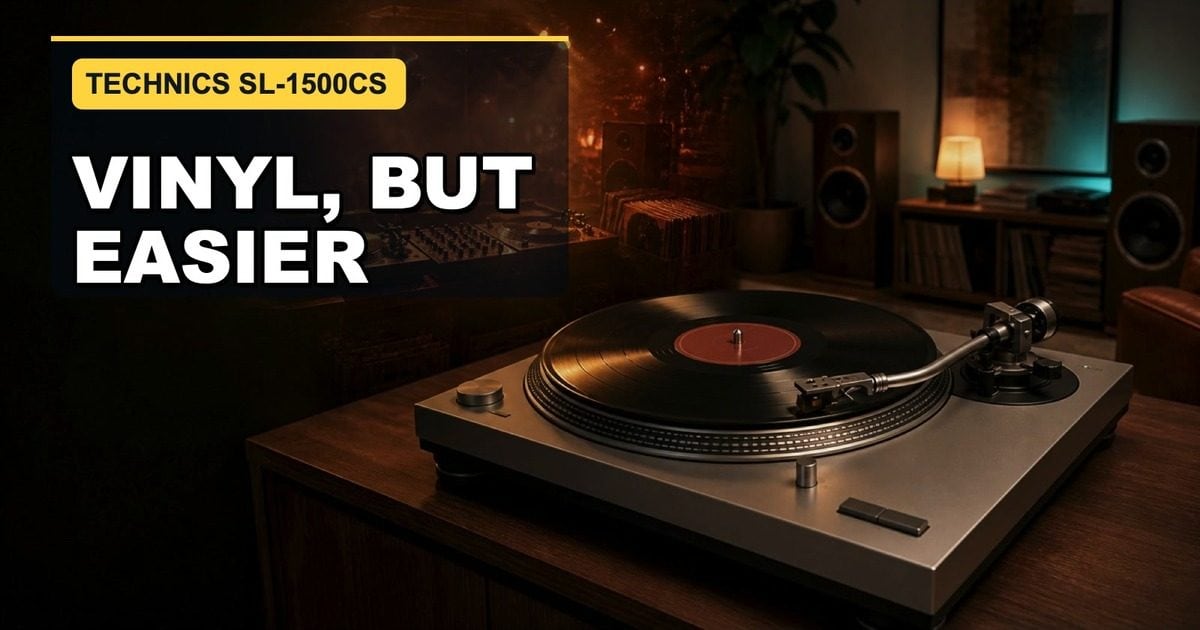
Synthetic media: The cover, editorial background, Open Graph image, and explanatory diagrams are AI-assisted editorial illustrations. They should not be treated as documentary product photography or evidence of a tested setup. The five historical turntable photographs are authentic images from the official Technics/Panasonic U.S. heritage archive, converted to WebP and visibly credited; they were not AI-generated.
Latest substantive update: August 20, 2026 — Removed the “years since 1970” bar chart because it did not meaningfully explain the history. Added five official Technics/Panasonic heritage photographs of the SP-10, SL-1100, original SL-1200, SL-1200MK2, and SL-1200MK3 with dated captions, alt text, and source credits. No hands-on product-test claim was added.
There are product names that sound like model numbers, and then there are product names that carry an entire room with them.
TECHNICS IS ONE OF THOSE NAMES.
Say “Technics turntable” and I do not picture a quiet shelf in a perfectly staged listening room. I picture two decks, a mixer, a record being held in place, another one moving underneath it, and a DJ turning music that already existed into something new.
That history is a big reason the new Technics SL-1500CS caught my attention. It looks connected to the machines that helped define DJ culture, but it is not really trying to turn my living room into a club booth. It is a serious home turntable with several of the annoying beginner decisions already handled.
And yes, I am interested in buying one.
I have not bought or tested the SL-1500CS, so this is not a hands-on review wearing a vintage record-store T-shirt. It is a researched first look, a little Technics history, and an honest attempt to decide whether this is useful nostalgia or a very expensive way to watch a platter spin.
TLDR
- Technics introduced the SL-1500CS on February 23, 2026 as an updated home-listening model with its newer Delta Sigma motor-control technology.
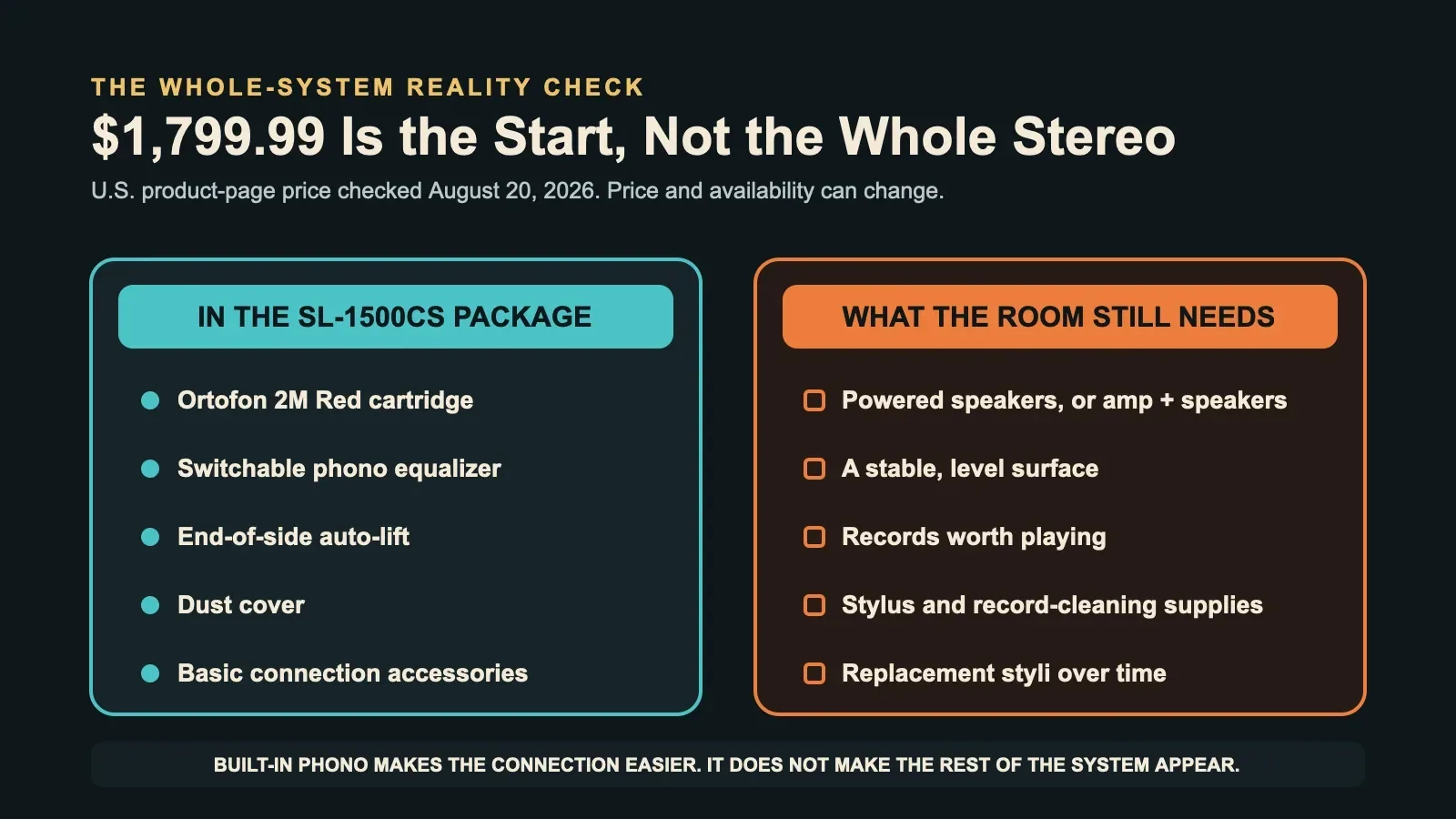
- The U.S. product page listed it at $1,799.99 when I checked on August 20, 2026. Prices and availability can change.
- It includes an Ortofon 2M Red cartridge, a built-in phono equalizer, a dust cover, and an auto-lift feature at the end of a record.
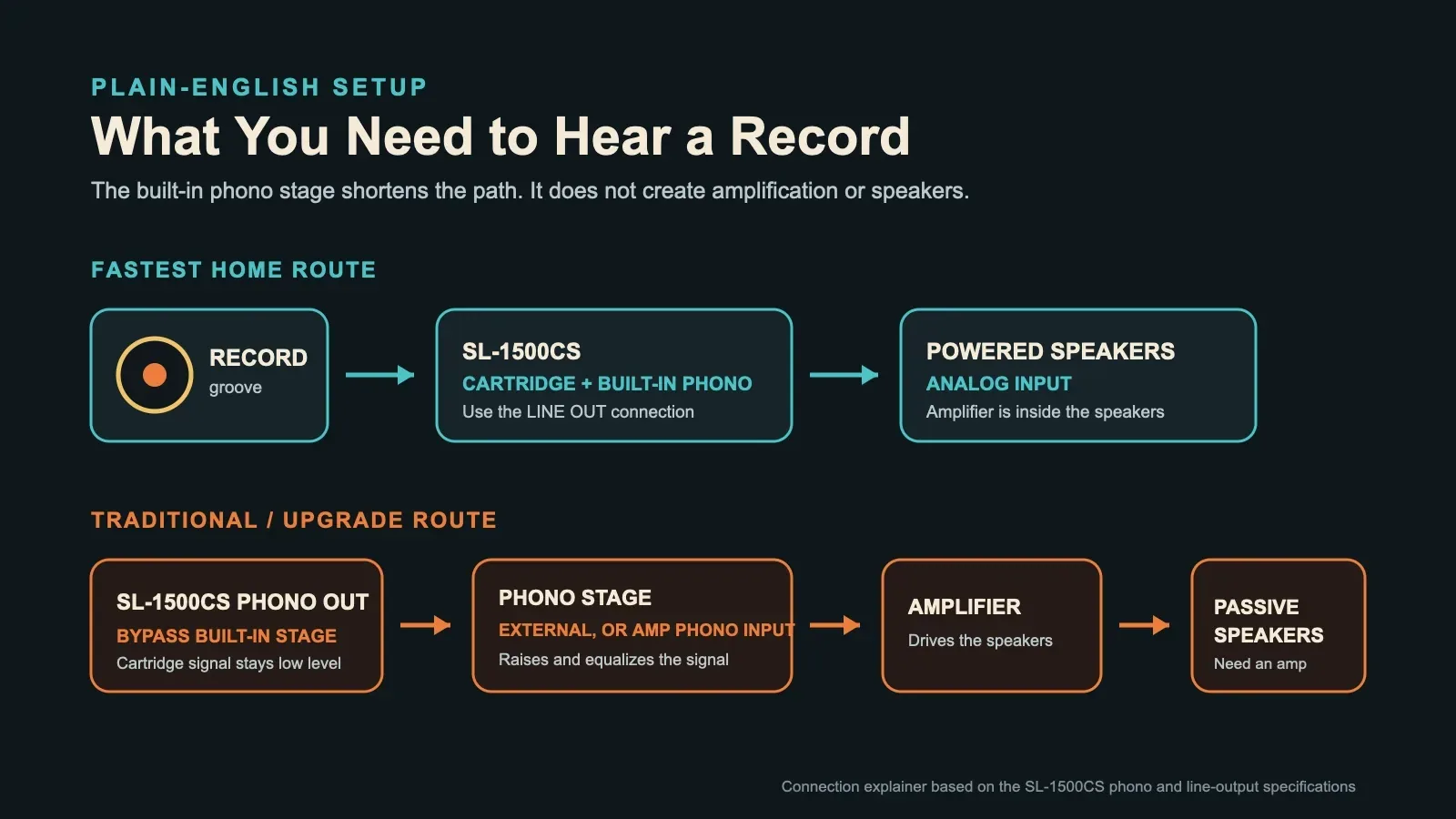
- It still needs an amplifier and passive speakers, or a pair of powered speakers with an analog input. The built-in phono stage is not a built-in speaker system.
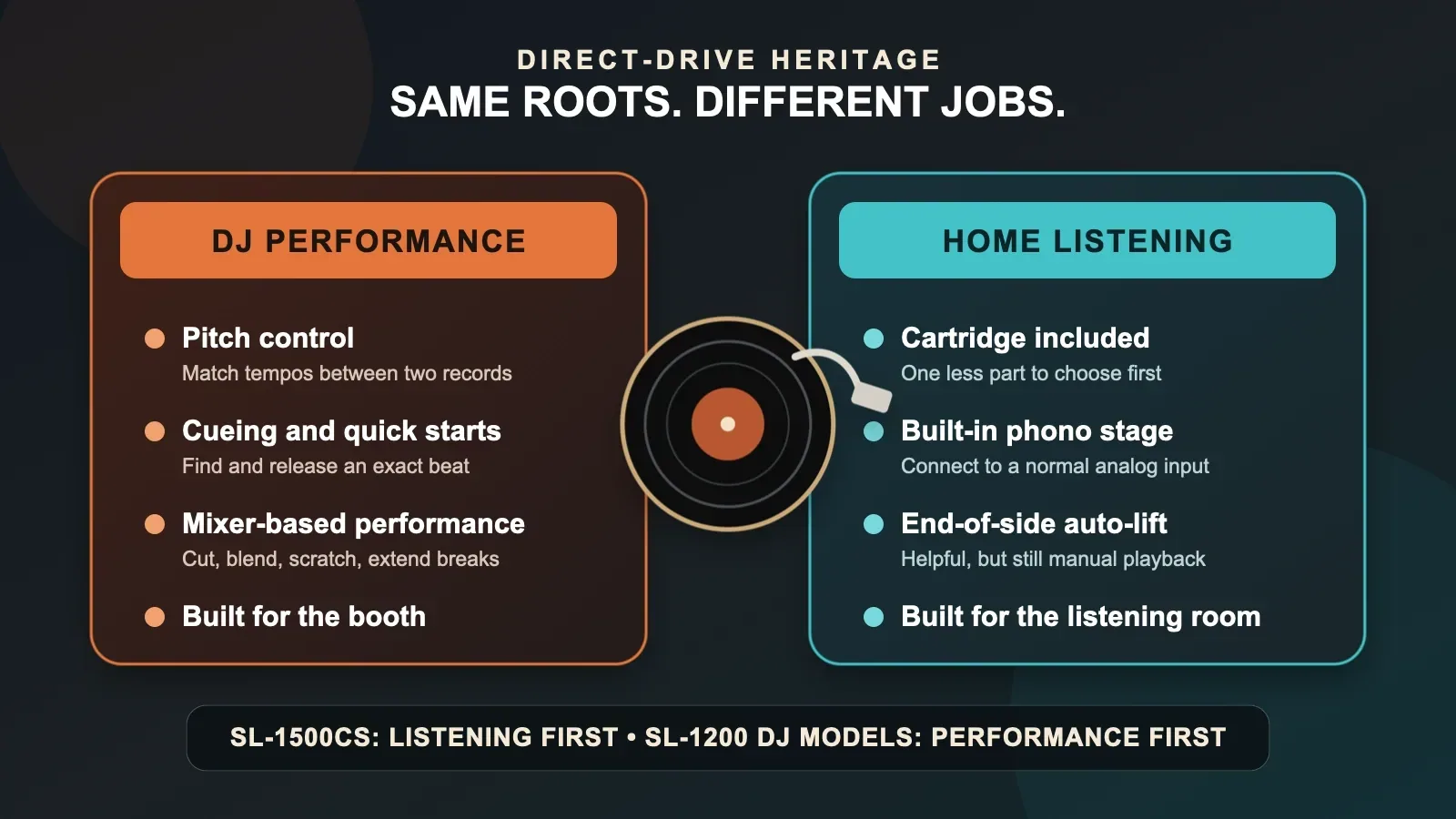
- This is not the Technics model I would buy for beatmatching or scratching. It leaves out the pitch control and other DJ-focused features of the SL-1200 family.
- My buying rule would be simple: prove that I will play records every week, price the whole listening setup, and audition the turntable before spending nearly $1,800.
Why Technics Still Feels Different
Plenty of companies make excellent turntables. Technics has something else attached to the name: cultural memory.
The important part of that story is not that a corporation invented hip-hop, disco, house, techno, scratching, or turntablism. It did not. DJs and music communities created those forms by experimenting with records, mixers, sound systems, dance floors, and whatever equipment they could put to work.
Technics made tools that happened to be unusually good at surviving—and supporting—that experimentation.
That distinction matters. The machine deserves respect. The artists deserve the credit.
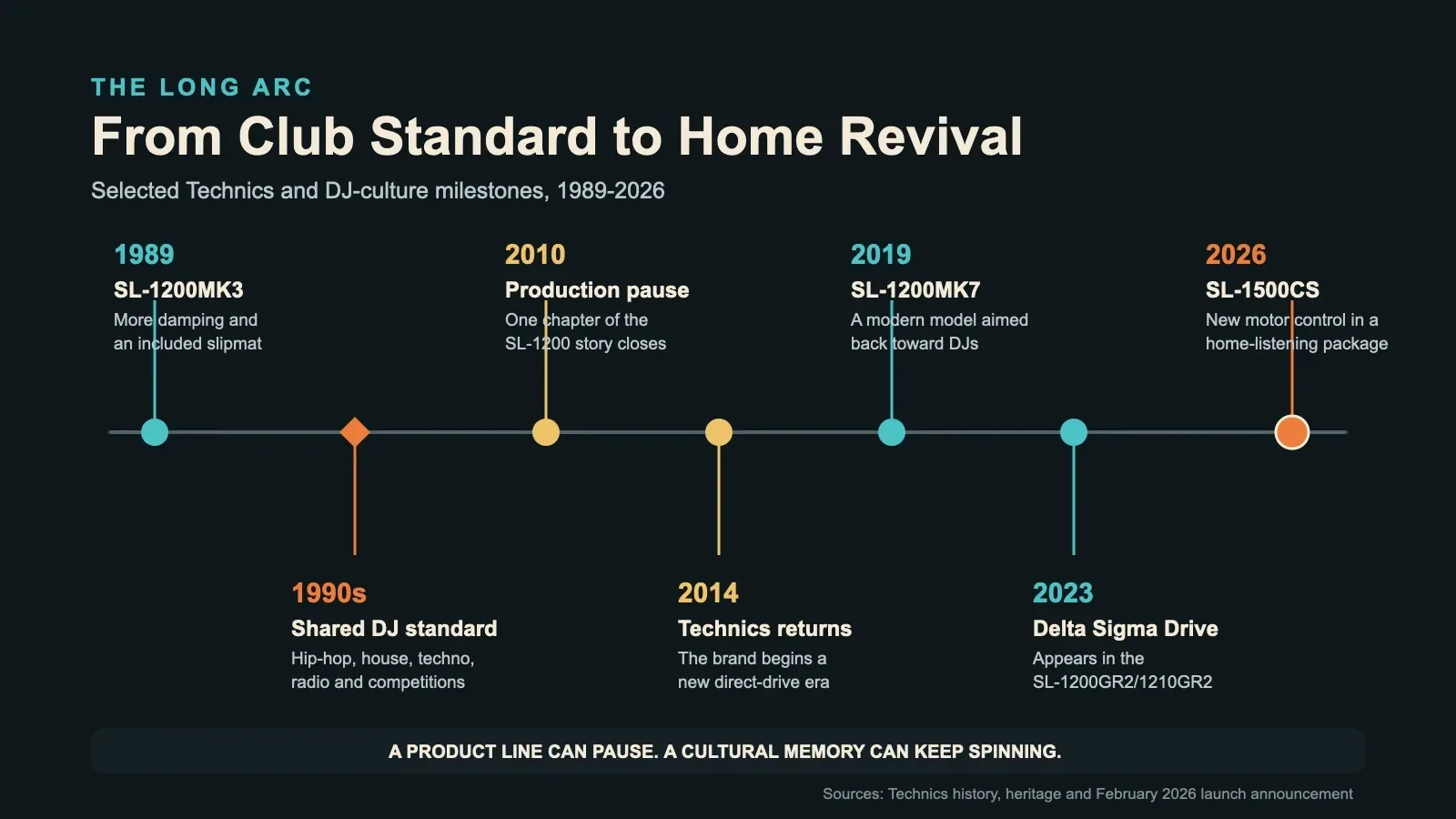
Selected milestones from Technics history and heritage sources; these dates do not reduce DJ culture to a product timeline.
Before the SL-1200 Became an Icon
Technics introduced the SP-10 in 1970, which the company describes as the first direct-drive turntable. Instead of using a belt to connect a motor to the platter, a direct-drive design turns the platter from the motor itself.
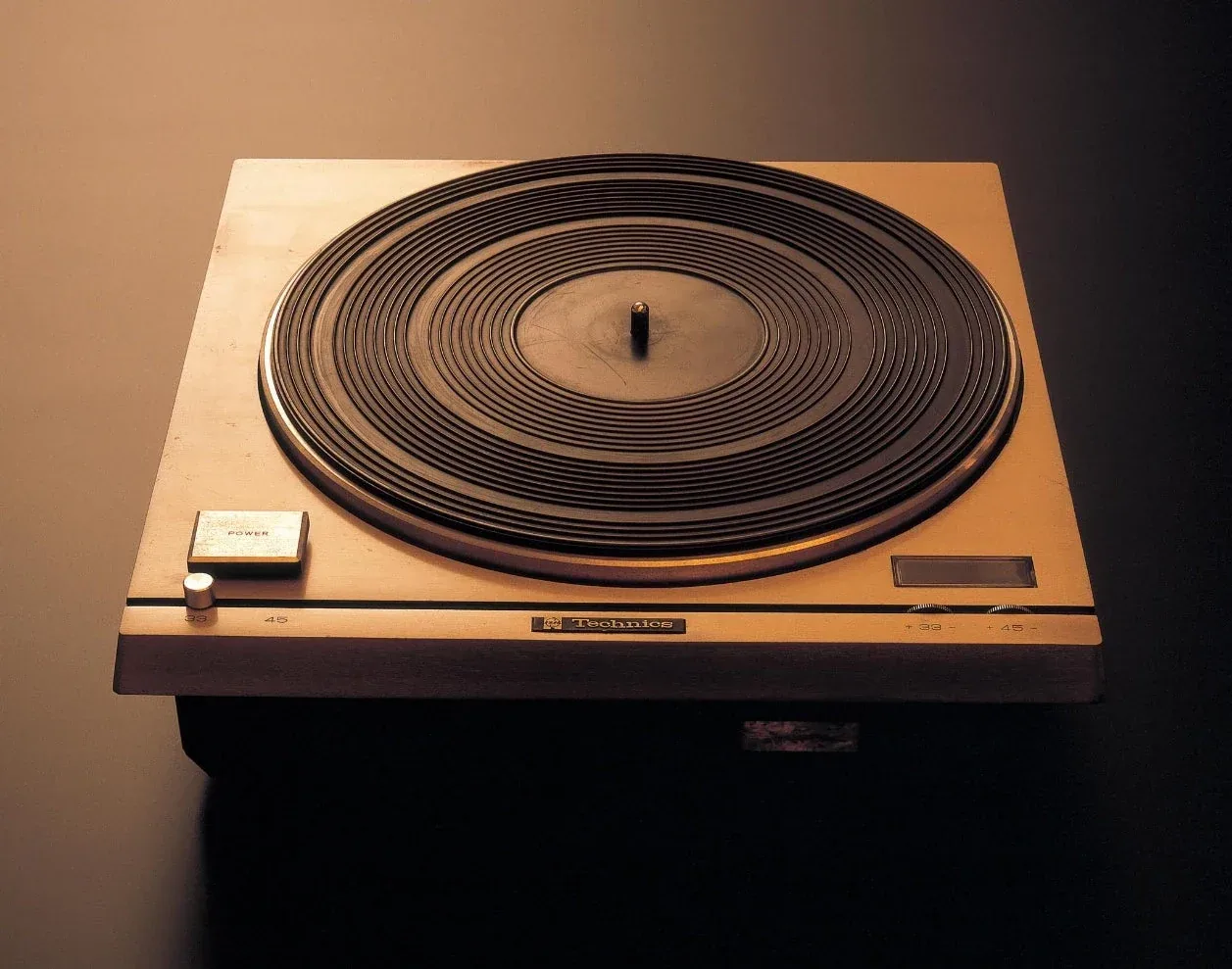
For a regular listener, the plain-English benefit is stable speed and quick response. For a DJ, those qualities became creative tools. A platter that reaches speed quickly and resists slowing down is much easier to cue, stop, release, and match with another record.
The SL-1100 followed in 1971. According to Technics’ history of the SL-1200 family, DJ Kool Herc used an SL-1100 at the famous 1973 Bronx party often associated with the beginning of hip-hop culture.
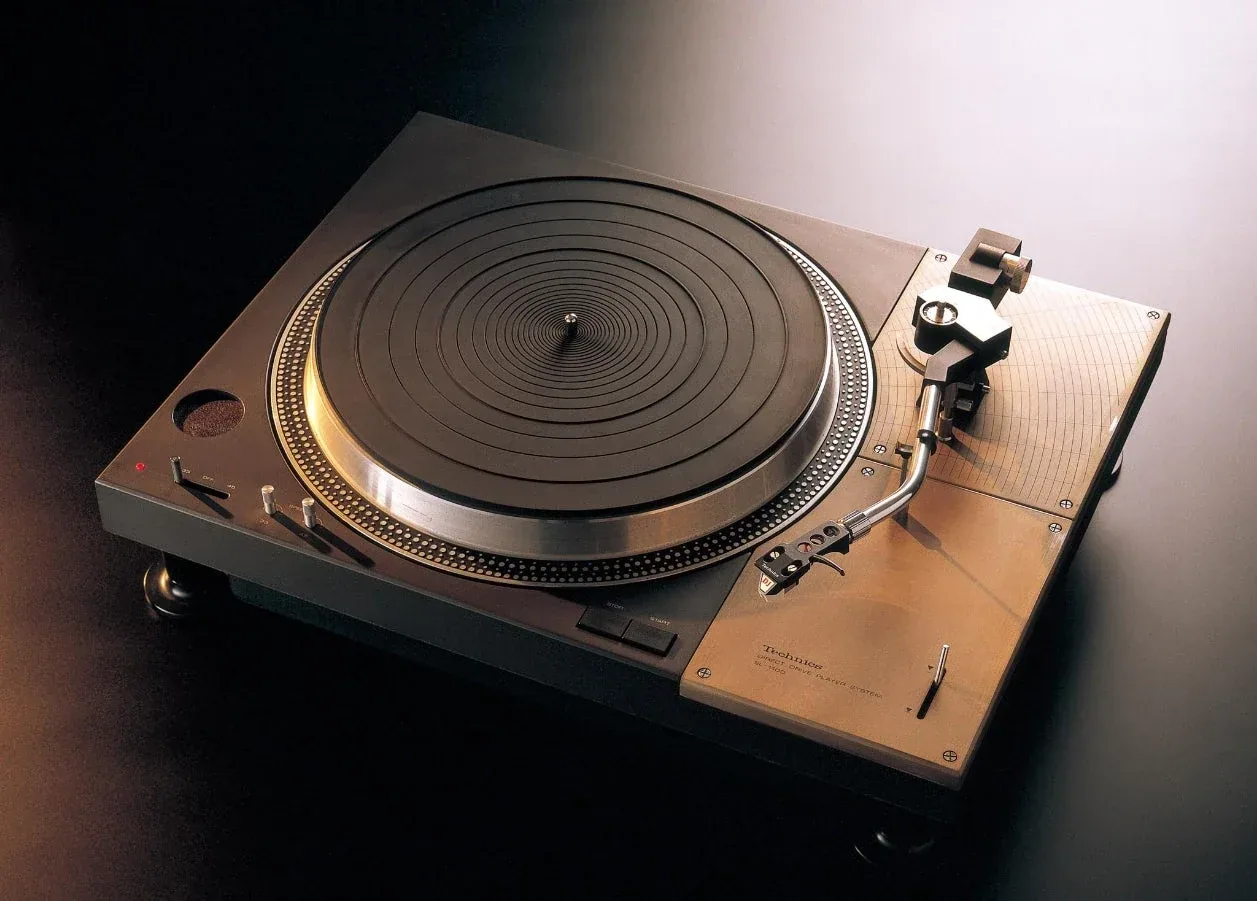
The broader story is bigger than one machine. In a detailed Recording Academy interview with Kool Herc and Cindy Campbell, Herc explains how he used two copies of the same record and moved between their instrumental breaks. His “merry-go-round” technique kept the break going for dancers and helped establish a new way of treating recorded music.
The record was no longer only a finished product to play from beginning to end. In a DJ’s hands, it became raw material.
1972: The SL-1200 Arrives
The original SL-1200 arrived in 1972. Technics says its strong torque, stable rotation, rugged cabinet, and vibration resistance happened to line up with what disco and club DJs needed. A pitch adjustment intended for speed correction was repurposed by DJs to control tempo and help match beats.
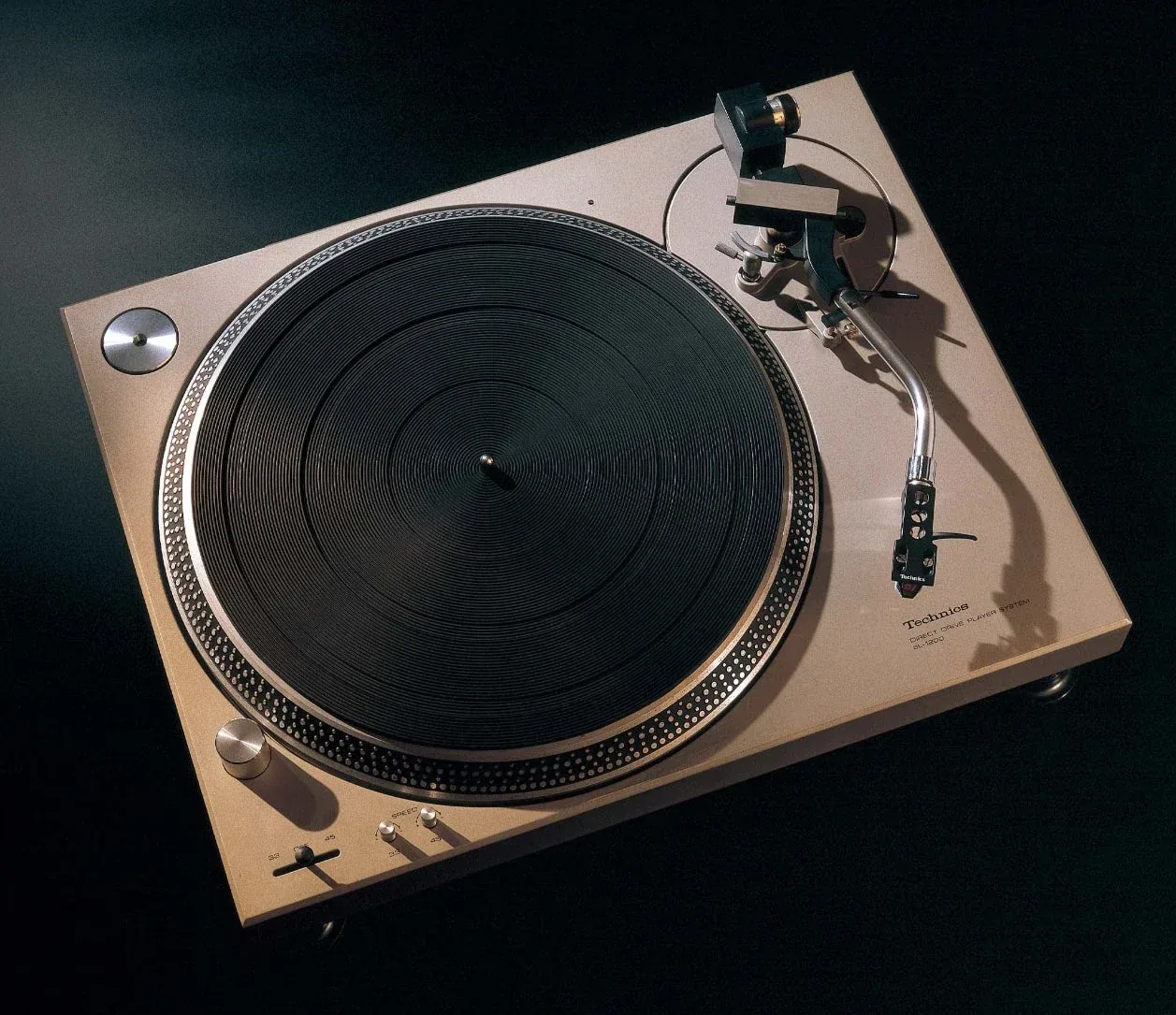
That is one of my favorite parts of technology history: the users discover what the machine is really for.
When two records are playing at slightly different tempos, a DJ can adjust one deck’s pitch until the beats line up. Done well, the transition feels continuous instead of sounding like two songs falling down the stairs together.
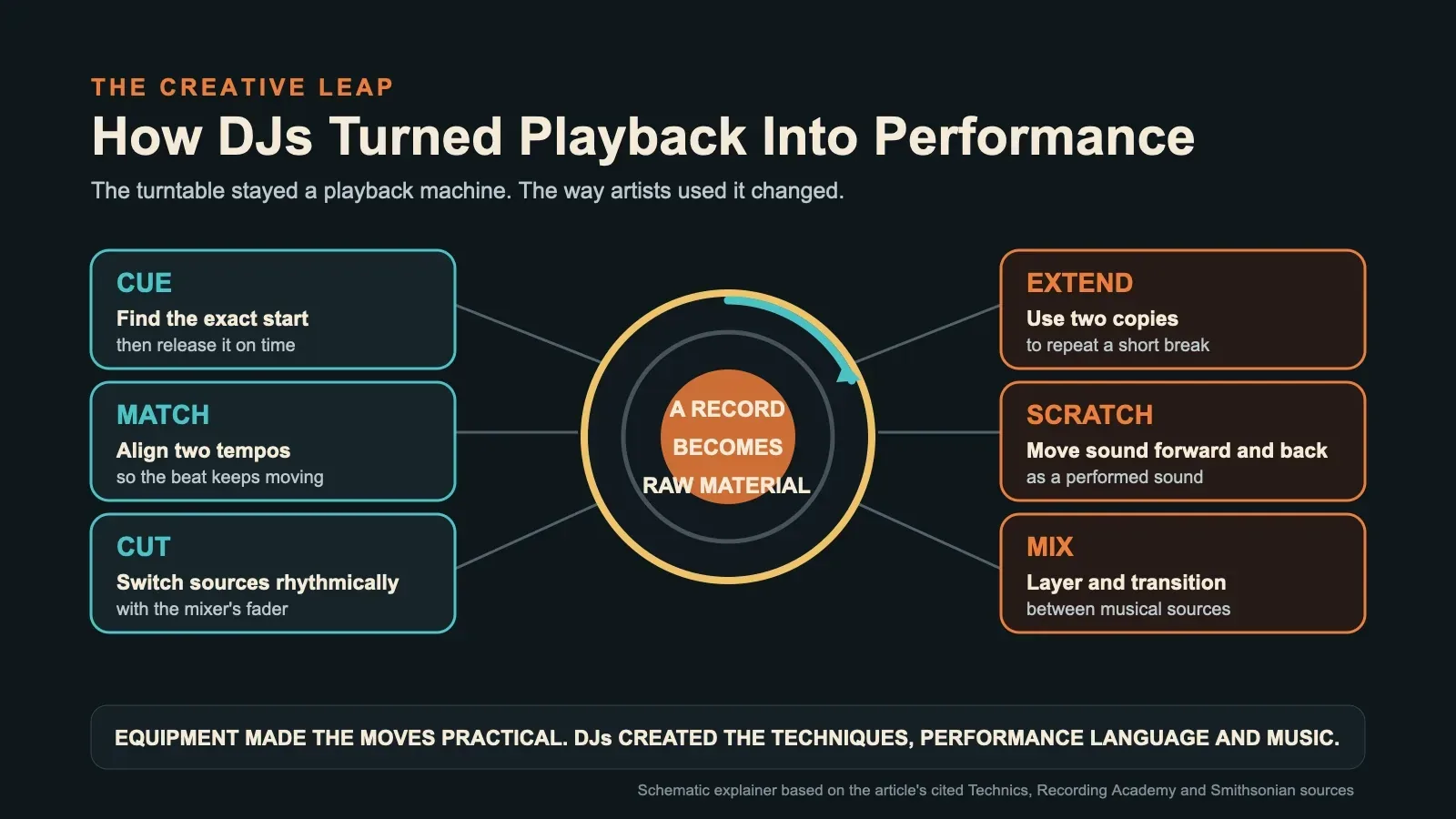
The same basic relationship made several now-familiar techniques more practical:
- Cueing: finding the exact point where a sound, beat, or song should begin.
- Beatmatching: adjusting tempo so two records can play together smoothly.
- Back-cueing: moving a record backward to return to a chosen starting point.
- Cutting: using a mixer to switch rhythmically between sources.
- Scratching: moving the record forward and backward so the recorded sound becomes a performance sound.
- Break extending: alternating between two copies of a record to keep a short rhythmic section going.
Those techniques were not merely clever party tricks. They changed how music could be performed, arranged, danced to, and eventually produced.
1979: The MK2 Turns a Record Player Into an Instrument
The SL-1200MK2 arrived in 1979 after Technics staff studied how DJs were using the original model. The company added more accurate quartz-controlled speed, a vertical pitch fader, improved vibration resistance, and controls that made more sense in a dark, loud club.
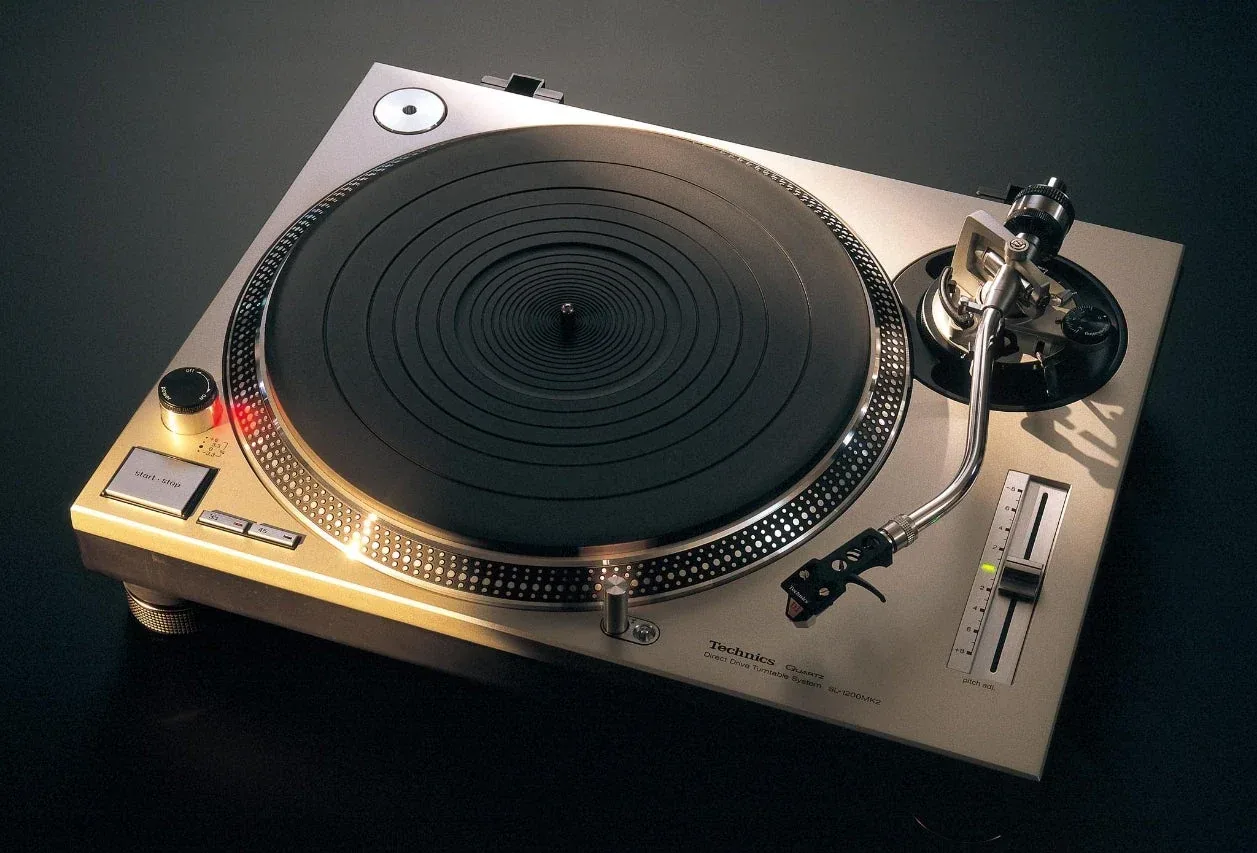
Technics’ heritage timeline describes the MK2 as its first hi-fi turntable designed with disco and club DJs in mind. By the 1980s and 1990s, versions of the SL-1200 became familiar equipment in hip-hop, disco, house, techno, radio, clubs, and DJ competitions.
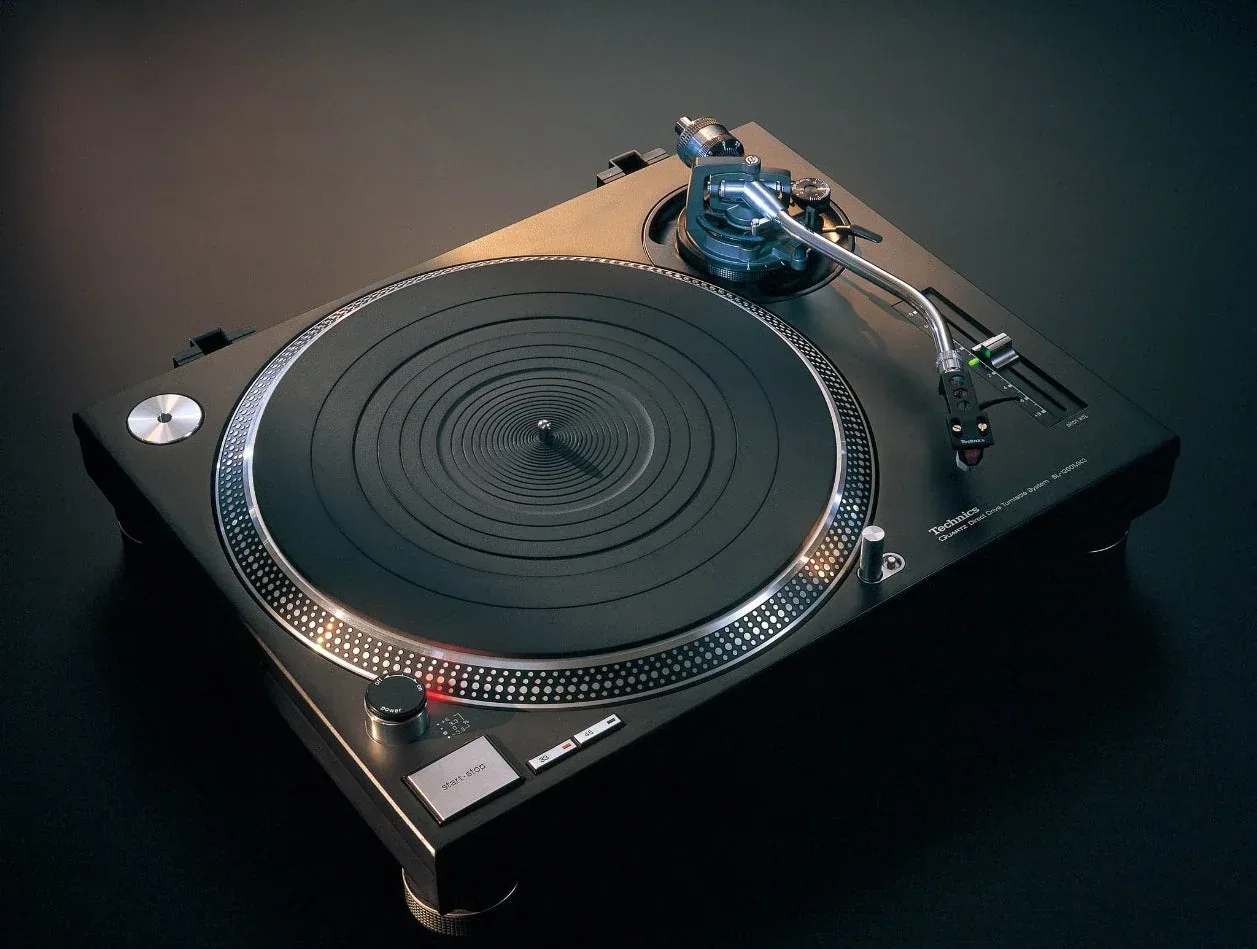
There is even a physical piece of that history in the Smithsonian. The National Museum of American History has an SL-1200MK2 used by Grandmaster Flash. The museum notes that the model began as a high-fidelity record player for consumers, was adopted by radio and club DJs, and became popular with early hip-hop DJs.
That is quite a journey for an appliance whose basic job was “spin this record at the correct speed.”
It also helps explain the nostalgia. A Technics deck is not only a way to replay old music. It is connected to the story of people discovering new music inside old records.
What the SL-1500CS Actually Is
The new SL-1500CS borrows the family resemblance and the direct-drive idea, but it has a different job.
This is a home-listening turntable. It does not have the pitch fader, strobe, or DJ-oriented controls that make an SL-1200MK7 the more obvious performance choice. An independent March 2026 review from Sound Advice describes it as the “domesticated” side of Technics direct drive, with pitch control removed and playback at 33⅓, 45, and 78 rpm.
That is not a downgrade if the goal is to sit down and listen to an album. It is focus.
Technics took the SL-1500C formula and added its Delta Sigma Drive motor control, a technology first used in more expensive models. The company says it smooths the motor’s drive signal, reduces vibration, and improves rotational accuracy. Those are manufacturer claims, not measurements I have independently tested.
Sound Advice’s reviewer reported a meaningful improvement in soundstage and stereo imaging, praised the build quality and bass performance, and liked the internal phono stage. The same review also said the included Ortofon 2M Red is a respectable starting cartridge, while some competing turntables at the price offer more refined cartridges.
That is the kind of review detail I trust more than “best turntable ever.” The machine may be excellent and still have tradeoffs.
Four Features That Make Vinyl Less Complicated
The specifications can become an alphabet soup of PWM, MM, Delta Sigma, and cartridge names. The practical appeal is easier to explain.
1. The Cartridge Is Already Included
The cartridge is the small component that holds the stylus and turns the movement in a record groove into an electrical signal. The SL-1500CS includes an Ortofon 2M Red mounted on the headshell.
That does not eliminate setup. The tonearm still needs to be balanced and the tracking force needs to be set correctly. But it removes the immediate question of which cartridge to buy before the first record can play.
2. The Phono Stage Is Built In
A turntable’s raw signal is much quieter and needs different equalization than a normal line-level source. Traditionally, that job belongs to a phono input on an amplifier or to a separate phono preamp.
The SL-1500CS has a switchable built-in phono equalizer. That means its line output can connect to a normal analog input on powered speakers or an amplifier.
It also has a standard phono output, so someone can bypass the internal circuit and add an external phono stage later. Beginner convenience does not close the upgrade door.
3. The Tonearm Lifts at the End
This is still a manual turntable. I would place the stylus on the record myself.
At the end of the side, however, the auto-lift raises the cartridge out of the run-out groove. That is a small feature until I imagine getting distracted, leaving the room, and making the stylus travel in circles while I answer an email.
It is not full automation. It is just enough help.
4. It Is Built Like a Real Piece of Equipment
The SL-1500CS weighs about 21.9 pounds and uses a two-layer platter, an aluminum chassis combined with a reinforced lower material, vibration-damping feet, and an aluminum S-shaped tonearm.
I would still put it on a stable, level surface away from stomping feet and speaker vibration. Physics remains annoyingly undefeated. But this does not sound like a decorative record player designed to survive one holiday season.
The Expensive Part Is Not Just the Turntable
The current U.S. price is the point where the nostalgic glow needs to step away from the calculator.
When I checked Technics’ U.S. page on August 20, 2026, the SL-1500CS was listed at $1,799.99. That price can change, and a sale or dealer offer could change the decision. Even so, this is not the “maybe I will try vinyl” part of the market.
The complete budget may also include:
- powered speakers, or an amplifier plus passive speakers
- a stable piece of furniture or equipment rack
- a basic stylus brush and record-cleaning supplies
- protective inner sleeves for older records
- replacement styli over time
- the records themselves, which have an impressive ability to turn twenty-dollar decisions into a lifestyle
The built-in phono stage makes the connection easier. It does not make the rest of the stereo appear by magic.
My One-Album Test Before Buying
I would not begin by shopping for fifty records. I would begin with one album I already love enough to hear from beginning to end.
Then I would answer five questions:
- Do I want to listen, or do I mainly want to own the object? Both feelings are real, but only one justifies an expensive playback system.
- Where will the turntable live? I need a level, stable surface with room to open the dust cover and enough distance from speaker vibration.
- What will the turntable connect to? I should be able to draw the path from record to turntable to amplifier or powered speakers without a mystery box in the middle.
- Will I play that favorite album at least once a week? If the answer feels forced before I own the turntable, the habit will not improve because the deck is gray and beautiful.
- Can I afford the whole system without raiding money meant for something more important? A turntable should add music to the house, not financial background noise.
If I can give four honest yeses, the next step is not “Buy Now.” It is listening to the SL-1500CS in person, comparing it with alternatives, and checking the current warranty, return policy, and dealer support.
That little pause separates a real home upgrade from collector cosplay.
If I reached the audition stage, I would bring that favorite album and check five more practical things:
- Whether sustained notes sound steady rather than wobbly
- Whether the controls and tonearm feel comfortable to use
- Whether the built-in phono stage works well with the speakers or amplifier I already own
- Whether I actually enjoy the included cartridge before thinking about upgrades
- Whether the dealer can clearly explain setup, warranty, returns, and support
Who This Turntable Makes Sense For
The SL-1500CS makes the most sense to me for someone who already knows why they want records.
They may have an existing collection. They may have inherited albums that deserve better than a box in the closet. They may enjoy listening to an entire side without tapping a screen. They may want the solidity and history of a Technics deck without paying for DJ controls they will never use.
It is especially appealing if the buyer wants a strong starting package that can grow later. The included cartridge and phono stage get music playing. The removable headshell, standard outputs, and bypassable phono circuit leave room for upgrades.
Who Should Probably Skip It
I would skip it if I wanted background music with the least possible effort. Streaming wins that contest before the first round.
I would also skip it if I had no records, no speakers, no place to put it, and no desire to build a listening ritual. At that point I would not be buying a turntable. I would be buying the first item in a much larger shopping list.
And if I actually wanted to learn beatmatching, scratching, or turntablism, I would look at a real DJ model. The SL-1500CS shares Technics history, but history alone does not add a pitch fader.
Would I Buy One?
I am genuinely interested.
The combination that gets me is not Delta Sigma Drive by itself. It is the way the SL-1500CS connects the rugged direct-drive idea to a calmer home-listening experience. It looks like serious equipment, includes the pieces that normally create beginner confusion, and still leaves an upgrade path.
The history makes me want it. The convenience makes me imagine using it.
My honest buying tension
The price keeps me honest.
At $1,799.99, this would go on my serious wish list, not directly into my cart. I would want to hear it, compare it with the outgoing SL-1500C, the simpler SL-100C, a DJ-focused SL-1200 option, and other turntables in the same total system budget. I would also want to know that I was buying a weekly habit, not a beautiful gray monument to a version of myself who listens to records more often.
That is probably the best compliment I can give the SL-1500CS without pretending I have reviewed one in person: it makes the habit feel believable.
What would most influence your decision to buy a better turntable?
Choose the factor that would move this from interesting object to real home upgrade.
- One favorite album becoming a weekly ritual
- Hearing a real difference in person
- An easy connection to my current speakers
- The Technics history and design
- Nothing—I prefer streaming
Final Thought
Technics turntables helped give DJs stable, responsive machines. DJs gave those machines a new identity.
They used records to extend breaks, match beats, create transitions, scratch sounds, support dancers and MCs, and build forms of music that reached far beyond the clubs and block parties where the experiments began.
The SL-1500CS is not asking me to recreate that history in my living room. It is offering a quieter connection to it: put on a record, lower the stylus, listen to the whole side, and make music a physical part of the room again.
I am not ready to say I need one.
But I have definitely started deciding where one would go.
Sources and Further Reading
- Technics SL-1500CS U.S. product page
- Technics February 23, 2026 launch announcement
- Technics history of the SL-1200 and club culture
- Technics SL-1200 heritage timeline
- Smithsonian: Technics SL-1200MK2 used by Grandmaster Flash
- Recording Academy interview with DJ Kool Herc and Cindy Campbell
- Sound Advice independent SL-1500CS review