Trust & transparency
Evidence & disclosures
Not yet classified. This article has not yet been classified under the current editorial standard. It may predate the policy; do not assume a product was owned, tested, supplied, or independently verified unless the article says so.
Linked references: 10 explicit sources in the article.
If you are trying to capture a moment and you are not shooting the next National Geographic special, almost any camera you already own can do the job.
That is not me saying every camera is equal. It is me saying the gap between “good enough to keep the memory” and “the newest flagship on a comparison chart” is a hell of a lot wider than camera marketing wants us to believe.
I have used quite a few DJI Action cameras and a bunch of older GoPros. I still own two of the original DJI Osmo Actions. The newest one in my collection is the Osmo Action 5 Pro, and I love it. But the GoPro HERO8 Black, in particular, has given me some of the best footage I have ever taken. Not some of the best footage for an old camera. Some of the best footage, period.
So this is not a lab test and it is not one of those reviews where every camera gets pointed at a resolution chart in a perfectly lit room. It is an old-school report from somebody who has actually carried these little boxes around, hit Record, missed shots, got good shots, and learned that the number on the front is rarely the whole story.
You Are Probably Not Shooting for National Geographic
Most of us are trying to record a bike ride, an FPV flight, a day on the water, a family trip, the dog doing something stupid, or a project we want to remember.
For that kind of work, the first job of the camera is not to have the biggest sensor or the newest stabilization mode. Its first job is to be there, charged, mounted, pointed in the right direction, and recording when the thing happens.
A perfect camera sitting at home captures nothing. An old GoPro on the handlebars might capture the clip you are still watching ten years later.
That is the part that gets lost when every new release is treated like your current camera has suddenly expired.
The HERO8 Is Still One of My Favorites
The GoPro HERO8 Black came out in 2019. On paper, that makes it ancient by gadget standards. In real life, it still records 4K at 60 frames per second, shoots 1080p slow motion at up to 240 frames per second, offers a high-bitrate mode up to 100 Mbps, and uses HyperSmooth 2.0 stabilization.
Those are not pity specs. That is a serious little camera.
More important, I know what the footage looks like because I have used it. The HERO8 has produced some of the best video I have personally taken. The color, the motion, and the overall feel of the footage have held up. If I put a good HERO8 clip next to a sloppy clip from a brand-new camera, the old footage does not lose just because the box says eight instead of thirteen, fourteen, or whatever number we are being sold next.
My Captain Colin Buffalo video was shot on a HERO8. That matters more to me than another page of numbers because it is an actual finished video and an actual memory. The camera did the job. Nobody watching it needs to stop and ask whether I should have waited for three more generations of hardware.
The HERO8 is not perfect. Its low-light footage can get noisy. Stabilization crops the frame. Old batteries may be tired. The fixed lens cover is not as friendly to damage as newer replaceable designs. None of that erases the footage it can make in decent light with a clean lens and a sensible setup.
If you already have one, I would test it before I replaced it.
EDITOR MEDIA SLOT — HERO8 VIDEO: Upload or embed “Captain Colin Buffalo” here. Shot on the GoPro HERO8 Black. Remove this note before publication.
EDITOR MEDIA SLOT — HERO8 PHOTOS: Add one or two HERO8 frame grabs, setup shots, or behind-the-scenes photos here. Remove this note before publication.
The Original DJI Osmo Action Got the Basics Right
DJI’s original Osmo Action also arrived in 2019. It had a 1/2.3-inch 12-megapixel sensor, 4K60 video, 1080p240 slow motion, RockSteady stabilization, a removable battery, and color screens on the front and back.
That front screen was a genuinely useful feature, not just marketing confetti. It made it easier to frame yourself without bolting on another module or guessing whether half your head was missing.
DJI also rated the camera waterproof to 11 meters without a housing when everything was properly closed. Again, that does not mean I would blindly throw a seven-year-old used camera into the ocean. Age, damage, dirt, doors, and seals matter. But it shows how complete these cameras already were in 2019.
This one is not just a camera I remember from an old launch story. I still have two original Osmo Actions. A lot of my early videos were shot on them, and I have made more timelapse videos with them than I could probably count. They earned their shelf space by being used, not by winning an argument on a spec sheet.
For normal daylight action footage, that original Osmo Action still has the fundamentals: 4K, useful frame rates, stabilization, dual screens, removable storage, and a replaceable battery. A new camera may do all of those things better. Better is not the same as necessary.
EDITOR MEDIA SLOT — ORIGINAL OSMO ACTION VIDEO: Upload or embed one representative early video shot on an original DJI Osmo Action here. Remove this note before publication.
EDITOR MEDIA SLOT — ORIGINAL OSMO ACTION TIMELAPSE: Upload or embed one of Colin’s original-Action timelapses here. Remove this note before publication.
EDITOR MEDIA SLOT — ORIGINAL OSMO ACTION PHOTOS: Add a photo of the two cameras, a field setup, or selected frame grabs here. Remove this note before publication.
DJI Action 2 Was Weird, Small, and Interesting
The DJI Action 2 took a different route in 2021. The camera unit was a tiny 56 grams, used a larger 1/1.7-inch sensor, and could record 4K at up to 120 frames per second. It could snap onto a front-screen module or a power module using DJI’s magnetic locking system.
That modular design was clever because it let the camera unit stay tiny. It also created tradeoffs. The camera unit itself was waterproof to 10 meters, but the front-screen and power modules were not waterproof without the proper case. The microSD card lived in a module, not the camera unit. DJI also warned that high-resolution, high-frame-rate recording could run into temperature limits.
That is a perfect example of why one giant specification does not tell the whole story. “4K120” looks like the winner. The practical questions are how long you need to record, whether you need external storage, whether the modules fit your use, and whether the tiny camera solves a problem you actually have.
For a small mount, wearable setup, or weight-sensitive project, Action 2 still makes sense. For a long, hot recording where you want a simple removable battery, another camera may make more sense. Context wins again.
Osmo Action 3 Was the Mature Middle Ground
By 2022, DJI had moved back to a more traditional action-camera body with Osmo Action 3. It kept the 1/1.7-inch 12-megapixel sensor and 4K120 video, added RockSteady 3.0 and horizon-leveling options, used a removable 1770 mAh battery, and was rated waterproof to 16 meters without a case.
This is the kind of older camera that still looks modern because the core design has not needed a revolution. It is a rectangle with a wide lens, good stabilization, touchscreens, a quick-release mounting system, and a battery you can swap.
Newer DJI cameras have improved sensors, low-light performance, battery life, audio connections, and other features. Those upgrades are real. But if Action 3 already gives you the shot you need, owning the newer list of features does not automatically make your video more watchable.
The Action 5 Pro Is Where I Am Now
The newest action camera in my collection is the DJI Osmo Action 5 Pro, and I love it. That does not contradict anything I have said about the old cameras. I can enjoy a newer camera without pretending the older ones suddenly forgot how to record video.
DJI released the Action 5 Pro in 2024. It has a 1/1.3-inch sensor, shoots roughly 40-megapixel stills, records up to 4K120, uses RockSteady 3.0 stabilization, includes 47 GB of usable built-in storage, and is rated waterproof to 20 meters without a case when properly closed and undamaged.
Those are real upgrades. The built-in storage alone can save your ass when you forgot a card. Better battery life, screens, low-light tools, subject tracking, and audio options all make a modern camera easier to live with. I bought into that newer generation, I use it, and I love it.
But my Action 5 does not reach backward through time and make the Captain Colin Buffalo video worse. It does not erase all those original-Action timelapses. It is another tool in the collection, not a court order telling me the others are obsolete.
EDITOR MEDIA SLOT — ACTION 5 PRO VIDEO: Upload or embed a favorite real-world Osmo Action 5 Pro clip here. Remove this note before publication.
EDITOR MEDIA SLOT — ACTION 5 PRO PHOTOS: Add Action 5 Pro sample frames, a setup photo, or a side-by-side collection photo here. Remove this note before publication.
The Five-Camera Reality Check
These are official launch specifications, not a controlled personal shootout. Manufacturer battery-life claims are not included because the test conditions differ too much to make a clean comparison.
- GoPro HERO8 Black — 2019; 12 MP stills; 4K60; 1080p240; HyperSmooth 2.0; 10 m; Proven footage, built-in mounting fingers, removable battery
- DJI Osmo Action — 2019; 1/2.3-inch; 12 MP; 4K60; 1080p240; RockSteady; 11 m; Front and rear color screens, removable battery
- DJI Action 2 camera unit — 2021; 1/1.7-inch; 12 MP; 4K120; 1080p240; RockSteady 2.0; HorizonSteady; 10 m camera unit only; 56-gram modular body for small or weight-sensitive setups
- DJI Osmo Action 3 — 2022; 1/1.7-inch; 12 MP; 4K120; 1080p240; RockSteady 3.0; HorizonBalancing; HorizonSteady; 16 m; Mature body, removable battery, quick-release mount
- DJI Osmo Action 5 Pro — 2024; 1/1.3-inch; approx. 40 MP; 4K120; 1080p240; RockSteady 3.0; HorizonBalancing; HorizonSteady; 20 m; Colin’s newest action camera, larger sensor, built-in storage, modern low-light tools
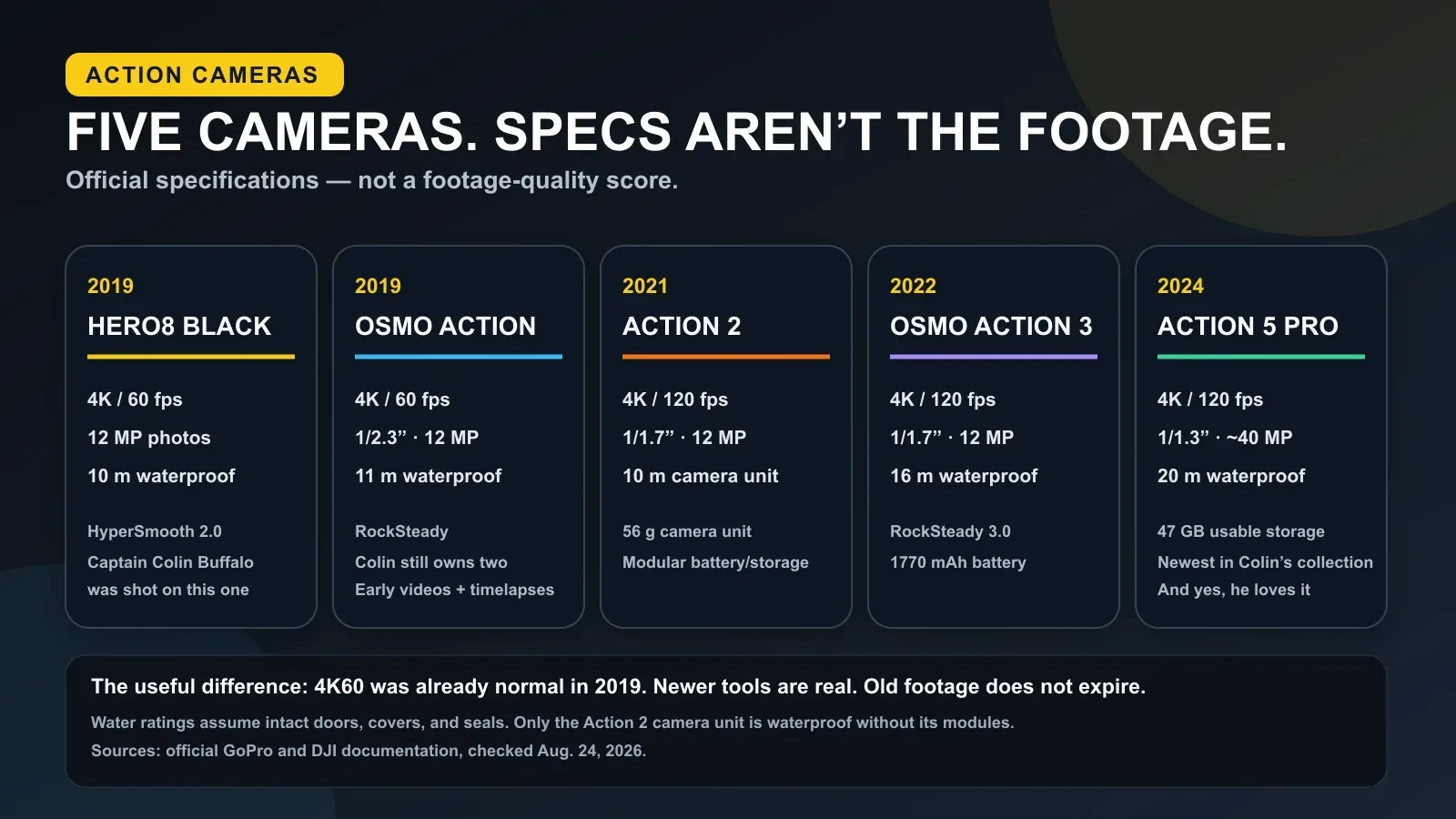
The chart is a specification reference, not a footage ranking. Waterproof ratings assume an undamaged camera with clean, intact, properly closed doors, covers, and seals.
Look at that table and the basic point becomes obvious: 4K60 action footage was already normal in 2019. The newer models add real capability, especially 4K120, better horizon control, improved batteries, larger sensors, built-in storage, and more flexible designs. But none of the five cameras is incapable of capturing a great moment.
Stats Are Not Footage
A specification sheet can tell me resolution, frame rate, sensor size, waterproof depth, bitrate, and battery capacity. It cannot tell me whether you noticed the light, cleaned the lens, chose the right angle, hit Record in time, or held the shot long enough to edit it later.
It also hides tradeoffs in tiny print.
Stabilization works by analyzing the image and cropping into the frame. GoPro explains that HyperSmooth uses that crop as a buffer to remove bumps and jitters. DJI describes RockSteady in basically the same practical way: the camera compensates by cutting off the edges and combining frames.
That is not bad. It is how the feature works. But “more stabilization” can also mean a tighter view, different low-light behavior, more processing, or a mode that is not available at every resolution and frame rate.
The headline number is only the start of the conversation.
Shit In, Shit Out
When I worked in music, I used to say:
“Shit in, shit out.”
an old music-studio rule
You could have the best console, the newest plug-ins, and a rack full of gear that cost more than a car. If the performance was bad, the microphone was in the wrong place, or the source sounded like crap, the equipment could only polish the problem.
Cameras are the same way.
A brand-new action camera pointed into the sun with a greasy lens, terrible framing, no subject, and twelve minutes of nothing is still twelve minutes of nothing. An old HERO8 placed well on a beautiful morning can make a clip you actually care about.
The gear matters. The input matters more.
New Features Are Great. They Are Not Magic.
I am not anti-upgrade. Better low-light performance is useful. Better stabilization is useful. Horizon lock is useful. A square sensor that lets you crop the same shot vertically or horizontally is useful. 360 cameras are great when reframing after the fact solves a real problem.
If you need one of those features, buy it and enjoy it.
But there is a difference between “this feature solves my problem” and “the internet made me feel like my camera is old.” One is a buying decision. The other is advertising doing its job.
360 is a good example. It can capture everything around the camera and let you choose the view later. That is fantastic for invisible-stick shots, rides, travel, and moments where you cannot point a normal camera. It also means more footage to manage, more reframing, more battery use, more storage, and more work if what you really wanted was a simple forward-facing clip.
The best feature is the one you will use after the first weekend.
Run This Test Before You Buy Another Camera
Take the camera you already own and shoot one short, repeatable sequence:
- Clean the lens.
- Charge the battery and use a known-good memory card.
- Record the same activity in daylight, shade, and the worst light you normally face.
- Use one normal frame rate and one slow-motion mode you actually understand.
- Make a 30-second edit and watch it on your phone, TV, and computer.
Then ask five questions:
- Is the footage sharp enough for where I really share it?
- Is the stabilization good enough for my actual movement?
- Does the battery last through the way I shoot?
- Can I mount it where I need it?
- Is there a specific shot I cannot make with this camera?
If you cannot name the missing shot, you may not need a new camera. You may need a better mount, a fresh battery, a clean lens, or ten more minutes thinking about the shot.
If You Buy Used, Inspect the Boring Stuff
Older action cameras can be a great value, but age changes the buying checklist. Do not buy one based only on the fact that it turns on.
- Check the lens or lens cover for scratches, chips, fogging, or coating damage.
- Inspect the battery door, USB door, seals, latches, and hinges.
- Test every button and touchscreen area.
- Record at the highest resolution and frame rate you plan to use long enough to expose overheating or card errors.
- Play the footage back and listen for damaged microphones or ugly rattling.
- Confirm the battery is not swollen and budget for replacement batteries.
- Check that the camera accepts a current, known-good memory card.
- Update the firmware through the manufacturer’s official method.
- Treat an old waterproof rating as something to inspect, not a dare.
For water use, I would rather add a proper housing than discover the hard way that a used door was bent or a seal had dried out.
Who Should Actually Upgrade?
Upgrade if the camera is costing you shots.
Maybe you film at night and the old sensor turns everything into mush. Maybe you need long battery life in the cold. Maybe you want 4K120 for a specific slow-motion project. Maybe you need 360 reframing because the camera cannot be pointed during the action. Maybe your current camera overheats, has unreliable doors, or will not work with the microphone or mounting system you need.
Those are reasons.
“There is a newer one” is not a reason by itself.
My Old-School Picks
If I were looking at this group with regular people in mind, here is how I would break it down:
- GoPro HERO8 Black: the sentimental and practical favorite. I know it can produce footage I love because it already has.
- Original DJI Osmo Action: the old workhorse. I still own two, and they shot a lot of my early videos and timelapses.
- DJI Action 2: the oddball pick when tiny size and modular mounting matter more than having a conventional body.
- DJI Osmo Action 3: the safest all-around older DJI choice on paper, with 4K120, removable batteries, and a mature mounting design.
- DJI Osmo Action 5 Pro: the newest one in my own collection and the modern camera I love using now. It gives me newer tools without making the old footage less valuable.
That is not a universal ranking. Condition, battery health, included mounts, and what you plan to shoot can matter more than the model name.
Final Thought
The camera business has to keep moving. Bigger sensors, smarter stabilization, 360 capture, better batteries, faster frame rates—I like all of it. New gear is fun.
But the moment does not care what year your camera came out.
If the old GoPro still turns on, the DJI Action still mounts where you need it, and the footage still makes you feel something, use it. Clean the lens. Charge the battery. Point it at something worth remembering. Hit Record.
That is still the whole damn job.
Sources and Specification Notes
- GoPro HERO8 Black user manual — official recording modes, HyperSmooth behavior, bitrate, waterproofing, and maintenance guidance.
- GoPro HERO8 Black launch announcement — official October 2019 launch context.
- DJI Osmo Action support and specifications — official sensor, video, stabilization, battery, screen, and waterproof specifications.
- DJI Action 2 support and specifications — official dimensions, weight, sensor, recording modes, storage, stabilization, battery-module, and waterproof details.
- DJI Action 2 launch announcement — official October 2021 product and modular-design context.
- DJI Osmo Action 3 support and specifications — official sensor, recording, stabilization, battery, and waterproof specifications.
- DJI Osmo Action 3 launch announcement — official September 2022 launch context.
- DJI Osmo Action 5 Pro specifications — official sensor, photo, video, stabilization, storage, battery, and waterproof specifications.
- DJI Osmo Action 5 Pro launch announcement — official September 2024 launch context.
- DJI Osmo Action 6 official product page — current-generation context for the square sensor, variable aperture, battery, and waterproof improvements mentioned in the article.
Specifications were checked August 24, 2026. Used-camera condition, battery health, app compatibility, accessory availability, and prices vary. Colin specifically confirmed using the HERO8 for “Captain Colin Buffalo,” owning two original DJI Osmo Actions used for early videos and many timelapses, and owning and loving the Osmo Action 5 Pro as the newest action camera in his collection. This article does not claim a controlled side-by-side laboratory test of all five listed models.