Trust & transparency
Evidence & disclosures
Not yet classified. This article has not yet been classified under the current editorial standard. It may predate the policy; do not assume a product was owned, tested, supplied, or independently verified unless the article says so.
Linked references: 9 explicit sources in the article.
A quick note before we start: this post discusses Robin Williams's death by suicide without describing the method. If you or someone you know needs immediate emotional support in the United States, call or text 988. Call 911 in a life-threatening emergency.
Some movies age because the clothes look old. Some age because the technology looks old. Then there are movies like Man of the Year, which somehow become more recognizable even while parts of the story become more ridiculous.
The 2006 film stars Robin Williams as Tom Dobbs, a political comedian whose audience dares him to run for president. He does, and his refusal to act like a normal candidate turns into a real movement. That part once felt like a broad Hollywood setup. Today, the idea that a media personality could turn attention, authenticity, anger, and entertainment into political power barely needs an explanation.
But the reason I wanted to write about this movie is not only politics.
Watching Robin Williams charge through a scene is still a reminder of how unusually gifted he was. Knowing what happened later is also a reminder that extraordinary talent does not make a person immune to illness, fear, confusion, or pain. A public smile is not a medical chart. A brilliant performance is not proof that someone is okay.
That is where this old political comedy becomes a mental-health conversation worth having.
The Short Review
Spoilers follow.
Man of the Year has a terrific first idea and a messier second one.
The first half works as political satire. Tom Dobbs is funny, impulsive, blunt, and able to say what scripted candidates will not. Christopher Walken gives the movie warmth as Dobbs's manager, Jack Menken. Lewis Black supplies the irritated voice in the room. Laura Linney plays Eleanor Green, a programmer who discovers that the election software incorrectly awarded Dobbs the presidency. Jeff Goldblum is perfectly chilly as the executive who understands that protecting the company may matter more to him than protecting the truth.
Then the movie swerves. What begins as a sharp comedy about celebrity politics becomes a corporate-conspiracy thriller, with intimidation, danger, and a romance competing for space. The shift is not impossible, but it feels like two movies arguing over the steering wheel.
That criticism is not new. The current Rotten Tomatoes page shows a 22% critics score and summarizes the problem as an unsuccessful mix of political comedy, thriller, and romance. I would not be that harsh, because Williams and the supporting cast keep it watchable. Still, the movie does not fully trust its strongest material.
My quick verdict:
- As a movie: 3 out of 5. Funny, relevant, and uneven.
- Robin Williams's performance: 4.5 out of 5. Fast, human, and far better than the machinery around him.
- As a conversation starter in 2026: 4 out of 5. The questions have aged better than the plot.
Why the Politics Feel More Familiar Now
Tom Dobbs does not win people over with a detailed policy binder. He wins them over by feeling unscripted. He is entertaining, emotionally direct, and willing to mock a system many voters already distrust.
That dynamic feels very current.
In a 2025 Pew Research Center survey, 21% of U.S. adults said they regularly got news from social-media news influencers. Among the people who did, major reasons included help understanding current events, speed, authenticity, different information, shared values, and entertainment. The political performer in Man of the Year no longer feels like an absurd exception. The line between comedian, podcaster, commentator, influencer, and candidate has become thinner.
The film also understands that politics can become a competition over who appears most real. That does not necessarily mean the person is more qualified, more honest, or better prepared. It means the audience feels spoken to rather than spoken at. Modern campaigns know the value of clips, reactions, podcasts, livestreams, and moments that look spontaneous enough to travel on their own.
The movie's election-software plot needs more care.
It is fair to take the story as a warning about private technology, poor testing, conflicts of interest, and the importance of transparency. It is not fair to treat a fictional software glitch as evidence that real election results are secretly fabricated. The U.S. Election Assistance Commission explains that reported election-night results are unofficial, canvassing reconciles ballots and voter records, most states require post-election audits, and only election officials certify the final result.
In other words, the useful lesson is not “never trust an election.” It is “build systems that can be checked, explain how they are checked, and do not ask the public to trust a black box.”
The movie is strongest when it asks what happens after people lose faith in ordinary institutions. Its answer is a fantasy candidate who can cut through the noise with honesty and humor. Our real answer has to be less cinematic: evidence, transparency, accountability, and enough patience to check a claim before sharing the clip.
Robin Williams Was the Special Effect
The political story works as often as it does because Robin Williams could make thought look physical.
He did not simply deliver jokes. He seemed to chase one idea down a hallway, open six doors, imitate everybody inside, and somehow return to the original point before the audience caught its breath. The voices, accents, facial changes, improvisational speed, and word associations were not random noise. There was structure inside the apparent chaos.
What made him more than a rapid-fire comedian was the gear change.
Williams could become still. He could let embarrassment, grief, tenderness, or moral weight settle into his face. Think about the difference between the manic energy of Aladdin or Good Morning, Vietnam and the patience of Awakenings, Good Will Hunting, Dead Poets Society, or even the unsettling control of One Hour Photo.
In Man of the Year, Tom Dobbs eventually has to decide whether he loves being president more than he values the truth. Williams makes that choice matter because the loud performer briefly becomes a quiet man carrying an impossible fact.
The film never becomes his finest work. It does show the range that made him special: comic speed, dramatic sincerity, warmth, anger, and the sense that another thought might burst into the scene before the current one finishes.
We Should Be Careful With the “Sad Clown” Story
After Robin Williams died in 2014, it became easy to repeat a simple story: the man who made everyone laugh was secretly depressed.
That story is emotionally powerful. It is also incomplete.
Williams did have a history of depression. His widow, Susan Schneider Williams, later wrote in the medical journal Neurology that it had not been active for six years before signs of depression returned during his final months. At the same time, he was experiencing a frightening mix of insomnia, anxiety, paranoia, delusions, memory and reasoning problems, movement changes, and visual-spatial difficulty.
He had received a Parkinson's disease diagnosis while he was alive. After his death, an autopsy revealed widespread Lewy body disease. His widow described it as diffuse pathology affecting nearly every region of his brain.
Lewy body dementia is a progressive brain disorder associated with abnormal deposits of a protein called alpha-synuclein. According to the National Institute of Neurological Disorders and Stroke, it can affect thinking, movement, sleep, behavior, mood, and automatic body functions. Early symptoms can resemble Alzheimer's disease, Parkinson's disease, or a psychiatric illness, which can make diagnosis difficult.
That does not mean depression was irrelevant. It means we should not reduce a complicated neurological illness to one familiar label. Mental health and brain health are connected, and symptoms that look emotional can sometimes be part of a wider medical problem.
We also should not look back at every joke, role, or smile and pretend it was a coded cry for help. That turns a whole human being into a clue we think we can solve after the fact. Williams's comedy was real. His joy was real. His love for other people was real. His illness was real too.
More than one thing can be true inside the same person.
What Helping Can Actually Look Like
Most of us are not neurologists or therapists. We do not need to become one before we care about somebody.
We do need a better plan than saying, “Let me know if you need anything,” and hoping the person knows how to turn that sentence into help.
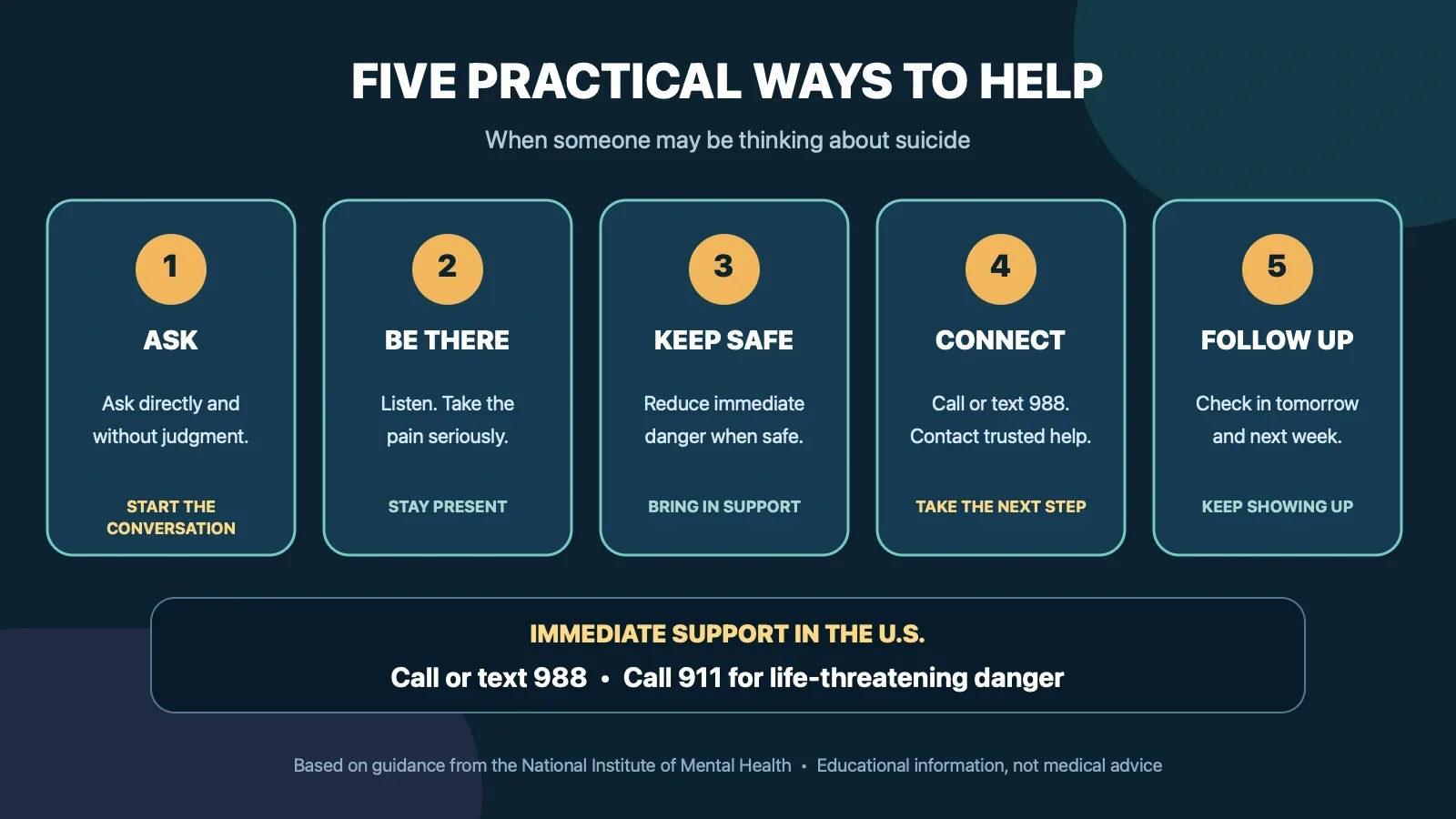
The National Institute of Mental Health recommends five practical steps when someone may be thinking about suicide: ask, be there, help keep them safe, help them connect, and follow up.
1. Notice the change, not the performance
Do not assume the funniest, busiest, most successful, or most generous person in the room is fine. Do not assume they are in crisis either.
Look for meaningful changes: withdrawing, hopeless talk, giving things away, major shifts in sleep, increased substance use, sudden agitation, risky behavior, confusion, or becoming dramatically unlike themselves. A single bad day is not a diagnosis. A pattern or sudden major change is a reason to check in.
Sudden confusion, paranoia, movement changes, hallucinations, or major cognitive changes also deserve medical attention. They may have psychiatric, neurological, medication-related, infectious, or other physical causes. Write down what changed and when, then help the person share that timeline with a clinician.
2. Ask a real question
“Are you okay?” is easy to answer with “fine.”
Try something more specific:
“You have not seemed like yourself lately, and I am worried about you. What has the last week really been like?”
If you are worried about suicide, ask directly:
“Are you thinking about suicide?”
NIMH notes that asking the question does not increase suicidal thoughts or behavior. It can open a conversation that the person may not know how to start.
3. Be present without trying to win the argument
You do not have to produce the perfect sentence. Listen without judgment. Take the pain seriously. Do not debate whether the person “should” feel that way, compare their life with somebody else's, or use guilt as a rescue tool.
Presence can sound like:
“I am glad you told me. I am staying with you while we figure out the next step.”
4. Help make the next connection
Support should become concrete.
Sit with the person while they call or text 988. Help them contact a family member, doctor, therapist, spiritual advisor, or trusted friend. Offer to drive them to an appointment. If there is an immediate life-threatening danger, call 911 or go to the nearest emergency department.
When suicide risk is present, NIMH also recommends helping reduce access to highly lethal items or places when it is safe to do so. This is not something one friend has to manage alone. Bring in professional and trusted support.
5. Follow up after the urgent moment
The next morning matters. So does the next week.
Send the message. Make the call. Bring food. Ask whether the appointment happened. Keep the connection going after the crisis has stopped being visible. NIMH notes that supportive, ongoing contact can play an important role in prevention.
A Small Help Plan You Can Save
If this post makes you think of someone, do not wait until you have a complete diagnosis or a perfect speech.
Use this simple plan:
- Name what changed. “You have stopped answering calls and you sound hopeless.”
- Ask directly. “Are you thinking about suicide?”
- Stay and listen. Do not leave an actively suicidal person alone.
- Connect. Call or text 988 in the U.S., contact a clinician, or use emergency services for immediate danger.
- Follow up. Put a specific check-in on your calendar.
This is not medical advice, and it is not a substitute for professional care. It is a way to stop helpless concern from becoming silence.
What the Movie Leaves Me With
Man of the Year asks whether a comedian can become president and remain honest when power finally arrives.
In 2026, that question feels less far-fetched than it did in 2006. We live in a political environment where attention can become authority, entertainment can become information, and authenticity can matter more than preparation. The film saw that tension coming, even if it could not keep its comedy, romance, and thriller pieces working together.
Robin Williams remains the reason to watch it.
His performance is bright, fast, generous, and alive. The tragedy of his later illness does not cancel that work, and the work should not be used to minimize the illness. We can appreciate the gift without turning his suffering into mythology.
Final Thought
The movie wonders whether the man behind the microphone can save the country.
The more useful question may be whether we notice the person after the microphone is turned off.
You do not need Robin Williams's talent to hide pain. You only need to know how to say “I'm fine” convincingly enough that people move on. That is why help cannot depend on appearance, success, humor, or one casual question.
Pay attention to changes. Ask directly. Stay in the room. Help make the call. Check again tomorrow.
We cannot always see what somebody is carrying. We can make sure they do not have to carry it alone.
Help and Sources
- 988 Suicide & Crisis Lifeline — call or text 988 in the United States; free, confidential support is available 24/7/365.
- National Institute of Mental Health: Five action steps to help someone having thoughts of suicide
- National Institute of Mental Health: Frequently asked questions about suicide
- National Institute of Neurological Disorders and Stroke: Lewy body dementia
- Susan Schneider Williams in Neurology: “The terrorist inside my husband's brain”
- U.S. Election Assistance Commission: Election results, canvass, and certification
- Pew Research Center: News Influencers Fact Sheet
- Pew Research Center: The political gap in Americans' news sources
- Rotten Tomatoes: Man of the Year