Trust & transparency
Evidence & disclosures
Evidence basis: Hands-on test. Colin personally used the product, process, aircraft, software, or location described.
Based on building and using the live Project Sequencer lab; native plug-in hosting and pro DSP features are roadmap ideas, not current capabilities.
Sources checked: Aug 20, 2026
Linked references: 1 explicit source in the article.
TLDR
I started Project Sequencer because finishing an album involves more than putting songs in a numbered list.
You have alternate mixes, mastering candidates, track-order ideas, transition notes, artwork, lyrics, approvals, and export requirements. Those decisions tend to end up spread across folders, text messages, notes, and a digital audio workstation session that may not explain why anything was chosen.
Project Sequencer is my attempt to bring that work into one non-destructive album workspace.
The hosted lab can already demonstrate sequencing, candidate review, transition planning, track-level edits, a shared master bus, live meters, presets, Reference A/B, assets, lyrics, approvals, and project export. It keeps the workflow flexible so album decisions can evolve without locking them in too early.
The next big idea is a professional DSP edition: a version that does not just organize mastering decisions, but can process and render them through a dependable audio engine. That version is a direction, not a finished product. There is no launch date or price to announce.
I Wanted to Solve the Decisions Before Building More Knobs
Music software has no shortage of knobs.
I like knobs. I have lost perfectly respectable portions of an afternoon to knobs.
But the difficult part of finishing an album is often not finding another EQ. It is keeping the whole decision trail together.
Which version of the song are we actually using? Is it the audition favorite or the approved master source? Does track four fade out, stop cleanly, or crossfade into track five? Are the lyrics attached to the same audio candidate we approved? Is the album order final, or is it still just the order everyone dislikes the least today?
Project Sequencer began with those questions.
The goal was to build the workflow around the album first, then decide how much audio processing belonged inside it. That order matters. A powerful DSP engine attached to a confused workflow would simply help me make the wrong decision faster.
What Project Sequencer Is Today
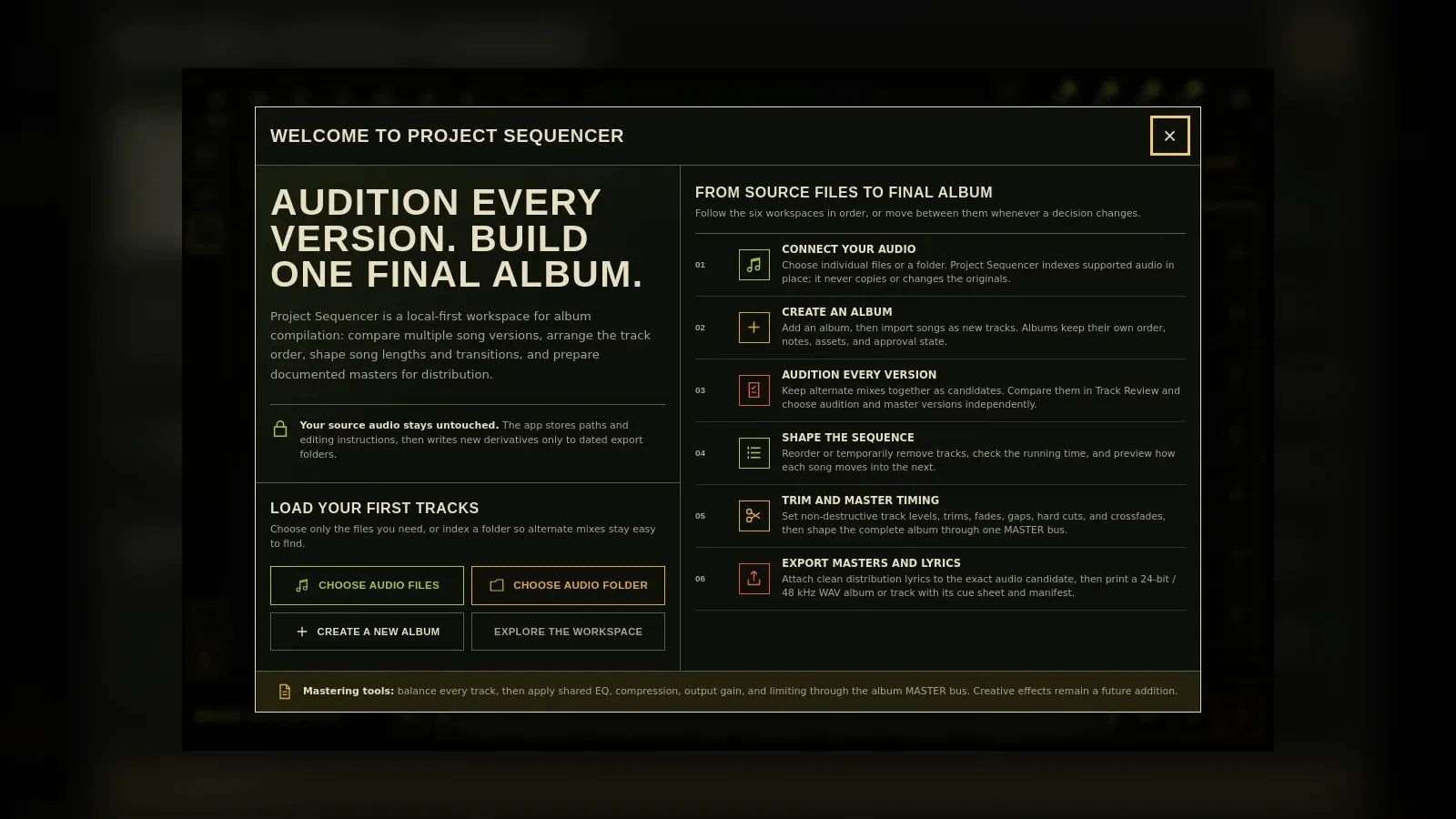
The workspace is split into seven focused views:
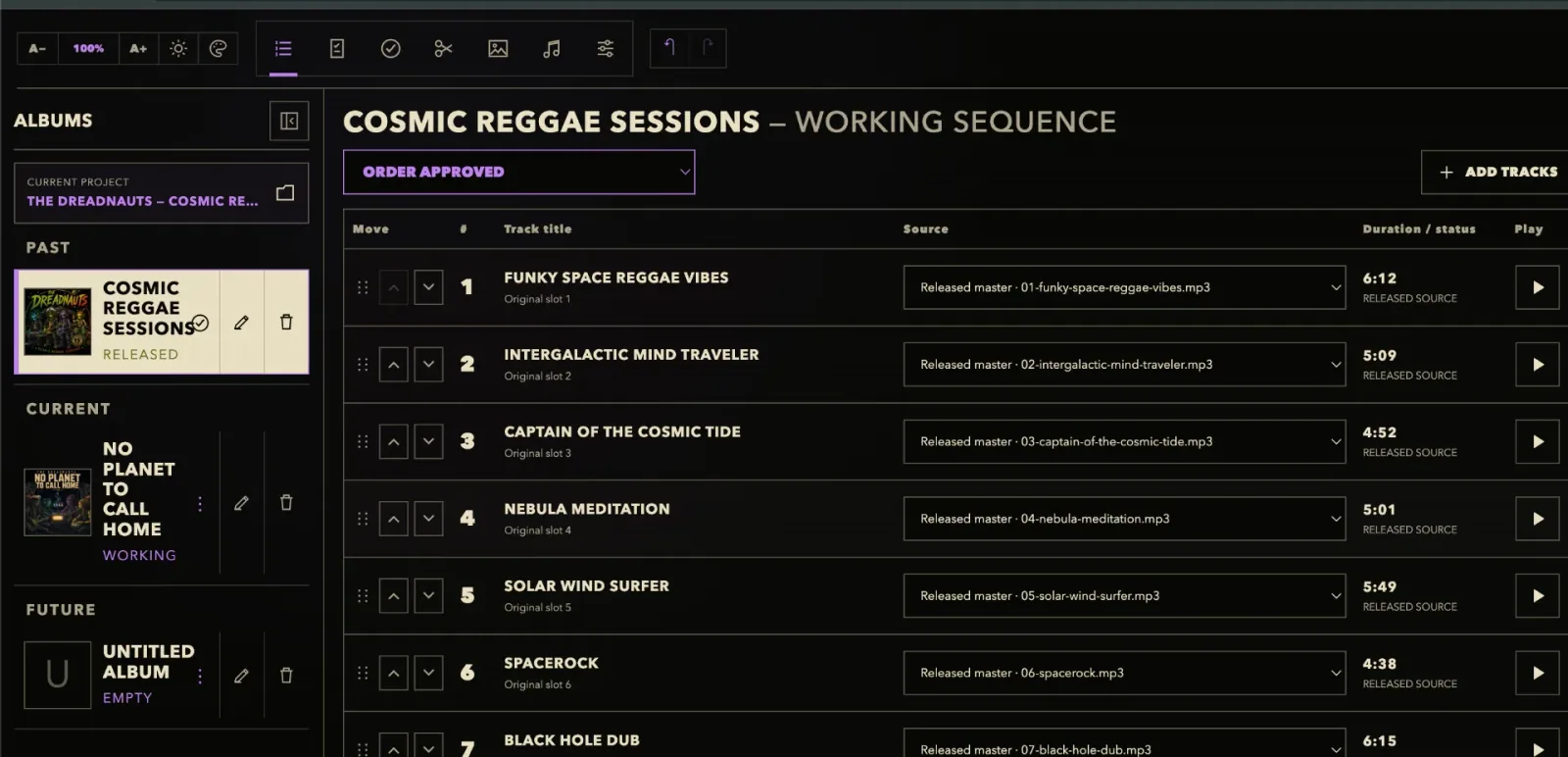
- Sequence arranges the track order, selects audition sources, checks running time, and plans how songs move into one another.
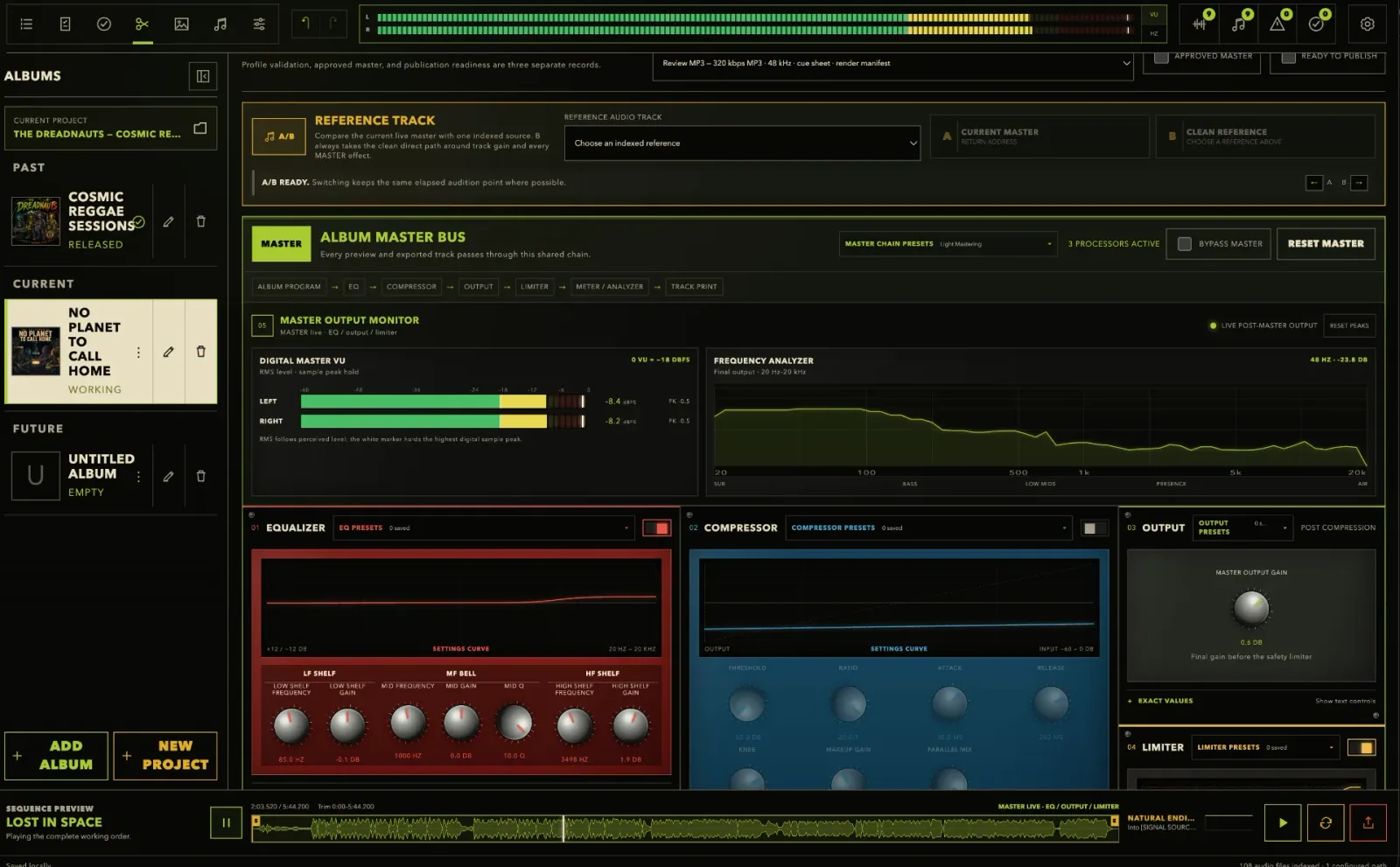
- Mastering holds track trims, fades, levels, endings, a shared album master bus, meters, presets, delivery profiles, and Reference A/B.
- Track Review keeps alternate audio candidates together with technical details, notes, dispositions, and separate audition and master decisions.
- Album Decisions saves order snapshots, compares transition ideas, records listening notes, and reports each readiness gate independently.
- Assets connects album art, track visuals, and lyric files to the project without copying or modifying them.
- Audio Library indexes connected audio, filters it, shows where each file is used, and lets a candidate be assigned to an existing or new track.
- Settings handles the project identity, appearance, saved browser projects, and project-data import or export.
That may sound like a lot, but the basic idea is simple: one place should explain how a folder full of songs became one finished album.
The Rule I Do Not Want to Break
The most important idea behind Project Sequencer is simple.
It is a non-destructive editor.
It helps organize the moving pieces of an album, shape the running order, refine the transitions, and keep the creative decisions connected from first review to final delivery.
The goal is to help bring an album to listeners the way it was meant to be heard. You can try a different sequence, compare versions, revise a fade, or return to an earlier decision without losing the thinking that got you there.
That is partly a creative decision and partly a trust decision. The tool should make experimentation feel safe while keeping the finished album faithful to the artist's intent.
Sequencing Is More Than Moving Rows
The Sequence view is the simplest place to understand the project.
Tracks can be moved, temporarily removed, auditioned from a chosen source, and returned to their original order. The footer keeps playback and sequence export close at hand, while the running program time changes with the current arrangement.
The more interesting work appears between the tracks.
In Album Decisions, each adjacent pair gets a transition notebook. I can compare two ideas for the same handoff, add a listening marker, choose a natural ending, hard cut, fade, or crossfade, and record the intended duration or silence after the track.
Those transition choices are instructions. They do not damage either song. They also remain understandable when I return later and wonder what Past Colin was thinking.
Past Colin occasionally needs documentation.
Candidate Review Without Losing the Thread
A song title is not the same thing as an audio file.
One track may have a streaming preview, an early mix, a vocal-up revision, a mastered file, and a replacement delivered two days later with a filename that explains absolutely nothing.
Track Review keeps those candidates attached to one track record. It shows technical information such as format, sample rate, channel count, bit rate, duration, and file size. It also keeps candidate notes and a decision record with states such as provisional selection, approved master source, replacement required, missing audio, legacy source, or released source.
Most importantly, the audition choice and the master decision remain separate.
That protects against a very human shortcut: liking what is currently playing and accidentally treating it as the approved final source.
The Mastering Layer Is Already Pointing Toward Pro DSP
The Mastering view is where the future starts to become visible.
Each track has a non-destructive level, start and end trims, opening and ending fades, gap controls, and an ending mode. The whole album then moves through one MASTER bus.
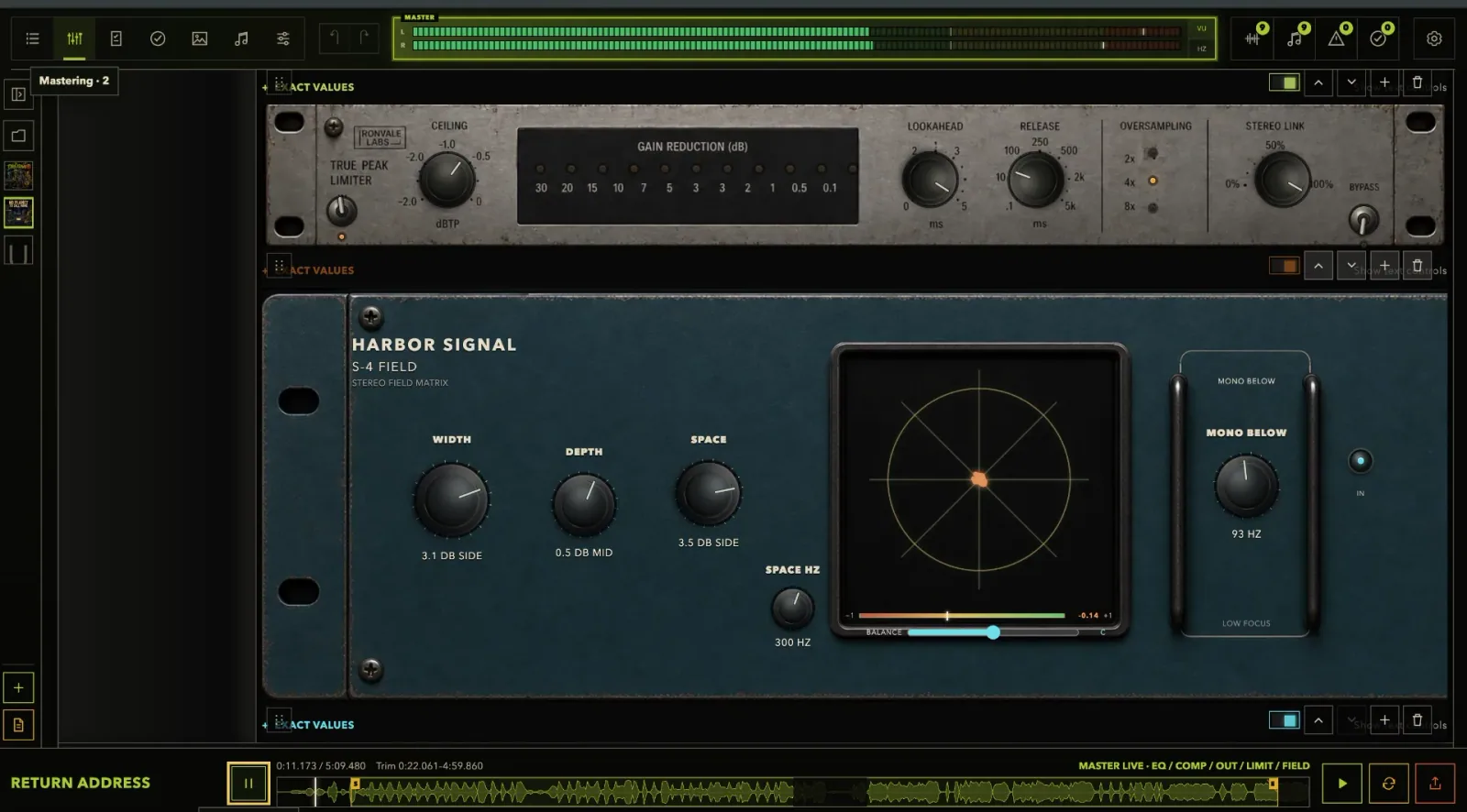
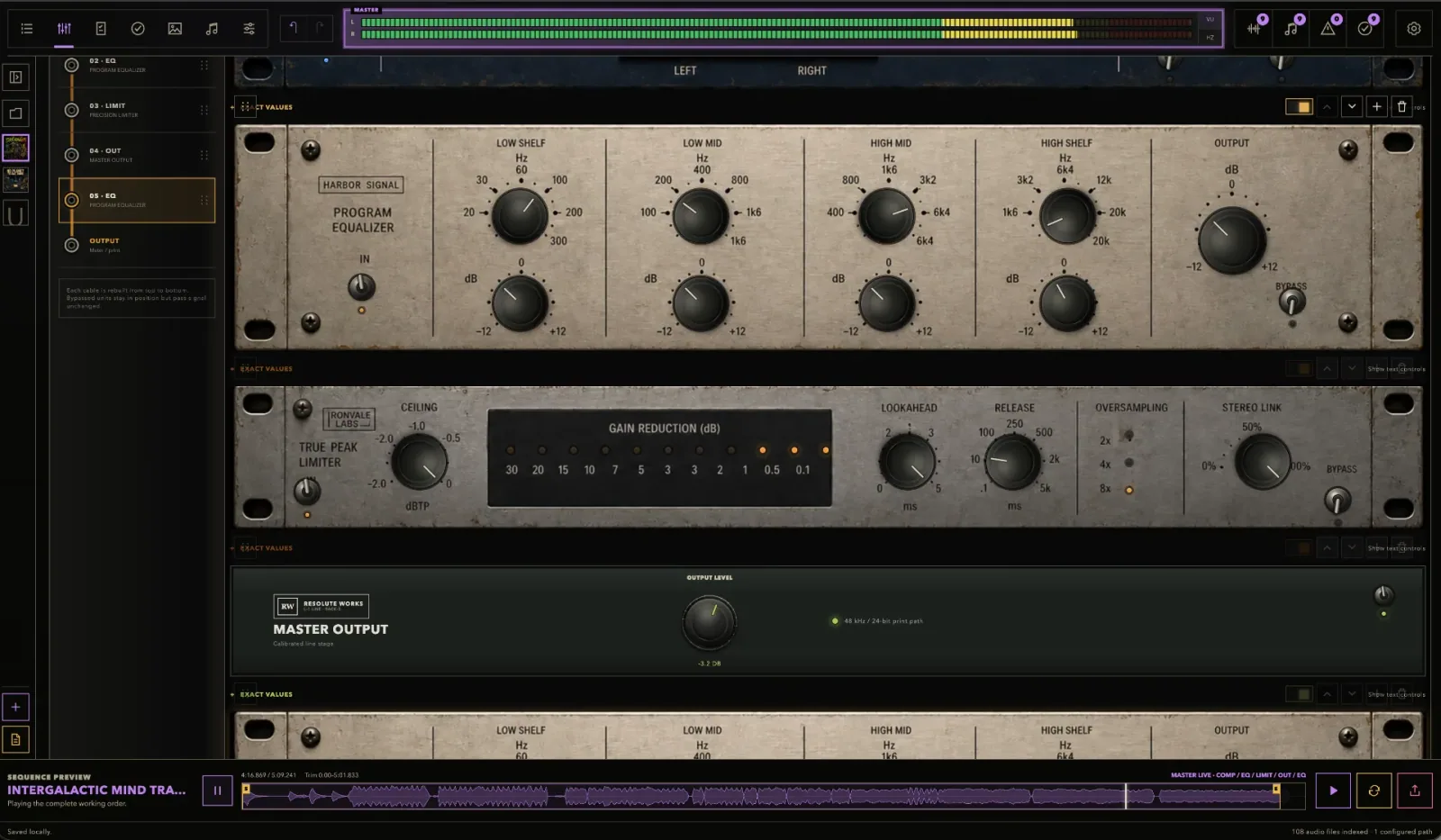
The current interface presents a Basic component chain with EQ, compressor, output gain, and limiter. It also exposes the concept of a Premium analog rack with multiple units and a signal order that can be patched by dragging.
The monitoring area includes left and right level meters, a frequency analyzer, stereo-field views, phase correlation, peak reset, and audition modes for stereo, mono sum, mid, and side. A Reference A/B area is designed to keep comparison close to the actual mastering decisions.
There are also delivery profiles for archive WAV, distribution WAV, and review MP3 outputs. The hosted lab deliberately keeps printing and some rendered previews unavailable. It is a workflow demonstration, not a cloud service that accepts or processes anyone's private masters.
This is the point where I need to be very clear: seeing an EQ curve in a browser is not the same thing as having a professional DSP engine behind it.
What DSP Actually Means Here
DSP stands for digital signal processing. In regular-person language, it is the audio engine doing the real math behind EQ, compression, limiting, gain, fades, resampling, metering, analysis, and rendering.
A professional DSP version of Project Sequencer would need to do more than make the controls move.
It would need repeatable processing, accurate timing, controlled latency, reliable renders, honest metering, and enough documentation to reproduce what happened. If the same project is printed twice with the same sources and settings, the results should not become a surprise remix.
That reliability is what I mean by pro. It does not mean adding tiny labels until the screen looks expensive.
The Future Pro DSP Edition I Want to Explore
The future edition should preserve the workflow that exists now and add a real processing layer underneath it.
Here is the direction I am exploring:
- Sample-accurate album timing. Trims, fades, gaps, hard cuts, and crossfades should render exactly where the project says they belong.
- A modular mastering chain. The basic EQ-compressor-output-limiter path could grow into a reorderable rack with saved units, clear bypass states, and dependable preset recall.
- Professional metering. Loudness, true peak, spectrum, stereo width, phase, and comparison views should help a user make a decision without pretending a meter can approve a master.
- Level-matched Reference A/B. Comparing a project with a reference should reduce the temptation to choose whichever one is louder.
- Real-time audition plus offline rendering. The preview needs to feel immediate, while the final print should favor quality, repeatability, and verification.
- Batch album and track exports. One approved project should be able to produce the intended album program, individual masters, a cue sheet, a render manifest, and checks that show which source and settings created each output.
- Revision-safe project history. Order changes, source decisions, mastering settings, and approvals should be recoverable without turning the project folder into FINAL-final-2-really-final.
- Hardware and plugin decisions made carefully. MIDI control, calibrated monitoring, and third-party Audio Unit or VST3 hosting are possibilities to investigate, not promises. A smaller verified rack may ultimately be safer than trying to host everything on day one.
The roadmap also leaves room for creative effects, but I do not want Project Sequencer to become a full digital audio workstation by accident. Recording, arranging MIDI, and producing a song are different jobs from choosing versions, shaping an album, mastering its flow, and documenting a release.
Knowing what a tool should not become is part of designing it.
Why I Built the Hosted Lab First
Building the browser lab before the pro engine lets me test the decisions before committing to a deeper DSP architecture.
Does the language make sense? Can an artist tell the difference between an audition source and an approved master? Can a sequence revision exist without changing track approvals? Are the delivery requirements visible before someone presses Print? Can a project explain itself to another person who did not build it?
Those questions are easier to improve now than after a large native audio engine has hardened the workflow around the wrong assumptions.
The hosted version also gives regular listeners, musicians, and technical users the same object to react to. A musician can tell me whether the sequence tools match how albums are actually discussed. A mastering engineer can point out where the controls or measurement language are too shallow. A developer can see where browser privacy ends and native processing should begin.
That feedback is more useful than saying, "Imagine a very good audio app," and waiting for everyone to imagine a different one.
Try the Lab Like a Producer, Not a Tourist
The public demo is available at Project Sequencer Lab.
I would test it with three questions:
- Can you understand which song version is being auditioned and which one is approved for mastering?
- Can you change your mind about the album order or a transition without losing the earlier decision?
- Can you tell what is ready, what is missing, and what still needs a human approval?
The demo is ready to explore in the browser, so you can move through the album workflow and test how the different decisions fit together.
Some in app screenshots:
What Happens Next
Project Sequencer is still a project in motion.
The hosted lab is real and usable as a demonstration of the album workflow. The professional DSP edition is the next larger direction, and it will require different engineering decisions from a browser-only lab.
I am not announcing a shipping date, price, supported plugin list, or magic button that masters an album for you. Those would be easy sentences to write and expensive promises to keep.
What I can say is that the project now has a much clearer spine: keep edits non-destructive, separate audition from approval, preserve the artist's intent, and make every final delivery traceable.
If the future DSP engine can preserve those rules while giving professional users the timing, processing, metering, and rendering depth they need, Project Sequencer could become more than a useful lab.
It could become the place where an album stops being a pile of files and starts becoming a finished record.