Trust & transparency
Evidence & disclosures
Evidence basis: Researched analysis. The article compares public evidence and does not claim hands-on testing unless a section says otherwise.
Based on official OpenAI model, Codex, and API materials plus an outside benchmark source; I did not independently reproduce every performance claim.
Sources checked: Aug 20, 2026
Linked references: 4 explicit sources in the article.
TLDR
- OpenAI released GPT-5.6 on July 9, 2026, with three main model tiers: Sol, Terra, and Luna.
- Sol is the flagship model, Terra is the balanced workhorse, and Luna is the lower-cost, faster option for higher-volume use.
- Codex is now positioned as the coding agent inside ChatGPT, across ChatGPT, the IDE extension, and the CLI.
- The headline is not just better chat. The headline is agents that can plan, use tools, run checks, and carry more of a real task from start to finish.
- The benchmark story is strong, but not simple. GPT-5.6 leads or improves in many coding, computer-use, and cyber evaluations, while competitors still win some individual tests.
- My take: this is one of those releases where the model number matters less than the workflow change. We are moving from "ask AI a question" to "give AI a job and supervise it."
OpenAI just dropped one of those releases that sounds technical at first, but the real story is pretty simple:
AI is getting better at doing work, not just answering questions.
The new GPT-5.6 family is here. Codex is now being presented as the same powerful coding agent inside ChatGPT. And the model lineup has split into three names that are easier to understand than a pile of tiny version numbers: Sol, Terra, and Luna.
That matters because most regular people do not care which model wins a lab benchmark by 1.3 points on a Wednesday afternoon. They care whether the thing can help them build an app, fix a broken project, summarize a pile of files, make a presentation, review code, or turn a messy idea into something usable.
That is where this release starts to feel different.
Not perfect. Not magic. Still very capable of being confidently weird if you give it the wrong job.
But different.
Don't feel like reading? Watch the video:
What OpenAI Released
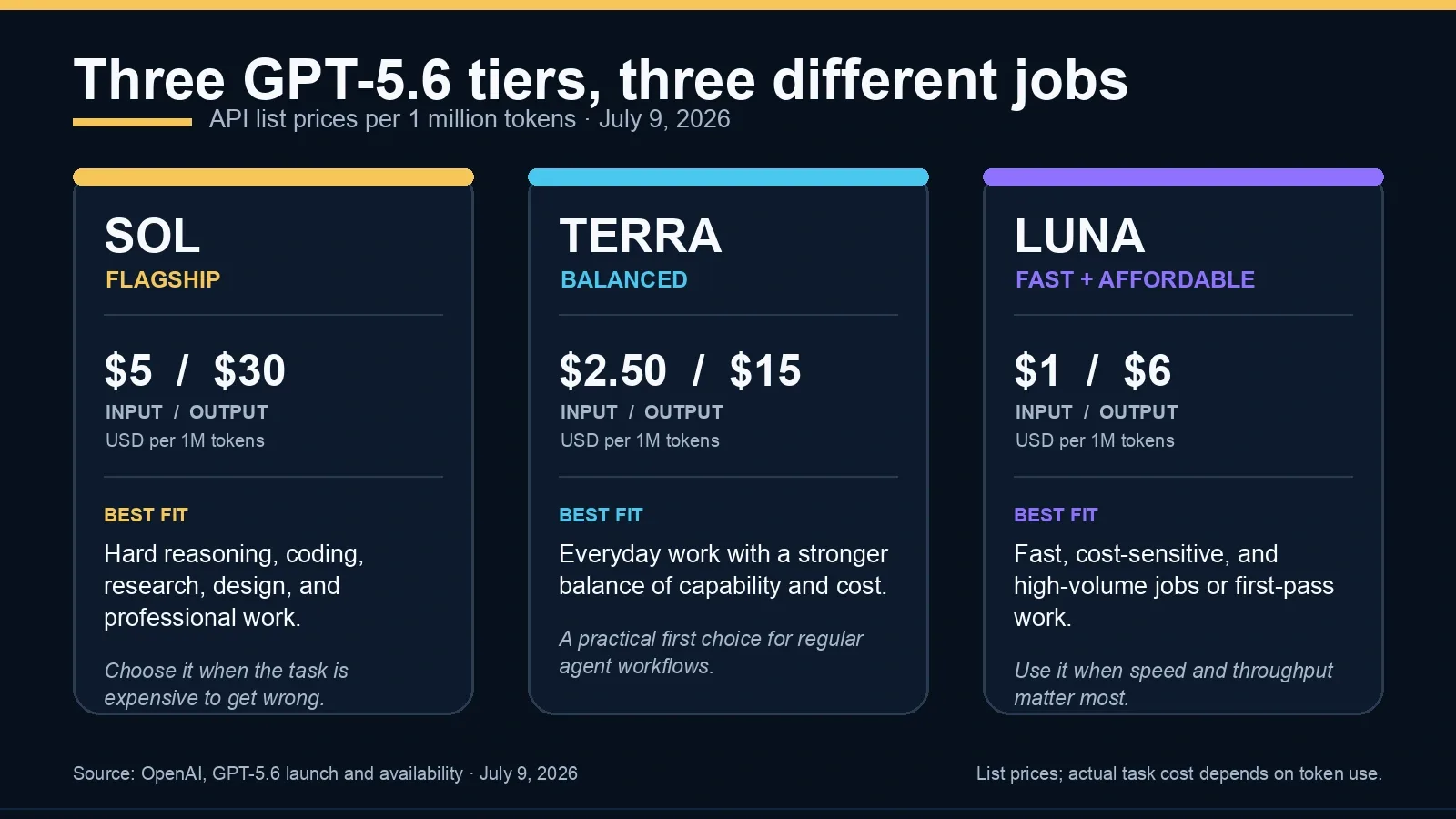
OpenAI's GPT-5.6 release has three main models:
- GPT-5.6 Sol: the flagship model for harder reasoning, coding, research, design, and professional work.
- GPT-5.6 Terra: a lower-cost model meant to balance intelligence and cost.
- GPT-5.6 Luna: the fastest and most affordable tier for cost-sensitive or high-volume work.
OpenAI says GPT-5.6 is available across ChatGPT, Codex, and the OpenAI API, with rollout happening globally over the first 24 hours after launch.
For ChatGPT Work and Codex, OpenAI says Free and Go users get Terra. Plus, Pro, Business, and Enterprise users can choose Sol, Terra, and Luna and set an effort level. The new `max` effort level is available to users with GPT-5.6 access in ChatGPT Work and Codex. The heavier `ultra` mode is available in ChatGPT Work for Pro and Enterprise, and in Codex for Plus and higher plans.
The API pricing is also now clearly tiered:
- Sol: $5 per million input tokens and $30 per million output tokens.
- Terra: $2.50 per million input tokens and $15 per million output tokens.
- Luna: $1 per million input tokens and $6 per million output tokens.
OpenAI's API model docs also list a 1.05 million token context window and 128K max output for the GPT-5.6 models, with support for tools like functions, web search, file search, and computer use.
That is a lot of product language, so here is the regular-person translation:
OpenAI is not just shipping one "best" model. It is shipping a small menu. You pick the expensive thoughtful one, the middle one, or the cheaper fast one depending on the job.
Honestly, that is how these tools should work.
I do not need the biggest brain in the building to rename files, clean up a checklist, or draft a plain email. But if I am asking an agent to work through a complicated app, hold a large codebase in mind, run tests, compare options, and come back with something I can actually use, then yes, give it the serious model and let it cook.
Where Codex Fits In
The link Colin sent me, `chatgpt.com/codex`, makes the product angle clearer than the model table does.
OpenAI is describing Codex as "the same powerful coding agent" now in ChatGPT. The page pitches it as a command center for agentic coding, with built-in worktrees, cloud environments, parallel agents, skills, background tasks, code review, the IDE extension, and the CLI.
That is the important part.
Codex is not just autocomplete. It is not only "write me a function." The product story is that Codex can take on real engineering work: features, refactors, migrations, reviews, test generation, issue triage, and longer-running tasks that need context.
That matches what I care about in my own workflows.
I do not want AI to only give me a paragraph about what I should do. I want it to inspect the project, make a plan, edit files, run checks, notice what broke, fix the issue, and then explain what changed in a way I can review.
That is a very different workflow from the old chatbot loop:
- Ask a question.
- Copy the answer.
- Paste it into the project.
- Find out it broke something.
- Go back and complain to the robot.
- Repeat until you lose either the bug or your will to continue.
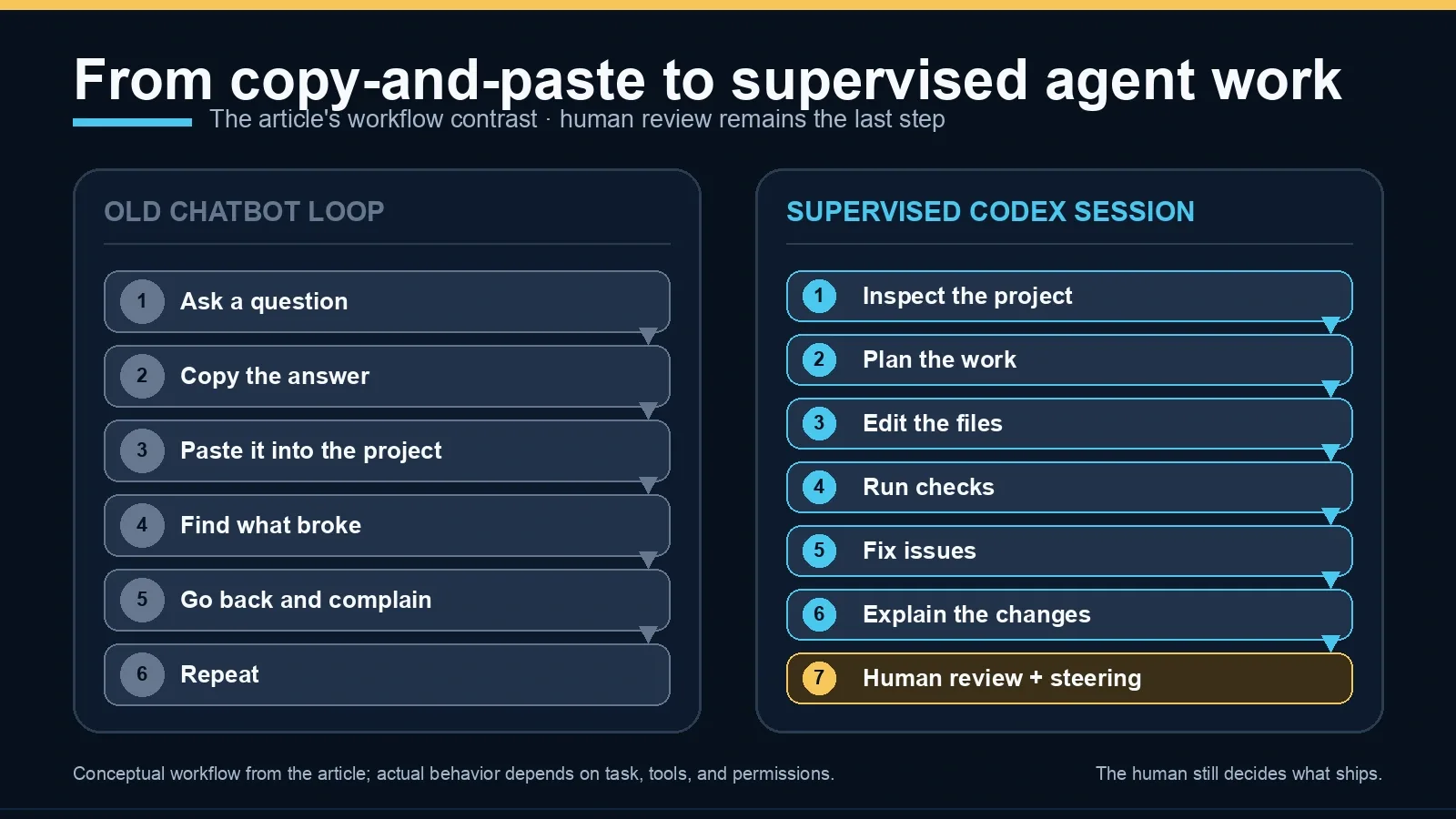
Codex is trying to collapse that loop into a supervised work session. You still review it. You still steer it. You still own the final decision. But the tool is carrying more of the boring middle.
That boring middle is where a lot of real work lives.
The Model Lineup In Plain English
Here is how I would think about the new models:
GPT-5.6 Sol
Sol is the model I would reach for when the task is expensive to get wrong.
That could be a larger coding change, a hard debugging session, a detailed research job, a technical article that needs careful comparison, a design-heavy app prototype, or a workflow where the model needs to use tools and keep track of a lot of moving pieces.
Sol is also the model OpenAI is putting forward for the big benchmark story. It is the flagship, and the numbers show real gains over GPT-5.5 in several areas.
GPT-5.6 Terra
Terra is probably the model most people will live with day to day.
It is not positioned as the absolute top model, but it is meant to be strong enough for everyday work while being cheaper than Sol. For a lot of tasks, that tradeoff matters more than squeezing out the final few points on a benchmark.
If I were running a bunch of normal Codex jobs, drafts, cleanup tasks, or content workflows, Terra is the kind of model I would test first.
GPT-5.6 Luna
Luna is the cost-sensitive option.
That does not mean "bad." It means OpenAI is acknowledging that price and speed matter. If you are doing high-volume work, smaller tasks, quick transformations, bulk cleanup, or a lot of first-pass drafts, Luna could be the practical choice.
I like that this release makes that distinction more obvious. Every job does not need the most expensive model. Sometimes you need the sharpest model. Sometimes you need the fastest cheap one. Sometimes you need the middle option because life is full of spreadsheets and compromises.
The Stats That Jumped Out
Now for the benchmark part.
I do not want this article to become a spreadsheet wearing a trench coat, so I am only pulling the numbers that tell the story.
Coding And Agent Work
On OpenAI's launch table, GPT-5.6 Sol scores 80 on the Artificial Analysis Coding Agent Index v1.1. That is higher than GPT-5.5 at 76.4, Claude Fable 5 at 77.2, Claude Opus 4.8 at 72.5, and Gemini 3.1 Pro Preview at 42.7.
On Terminal-Bench 2.1, GPT-5.6 Sol scores 88.8%, and Sol Ultra reaches 91.9%. GPT-5.5 is listed at 85.6%, Claude Fable 5 at 83.1%, Claude Opus 4.8 at 78.9%, and Gemini 3.1 Pro Preview at 70.7%.
On DeepSWE v1.1, Sol scores 72.7%. GPT-5.5 is at 67%, Claude Fable 5 is at 69.7%, Claude Opus 4.8 is at 59%, and Gemini 3.1 Pro Preview is at 11.8%.
That is the pro-OpenAI version of the story.
But the honest version also includes this: on SWE-Bench Pro, OpenAI's table lists GPT-5.6 Sol at 64.6%, while Claude Mythos 5 is listed at 80.3% and Claude Fable 5 at 80%.
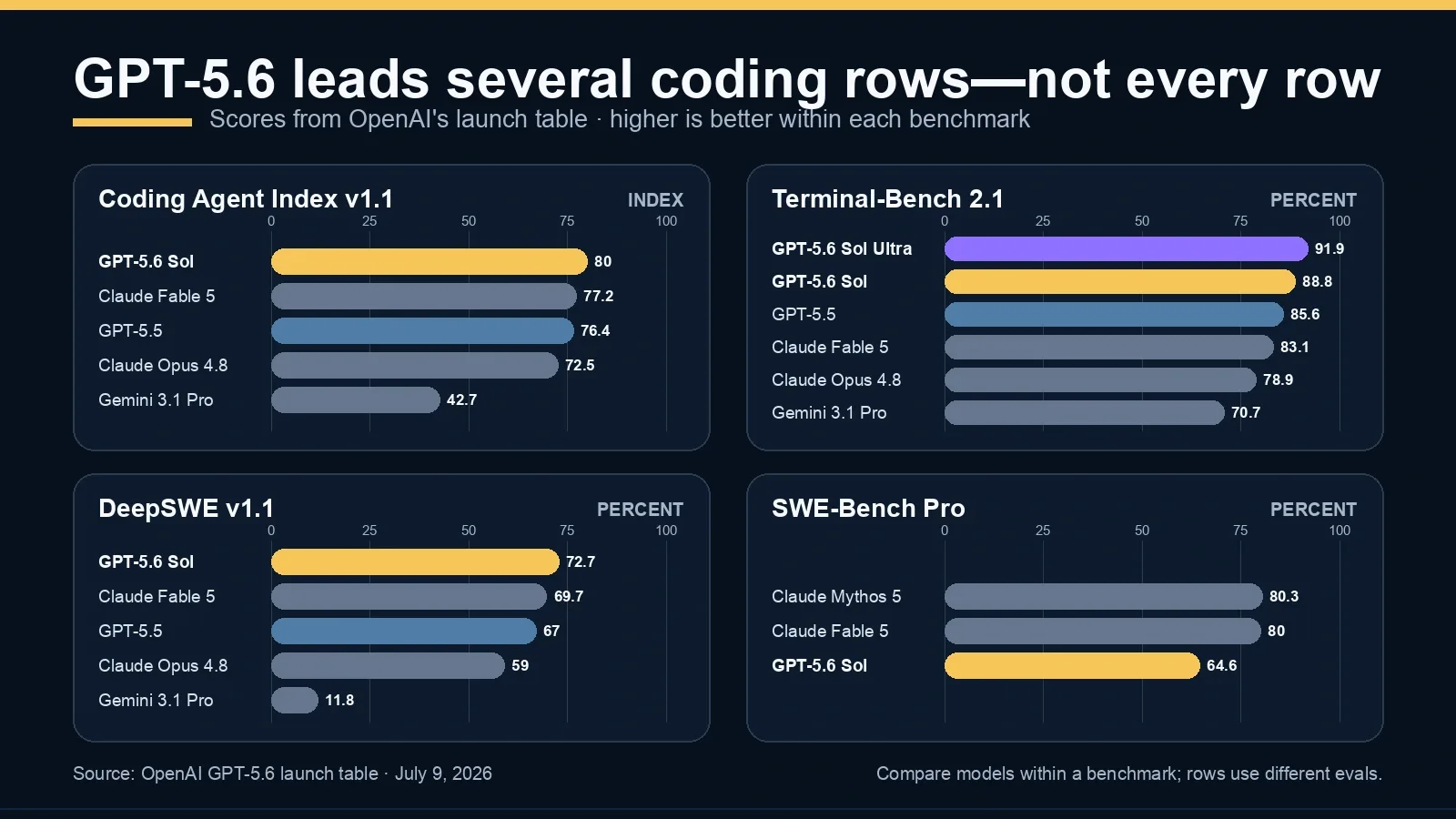
So no, this is not "OpenAI wins every row, everyone else can go home." That is not what the table says.
The stronger takeaway is that GPT-5.6 looks very competitive across a broad coding-agent mix, especially when cost, token use, and time matter, but the top spot still depends on the exact benchmark.
That is more realistic anyway.
Knowledge Work And Computer Use
OpenAI's table shows GPT-5.6 Sol at 90.4% on BrowseComp, with Sol Ultra at 92.2%. GPT-5.5 is listed at 84.4%, Claude Opus 4.8 at 84.3%, and Gemini 3.1 Pro Preview at 85.9%.
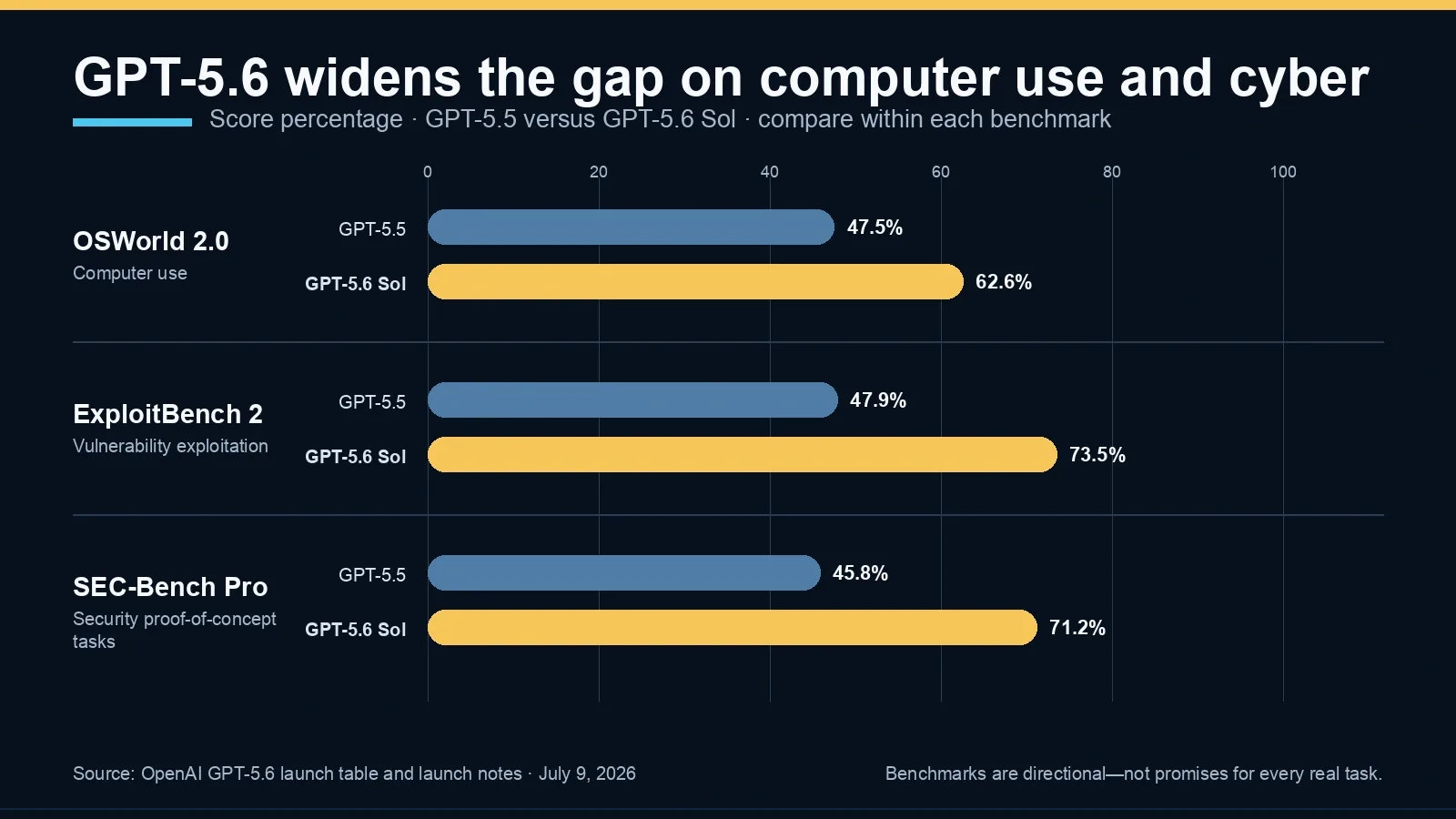
On OSWorld 2.0, which is meant to test computer-use tasks, Sol scores 62.6%. GPT-5.5 is at 47.5%, and Claude Opus 4.8 is at 54.8%.
This part matters because it points beyond coding. A model that can operate a computer more reliably can help with research, files, browsers, documents, spreadsheets, and app workflows.
That is why Codex being inside ChatGPT is such a big deal. The future is not only "write better Python." The future is "help me move through this whole messy computer task without dropping half the context on the floor."
That is the dream, at least. We are still going to supervise the dream because, well, computers.
Cybersecurity
The cybersecurity jumps are also large, and they come with safety caveats.
OpenAI says GPT-5.6 scores 73.5% on ExploitBench 2 compared with GPT-5.5 at 47.9%. On SEC-Bench Pro, GPT-5.6 scores 71.2% compared with GPT-5.5 at 45.8%. On ExploitGym 3, OpenAI says GPT-5.6 nearly doubles GPT-5.5's peak pass rate under the two-hour cap, and reaches 33.7% with a six-hour limit.
Those are big numbers.
They are also the kind of numbers that explain why OpenAI is talking so much about safeguards, trusted access, hardware-backed passkeys for some advanced cyber access, monitoring, and routing certain higher-risk requests to lower-capability models.
The same model behavior that can help a defender find and fix a vulnerability can also be misused. That is not a footnote. That is the whole tension.
For normal readers, the practical takeaway is simple: better coding agents are also better security agents. That is good for people trying to protect software, but it raises the stakes around access and guardrails.
Cost And Efficiency
Artificial Analysis published a useful benchmark writeup on GPT-5.6, and their summary is probably the most interesting outside read so far.
They say GPT-5.6 Sol at max reasoning scores about one point below Claude Fable 5 in their Intelligence Index, but at roughly one third of the cost. They also say GPT-5.6 Sol leads their Coding Agent Index at 80 points.
That cost part is important.
Model rankings are fun, but product economics are where these tools either become normal or stay locked in "cool demo" land.
If a model gets close to the top competitor while costing much less per task, that changes who can afford to use it regularly. It also changes what kinds of products developers can build on top of it.
This is why Luna and Terra may matter more than they sound. The flagship model gets the applause, but the cheaper models often decide whether people actually use the thing every day.
Where Competitors Still Matter
It would be easy to write a breathless "OpenAI crushes everybody" post.
That would also be lazy.
The comparison is more interesting than that.
In OpenAI's own table, Claude Fable 5 is slightly ahead of GPT-5.6 Sol on GDPval-AA v2: 1,759.6 Elo versus 1,747.8 Elo. Claude Mythos and Claude Fable also show very strong SWE-Bench Pro results. On Toolathlon, OpenAI lists GPT-5.6 Sol at 58, while Claude Mythos 5 and Claude Fable 5 are both listed at 61.7, and Claude Opus 4.8 at 59.9.
So the honest story is this:
OpenAI made a major move, especially for Codex, coding-agent work, computer use, cost efficiency, and long-running agent workflows. But Anthropic and Google are not irrelevant. The model race is still alive, and the "best" model depends on what you are trying to do.
That is actually good for users.
Competition keeps these companies from getting too comfortable. It also means we should stop asking "which AI is best?" as if there is one permanent answer.
The better question is:
Which model is best for this job, at this price, with this tool access, under these safety rules?
That is less catchy, but far more useful.
Why This Matters For Regular Builders
For developers, this release is obviously important. Better coding agents can save time, improve reviews, generate tests, migrate code, inspect repositories, and handle longer tasks.
But I think the bigger story is for people who are not traditional developers.
Codex is still a coding agent, but code is becoming a tool for doing all kinds of work. You can use code to clean data, compare documents, build a small website, generate a report, scrape your own exported files, make charts, test an idea, or automate a boring process.
That means better coding agents are not only for software engineers.
They are for small business owners trying to make a dashboard.
They are for creators trying to turn notes into a workflow.
They are for students trying to understand a project.
They are for teams that need internal tools but do not have a spare engineering department sitting around eating snacks and waiting for requests.
They are for people like me, who look at a mess of notes, drafts, images, source links, and half-built automation ideas and think:
There has to be a better way to turn this into something finished.
Codex is becoming one of those better ways.
My Take
The model names are new, but the deeper shift is the workflow.
ChatGPT used to feel mostly like a conversation. Codex feels more like a workbench. GPT-5.6 gives that workbench more capable tools.
That is the part I care about.
I do not want AI to replace my taste, my judgment, or my voice. I want it to help with the parts of the work that slow everything down: setting up files, checking details, comparing sources, running tests, creating drafts, catching obvious mistakes, and keeping enough context to not make me repeat myself fifty-seven times.
The danger is that people will either overtrust it or dismiss it.
Overtrusting it is how you publish bad facts, ship broken code, or let a model make decisions it should not be making.
Dismissing it is how you miss a real shift in how work gets done.
The middle path is supervision.
Use the agents. Check the work. Ask for sources. Run the tests. Compare the numbers. Keep your standards. Do not let the machine become the final editor of your life.
But also do not ignore what is happening.
This release makes the direction pretty clear: the next phase of AI is not only smarter answers. It is longer-running agents, model tiers tuned for different jobs, and tools that can actually move work forward.
That is worth paying attention to.
And yes, it is also worth trying.
Sources
- OpenAI, GPT-5.6 launch: https://openai.com/index/gpt-5-6/
- ChatGPT Codex product page: https://chatgpt.com/codex/
- OpenAI API model docs: https://developers.openai.com/api/docs/models
- OpenAI, GPT-5.5 launch: https://openai.com/index/introducing-gpt-5-5/
- Artificial Analysis, GPT-5.6 benchmarks across Intelligence, Speed and Cost: https://artificialanalysis.ai/articles/gpt-5-6-has-landed