Trust & transparency
Evidence & disclosures
Evidence basis: Mixed evidence. The article combines more than one evidence type; the evidence summary identifies which claims come from which basis.
Combines personal reflection with WHO, BLS, Census, Pew, and social-science sources; local meeting places are examples, not guaranteed social outcomes.
Sources checked: Aug 20, 2026
Linked references: 12 explicit sources in the article.
Morpheus Lied to Us: Where Do You Meet People Anymore?
Sometimes I wonder if we took the wrong pill.
Morpheus made waking up sound dramatic. You take the pill, see the world as it really is, dodge a few bullets, and finally understand what has been happening around you.
Instead, we woke up in sweatpants, ordered dinner through an app, worked through a laptop, watched entire friendships become group texts, and started judging potential relationships with one thumb.
I would like to speak to whoever handled that part of the simulation.
Because since COVID, the world feels different. Not just busier. Not just more digital. Different.
People stayed home because they had to. Then many of us discovered we could work from home, shop from home, stream from home, exercise from home, date from home, and have almost anything dropped at the front door without speaking to another human being.
It is incredibly convenient.
It is also a strange way to find your person.
And I do not only mean a romantic partner. I mean the friend who checks in without needing a reason. The neighbor who knows your name. The person who sees the real version of you instead of the profile version. The person you can call when life gets weird—and life has been plenty weird.
So where do you meet people anymore?
No, You Are Not the Only One
I started looking into this because I wanted to know whether the feeling was real or whether I had simply become the guy yelling, “Nobody talks anymore!” while holding a phone.
The feeling is real.
The World Health Organization reported in 2025 that about one in six people worldwide experiences loneliness. The WHO defines loneliness as the painful gap between the connection we have and the connection we want. That wording landed with me because it explains how someone can be surrounded by messages, notifications, coworkers, followers, and family—and still feel alone.
The U.S. Bureau of Labor Statistics found that in 2024, only 30% of Americans age 15 and older spent time socializing and communicating on an average day, down from 38% in 2014. Average time spent on it fell from 43 minutes to 35 minutes.
COVID did not invent every part of this problem. The trend was already moving. But the pandemic hit the fast-forward button.
The Census Bureau found that the share of people working from home more than tripled between 2019 and 2021, from 5.7% to 17.9%. Remote work gave many people freedom, saved commuting time, and kept businesses alive. I am not arguing that everyone needs to put on hard pants and report to a cubicle again.
But work used to create accidental contact. So did shopping, commuting, lunch, church, school events, neighborhood routines, and the little places where you kept seeing the same faces. We removed a lot of friction from life. We also removed a lot of collisions.
That may be the trade nobody explained when we swallowed the convenience pill.
The Apps Are a Door, Not a Room
Online dating is not fake, useless, or automatically miserable. Real people meet real partners there.
It is also not strange if it leaves you tired.
In a 2023 Pew Research Center survey, 53% of people who had used dating sites or apps described their overall experience as positive, while 46% described it as negative. Among recent users, about nine in ten said they had felt disappointed at least sometimes, even though about eight in ten had also felt excited.
That sounds like modern dating in one sentence: hopeful enough to keep swiping, disappointed enough to wonder why you are still doing it.
I do not think the answer is to delete every app and wait for destiny near the frozen pizzas. An app can introduce two people who would never cross paths otherwise. That is useful.
But a profile is not a relationship. A match is not a conversation. A conversation is not trust. The app is the door. At some point, two people still have to walk into the same room and become real to each other.
What Actually Helps People Connect
The best answer I found was not a particular bar, app, event, or secret singles aisle at Target.
It was repetition.
Research on “third places”—the places outside home and work where people can spend time together—has linked them with more neighbor interaction and community cohesion. Studies of friendship formation also keep finding that proximity matters. We tend to connect with people we see again, not just people who make a perfect first impression.
That makes sense. Familiarity gives a person time to become more than a photo and three facts. You learn how they treat people. They learn your actual sense of humor. You get another chance if the first conversation is awkward, which is good news for almost all of us.
So I would stop asking, “Where can I meet someone tonight?”
I would start asking, “Where could I become a regular?”
The useful places usually have four things in common:
- The same people can return. A weekly class beats a giant one-time event.
- There is something to do together. Side-by-side activity takes pressure off the conversation.
- Talking is normal. A volunteer shift, club, workshop, or group walk gives you a reason to speak.
- The place fits your real life. If you hate running, do not join a run club just because attractive people might own sneakers.
That last one matters. The goal is not to invade every hobby like it is a dating marketplace. The goal is to build a life that puts you around people you might genuinely like.
Romance has a better chance when connection is allowed to exist before it is forced to audition.
So Where Would I Go Around Jupiter?
Once I stopped looking for a magical “meet people here” sign, I found plenty of normal places where repeated contact can still happen.
The Town of Jupiter Recreation Department lists adult programs, open-gym activities, workshops, classes, and community events. The Jupiter branch of the Palm Beach County Library runs recurring activities, including exercise, technology, music, and other interest-based programs. Those are low-pressure places where showing up twice is more useful than making a dazzling entrance once.
Volunteering may be even better because you arrive with a shared purpose. Loggerhead Marinelife Center has recurring volunteer roles and Saturday beach cleanups. Busch Wildlife Sanctuary explicitly describes its volunteer program as a way to meet people who care about the same environmental work.
Other versions of the same idea are everywhere:
- A photography walk, drone or RC group, maker meetup, or technology class.
- Pickleball, volleyball, a walking group, a gym class, or a run club that welcomes beginners.
- A church group, civic organization, neighborhood cleanup, or local board.
- Live music, trivia, game nights, book clubs, art classes, and community workshops.
- A friend’s cookout, birthday, game night, or casual invitation you would normally decline because staying home is easier.
The specific calendar will change. The principle will not: pick something repeatable, close enough to attend, and interesting enough that the night is not a failure if you do not meet your future spouse.
My 30-Day Connection Reboot
I do not need another inspirational command to “put myself out there.” That phrase is somehow both vague and exhausting.
I need an experiment small enough to do.
Here is the one I would try for 30 days:
- Choose one repeatable place. One weekly class, volunteer shift, cleanup, club, or group activity. Not five. One.
- Show up at the same time for four weeks. Your job is not to impress anyone. Your job is to become familiar.
- Keep the phone away for the first 20 minutes. Looking available to talk is part of being available to talk.
- Ask two real questions each time. “How did you get involved with this?” is better than performing your résumé.
- Remember one name. Use it the next time. “Good to see you again” is a surprisingly powerful sentence.
- Make one small invitation by week four. Coffee after the activity. Another event. Exchanging numbers. Something specific, easy, and safe to decline.
The scorecard is simple:
- Did I show up?
- Did I learn a name?
- Did I ask a follow-up question?
- Did I return?
- Did I make one clear invitation?
No points for getting a phone number. No failure because nobody became your soulmate. The experiment measures the parts you control.
The Awkwardness Is Probably Lying Too
One reason people do not start conversations is that we assume the other person does not want to be bothered.
The research is kinder than our anxiety.
In studies of what researchers call the “liking gap,” people consistently underestimated how much a new conversation partner liked them and enjoyed their company. A separate commuter experiment found that people who spoke with a stranger had a more positive experience than those who stayed alone, partly because they had expected other people to be uninterested.
In other words, both people may be standing there waiting for proof that the other one is open to talking.
You do not need a perfect opening line. Use the world you are already sharing.
“Have you done this before?”
“How did you hear about this group?”
“I am new. Is everyone as confused as I am?”
Then listen to the answer. A 2025 study of conversations between strangers found that behaviors such as verbal acknowledgment and follow-up questions were linked with stronger connection. Apparently the secret technique is being interested, which is terrible news for anyone who bought a course on mysterious body language.
If You Are Looking for More Than Friendship
There is nothing wrong with admitting that you want a partner.
You can want community and still hope one person in that community becomes something more. The trick is not pretending to be somebody’s friend for six months while secretly running a relationship campaign they never agreed to join.
If the conversation grows and the interest feels mutual, be clear and normal:
“I have really enjoyed talking with you. Would you want to get coffee sometime—just the two of us?”
That is enough.
No speech. No pressure. No courtroom presentation about why the two of you make sense.
If the answer is yes, make a plan. If it is no, accept it cleanly. A respectful no is not humiliation. It is information, and handling it well lets both people keep their dignity.
If you meet online, move carefully: meet in a public place, keep your own transportation, tell someone where you are, and trust the feeling that tells you something is off. Connection matters. So does safety.
Maybe Morpheus Did Not Lie
Maybe Morpheus did not lie to us.
Maybe we confused waking up with logging in.
The world did change. The routines that used to create relationships are weaker. Many of us are rusty. It can feel strange to talk to somebody without knowing their entire profile first. It can feel even stranger to go somewhere alone and hope the night becomes something.
But I do not think people disappeared.
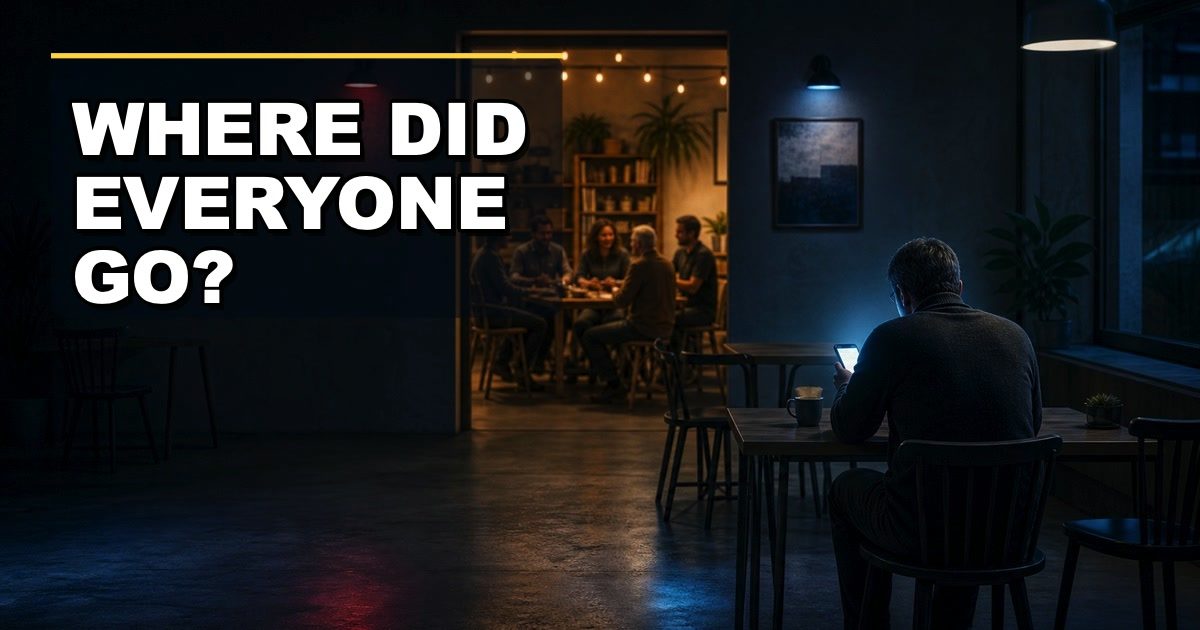
I think a lot of us are inside, tired, holding the same glowing rectangle, wondering where everybody went.
There may not be one place where people meet anymore. The bar is not the answer for everyone. Neither is church, the gym, volunteering, a dating app, or standing in produce while looking emotionally available near the avocados.
The answer may be smaller and less cinematic.
Choose one real place. Put the phone away. Ask a question. Learn a name. Go back next week.
Do that long enough and strangers become familiar. Familiar people become friends. Sometimes a friend introduces you to someone. Sometimes one of those conversations becomes the person you were hoping to find.
The right pill may not be red or blue.
It may just be the one labeled: Leave the house. Return next Tuesday.
Sources
- World Health Organization: Social connection
- U.S. Bureau of Labor Statistics: American Time Use Survey—2024 Results
- U.S. Census Bureau: Home-Based Workers and the COVID-19 Pandemic
- Pew Research Center: The experiences of U.S. online daters
- Social Science Research: Third places, neighbor interaction, and cohesion
- Psychological Science: The liking gap in conversations
- Journal of Experimental Psychology: Pleasant conversations with strangers
- Social Psychological and Personality Science: Listening behaviors and social connection
- Town of Jupiter Recreation
- Palm Beach County Library System: Jupiter Branch
- Loggerhead Marinelife Center: Volunteer
- Busch Wildlife Sanctuary: Volunteer