Trust & transparency
Evidence & disclosures
Not yet classified. This article has not yet been classified under the current editorial standard. It may predate the policy; do not assume a product was owned, tested, supplied, or independently verified unless the article says so.
Linked references: 19 explicit sources in the article.
A two-dollar gadget is only a bargain if it does the job, arrives as described, and does not create a new problem that costs more than the thing itself.
That is the part that gets lost when an app throws coupons, countdown clocks, spinning wheels, “almost gone” warnings, and a parade of products at you. The little price is real. The feeling that you must decide right now may not be.
I wanted a better answer than “Temu is a scam” or “everything on Amazon comes from the same factory anyway.” Both lines are satisfying. Neither one is useful enough.
So I looked at current Temu product testing, shopper surveys, U.S. and European enforcement, and academic work on shopping-app design. My conclusion is not that every cheap product is junk. It is that the buyer is being asked to do more of the quality control, safety checking, and self-control than the low price suggests.
This is a source-backed buying analysis, not a hands-on product review. I did not place a controlled Temu test order for this article, and Temu did not pay for or review it.
TLDR
- Temu is a real third-party marketplace, not a fake store that simply takes every shopper's money and disappears.
- A small 2025 CHOICE survey found that most respondents were satisfied, but the same shoppers also reported poor quality, misleading listings, excessive games, and notification overload.
- Independent laboratory testing and regulators have found serious problems in selected categories, especially chargers, baby products, toys, jewelry, and other safety-sensitive goods.
- In May 2026, the European Commission fined Temu €200 million for failing to properly assess the systemic risk of illegal products on its platform. Temu disagreed with the decision and said its systems had improved.
- My practical rule: use Temu only for simple, low-stakes, easily inspected products. Buy safety gear, mains-powered electronics, baby products, health products, and anything whose failure could seriously hurt someone from a seller you can identify and hold accountable.
My Short Verdict: Temu Is Not Automatically a Rip-Off, but It Can Make Bad Value Feel Like a Win
Calling the entire platform a rip-off goes too far. Products do arrive. Refunds happen. Plenty of shoppers believe they received fair value for what they paid.
Australian consumer organization CHOICE surveyed 209 people who had purchased from Temu in August and September 2025. It found that 80% were satisfied, 79% said they would buy again, and 71% would recommend it. The common verdict was basically, “you get what you pay for.” That is real evidence that the experience is not universally terrible.
The same CHOICE survey also recorded complaints about poor quality, misleading photos and descriptions, damaged packaging, unsafe electronics, too many games, and too many notifications. It was a small shopper survey, not a laboratory test or a universal score for every country and category.
That split is the honest internet consensus: a lot of people are happy with cheap, low-stakes items; a lot of people receive flimsy or disappointing products; and the most serious concerns appear when “good enough” is not good enough.
The mistake is treating delivery as the only test. A package showing up proves that the marketplace can fulfill an order. It does not prove that the item is durable, electrically safe, accurately labeled, ethically sourced, legally compliant, or cheaper after returns and replacements.
Why Can the Prices Be So Low?
There is no single secret factory door that explains every listing. The lower prices come from a stack of advantages and tradeoffs.
Temu's parent company says the platform helps merchants streamline manufacturing and commercial operations, reducing waste and prices. A marketplace connecting factories and sellers more directly to buyers can remove some traditional distributor, retail, showroom, and inventory costs. Enormous seller competition also squeezes margins.
Some products are genuinely generic items that local resellers may offer at a much higher markup. That is why shoppers sometimes find what appears to be the same organizer, cable clip, craft tool, or case on several marketplaces at wildly different prices.
But a low price can also mean thinner materials, weaker packaging, limited testing, inconsistent quality control, little after-sales service, or a seller that may be difficult to identify later. Those are costs too. They are simply not printed on the product card.
One older explanation also needs an update. For years, low-value packages entering the United States could often use the duty-free “de minimis” channel. U.S. Customs and Border Protection says duty-free treatment for shipments valued at $800 or less was suspended for all countries effective August 29, 2025. In other words, an old article claiming Temu's U.S. prices are cheap mainly because every small package still enters duty-free is now describing a previous version of the market.
Cheap can come from real efficiency. It can also come from moving verification, waiting, failure, disposal, and replacement costs onto the buyer.
The Quality Question Changes Completely by Product Category
There is no meaningful way to assign “Temu quality” to millions of products from third-party sellers. The useful question is what happens if this particular item is bad.
A crooked plastic drawer divider is annoying. A bad charger can overheat. A loose button on an adult costume is disappointing. A detachable part on a baby toy can become a choking hazard.
That is why the strongest evidence should change our behavior even though it does not describe every listing.
In May 2026, the European Commission fined Temu €200 million under the Digital Services Act. The Commission said Temu had failed to diligently assess the systemic risk of illegal products on its service. Its mystery-shopping evidence found that a very high percentage of selected chargers failed basic safety tests and that a high percentage of tested baby toys presented medium-to-high safety risks.
That decision was about Temu's risk assessment and platform obligations. It was not a finding that every Temu product is illegal. Temu said it disagreed with the decision, considered the fine disproportionate, and had strengthened its systems since the period reviewed.
Independent testing points in the same direction for selected high-risk categories. In a joint 2025 project, Stiftung Warentest and Belgian and Danish consumer groups tested 162 toys, necklaces, and USB chargers purchased from Temu and Shein. They reported that 110 failed EU requirements and rated roughly a quarter of the combined sample as potentially dangerous. The results cannot be stretched into “two-thirds of everything on Temu is unsafe,” because the sample covered three categories across two platforms. They can absolutely justify refusing to gamble on a mystery charger or baby product.
The United States has seen specific recalls too. In February 2025, the Consumer Product Safety Commission recalled about 18,650 sling carriers sold on Temu because they violated federal requirements and posed a fall hazard to babies.
One recall does not condemn a whole marketplace. It does show why a seven-dollar price should not be the main decision point when a product is carrying a child.
Are the Products Knockoffs, the Same Factory Goods, or Just Cheaply Made?
The frustrating answer is: all of those can exist in the same marketplace.
Some listings are unbranded commodities. Some are white-label products sold under several names. Some may look identical to products on Amazon, Walmart, or another marketplace because sellers reuse catalog photos or source similar products. Some copy the appearance of a branded item without using the name. Some are alleged or confirmed counterfeits.
A shared photo does not prove a shared factory, bill of materials, safety test, battery cell, firmware, inspection standard, or production batch. Even if two items came from the same factory, one could be a rejected run, a lower-spec version, or a lookalike made to hit a lower price.
In the United States, Temu agreed in 2025 to pay a $2 million civil penalty to resolve Federal Trade Commission allegations that it failed to provide required seller information and reporting tools across parts of its marketplace, including gamified listings. Those rules exist so shoppers can identify high-volume sellers and report suspicious, counterfeit, stolen, or unsafe goods.
Temu has an intellectual-property reporting portal and says its 2025–2026 enforcement program expanded proactive monitoring. Those company claims are worth noting. They do not give a shopper permission to assume that a suspiciously cheap branded item must be authentic.
My rule would be simple: if the listing's value depends on the item being a real brand, treat a price that makes no economic sense as a warning, not a personal invitation to beat the system.
The Bigger Trap May Be the Shopping Experience
The most interesting part of Temu may not be how cheaply it sells products. It may be how effectively it turns shopping into a series of tiny unfinished games.
The word “dopamine” gets thrown around too casually online. I cannot diagnose an app—or a shopper—as addictive from a colorful wheel. But I can identify design patterns that reduce the quiet time people normally use to ask, “Did I come here to buy this?”
The European Union's consumer-protection network has an ongoing action against Temu. It identified concerns including fake discounts, pressure selling through false scarcity or deadlines, forced spin-the-wheel gamification with hidden reward conditions, misleading return information, questionable review authenticity, and hard-to-find contact details.
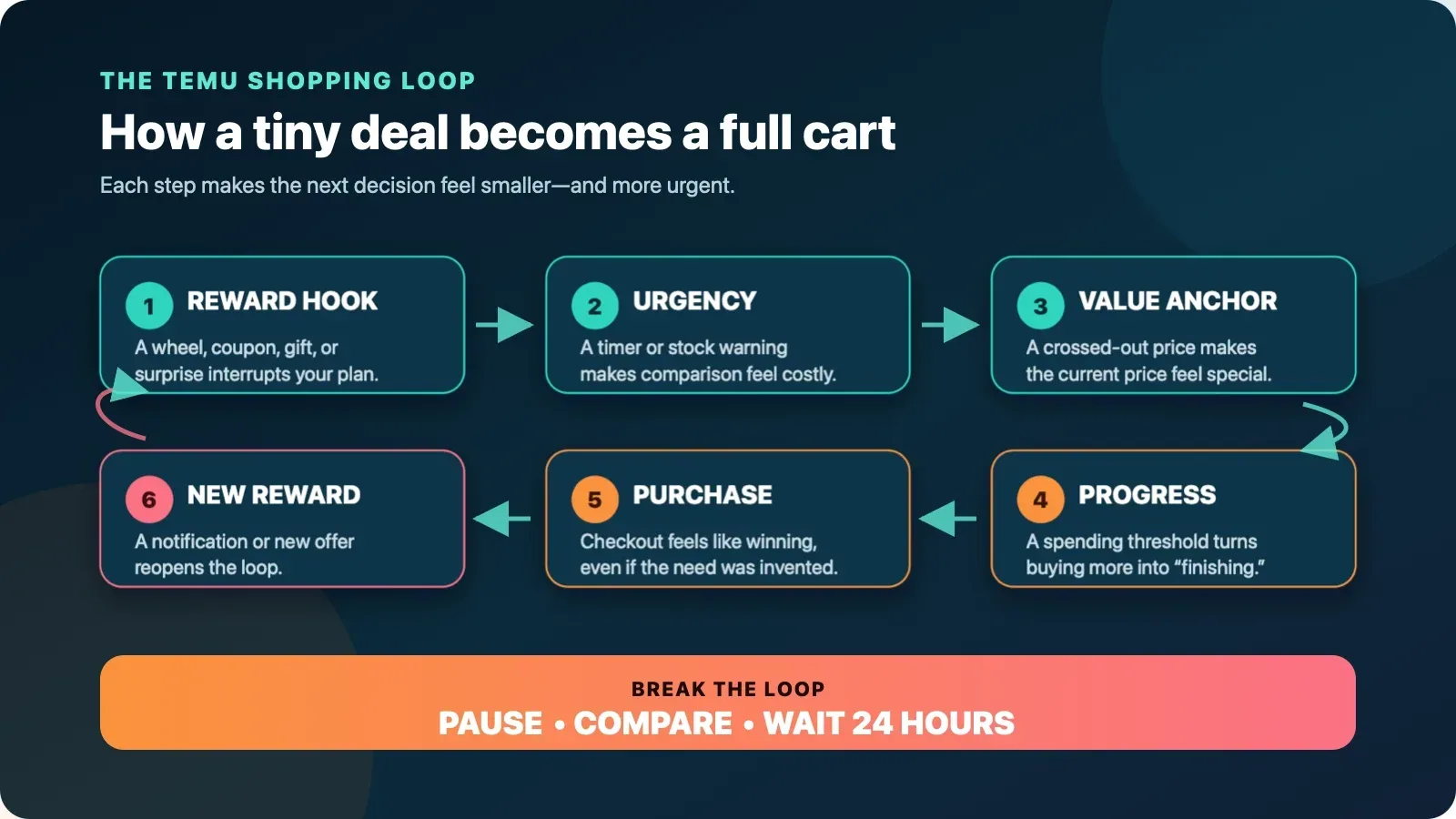
Those are not random complaints from someone irritated by a pop-up. They map onto a shopping loop:
- Interrupt the plan. A wheel, coupon, gift, or personalized recommendation replaces the item you originally meant to find.
- Create urgency. A countdown, stock warning, or expiring reward makes comparison feel like losing.
- Anchor the value. A large crossed-out price makes the current number feel cheap before you know whether the reference price was meaningful.
- Create progress. A minimum order, coupon threshold, or nearly completed reward turns spending more into “finishing.”
- Add social proof. Sales counts, ratings, cart activity, and reviews make hesitation feel unnecessary—even though EU authorities questioned how review authenticity was explained.
- Bring the shopper back. Notifications and new rewards reopen the loop after the original need is gone.
A 2024 peer-reviewed design study that examined Temu alongside another shopping app found pressuring dark patterns were the most frequent type observed and that intrusive pop-ups disrupted attention. The researchers reported that older participants had more difficulty recognizing patterns that did not apply direct pressure. A separate 2026 university study of 251 Temu users in Lima found that reward, competition, absorption, and autonomy were positively related to enjoyment, which was then related to purchase intention. These studies have limited samples and settings, but they support the basic point: the games are not decorative. They are commerce tools.
The FTC's broader dark-pattern report explains why baseless countdown timers, false limited-time messages, fake discounts, and hidden information matter. They can impair choice even when the final purchase still requires a tap.
This is the social part of the trap too. Referral rewards turn friends and family into distribution. Sales counts and reviews turn other shoppers into pressure. Influencer promotions turn a product demonstration into a relationship signal. The app does not merely show inventory. It surrounds the purchase with reasons to act before the boring part of your brain finishes checking the dimensions.
What the Coupon Trap Looks Like in a Live Session
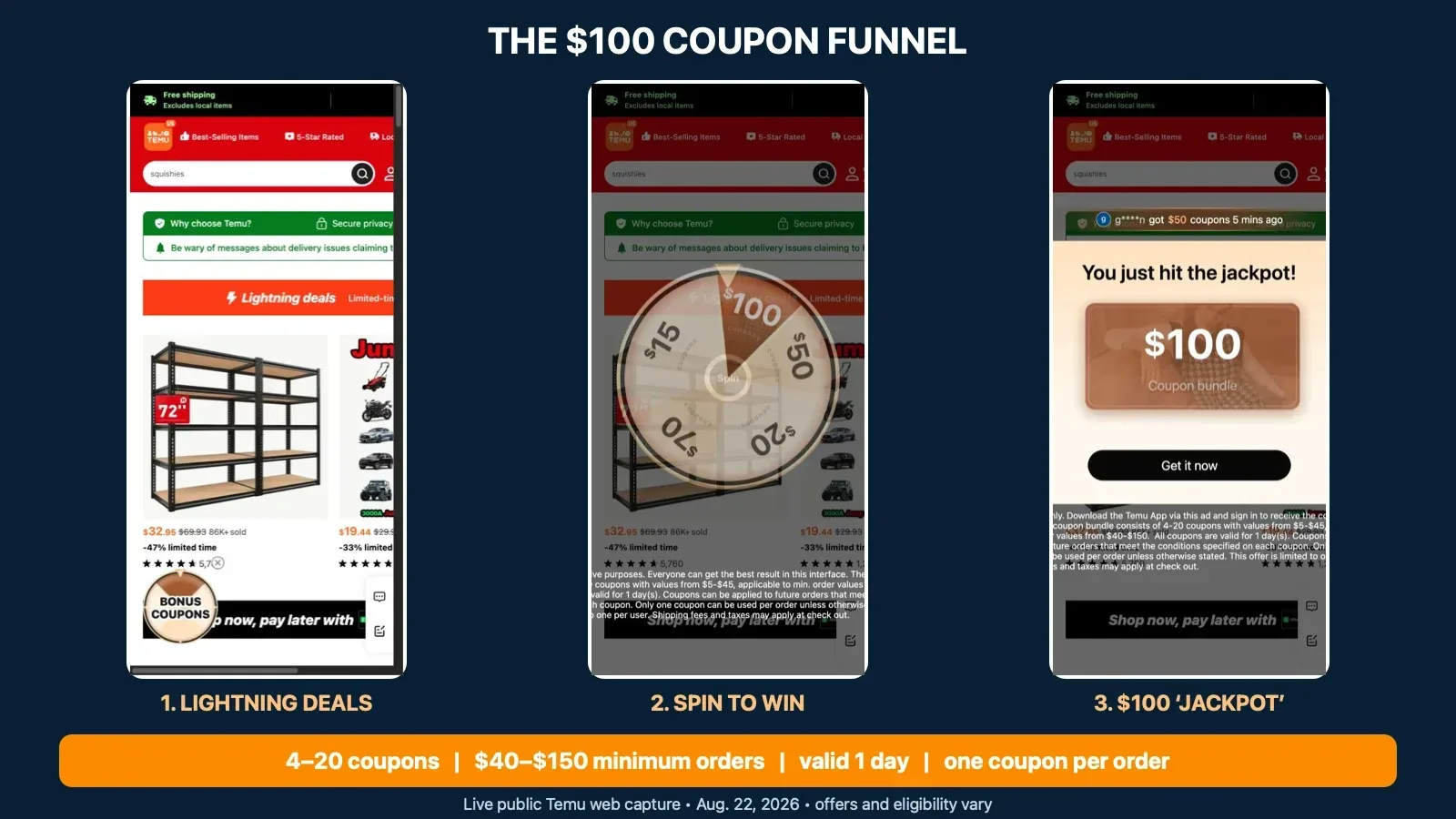
I opened Temu's public U.S. website in a mobile-sized browser on August 22, 2026. This was the responsive web experience, not a recording of the native app, and the exact offers can vary by account, place, and time. Still, the sequence was revealing.
The home page showed “Lightning deals,” crossed-out reference prices, percentage discounts, sold counts, review counts, and a floating “Bonus Coupons” button. Tapping that button opened a prize wheel with a $100 slice. The small disclosure under the wheel said everyone could get the best result in that interface. The next screen announced, “You just hit the jackpot!” and displayed a $100 coupon bundle beside a “Get it now” button and a recent-winner message.
The large number did not mean $100 off one purchase. The terms visible in that same flow described a bundle of 4–20 coupons, individual coupon values from $5 to $45, minimum orders from $40 to $150, a one-day expiration, and one coupon per order unless otherwise stated. That is a perfect example of how a big headline can create excitement before the conditions turn the “prize” into several future spending prompts.
What the Internet Actually Thinks
There is no clean internet consensus because people are reviewing different sellers, products, countries, expectations, and price points.
Positive stories usually sound like this: “I knew it was cheap, I read the photo reviews, I bought a simple item, it arrived, and it was good enough.” Negative stories usually sound like this: “The photo oversold it, the material was worse than expected, the sizing was strange, the item failed, or the return was not worth the time.”
Both can be true.
The more reliable synthesis is:
- Low-stakes products can be genuinely inexpensive and useful. A buyer who can inspect the item immediately and tolerate a dud may get real value.
- Quality is inconsistent because the platform is a marketplace, not one manufacturer. The product page, seller, and exact variant matter more than the Temu logo at the top.
- Reviews help, but they are not laboratory tests. Photo and video reviews can reveal size and finish; they cannot prove electrical isolation, chemical limits, load ratings, or authentic components.
- The refund experience reduces the perceived risk for many shoppers. It does not undo waste, lost time, copied designs, or an unsafe item already used.
- The platform is built for discovery and impulse, not calm procurement. The buyer has to deliberately reintroduce friction.
That is why I would not call Temu a universal scam. I would call it a high-verification marketplace wrapped in a low-friction spending machine.
What I Would Buy—and What I Would Avoid
I would consider simple, unbranded, low-stakes items that can be inspected with my eyes and hands before use: basic organizers, non-electrical craft tools, simple party decorations, storage accessories, or an inexpensive case where failure is merely annoying.
I would slow down around clothing, shoes, hand tools, jewelry, pet accessories, and anything described with a familiar brand shape but an unfamiliar seller. The savings may be real, but sizing, materials, durability, skin contact, load strength, and design-copying questions can change the answer.
I would buy elsewhere when the product:
- plugs into household power, charges an expensive device, contains an unknown battery, or can overheat;
- protects a head, body, child, pet, vehicle, home, password, or door;
- touches food for heat or long storage;
- goes in or on the body as medicine, supplements, cosmetics, or protective health gear;
- is intended for a baby or young child;
- claims a safety certification, load rating, storage capacity, ingredient list, or branded identity that I cannot independently verify;
- would be difficult to return, expensive to replace, or dangerous to discover was bad.
This is not because products made in China are automatically poor quality. Many excellent products are made in China. The issue is whether the specific seller, specification, testing, traceability, and accountability are visible.
The Bargain-or-Trap Test
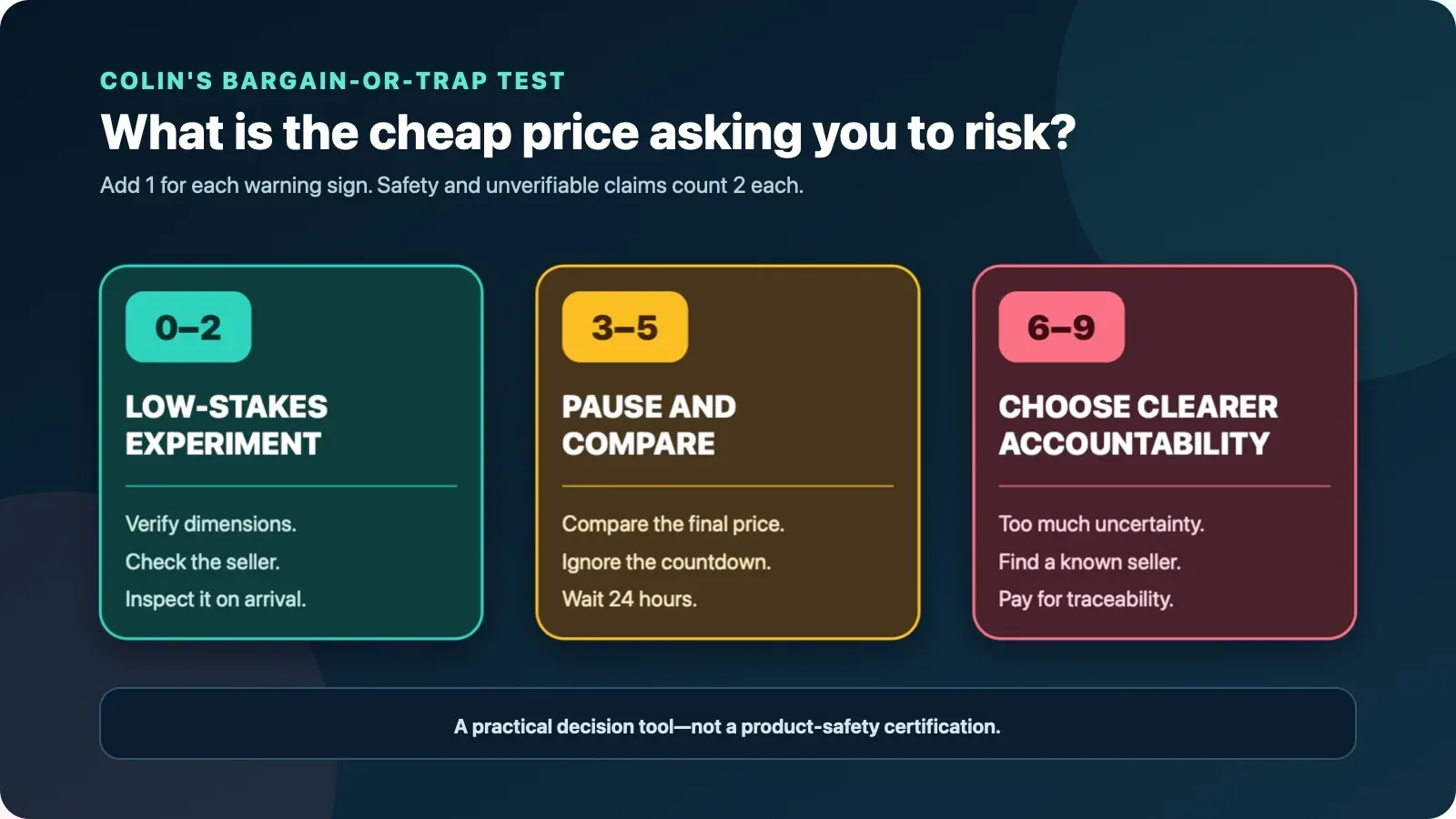
Before buying, score one point for every “yes.” Score two points for the first two questions because safety and unverifiable claims deserve more weight.
- Could failure burn, cut, poison, injure, unlock, strand, or expose someone? Add 2.
- Does the value depend on a brand, certification, ingredient, capacity, load rating, or safety claim I cannot verify? Add 2.
- Is the seller's identity or contact information hard to find? Add 1.
- Is the deal being pushed by a countdown, wheel, huge crossed-out price, minimum spend, or expiring reward? Add 1.
- Can I buy a clearly verified alternative locally or from a known seller for only a little more? Add 1.
- Would one return, replacement, or hour of my time erase the savings? Add 1.
- Did I search for this item before opening the app, or did the app create the desire? If the app created it, add 1.
- 0–2 points: Probably a reasonable low-stakes experiment. Still verify the dimensions and seller.
- 3–5 points: Pause, compare the delivered price, and wait 24 hours.
- 6–9 points: The cheap price is asking you to accept too much uncertainty. Buy from a seller with clearer accountability.
A 15-Minute Way to Break the App's Spell
If you want to test whether Temu is saving you money, do not start by browsing the feed.
- Write down the exact item and job before opening the site.
- Use the website in a browser if that gives you fewer interruptions, and turn off promotional notifications.
- Ignore wheels, gifts, coupon thresholds, and crossed-out reference prices.
- Compare exact dimensions, materials, model numbers, seller identity, shipping, duties, and the final delivered total.
- Search the product image and description elsewhere. Similar is not proof of identical, but it can expose a fake markdown or a better-supported seller.
- Check independent recalls and safety advice for the category.
- Leave the cart for 24 hours. If the product still solves the original problem, reconsider it without the timer running.
That little bit of friction is not ruining the bargain. It is restoring the decision the interface was trying to hurry.
One More Cost the Price Tag Does Not Show
Low prices also raise labor and supply-chain questions. A bipartisan U.S. House Select Committee reported in 2023 that Temu had no audit or compliance system at that time to affirmatively ensure compliance with the Uyghur Forced Labor Prevention Act, beyond supplier terms. Temu now publishes a third-party code of conduct prohibiting forced labor and says it uses risk assessment and compliance processes.
Those facts should not be compressed into “every Temu product uses forced labor” or “a policy PDF proves the supply chain is clean.” The honest conclusion is that traceability matters, the historical finding was serious, and ordinary shoppers still have limited visibility into the path of a particular product.
The same caution applies to environmental cost and copied creative work. A refund may make the shopper whole financially while leaving behind an unusable product, extra packaging, another shipment, or an artist trying to remove copied designs from a dozen seller accounts.
Bonus: Temu's Hall of Questionable Ideas
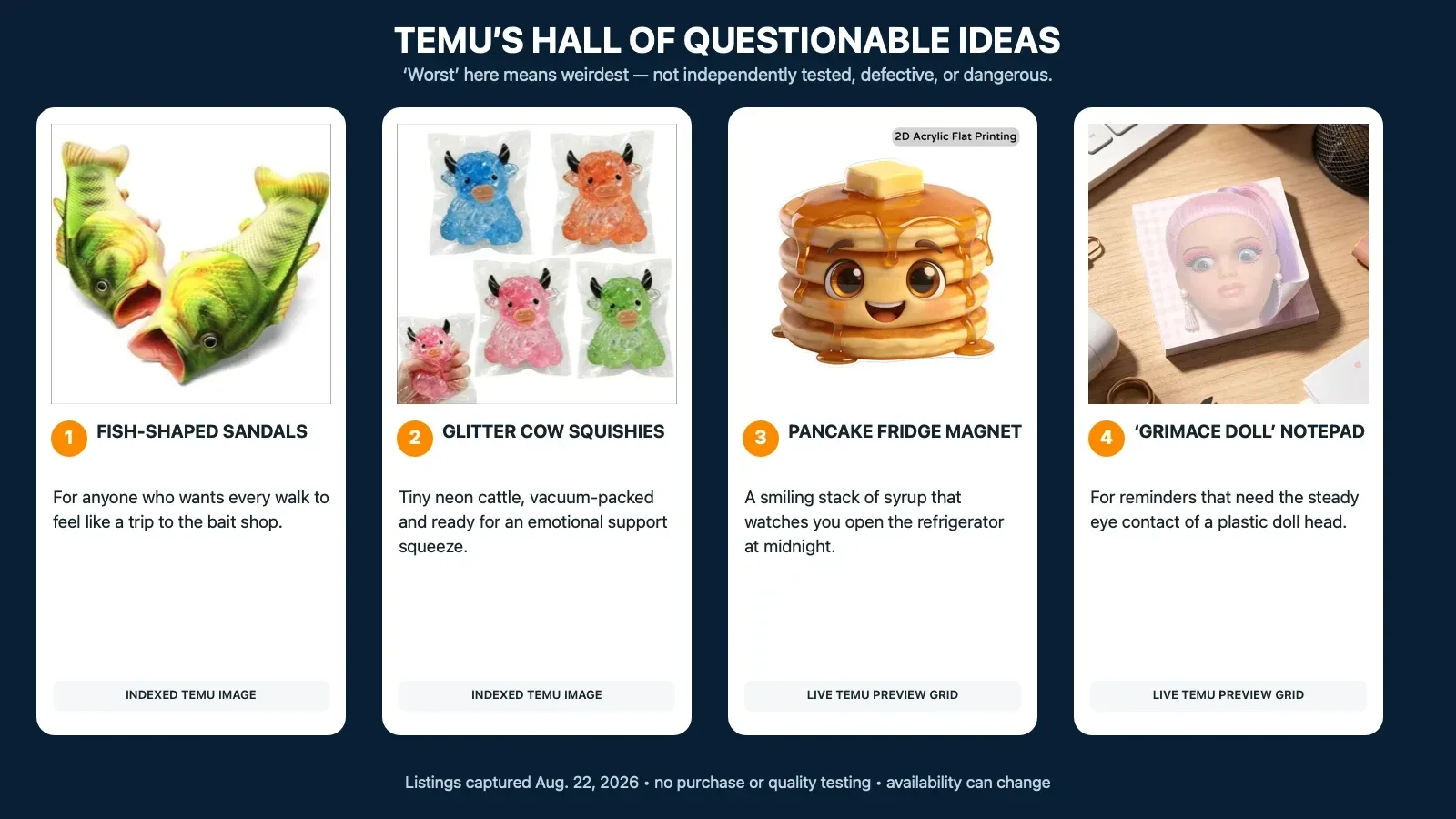
After all that serious shopping psychology, I needed a laugh. So here is a tiny gallery of products that Temu's public pages or current search index put in front of me. I did not order or quality-test any of them. “Worst” means weirdest here—not defective, unsafe, or a scam. Listings, prices, and availability can change quickly, and a direct page may later disappear or require sign-in.
- Fish-shaped sandals: for anyone who wants every walk to feel like a trip to the bait shop.
- Glitter cow squishies: tiny neon cattle, vacuum-packed and ready for an emotional-support squeeze.
- A smiling pancake fridge magnet: it watches you open the refrigerator at midnight and knows exactly why you are there.
- A “grimace doll” notepad: for reminders that need the steady eye contact of a plastic doll head.
Final Thought
Temu understands something important about money: when life is expensive, a tiny price feels like relief.
That does not make the shopper foolish. It makes the offer powerful.
But cheap and valuable are not the same word. A real bargain survives a safety check, a seller check, a comparison, and one night's sleep. If the deal only works while a clock is ticking and confetti is falling, the product may not be the thing on sale. Your attention may be.
I would still use Temu selectively. I would just shop like the quality-control department is me—because sometimes it is.