
Trust & transparency
Evidence & disclosures
Not yet classified. This article has not yet been classified under the current editorial standard. It may predate the policy; do not assume a product was owned, tested, supplied, or independently verified unless the article says so.
Linked references: 7 explicit sources in the article.
TL;DR
- Hypershell Halo is a newly announced full-leg consumer exoskeleton with four motors, a detachable battery, and a current U.S. preorder price of $2,299.
- The idea is genuinely interesting to me after rehab: assistance that helps somebody keep moving could also help rebuild confidence. But Hypershell explicitly says Halo is not a medical or rehabilitation device, does not provide balance support or fall prevention, and requires unassisted walking and balance.
- Before I would trust it on a trail, I would want a correct fit, the real ready-to-wear weight, a battery-depletion plan, a simple indoor test, a flat familiar route, a companion, and much more independent evidence.
I have spent enough time recovering and going through rehab to understand why a powered walking exoskeleton gets people's attention.
It is not only the robot part, although I am absolutely not above being impressed by robot legs.
It is the possibility that a device could help an older person, somebody coming back from a long health setback, or somebody whose confidence has taken a beating feel more capable of moving through an ordinary day.
I also understand why something that looks like outdoor gear might feel less conspicuous than a cane or crutches. That feeling is real. But a mobility aid that keeps somebody safe should never be treated as embarrassing, and a sleek gadget is not automatically a safer replacement.
That is exactly where the Hypershell Halo story becomes interesting—and where the marketing needs a reality check.
What Hypershell Announced
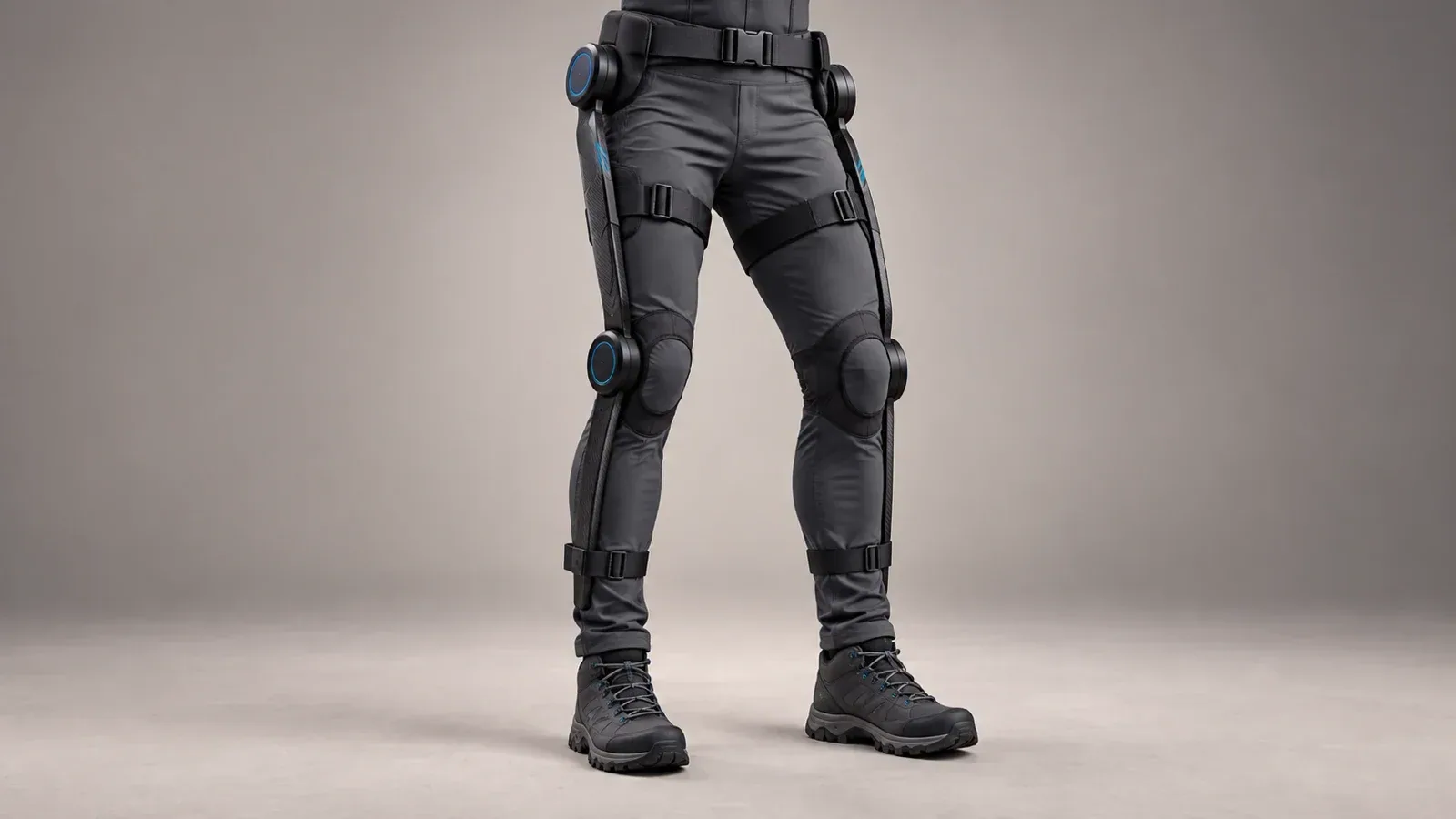
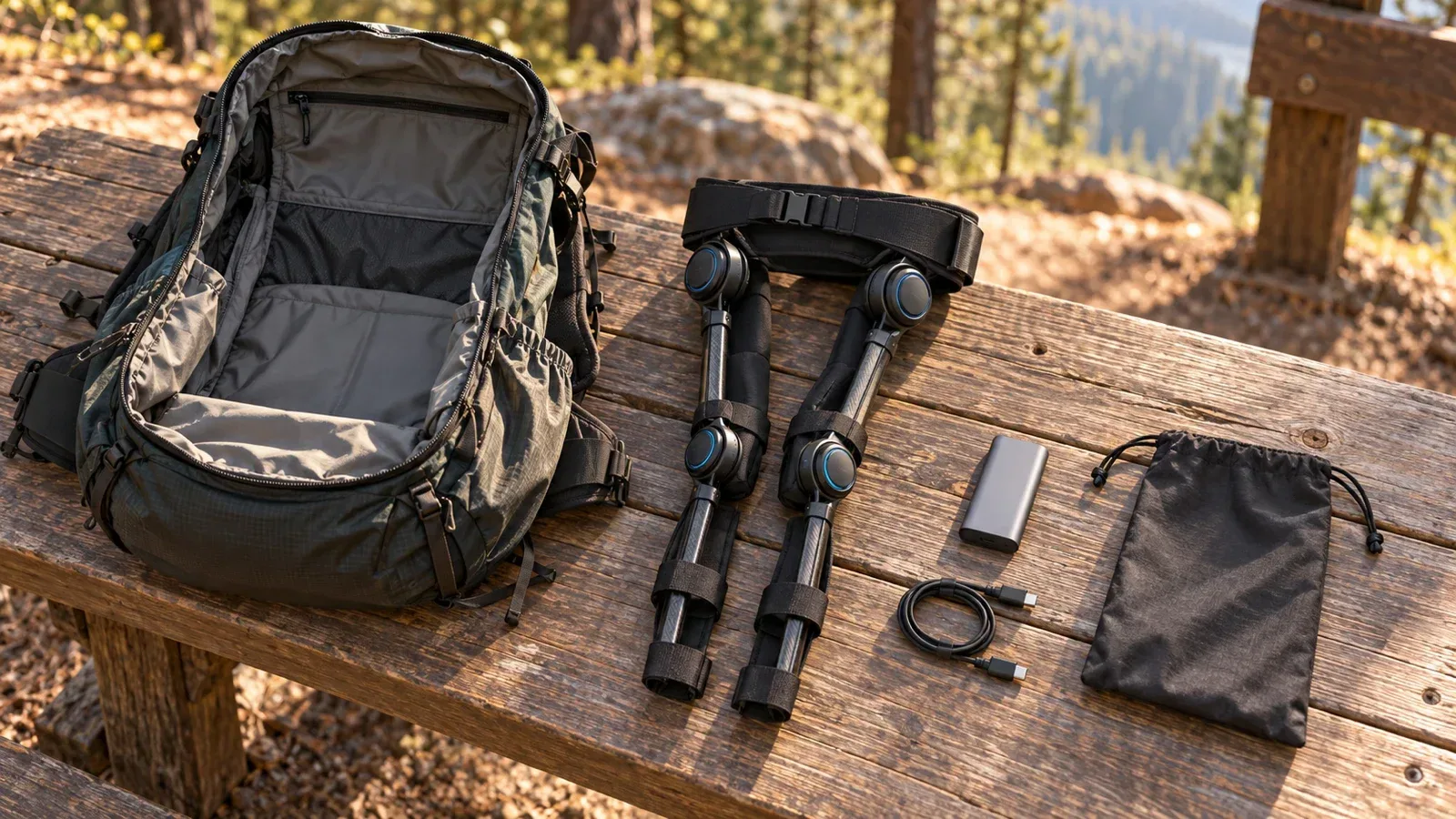
Hypershell unveiled Halo at IFA 2026 as a full-leg consumer exoskeleton that powers both the hips and knees. The company says its four motors can produce up to 1,490 watts, its detachable 72 Wh battery can provide up to 20 kilometers of range, and the frame folds into less than eight liters of space.
The current U.S. product page lists Halo at $2,299 as a preorder, with shipping estimated to begin in late November 2026. Hypershell also lists an IP54 ingress rating and a 14-day return window.
Those are all company specifications or policies, not my test results. Hypershell says actual range and performance vary with the user, fit, assistance level, terrain, load, temperature, battery condition, and other conditions.
One detail already shows why ordinary questions matter. The launch announcement highlights a 2.6 kg frame. The product page separately lists 3.2 kg with the wearable system, excluding the battery, and says the battery weighs 370 g. I would want the exact ready-to-wear number—with straps, battery, cables, and whatever I am carrying—before deciding whether it feels lightweight after an hour.
The Medical Line Is Not Fine Print
Hypershell's own product page calls Halo “lifestyle power,” says it requires unassisted walking and balance, and says it is not a medical aid. Its safety guide goes further: the product does not provide balance assistance, weight support, fall prevention, or pain relief.
That matters for the exact reason I find the product interesting.
I can imagine a future where consumer exoskeletons help people stay active, keep up with family, or feel less intimidated by a longer walk. I can also imagine somebody seeing the same video and assuming the device can replace a cane, compensate for instability, or become a do-it-yourself rehabilitation tool.
Halo is not sold for that job.
In the United States, powered lower-extremity exoskeletons intended for medical purposes have a separate FDA Class II device category. That does not make every powered frame a medical device. It explains why a consumer product and a prescription rehabilitation system should not be treated as interchangeable just because both have motors near the knees.
I am not a doctor, and this is not medical advice. This is just what I am learning through my own recovery, and anything medical should be discussed with your own care team.
The 10 Normal Questions I Would Ask
1. Can I already walk and balance safely without it?
This is the first question because it can end the shopping process before the fun specifications begin.
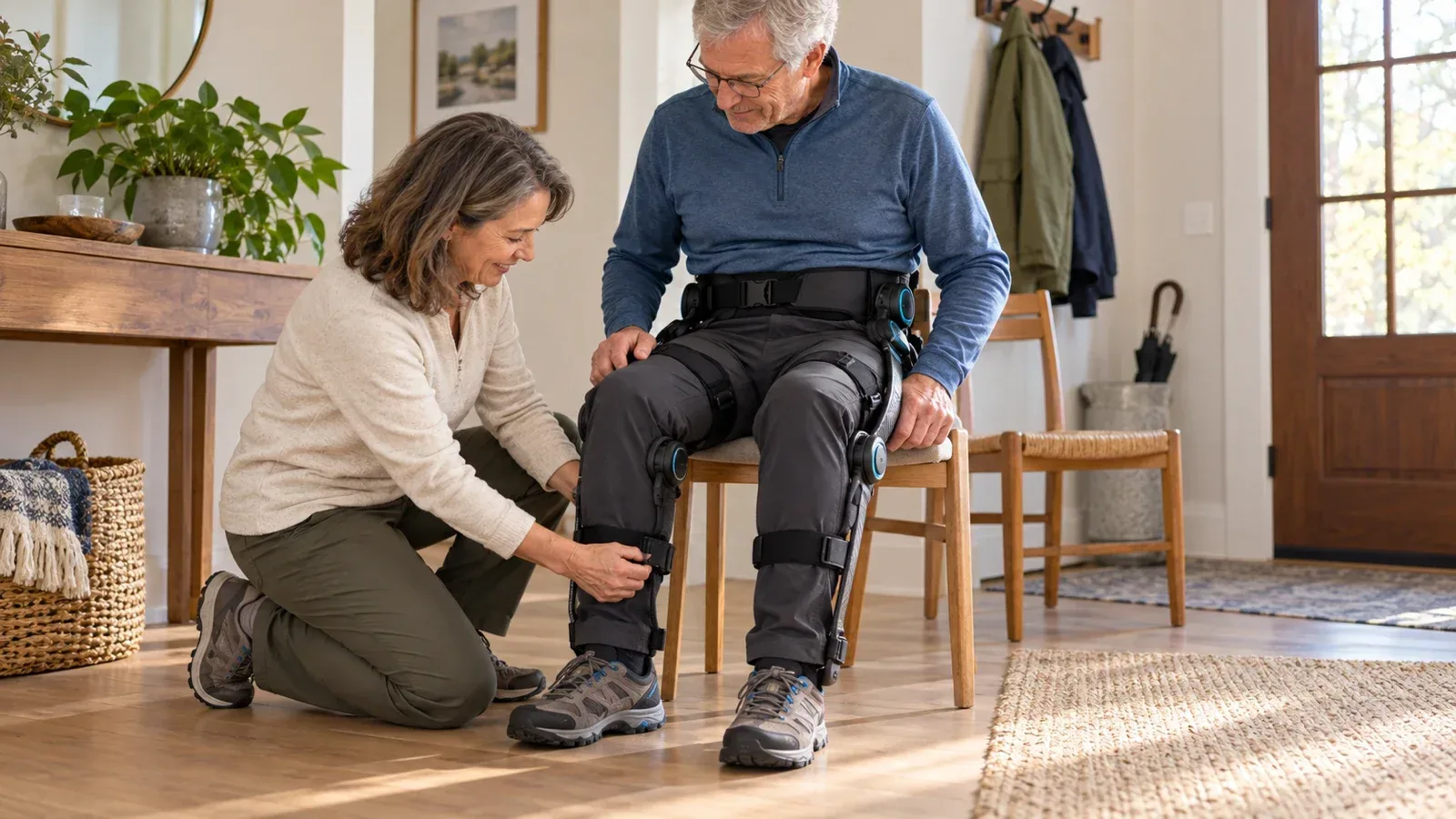
Hypershell says Halo requires unassisted walking and balance. Its safety guide tells older adults, people who are physically frail, people with mobility or balance limitations, and people with cardiovascular, neurological, or musculoskeletal conditions to get and follow explicit medical clearance before first use.
If what I really need is balance support, fall prevention, pain relief, or a medically supervised rehabilitation tool, Halo's own documents say this is not that product.
2. Does it fit my body—not just my height?
An exoskeleton is not a pair of headphones. The mechanical joints need to line up with human joints.
Hypershell's fit process asks for height, weight, waist circumference, hip width, and the distance from the hip joint to the outside of the knee. The current standard-fit ranges include a 64–140 cm waist, 31–41 cm hip width, and 38–48 cm hip-to-knee length.
I would not buy based on height alone. I would want a supervised fitting, a slow sit-to-stand check, a few turns, and enough time to notice rubbing, pressure, slipping, or a knee joint that feels slightly out of place.
3. What is the real weight once it is ready to wear?
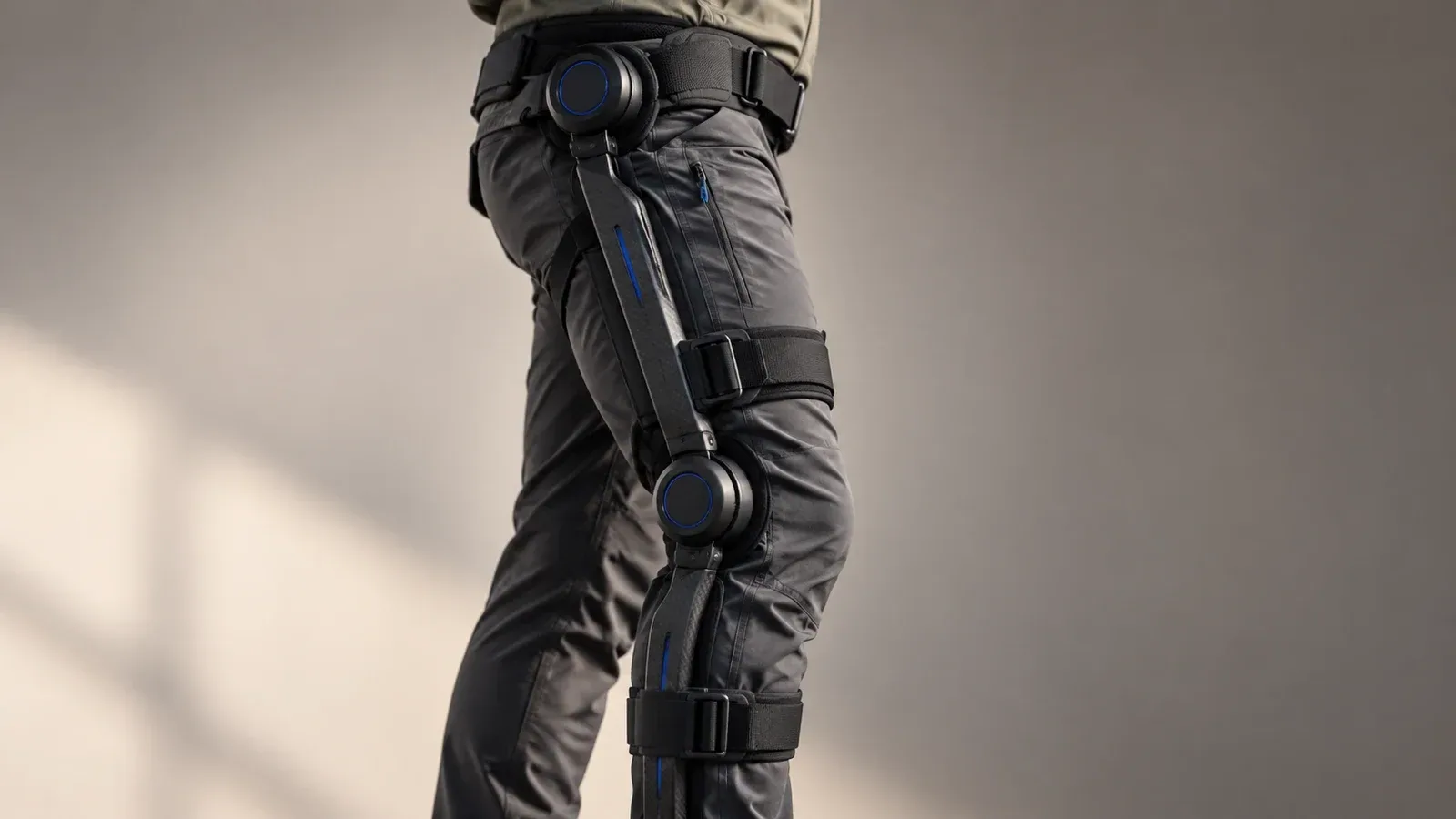
“2.6 kg” sounds impressively backpackable. It is about 5.7 pounds.
But the product page lists 3.2 kg with the wearable system while still excluding the 370 g battery. That appears to put a complete worn setup above the headline number before spare batteries, water, a phone, or normal trail gear enter the picture.
That does not automatically make Halo too heavy. It means the useful number is not the lightest component number. It is the total weight I will wear and carry after the excitement wears off.
4. What happens when the battery gets low—or the system stops assisting?
Hypershell rates one battery for up to 20 km, but it also says range changes with slope, speed, weight, temperature, mode, fit, battery condition, and load.
The battery is detachable and swappable, which is good. My next questions would be less glamorous: Can I change it while standing safely? How heavy and expensive is a spare? How does the device behave at zero charge? Can I comfortably walk back with the motors off?
A powered device should never become the only plan for getting home.
5. How hot, sweaty, or annoying does it get after an hour?
The Halo uses a waist system and straps around the legs. Hypershell says the straps should be worn over clothing, not against bare skin, and tells users to stop if skin problems occur.
That makes heat and friction buying questions, especially for me in Florida. A five-minute trade-show demo cannot answer what the waist belt feels like in humidity, what happens under a backpack hip belt, or whether a small pressure point becomes a big problem at mile three.
I would want a real return-window test with the same pants, pack, weather, and walking pace I normally use.
6. What does IP54 actually let me do?
IP54 is useful, but it does not mean waterproof.
Hypershell describes Halo as protected against dust and splashing water. The company's broader safety guide still says to avoid exposing the product and battery to rain, moisture, or immersion and never to charge wet equipment.
My plain-English rule would be simple: a light accidental splash is not permission to plan a wet-weather adventure. I would want Halo-specific guidance on rain before trusting it under a Florida sky that can turn into a car wash with almost no notice.
7. What happens if I trip, turn awkwardly, or the device misreads me?
This is where “assistive” can be confused with “protective.”
The company says Halo can cushion impacts and assist different movements, but its safety guide says the exoskeleton does not prevent falls or provide balance assistance. It also advises against making the first use outdoors or in a hazardous area.
My first test would not be a rocky trail, a steep descent, or a heroic video. It would be indoors or on a flat, familiar path, at low assistance, with room to stop and a companion close enough to help if something feels wrong.
8. Is it actually allowed on the trail I want to use?
There may not be one universal answer.
Land managers write rules around motorized equipment, mechanized travel, accessibility, wilderness protection, and other power-driven mobility devices. The National Park Service, for example, distinguishes wheelchairs from other battery-powered mobility devices and tells visitors to check individual park guidance.
I would contact the park, preserve, or trail manager with the exact product name and route before arriving. “But it attaches to my legs” is not the kind of legal interpretation I want to test with a ranger halfway into a hike.
9. What happens when it needs service—or simply does not work for me?
The current U.S. listing advertises a 12-month warranty and 14-day returns. Hypershell's return policy says a non-defective return may leave the customer responsible for shipping, and the product needs to remain in like-new condition with its packaging and accessories for approval.
That creates a practical conflict: the only way to know whether a wearable fits may be to use it, but visible trail wear could complicate a return.
Before paying $2,299, I would get written answers about trial fitting, return shipping, restocking or inspection, repair turnaround, replacement parts, battery replacement, and support after the warranty. I would also keep every piece of packaging until I was certain.
10. What independent evidence would make this more than a very good demo?
I found recent trade-show hands-on coverage, including a GameStar editor who wore Halo on an indoor course and reported noticeable assistance and good freedom of movement. That is useful first-impression evidence. It is not a long trail test, a rehabilitation study, a fall-risk study, or proof of long-term reliability.
The evidence I want is wonderfully boring: diverse body sizes, older users, hot-weather walking, repeated battery cycles, powered-off walking, missteps, emergency removal, long-term strap wear, repair data, and a clear test method behind every fatigue percentage.
For any recovery-related claim, I would want evidence designed and reviewed for that population—not an outdoor marketing video with a new caption.
The One Ordinary-Day Test I Would Actually Want
Before shopping, I would take one normal walk without an exoskeleton and write down five things:
- Distance and time.
- Hills or elevation change.
- Backpack weight.
- Weather and temperature.
- The exact point where fatigue, discomfort, instability, or lack of confidence changes the plan.
That little record is more useful than a peak-watt number because it identifies the real problem.
If I ever tested Halo after getting the right medical guidance, I would repeat that walk on a flat, familiar route with a companion. I would start with low assistance, stay close to the starting point, and stop at the first sign of rubbing, balance trouble, unusual fatigue, pain, dizziness, device error, or behavior I did not expect.
The goal would not be to prove I can go farther. The goal would be to learn whether the machine makes an ordinary walk feel more manageable without creating a new problem.

My Answer Today
I am interested. Very interested.
The idea of a device that quietly gives somebody a little help at the hips and knees feels much more human to me than the usual “become superhuman” sales pitch. Confidence and dignity matter, especially when illness, surgery, age, or a long stretch of reduced activity has made ordinary movement feel less ordinary.
But the responsible version of that hope has boundaries.
Halo is currently a $2,299 preorder. It has promising specifications, a clever full-leg design, and a few encouraging trade-show impressions. It also has no verified long-term record yet, and the manufacturer explicitly says it is not a medical or rehabilitation device and does not replace balance support.
So I would not buy it to fix recovery. I would consider it only as consumer outdoor equipment, after fit and safety questions were answered, and only if the ordinary-day problem it solves was clear.
Final Thought
Recovery can make confidence feel like a physical thing. Sometimes the hardest part of a walk is not the distance. It is wondering whether your body will cooperate all the way back.
That is why I do not want to dismiss consumer exoskeletons as toys. I can see the possibility. I can also see how quickly possibility turns into a promise the product was never tested or approved to make.
The right first question is not, “How powerful are the robot legs?”
It is, “What would make one ordinary day safer, easier, and more independent—and what evidence do I need before I trust a machine with that job?”
For now, my first step is much less futuristic: measure the real walk, name the real problem, and do not let a shiny gadget answer a medical question it was never built to answer.
Sources and Access Notes
All sources below were accessed September 13, 2026. Product price, preorder status, delivery timing, policies, specifications, and guidance can change and should be rechecked immediately before publication or purchase.
- Hypershell Halo announcement, September 3, 2026
- Hypershell Halo U.S. product page
- Hypershell Exoskeleton Safety Guidelines v2.0
- Hypershell return and replacement policy
- FDA powered lower-extremity exoskeleton classification
- National Park Service mobility-device guidance
- GameStar IFA 2026 hands-on report
This is a researched first look. I have not bought, worn, tested, or received Hypershell Halo. Manufacturer claims are identified as claims, and the independent hands-on cited above was a short trade-show experience rather than long-term testing.