
Trust & transparency
Evidence & disclosures
Evidence basis: Mixed evidence. The article combines more than one evidence type; the evidence summary identifies which claims come from which basis.
Sources checked: Aug 22, 2026
Linked references: 15 explicit sources in the article.
The HOVERAir VERSA might be the first camera pitch this year that I understood before the demonstration was over: it is basically a DJI Pocket with removable wings.
That sounds ridiculous. It also makes a strange amount of sense.
Use it in your hand for stabilized vacation clips. Snap on the Flight Kit when a selfie stick cannot get far enough away. Let it follow you through an open park, pull back to reveal the view, or orbit the family without asking a stranger to become the camera operator.
The question is not whether that trick is cool. It is. The real question is whether the VERSA is good enough on the ground, useful enough in the air, and affordable enough as a complete kit to replace gear instead of becoming one more interesting object in the camera bag.
I have not used a production VERSA, and the first full independent reviews were not available when I researched this on August 21, 2026. HOVERAir's image-quality, tracking, dynamic-range, battery, and flight claims are company claims until production hardware is tested. This is a buying analysis, not a hands-on review wearing a fake mustache.
Watch HOVERAir Introduce VERSA
HOVERAir's launch post includes this release video from founder and CEO MQ Wang. It is a useful way to see the handheld-to-flight idea being pitched, but it is first-party launch material rather than an independent camera or flight test.
TLDR
- HOVERAir VERSA is a real two-in-one idea: a three-axis handheld gimbal camera that connects to a self-flying module for automatic follow, orbit, pull-back, and other aerial shots.
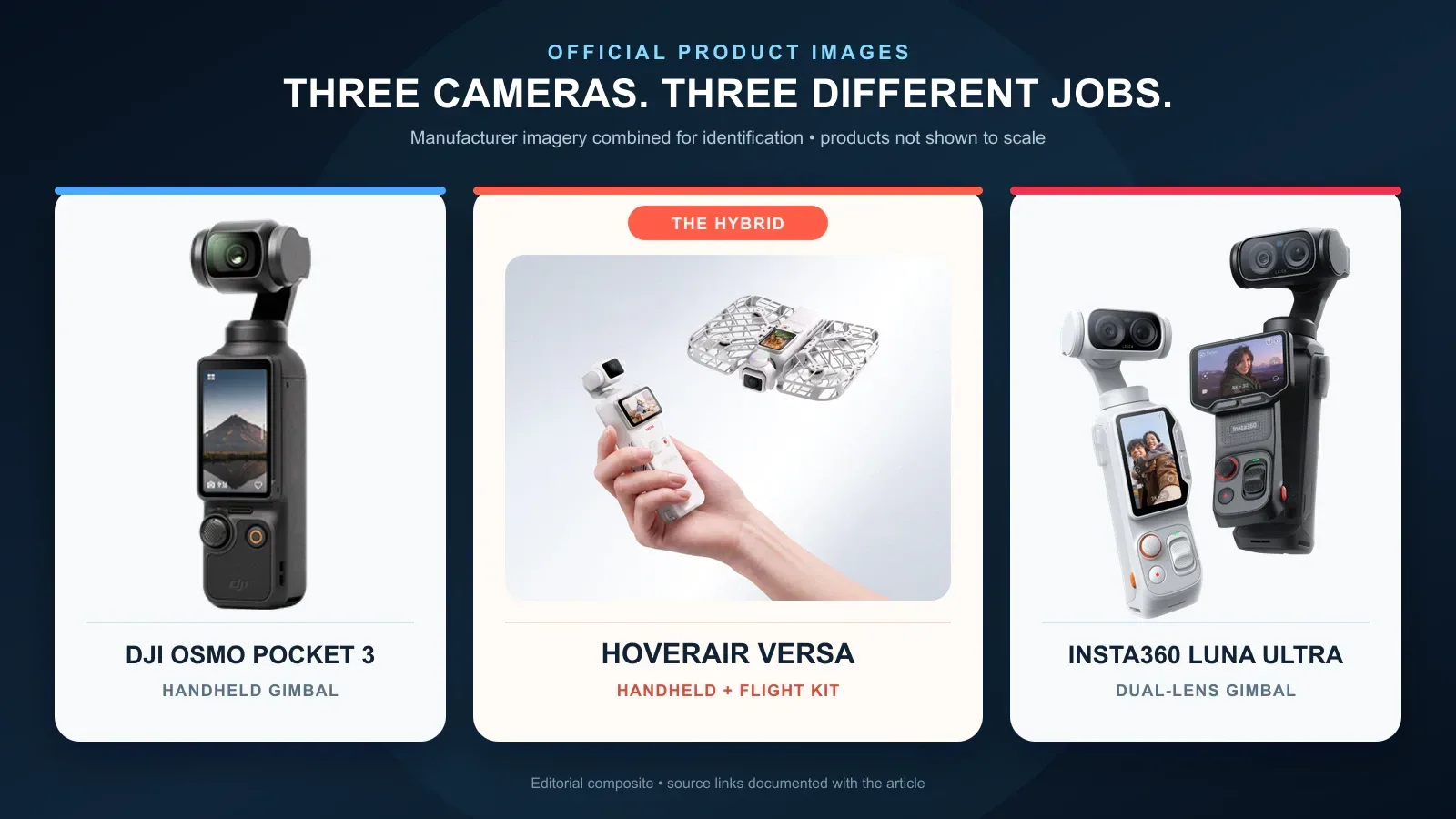
- The camera records up to 4K/60fps from a 1/1.3-inch sensor. That sensor is smaller than the 1-inch main cameras in the DJI Osmo Pocket 3 and Insta360 Luna Ultra.
- The $499 campaign price reported for the VERSA alone is not the price of the full flying experience. The Flight Kit is the feature that makes the product special, so compare complete tiers, shipping, and taxes.
- HOVERAir claims up to 180 minutes of handheld 4K/30 recording and up to 14 minutes of flight. Those figures describe very different jobs and should not be treated as one continuous battery.
- At under 230 grams in flight configuration, it may avoid U.S. recreational registration in some situations, but it is still a drone when it flies. Airspace, TRUST, line-of-sight, park, property, and non-recreational rules still matter.
- My verdict today: genuinely useful for the right solo traveler, parent, or creator, but a wait-for-reviews purchase for most people.
What VERSA Is Actually Trying to Replace
HOVERAir is not really selling a better selfie stick. It is trying to replace three separate ways of filming:
- A phone or pocket camera for normal handheld video
- A phone gimbal or selfie stick for smoother movement and wider framing
- A small follow-me drone for the occasional shot where the camera needs to leave your hand
That last part is the reason VERSA is more interesting than another pocket camera announcement. A Pocket 3 can pan and track you from a table or tripod, but it cannot move ten feet behind you while you walk. A Luna Ultra can switch between a wide main camera and a telephoto view, but it cannot rise above a path and reveal the landscape.
VERSA's removable flight hardware changes where the camera can be, not just how steady the picture looks.
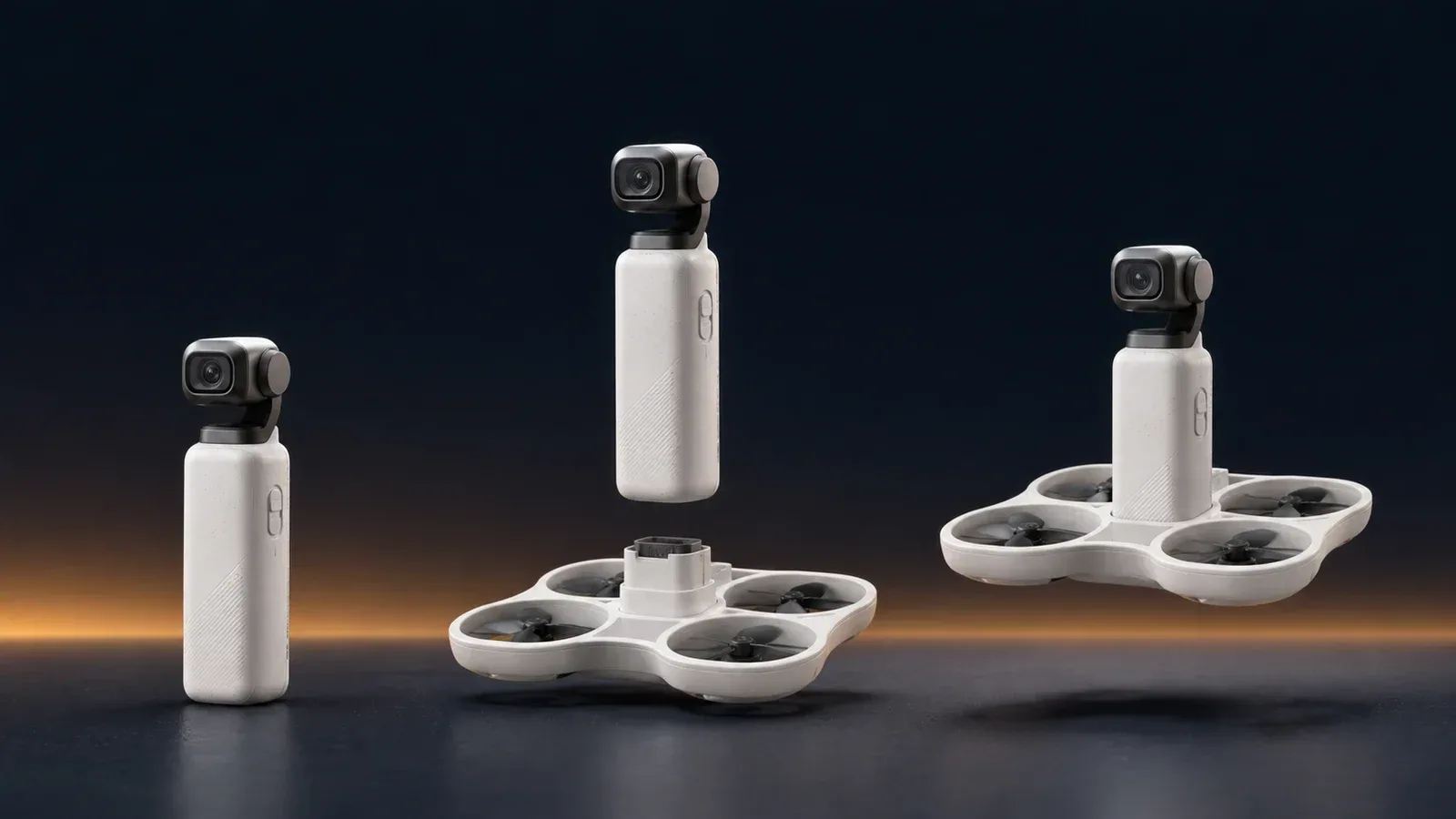
The catch is that a two-in-one gadget has to be good enough at both jobs. If it is only an average pocket camera and an average drone, the clever connection becomes the most impressive part of a compromise.
The Camera Comparison
Binary feature comparison from current official specifications and review availability. A value of 1 means the feature is documented; 0 means it is absent or not confirmed for production VERSA hardware as of August 21, 2026.
The battery row is not a laboratory showdown. Each manufacturer uses different recording settings and test conditions. It tells us all three should survive normal handheld outings better than VERSA survives a flight, not that one has won by fourteen minutes.
The Camera Is Where VERSA Makes Its Compromise
HOVERAir says VERSA records 4K video up to 60 frames per second using a 1/1.3-inch sensor. It also promotes 10-bit H-Log and HDR recording, 12-megapixel photos, and up to 17.5 stops of dynamic range in certain modes.
Those are promising specifications. They are not proof that VERSA beats an established pocket camera.
Both the DJI Osmo Pocket 3 and the Insta360 Luna Ultra use a larger 1-inch main sensor. A larger sensor generally has more room to gather light, which can help with night scenes, indoor family video, highlight control, and natural background separation. Processing, lens quality, autofocus, stabilization, color science, and heat management still matter, so sensor size does not decide the entire result. It does tell me not to assume the camera with wings is secretly a Pocket 3 killer.
The claimed 17.5-stop dynamic-range figure also needs a giant company-claim label. Dynamic-range numbers can be measured under different conditions, and a log or multi-exposure mode may not look good without the right processing. I want to see faces moving through backlight, trees against bright sky, nighttime noise, autofocus transitions, and unedited files before treating that number as a buying reason.
There is another small warning for photographers: current launch reporting lists 12MP stills and does not confirm RAW capture. DJI documents JPEG and DNG RAW for the Pocket 3. Insta360 documents JPG plus RAW on the Luna Ultra. If still photography matters, VERSA needs a clearer answer.
VERSA Versus DJI Osmo Pocket 3
The Pocket 3 is the practical benchmark because it starts at the same $499 standard price in the United States and has years of real footage, accessories, reviews, and user experience behind it.
DJI gives you a 1-inch sensor, 4K/60 normal recording, 4K/120 slow motion, D-Log M and HLG 10-bit options, a two-inch rotating screen, three built-in microphones, fast charging, and a camera body that weighs 179 grams. It is easy to understand because the entire product is focused on one job: good stabilized handheld video in a tiny package.
VERSA wins the one comparison DJI cannot answer. It can leave your hand.
If I were filming indoor family moments, evening boardwalk clips, food, talking-to-camera video, or anything where low light and reliable autofocus matter more than perspective, I would choose the proven Pocket 3 until VERSA reviews show otherwise.
If I regularly filmed myself walking, biking on a safe open route, or exploring a permitted outdoor location alone, VERSA could create shots the Pocket 3 simply cannot. That is not a small feature. It is the whole argument.
VERSA Versus Insta360 Luna Ultra
The Luna Ultra is the ambitious camera-first choice. Its one-inch main camera records up to 8K/30, and a second 1/1.3-inch telephoto camera provides a 60mm-equivalent view. It also has a detachable screen that can work as a remote monitor, 47GB of internal storage, 10-bit recording, and an official $769.99 starting price.
That makes Luna more flexible without becoming airborne. It can frame a face, a detail across the room, or a tighter travel shot without asking the operator to walk closer. Independent reviews already exist, which means buyers can judge real strengths and flaws instead of studying campaign graphics.
Luna is also heavier, more expensive, and still cannot create a third-person moving shot without another person, a mount, or a separate drone.
I would pick Luna for camera quality, focal-length choice, and more serious handheld creation. I would pick VERSA only if flight is a real part of the plan. Buying VERSA and never attaching the wings would be like buying a convertible and permanently gluing the roof shut.
The One Family-Park Test That Would Prove the Idea
The best VERSA demonstration is not a mountain-bike chase or a cinematic trip to Iceland. It is one ordinary family walk in a local park where drone use is allowed.
Here is the test I would run:
- Record the family arriving with VERSA in handheld mode.
- Walk beside everyone for a normal stabilized clip.
- Stop in an open area away from crowds, attach the Flight Kit, and launch from the hand.
- Capture one automatic follow shot from behind.
- Use a pull-back or orbit to show the family and the location together.
- Hand-land, remove the flight hardware, and record the rest of the walk normally.
- Put the clips on a television and ask whether the flying shot actually improved the memory or merely announced that somebody brought a drone.
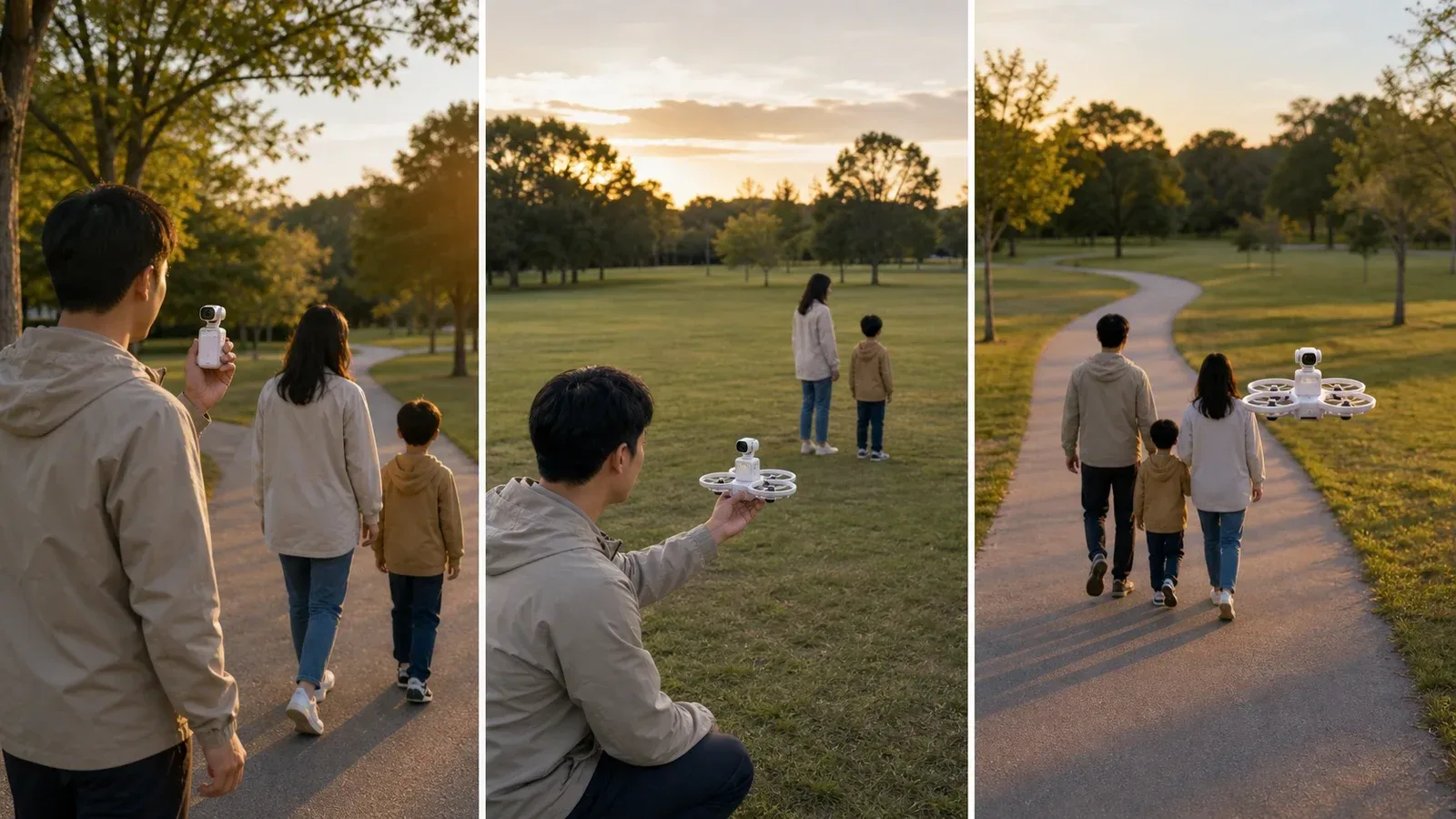
That last question matters. Aerial footage is useful when it reveals scale, puts people inside a place, or lets everyone appear in the memory. It is a gimmick when every video pauses for the same orbit because the gadget has a button for it.
The experiment also exposes the practical friction: how long the switch takes, whether the connection feels secure, how loud the aircraft is, how confidently it tracks near trees, and whether a 14-minute maximum flight becomes eight or ten comfortable minutes in real conditions.
What Your Phone Still Does Better
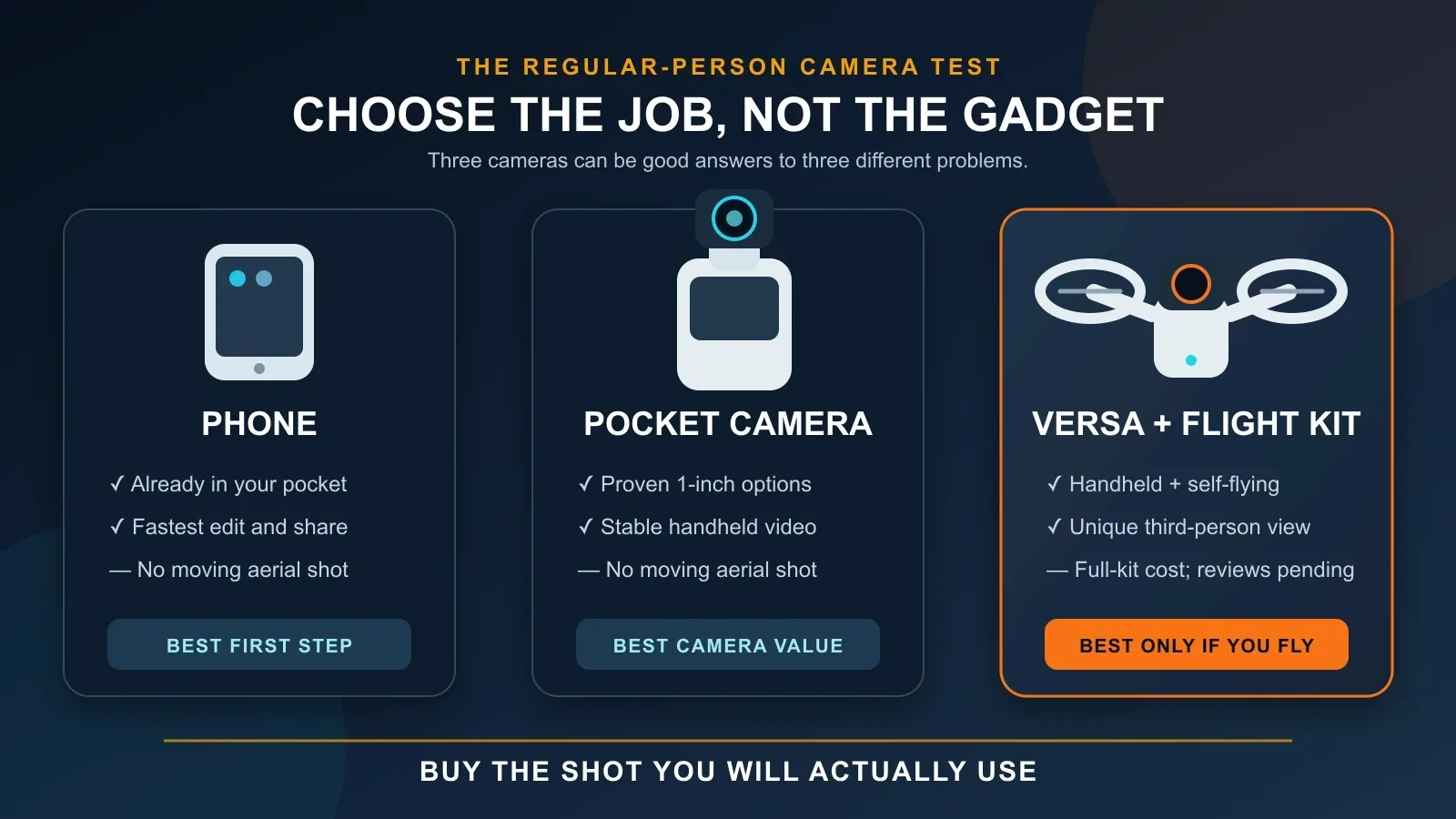
VERSA does not make the phone disappear. The phone is still the fastest camera to pull out, the easiest place to edit and share, and often the device with the smartest automatic HDR, portrait, and family-photo processing.
A recent high-end phone may also produce better point-and-shoot results than a small dedicated camera in difficult mixed light. What it does not have is a mechanical three-axis gimbal or removable propellers.
For most families, the buying order should be:
- Use the phone already in your pocket.
- Add a small phone grip, tripod, or gimbal if shaky handheld video is the real problem.
- Consider a pocket camera when faster recording, better stabilization, longer sessions, or dedicated controls will be used often.
- Consider VERSA when a flying third-person shot is a repeated need, not a one-week curiosity.
VERSA earns its bag space only if it removes a separate gimbal and a separate self-flying camera—or captures memories that those less expensive steps cannot.
The Money Comparison That Matters
- Keep using your phone: Best starting value for most families because the camera, editor, and sharing device are already owned.
- DJI Osmo Pocket 3 at its $499 list price: Best established value when proven handheld image quality matters more than flight.
- HOVERAir VERSA camera-only at its reported $499 campaign list: Hard to justify against Pocket 3 because the feature that makes VERSA unique is not included.
- HOVERAir VERSA with Flight Kit: Potentially worth it when automatic third-person and reveal shots will be used regularly.
- Insta360 Luna Ultra at $769.99: Premium camera-first choice for creators who want dual-lens reach, not flight.
Crowdfunding tiers, early-bird discounts, shipping, tax, included batteries, and accessories can change the VERSA total substantially. I would ignore the largest discount percentage on the campaign page and write down the final delivered cost of the exact tier that includes the Flight Kit.
Then compare that total with a Pocket 3—or with simply keeping the phone and buying nothing. “Less than buying three gadgets” is only a bargain if you were genuinely going to buy all three.
My Five-Question Gimmick Test
Give yourself one point for each honest yes:
- Do I regularly visit open places where I can legally and safely fly?
- Do I often film without another person available to operate the camera?
- Can I name a specific follow, pull-back, or orbit shot I would use more than once?
- Am I comfortable carrying the flight hardware and managing short flight batteries?
- Am I comfortable backing a crowdfunding project before independent reviews and final retail support are settled?
Four or five points: VERSA solves a real problem for you.
Two or three points: the idea fits, but waiting for retail availability and production reviews is smarter than chasing an early-bird timer.
Zero or one point: enjoy the launch video. Your phone is probably the better camera purchase because it is already paid for.
The Part Where a Flying Camera Is Still a Drone
HOVERAir markets VERSA as a self-flying camera because that feels friendlier than “autonomous aircraft.” The name does not change what happens when the propellers start.
At under 250 grams in its reported flight configuration, a purely recreational U.S. flight may fall under the small-drone registration exception. That does not erase the rest of the rules. Recreational flyers still need to complete the free TRUST safety test, keep the aircraft within visual line of sight, follow airspace limits, avoid creating a hazard, and obtain authorization before flying in controlled airspace.
If the flight supports work, a business, or another non-recreational purpose, the under-250-gram registration exception does not apply the same way. Local park rules, property-owner rules, wildlife protections, event restrictions, and temporary flight restrictions can also close a location that looks perfect in a product video. The National Park Service generally prohibits launching, landing, or operating drones on park lands.
This does not need to become another 2,000-word drone-rules article. It does mean the wings will sometimes stay in the bag even when the shot would look great.
Crowdfunding Changes the Recommendation
Indiegogo says plainly that crowdfunding is not the same as buying a finished product from a store. Delivery dates are estimates, products can change, and fulfillment and refunds are ultimately the creator's responsibility.
HOVERAir is an established company with shipped products, which is more reassuring than an anonymous team with a rendering and a dream. It does not turn a pledge into a normal retail purchase with mature firmware, broad stock, easy returns, and months of independent tests.
Before backing, I would want clear answers to five things:
- What exactly is included in the flight-capable tier?
- What is the final delivered price with shipping and tax?
- Does the production camera record RAW stills?
- What warranty and repair path applies in my country?
- Can I wait until reviewers test production autofocus, low light, tracking, wind, noise, connection durability, and real flight time?
If the early-bird discount is the only reason to buy, that is usually the answer.
My Buying Verdict
HOVERAir VERSA is not just a gimmick. The removable flight module solves a real camera problem: sometimes the shot you want requires the camera to move away from your hand, and a selfie stick cannot fake it.
It is also not automatically good value.
The Pocket 3 gives camera-first buyers a larger sensor and a proven system at the same $499 standard starting point as the reported VERSA camera-only campaign price. The Luna Ultra gives premium buyers a larger main sensor, 8K, and a real telephoto option. The phone gives almost everyone the simplest camera they will actually carry.
VERSA wins only when the wings are not a bonus. They must be the reason.
My recommendation on August 21, 2026 is to wait for production reviews unless you already know you need frequent automatic third-person shots, accept crowdfunding risk, and have checked the complete flight-capable cost. If independent footage shows solid autofocus, natural color, reliable tracking, and usable real-world flight time, VERSA could become one of the rare odd gadgets that earns its weirdness.
Final Thought
The best test for any all-in-one gadget is simple: what leaves the bag when this goes in?
If VERSA lets a solo traveler leave the phone gimbal and separate follow-me drone at home, it is useful. If the wings come out twice and then live in a drawer, it is a very clever pocket camera bought for one expensive party trick.
I love the idea. I am not ready to confuse loving the idea with getting my money's worth.
Sources
- HOVERAir: VERSA launch post — first-party launch claims; published August 18, 2026; accessed August 21, 2026.
- HOVERAir: official VERSA release video — founder introduction embedded in HOVERAir's launch post; accessed August 21, 2026.
- HOVERAir: VERSA product page — first-party feature overview; accessed August 21, 2026.
- TechRadar: HOVERAir VERSA launch details and reported campaign pricing — published August 19, 2026; accessed August 21, 2026.
- DJI: Osmo Pocket 3 specifications — official technical specifications; accessed August 21, 2026.
- DJI Store: current U.S. Osmo Pocket 3 configurations — official pricing and availability; accessed August 21, 2026.
- Insta360: Luna Ultra hardware specifications — official technical specifications; accessed August 21, 2026.
- Insta360: Luna Ultra photo and video specifications — official recording formats; accessed August 21, 2026.
- Insta360: Luna Ultra charging and battery life — official laboratory runtime figures; accessed August 21, 2026.
- Insta360 launch release: Luna Ultra pricing and availability — company release; published June 10, 2026; accessed August 21, 2026.
- TechRadar: Insta360 Luna Ultra review — independent hands-on review; accessed August 21, 2026.
- FAA: Recreational Flyers and Community-Based Organizations — current U.S. recreational flight requirements; accessed August 21, 2026.
- FAA: How to Register Your Drone — under-250-gram and Remote ID boundaries; accessed August 21, 2026.
- National Park Service: Uncrewed Aircraft Systems — park launch, landing, and operation policy; accessed August 21, 2026.
- Indiegogo: What Is Crowdfunding? — platform explanation of backing and fulfillment risk; accessed August 21, 2026.