Trust & transparency
Evidence & disclosures
Evidence basis: Mixed evidence. The article combines more than one evidence type; the evidence summary identifies which claims come from which basis.
Product details come from GOAT Guns and Roman Atwood material; my discovery and video-making process are hands-on, but I did not test every model.
Sources checked: Aug 20, 2026
Linked references: 4 explicit sources in the article.
GOAT Guns Are Ridiculously Cool, and Now I Want Them All
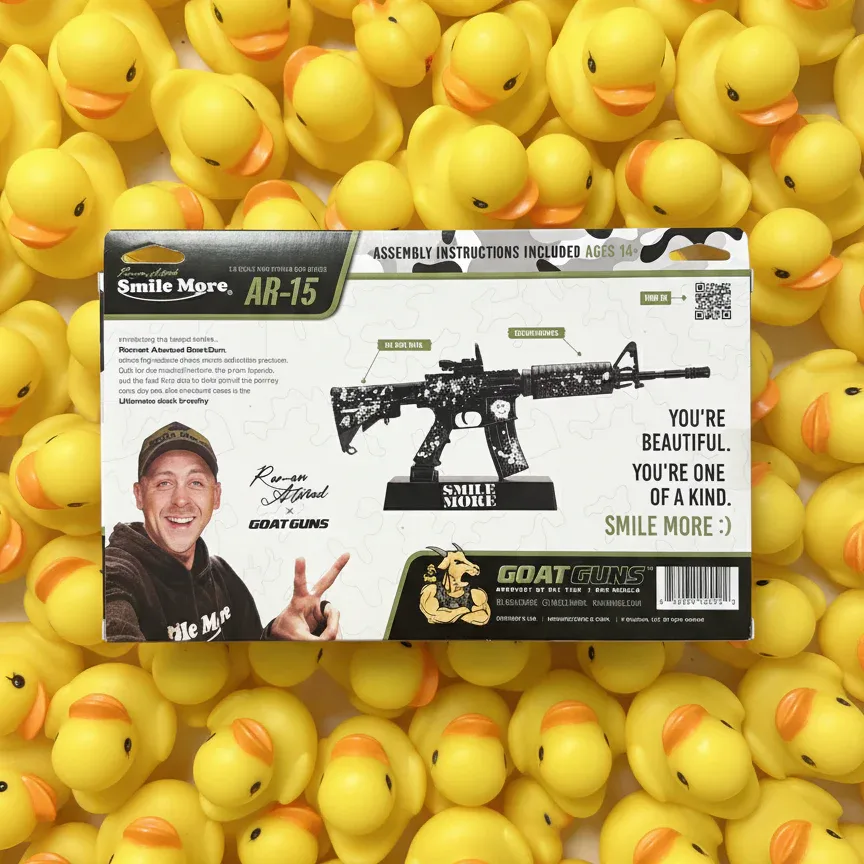
I first noticed GOAT Guns in one of Roman Atwood's vlogs when he was at Smile More Laundry & Tan.
I do not remember what else happened in that video. I do not remember what anybody was talking about. I just remember seeing these detailed miniature guns sitting there and immediately thinking, "What are those, and why do I suddenly need all of them?"
That was it. The old collector switch flipped.
Maybe it is because they remind me of Micro Machines. Maybe it is the tiny working parts. Maybe it is because I am apparently at the age where a perfectly reasonable desk can be improved by adding a miniature armory.
Whatever the reason, GOAT Guns are just cool.
Before we go any further: this post is not sponsored. GOAT Guns did not contact me, send me anything, or pay me. There are no affiliate links here. I have not even bought my first one yet. I saw them, fell into the rabbit hole, made a ridiculous little retro commercial and song about them, and decided I had to share the discovery.
TLDR
- GOAT Guns are non-firing, die-cast miniature display models, usually around 1:3 or 1:4 scale.
- Many arrive as small kits and include moving or removable details such as magazines, stocks, sights, bolts, and dummy rounds.
- Individual models currently tend to land around $40 to $60, although sales, limited editions, kits, and inventory change constantly.
- The official place to browse them is GOATGuns.com.
- There is even a Roman Atwood "Smile More" special-edition model, which feels like the obvious place for me to start.
- No, they do not fire. They are detailed desk and shelf collectibles, not functional firearms.
- The discovery also became a real test of the creative pipeline I am building—from rough idea to original song, storyboard, generated visuals, licensed B-roll, timed animation, review, and final render.
I Blame Roman Atwood for This
Seeing them in Roman's vlog was the perfect delivery system for this particular obsession.
They were not presented to me in a polished product advertisement. They were just sitting in a real place, looking like somebody had taken a full-size collection and hit it with a shrink ray. That made them more interesting. They looked like something you would pick up, turn over in your hands, move the little parts around, and then spend the next hour deciding where they belonged on your desk.
It turns out the Roman Atwood connection goes beyond the vlog. GOAT Guns currently has a special-edition Roman Atwood "Smile More" AR15 model. The official listing describes it as a 1:3-scale, non-firing, die-cast collectible with Roman's styling, a branded stand, reflex sight, and special packaging.
As of July 11, 2026, it was listed for $20, marked down from $59.99. Prices and stock can change, so check the listing instead of trusting an old blog post with your wallet.
Still, come on. The exact creator who introduced me to the things has his own model, and it is currently one of the cheapest ways into the collection. That feels less like a purchasing decision and more like the universe being unnecessarily specific.
What GOAT Guns Actually Are
Despite the name, these are not functioning firearms. GOAT Guns describes them as non-firing die-cast models—the firearm equivalent of a detailed model car that does not drive.
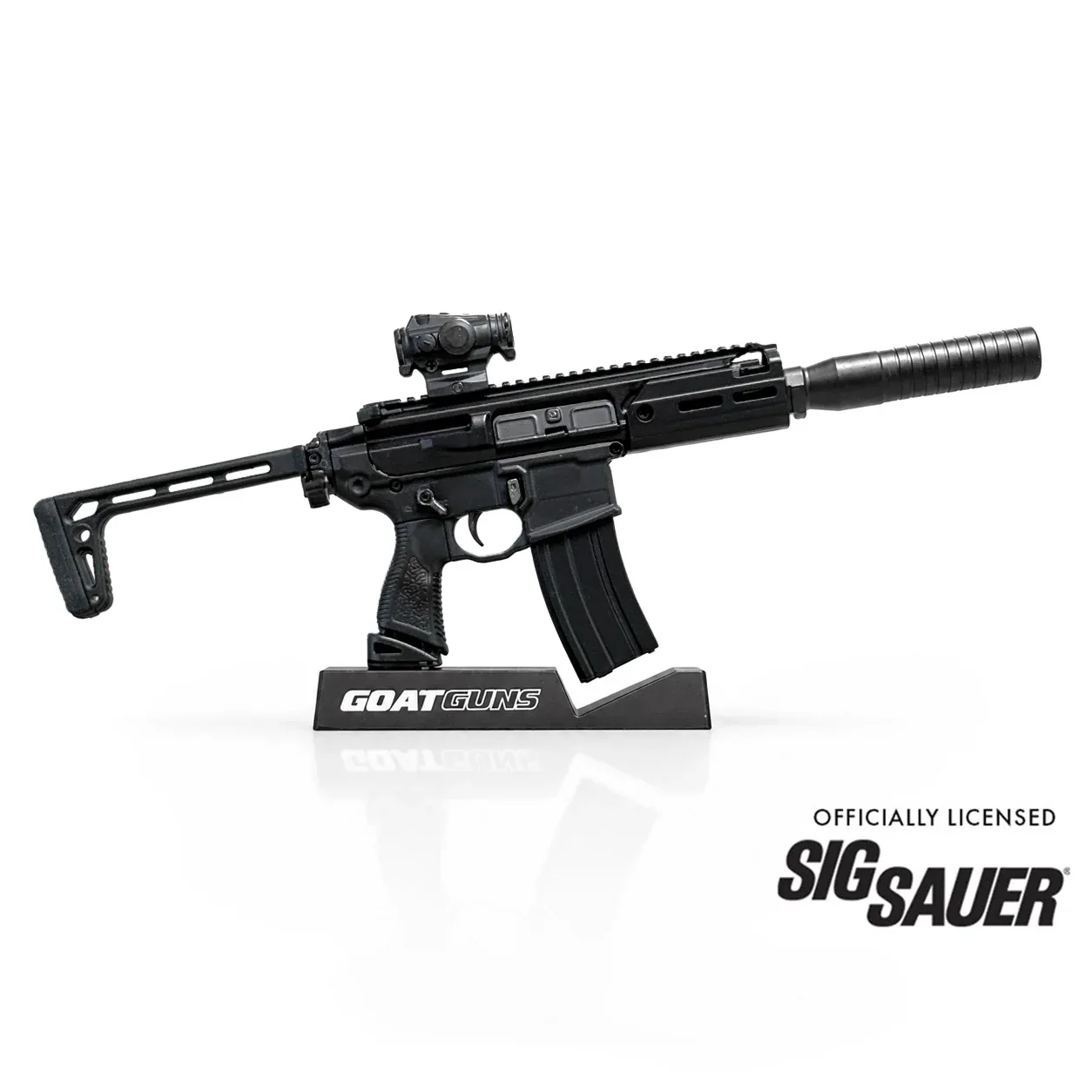
The company's current catalog includes miniature versions inspired by AR-style rifles, AKs, the M16A1, M1 Garand, FN SCAR, Barrett models, sniper rifles, older historical designs, and plenty of other recognizable shapes. Depending on the model, the scale is commonly 1:3 or 1:4.
The appeal is in the mechanical detail. Some models have removable magazines, adjustable stocks, moving selector switches, working bolts, folding sights, removable accessories, display stands, and tiny dummy rounds. Certain models can cycle those dummy rounds. Others are simpler display pieces.
GOAT Guns says its models range from roughly 4 to 16 inches and can weigh up to a pound or more. That is large enough to feel substantial on a desk but small enough to make you grin when you see a magazine and rounds scaled down to action-figure proportions.
Most are not complicated model kits in the paint-and-glue sense. Product pages commonly describe five-to-ten-minute assembly. You get the satisfaction of putting something together without accidentally committing the next six weekends to it.
Why They Hit the Micro Machines Part of My Brain
If you grew up around Micro Machines, you probably understand this without much explanation.
The magic was not just that the cars were small. It was that there were so many of them. Every new vehicle made the collection feel more like a tiny world. You could line them up, compare the details, build a display, and convince yourself that the next one was absolutely necessary because you did not have that exact shape in that exact color.
GOAT Guns push the same button for me.
One model would look cool on a shelf. Three models would look like the beginning of a collection. A rack with one empty space would become a personal insult.
That is the dangerous brilliance of miniature collectibles: they do not take up enough room to trigger your common sense. A full-size object requires planning. A tiny object whispers, "There is plenty of space right there."
Then the accessories get involved. Scopes, stocks, magazines, grips, stands, racks, and display cabinets turn a simple model into a customizable little desk project. Suddenly you are not merely buying a thing. You are building your optimal tiny loadout, which is apparently a sentence my adult brain is willing to accept.
What They Cost and Where to Get Them
The cleanest place to start is the official GOAT Guns catalog. That is where you can see current stock, sales, limited editions, accessories, and model-specific details.
At the time I checked on July 11, 2026, a few examples included:
- Roman Atwood "Smile More" AR15 model: $20 sale price.
- AK47 models: around $39.99 for some finishes.
- AR15 and M16A1 models: around $49.99.
- FN SCAR, M1 Garand, STG44, GP5, and several other models: commonly around $59.99.
- Accessories such as magazines, grips, sights, and dummy rounds: often around $10 to $20.
- Multi-model kits and display bundles: roughly $140 and up, depending on the kit and sale.
Those are snapshots, not promises. Some products were sold out, others were on sale, and a few were preorders. This is exactly the kind of catalog where the phrase "I will come back later" can turn into "why is the one I wanted gone?"
The company currently advertises U.S. shipping through USPS and UPS, shipping to Canada and much of Europe, and a return window of up to 100 days. International buyers should check current customs rules, taxes, duties, and local restrictions before ordering a realistic-looking miniature replica.
Which One Would I Buy First?
The sensible answer would be one model. Pick a favorite design, assemble it, see how the quality feels, and decide whether the collection itch survives contact with an actual purchase.
For me, the Smile More edition makes the most sense. It connects directly to where I first saw them, it has its own look, and the current sale price makes it a relatively inexpensive experiment.
The less sensible answer is the starter kit with the display rack, because nothing encourages responsible collecting like purchasing the empty spaces at the same time as the collectibles.
The starter pack includes an AR, AK47, 1911, a display rack, and several accessories. It was listed at $179.99 when I checked, but it was also sold out. That is probably good news for my bank account and bad news for the part of my brain already arranging the shelf.
My actual beginner plan would be:
- Buy one model connected to the reason I discovered the collection.
- Put it together and see whether the moving details are as satisfying as they look.
- Give it a real place on the desk instead of creating another box of things I "will display later."
- Wait at least a week before deciding I need a rack.
- Completely ignore step four.
Are They Worth It?
I cannot honestly review the build quality yet because I do not own one. This is a discovery post, not a hands-on review wearing a fake mustache.
What I can say is that the concept makes immediate sense to me. The combination of die-cast metal, recognizable designs, moving details, light assembly, customization, and display-friendly size is exactly what I want from a grown-up desk toy.
If you want something functional, this is not that. If you dislike replicas or do not want realistic-looking miniature firearms in your home, this is also not that. Even though they are non-firing models, I would still use common sense about where I display or transport one. A detailed replica can look very different to somebody who sees it from across a room or through a window.
But if you like model cars, action figures, military history, mechanical miniatures, movie props, desk toys, or collectibles with parts you can actually move, I understand the attraction completely.
Apparently I Have a Gadgets & Toys Problem Now
This may be the beginning of a new section on the blog: Gadgets & Toys.
I already write about drones, cameras, AI, software, recovery, and whatever questionable machine the internet has convinced somebody to buy this week. Tiny die-cast collectibles fit more naturally into that world than I expected.
Not every interesting thing needs to become a technical review. Sometimes something is worth sharing because it is clever, tactile, nostalgic, or just ridiculously cool.
GOAT Guns managed to hit all four.
They also inspired me to make an old-school, fast-talking, 1980s-style toy commercial complete with a song called "GOAT Guns: Gotta Get 'Em All." That is a completely normal response to discovering a desk collectible, and I will not be taking questions at this time.
Except the video became more than a joke. It turned into a useful test of the creative pipeline I have been trying to build.
BONUS AREA: Video pipeline
The Video Idea Was the Real Rabbit Hole
The original idea was not a formal script or a polished advertising brief. It was basically me blurting out:
Have you seen these things yet? GOAT Guns! Why do I want every single one? They remind me of Micro Machines. GOAT Guns—gotta get 'em all!
That rough thought already contained the whole creative direction.
There was the product discovery. There was the grown-man-versus-inner-kid joke. There was the Micro Machines nostalgia. There was the fast-talking commercial energy. There was even a hook that sounded like it wanted to become a song.
Instead of sanding all the personality off the idea and turning it into a generic product explainer, I wanted the pipeline to preserve the messy part that made it mine.
The commercial is not pretending to be an official GOAT Guns advertisement. It is an unsponsored creative experiment built around my genuine reaction to seeing the models.
How I Turned One Random Thought Into a Finished Commercial
The workflow ended up looking like this:
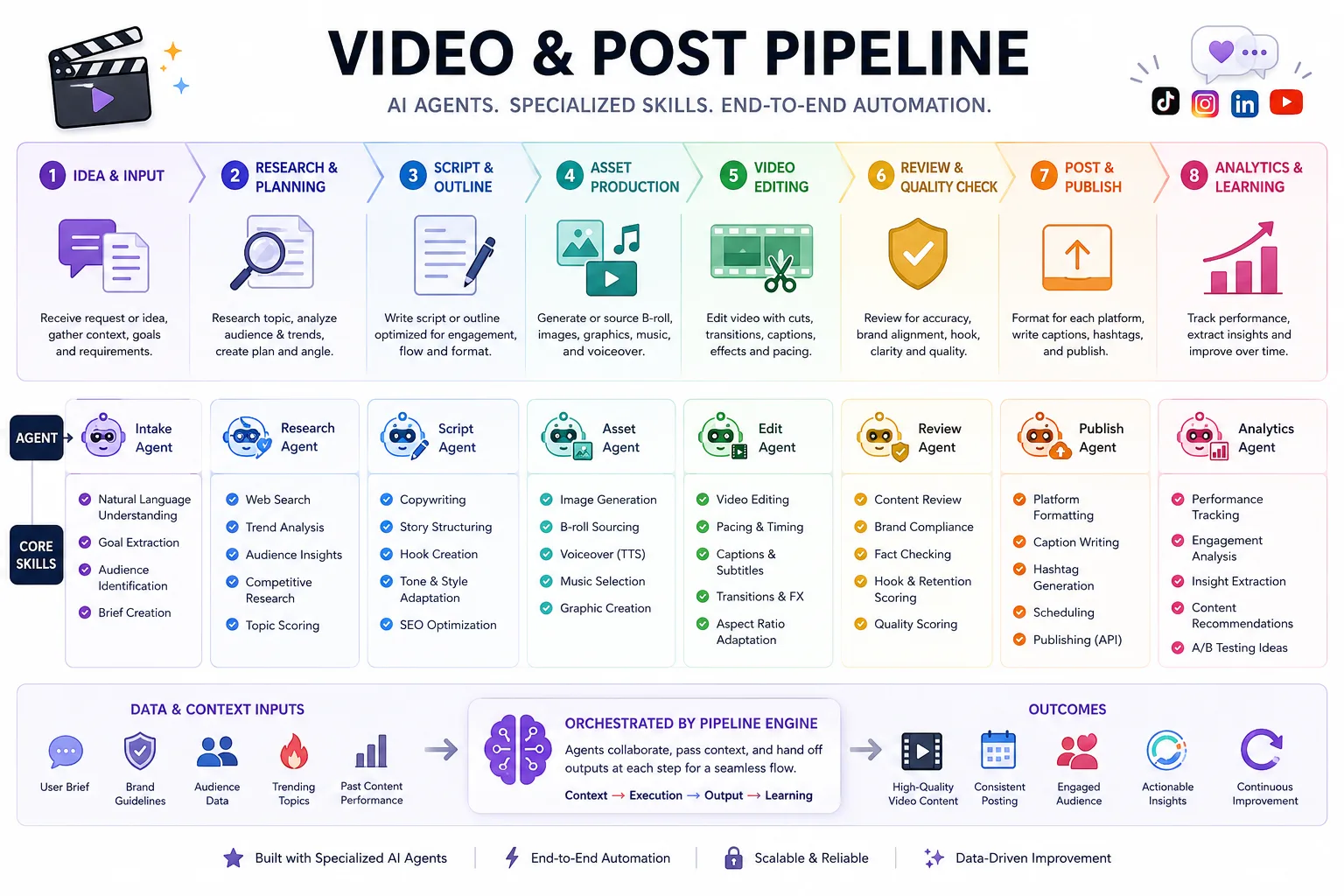
- Capture the idea in my own words. I kept the confusion, excitement, nostalgia, and slightly irresponsible urge to collect everything.
- Turn the feeling into an original song brief. The music direction called for a 164-BPM retro toy-commercial comedy jingle with a conversational opening, extremely fast talk-singing, a simple shouted hook, and no copied melody or old commercial audio.
- Build a visual cue sheet around the song. Every lyric needed a matching picture idea: tiny details, desktop lineups, toy-store memories, responsible adult brain, excited kid brain, collection overload, and the final product-name button.
- Generate a storyboard before animating. Seven planned frames gave the commercial a consistent workshop, character, miniature scale, lighting style, and visual sequence before I started throwing things onto a timeline.
- Create the media package. I generated additional close-ups and collection scenes, then added licensed toy-car B-roll for the nostalgia section. I kept the source pages and licensing notes with the project instead of assuming that anything found online was free footage.
- Build the animation in Remotion. The images became layered scenes with camera pushes, parallax, split screens, moving crops, scan lines, tracking noise, starbursts, stickers, flashes, and aggressively cheerful 1980s colors.
- Render it, watch it, and admit what was wrong. This step may be the most important part of the whole pipeline.
- Correct the timing and render again. The final pass used measured word-level vocal timestamps, more movement, more images, real B-roll, and a dedicated sharing card for the blog version.
That is the pipeline I am after:
Idea → research → original music → cue sheet → storyboard → assets → animation → review → correction → publish
It is not one giant "make me a video" button. It is a chain of small creative handoffs with places for me to make decisions, spot problems, and change my mind.
The First Cut Taught Me More Than the Prompt Did
The first version looked good, but something felt off.
The audio seemed late compared with what was happening on screen. After looking closer, the track was not actually late. The captions and visual ideas were arriving too early. The screen was telling viewers what they were about to hear instead of moving with the vocal.
That is the kind of mistake a technically successful render will never report.
The file existed. The code worked. The frames rendered. The music played. Every automated check could have passed while the commercial still felt wrong.
So I transcribed the finished song, measured the real vocal entrances, and moved each text phrase to the first frame at or after the singer started it. I also left the instrumental section from roughly 5.95 to 9.19 seconds completely free of lyrics. The visuals finally had room to move without explaining a line that had not happened yet.
Then I added more motion, three new generated images, and two licensed toy-car clips. The nostalgia section now uses fresh miniature footage with a CRT treatment instead of lifting protected footage from an old Micro Machines commercial. The project keeps a small source ledger explaining where the clips came from and how they were used.
That revision is the part I want to show more often.
AI can help create options quickly, but taste still lives in noticing that a result feels wrong, understanding why, and doing another pass.
Why I Am Showing More of the Pipeline
The finished commercial is fun, but the more interesting story may be how many different creative jobs it pulled together.
This one little project touched writing, songwriting, music direction, visual development, storyboarding, image generation, stock-footage research, licensing notes, React animation, audio transcription, typography, editing, rendering, and quality control.
A few years ago, that would have felt like several separate projects. Now I can move through the whole chain locally, keep the files together, preserve the decisions, and reuse the same structure for the next idea.
That does not mean every step is automatic. I do not want it to be.
The goal is to build a repeatable creative bench where a strange little thought can become a song, a video, a blog post, a thumbnail, and a shareable package without losing the human reason I cared about it in the first place.
GOAT Guns happened to be a perfect test subject because the idea was specific, visual, nostalgic, funny, and small enough to finish.
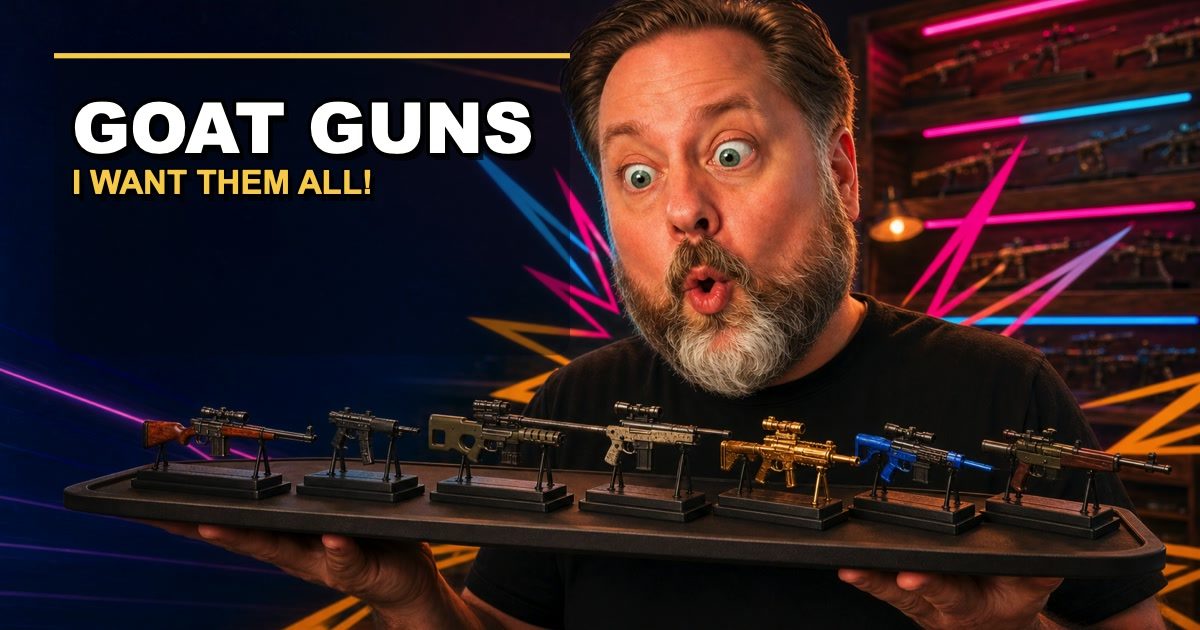
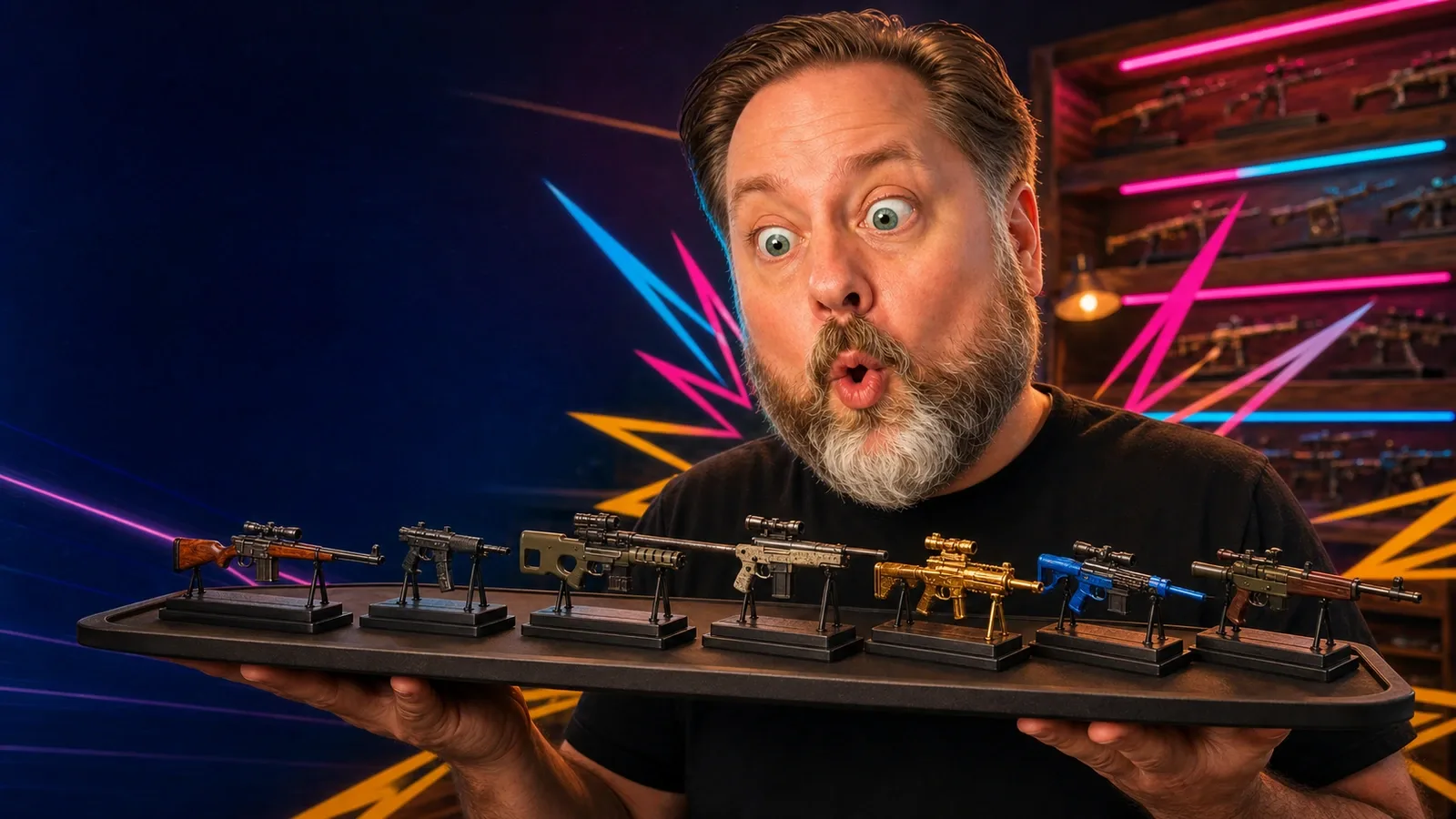
One more pass made the character itself consistent with the rest of my recent visual work. I brought in the same exaggerated duck-face caricature from my other thumbnails—the huge green-blue eyes, oversized head, salt-and-pepper beard, and puckered "what am I looking at?" mouth—and rebuilt the hook, wallet joke, chorus, and final button around him. That gave the video a recognizable personality instead of another generic excited collector.
Watch the Finished Commercial
The finished blog cut runs about 54 seconds, including a short closing card for sharing the video and finding the full story on ColinMichaels.com.
The song stays fast, the visuals lean hard into old toy-commercial energy, and the whole thing ends exactly where this started: a grown man looking at a collection of tiny models and wondering why one is clearly not going to be enough.
The public video player is meant to sit directly with this section. If you are reading a draft without the player, the last step is still connecting the final upload to the post—because apparently even a creative pipeline needs one more deployment step.
If the video makes you grin, share it with the friend who has a shelf, a display case, or one suspiciously empty space on a desk. They will understand.
Final Thought
I am not telling you that you need a miniature die-cast armory on your desk.
I am only telling you that I saw one in a Roman Atwood vlog, immediately remembered the joy of collecting tiny cars, discovered there is a whole catalog of models and accessories, and somehow ended up producing a commercial before purchasing the product.
That seems like a healthy and measured reaction.
If you want to see what started the problem, browse the official GOAT Guns collection. Just remember: the models are small, but the rabbit hole appears to be full size.