Trust & transparency
Evidence & disclosures
Evidence basis: Mixed evidence. The article combines more than one evidence type; the evidence summary identifies which claims come from which basis.
Combines my opinion with Flock policies, government audits, reporting, transparency portals, and court records; I did not access Flock’s private network or logs.
Sources checked: Aug 20, 2026
Linked references: 14 explicit sources in the article.
I am probably not the person anyone would recruit for an anti-camera protest.
If I am walking through a store, driving down a public road, or standing in a parking lot, I assume a camera may see me. That does not bother me very much. I am not doing anything wrong, and if someone ever hurts me, steals my car, hits me and drives away, or does something to somebody I love, I would be very happy to learn that a camera captured a useful clue.
That is why I see Flock license plate cameras as a potentially essential public-safety tool.
But “useful tool” is not the same thing as “blank check.”
The more I researched who can search Flock data, how widely it can be shared, and what has already gone wrong, the clearer my position became: the cameras are not the part that scares me. Unchecked access is.
TL;DR
- Flock's license plate readers are not facial-recognition cameras. They primarily record a plate, vehicle details, time, and location.
- That information can help find stolen vehicles, locate missing people, and give investigators a lead after serious crimes.
- It does not automatically prove who was driving, what happened, or whether anyone is guilty.
- Flock says local customers control access, searches are logged, data is encrypted, and records are often deleted after 30 days.
- Documented audits have also found improper sharing, federal access, searches that crossed legal boundaries, and local leaders who did not fully understand their settings.
- My verdict: the danger is not imaginary, but neither is the public-safety value. I support the tool only when the rules are public, sharing is limited, every search is auditable, and misuse has real consequences.
What a Flock camera actually records
This article is about Flock's automatic license plate readers, often called LPRs or ALPRs. Flock sells other products too, including video, audio, drone, and software systems. Those are separate conversations.
According to Flock's product description, an LPR camera photographs a passing vehicle and turns visible details into searchable data. That can include:
- The license plate and issuing state
- The vehicle's make, model, and color
- Other visible vehicle features
- The date and time
- The camera location
Flock says this product does not use facial recognition or classify people by race or gender. That matters, but it does not make the data anonymous. A plate can usually be connected to a registered owner through other law-enforcement systems, and several sightings can reveal a route or routine.
There is another important limit: this is not necessarily a perfect movie of the crime.
If a Flock image shows a car passing an intersection at 9:42 p.m., that can be a strong lead. It does not automatically prove who was behind the wheel, what happened before or after the image, or whether the registered owner committed a crime. I still want the evidence. I just want it described honestly.
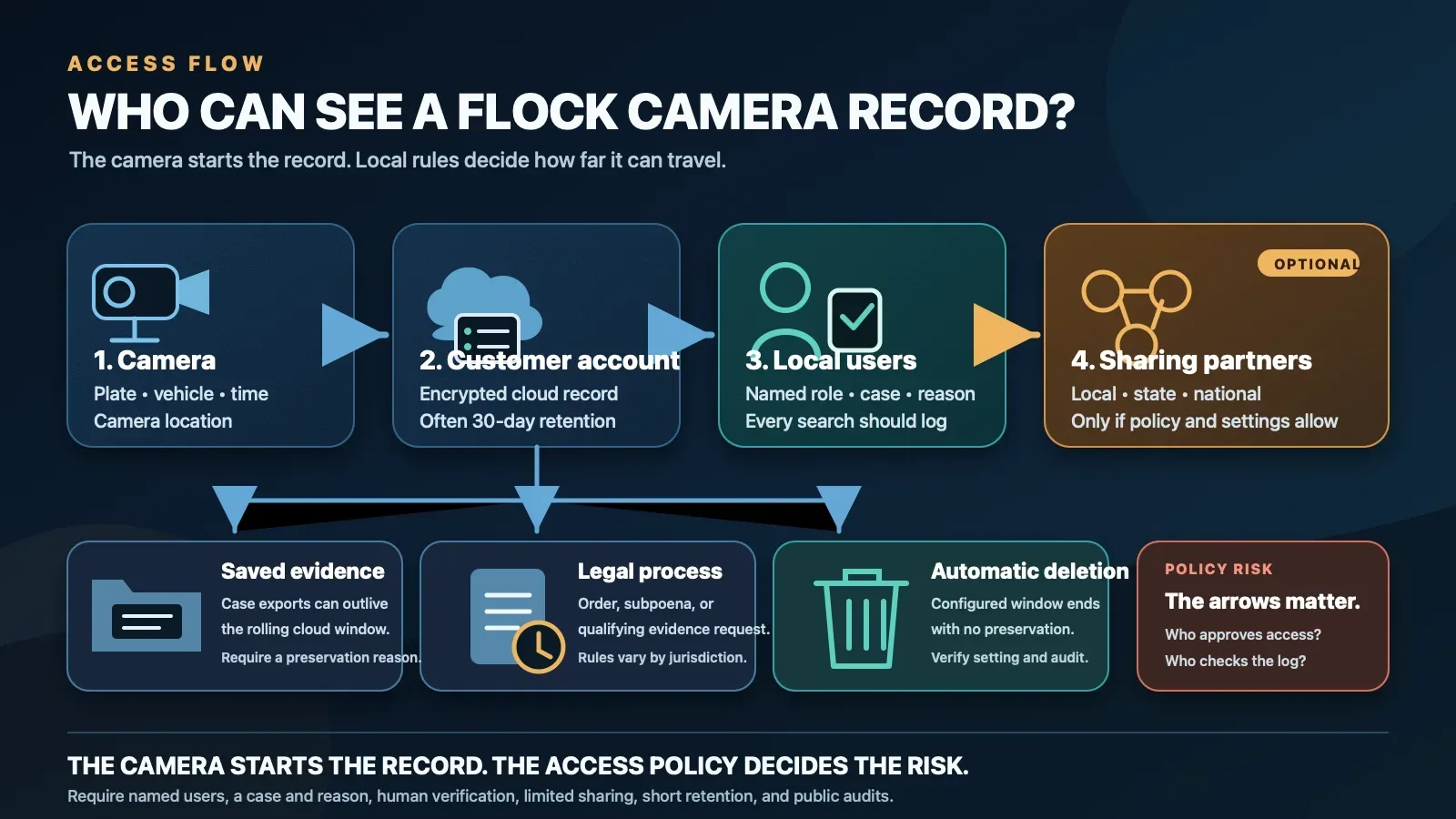
Who can actually access the data?
The short answer is: more than one person, but not everybody.
The customer and its authorized users
The customer might be a police department, sheriff's office, school district, business, neighborhood, or homeowners association. Flock's current terms say the customer owns the captured data and decides which employees, agents, or contractors are authorized users.
For a police program, that could include investigators, analysts, dispatchers, supervisors, or other staff whose accounts have been approved. Good policy should make those accounts individual—not shared—and remove access the moment somebody changes jobs or leaves.
Other law-enforcement agencies
This is where the simple “local police own it” answer becomes incomplete.
Flock customers can choose sharing relationships. Depending on settings and local law, that may mean one neighboring agency, a statewide network, or a wider national lookup. An outside agency may run a search against shared camera networks, or a local officer may run a search on another agency's behalf.
That second route matters. A federal agency does not need its own permanent login if a cooperating local department searches for it.
Federal agencies
Flock currently says it has no contract with ICE, ICE cannot directly access customer cameras or data, and any federal access must be explicitly granted by a local customer.
That is an important safeguard. It is not the same as saying Flock data can never reach a federal investigation.
Local sharing, proxy searches, legal process, and special partnerships can all create a route. In 2025, Flock paused pilot programs involving Customs and Border Protection and Homeland Security Investigations after an Illinois state audit found CBP had accessed Illinois plate data in violation of state law. Flock's CEO acknowledged to the Associated Press that the company had not created distinct permissions and protocols to guarantee local compliance for federal users.
Flock says it has added stronger federal-sharing controls since then. That is good. It also proves the controls were needed.
Flock and its service providers
Flock operates the platform, stores the information, maintains the service, and responds to qualifying legal requests. Its standard contract gives the company a license to use customer data to provide and improve its services. Flock says that language does not transfer ownership, authorize data sales, or cancel its retention rules.
I am not claiming Flock secretly keeps every plate image forever. I am saying a city attorney and elected council should read the actual contract before telling residents, “Don't worry, we own the data.” Ownership is only one part of control.
Courts, prosecutors, defense attorneys, and case files
Specific records may be preserved or downloaded for an investigation. Once an image becomes evidence in a case file, it may outlive the normal rolling deletion window. Courts, prosecutors, defense attorneys, and other authorized participants may receive it through the legal process.
That can protect a victim. It can also protect an innocent defendant. Evidence is not only for the government.
The general public
There is no public website where a random neighbor can type in your plate and replay your month. Public-record laws may allow people to request policies, contracts, audits, and some logs, but raw plate data and investigative records are often restricted or redacted. The exact answer depends on state law and the agency.
So no, “anyone can watch you” is hype. But “only one trusted local detective can ever see it” can also be hype.
What safeguards exist now?
Flock's privacy materials describe several meaningful protections:
- Role-based access controlled by the customer
- A required reason for law-enforcement searches
- Search logs that can be reviewed
- Encryption in transit and at rest
- Automatic deletion after a configured period, often 30 days
- No facial recognition in the LPR product
- Customer controls for data sharing
Flock's evidence policy says 30 days is the standard LPR retention period. Longer retention may exist where law requires it, where specific evidence is preserved, or where an agreement says otherwise. Flock says a customer seeking up to one year of extended retention—when the law does not already require it—must obtain approval from an elected official or governing body.
Those are sensible features. The problem is that a feature is not self-enforcing public policy.
An audit log does not protect us if nobody audits it. A sharing switch does not protect us if somebody turns it on without understanding the network. A required “reason” does not protect us if vague words such as “investigation” satisfy the box.
The privacy concern is not a conspiracy theory
The most convincing evidence is not a spooky video online. It is the audit trail.
Illinois found federal access that violated state law. In June 2026, San Francisco police said an audit found nearly 300 improper outside searches of its Flock network over roughly a year. The department said that represented about 0.005% of searches and that the audit found no immigration- or reproductive-rights-related inquiries. That context matters. So does the fact that the searches crossed the allowed boundary at all. CBS Bay Area reported both findings.
The Electronic Frontier Foundation, a civil-liberties advocacy group, says it analyzed more than 12 million logged searches from more than 3,900 agencies and found searches tied to protests, immigration, reproductive-health investigations, and discriminatory language. EFF is not a neutral product reviewer, but its findings are based on the kind of logs every community should be examining.
That is the part internet arguments often miss. Audit logs are evidence of both sides of the story. They can expose misuse, and they can show when a department stayed inside its rules.
Does Flock actually help solve crimes?
Yes, it can. That is not just marketing.
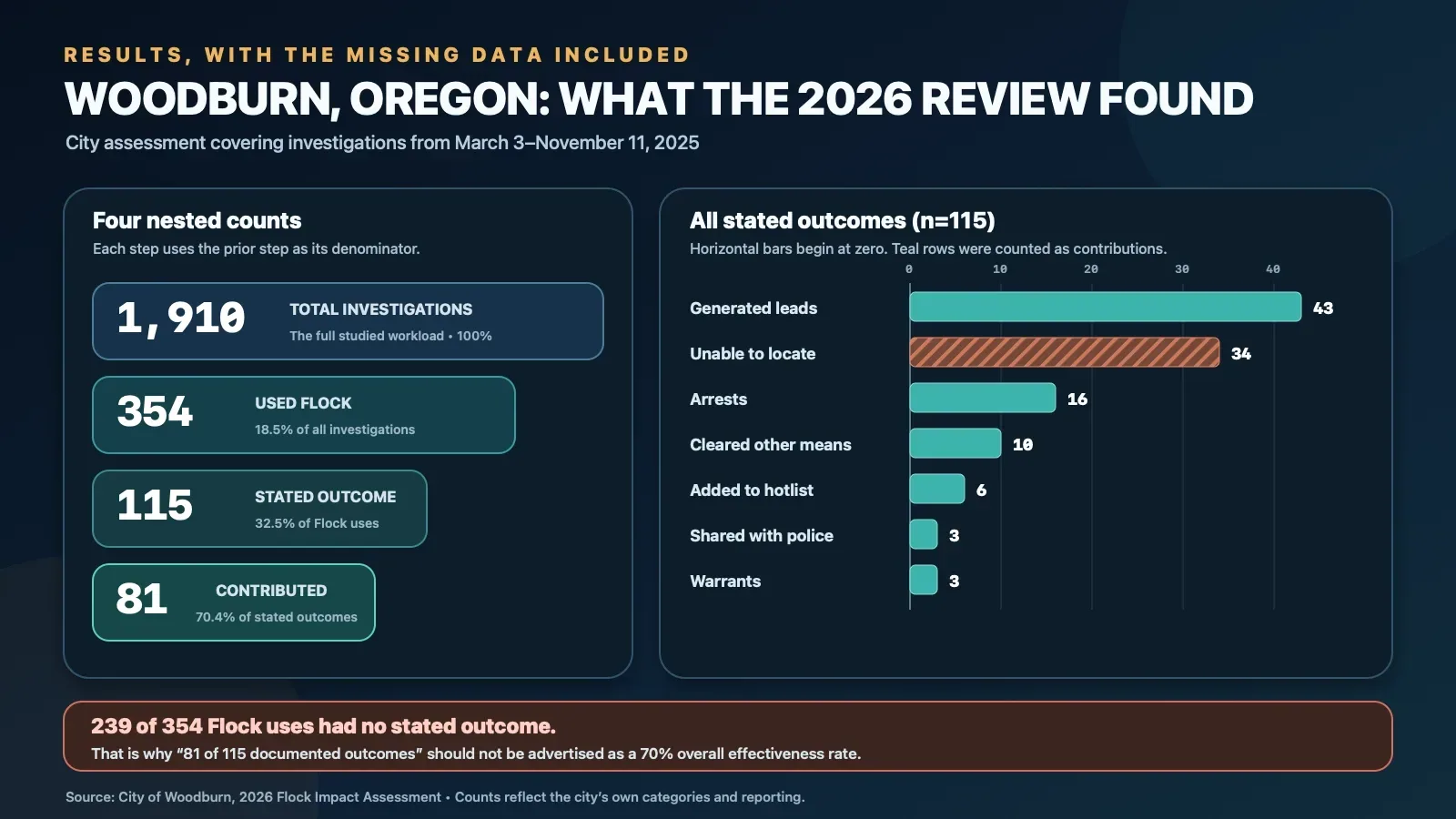
A detailed 2026 assessment from Woodburn, Oregon found that officers used Flock in 354 of 1,910 investigations during the studied period. Only 115 of those uses had a documented outcome, which is an important weakness in the data. Of those 115, officers said Flock contributed in 81 cases.
The documented contributions included 16 arrests, 10 cases cleared by other means, 43 generated leads, and three warrants.
I would not turn that into “Flock is 70% effective.” Most uses had no recorded outcome, one city is not the whole country, and “generated a lead” is not the same as “solved the case.” But it is fair evidence that the system can do real investigative work.
That fits my original instinct. If somebody steals a car, kidnaps a child, hits a pedestrian and runs, or uses a vehicle during a violent crime, a time-stamped vehicle sighting can be exactly the clue police need.
Flock is best understood as an evidence and lead tool—not a magic crime-prevention machine.
A live example close to home
I looked at the public Jupiter Inlet Colony Police transparency portal, which is a useful Florida snapshot.
When I checked it on August 4, 2026, the portal showed two cameras, a 30-day retention period, 6,072 unique vehicle detections during the prior 30 days, and two search sessions. It also said searches require a valid reason, hotlist hits must be human-verified, and personal use, harassment, immigration enforcement, and use based only on a protected class are prohibited.
Those two counts show how much routine collection can sit behind a small number of searches. They are different measures—not an effectiveness ratio—but the contrast still makes the policy stakes easier to see.
I can accept that trade when the searches stay narrow, justified, and reviewed. I would not accept it if the same data were casually opened to a huge network with no public accounting.
“I'm not doing anything wrong” is a fair starting point—not the final policy
I understand the argument because I make it myself. I am not doing anything wrong. Why should I care if a camera sees my car?
For one camera at one intersection, I usually do not care.
The question changes when thousands of cameras become one searchable history. Privacy is not only about hiding wrongdoing. It is also about limiting how easily somebody can reconstruct ordinary life: where you worship, which doctor you visit, who you spend time with, which meeting you attended, or whether your car regularly sits outside an ex-partner's home.
Maybe today's police chief would never misuse that power. Good policy is written for the person who comes after today's chief too.
I also want protection from errors. A plate can be misread. A hotlist can be outdated. A vehicle may have a different driver. Every alert should be verified by a person before police take action, and an ALPR hit alone should never become automatic proof of guilt.
The law is still catching up
As of August 4, 2026, courts had not produced one simple nationwide rule for every use of networked ALPR history.
A federal district court upheld Norfolk, Virginia's operation of a 176-camera system in January 2026. The residents challenging that system appealed, and the Fourth Circuit case remained pending at this article's research cutoff. In a separate criminal case, a Virginia Court of Appeals panel held that police did not need a warrant to access images of a vehicle traveling on public roads.
The fact that a use is currently lawful does not settle whether it is wise. Cities can choose stricter rules than the constitutional floor, and states can set sharing, retention, warrant, and audit requirements.
This is general information, not legal advice. The law and the system are both changing quickly.
My line: camera, yes; open-ended network, no
I do not want communities to throw away a useful tool because somebody shouted “Big Brother.” I also do not want them to buy a powerful system because a salesperson said “trust us.”
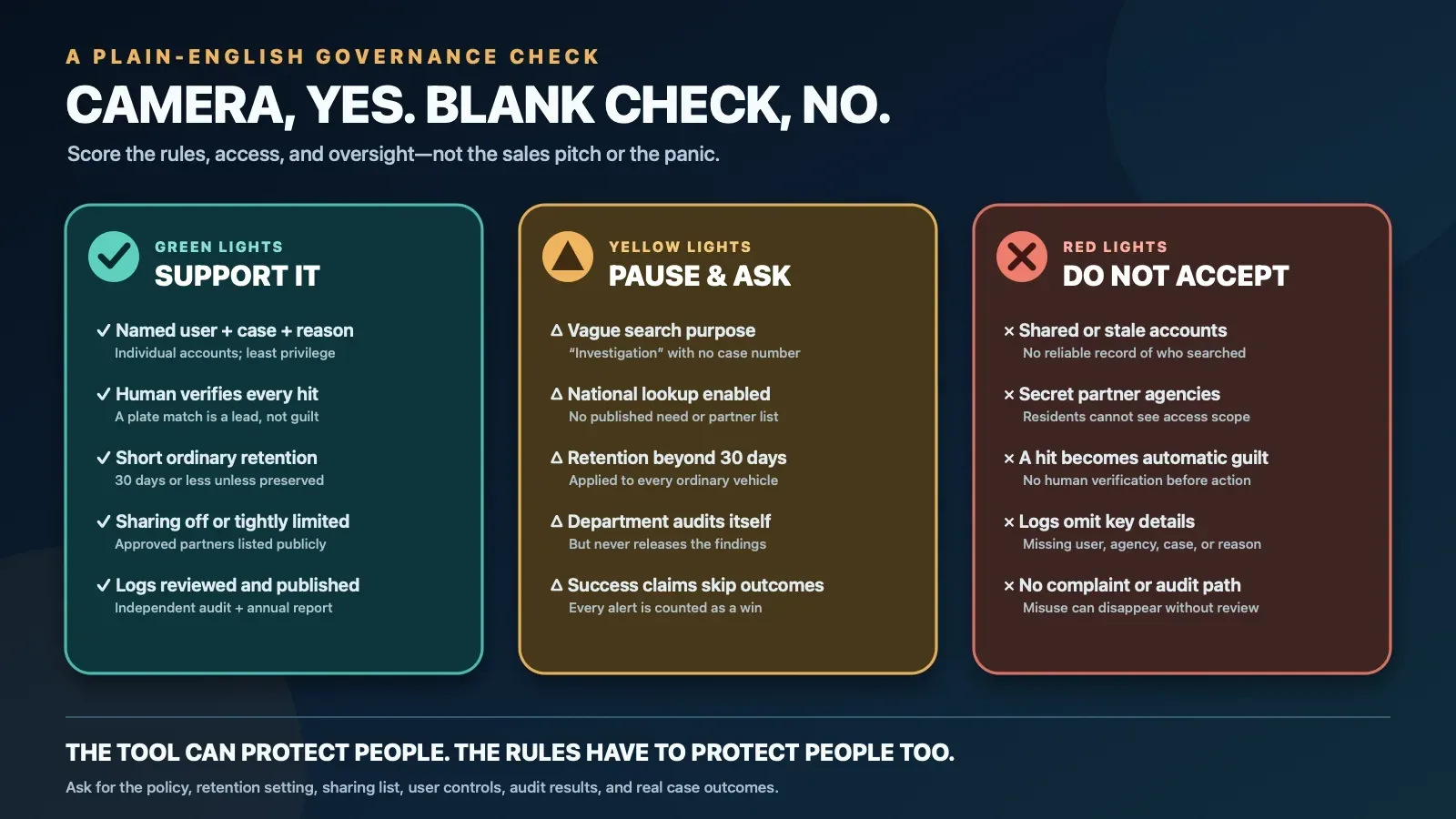
Here is the minimum I would require before supporting a local Flock program.
Green lights
- A public policy limits use to specific crimes, stolen vehicles, missing or endangered people, and clearly defined emergencies.
- Ordinary records expire in 30 days or less; longer preservation is tied to a documented case and legal authority.
- Every user has an individual account, least-privilege access, and multifactor authentication.
- Every search requires a case number, a specific offense or purpose, and a named user.
- A human must verify hotlist matches before a stop or other enforcement action.
- Network sharing is off by default and approved partner agencies are publicly listed.
- Proxy searches for agencies that lack access follow the same rules and appear clearly in the log.
- Supervisors review logs monthly, an independent party audits them at least quarterly, and the public receives an annual report.
- The report includes scans, searches, outside searches, hotlist alerts, confirmed matches, arrests, case contributions, false or stale alerts, complaints, and discipline.
- Misuse triggers immediate suspension, investigation, discipline, and notice where the law permits.
- Contract changes and new search features require public review before activation.
Yellow lights
- Vague purposes such as “public safety” or “investigation” with no offense or case number
- Statewide or national lookup enabled without a published need
- Retention longer than 30 days for every vehicle
- The police department audits itself but never publishes the results
- Outcome claims count every search or alert as a success
- The sharing list exists inside the software but not in any public report
Red lights
- No public policy or contract
- Shared accounts or former employees who keep access
- Secret partner agencies
- No human verification before a high-risk stop
- Search logs that omit the user, agency, case, or real purpose
- No way for the public to report suspected misuse
- Leaders who answer specific access questions with “if you have nothing to hide, you have nothing to worry about”
That last line is not a security policy. It is a way to avoid writing one.
What a regular person can do
You do not need to become a surveillance expert. Start with your city or police department website and search for “Flock transparency portal” or “ALPR policy.” Then ask for seven things:
- The current ALPR policy
- The full vendor contract and any recent amendments
- The configured retention period
- The current list of sharing partners and whether national or federal sharing is enabled
- The number and roles of authorized users
- Recent internal and external search audits, with plate numbers and personal details redacted
- Outcome data that separates searches, leads, confirmed matches, arrests, case clearances, false alerts, and unknown results
If your community has no public answers, ask for them before arguing about whether the camera should stay or go. The better question is often not “Do we have cameras?” It is “Can the people paying for them verify how they are used?”
If you are a victim and believe a camera may have captured useful evidence, move quickly. The normal retention window may be short. Contact the investigating agency or an attorney about a lawful preservation request rather than assuming the image will still be there months later.
My verdict
Flock cameras are not automatically tyranny. They are also not just a harmless digital version of an officer glancing at traffic.
They are a powerful way to turn ordinary vehicle sightings into searchable evidence. That power can help recover a stolen car, locate a missing person, connect a suspect vehicle to a serious crime, or preserve a fact that protects an innocent person. Those are good reasons to use it.
The concerns are not conspiracy theory hype. Audits have already found access that violated law or policy, and a wide network can make one badly governed search travel much farther than one badly governed officer ever could.
My answer is not “take every camera down.” My answer is put the guardrails in writing, test them, publish the results, and punish misuse.
I still want the camera there if something happens to me.
I just want the public to know exactly who is allowed to watch the recording afterward.
Sources and fact-check notes
Research was checked on August 4, 2026. Product features, contracts, sharing settings, local laws, and court rulings can change.
- Flock Safety: License Plate Readers
- Flock Safety: Data Privacy and Protection
- Flock Safety Privacy Policy
- Flock Evidence Policy
- Flock's current statement on ICE and federal access
- Illinois Secretary of State audit release
- Associated Press report on paused federal pilot programs
- Woodburn, Oregon Flock impact assessment
- Jupiter Inlet Colony Police Flock transparency portal
- EFF's 2025 ALPR investigations review
- Schmidt v. Norfolk Fourth Circuit docket