
Trust & transparency
Evidence & disclosures
Not yet classified. This article has not yet been classified under the current editorial standard. It may predate the policy; do not assume a product was owned, tested, supplied, or independently verified unless the article says so.
Manufacturer claims, IFA recognition, and current FAA/FWS guidance. No hands-on product testing. Original hypothetical buyer checklist.
Sources checked: Sep 21, 2026
Linked references: 7 explicit sources in the article.
AI assistance: Research organization, drafting, and visual package preparation used AI assistance based on the supplied editorial brief.
Synthetic media: Cover, thumbnail, and social preview are AI-generated editorial illustrations based on official product references, with deterministic typography. Not photographs or flight-test evidence. Inline decision diagram is original editorial artwork. Five additional inline images reproduce manufacturer product artwork and demonstration stills with source-linked captions; these are not independent tests.
Some gadgets require a ten-minute explanation before I understand why anybody wants one. A remote-controlled mechanical eagle does not have that problem.
It flaps. It glides. It looks like somebody gave an RC aircraft a very dramatic personality.
The EagleSight Dynamics ESD Eagle X caught my attention for exactly that reason. But the question I want answered is much less cinematic: would I enjoy learning to fly this thing in a place where I can actually use it?
I have not flown or tested an Eagle X. This is my prelaunch reality check, based on the sources available on September 21, 2026. The cover is an editorial illustration; the product images below come from the manufacturer and are credited individually. None documents a flight I took.
What this unusual aircraft actually promises
An ornithopter is an aircraft that flies by flapping its wings. EagleSight describes the Eagle X as combining powered flapping with gliding, rather than using the familiar quadcopter layout.
As checked on September 21, its page says Kickstarter preorders are coming soon. The company advertises roughly one-minute assembly, flight assistance, around 15 minutes with the standard removable battery, individually replaceable wings and tail, and mounting options for cameras. Those are manufacturer claims; I have not verified their real-world performance. EagleSight Dynamics product page
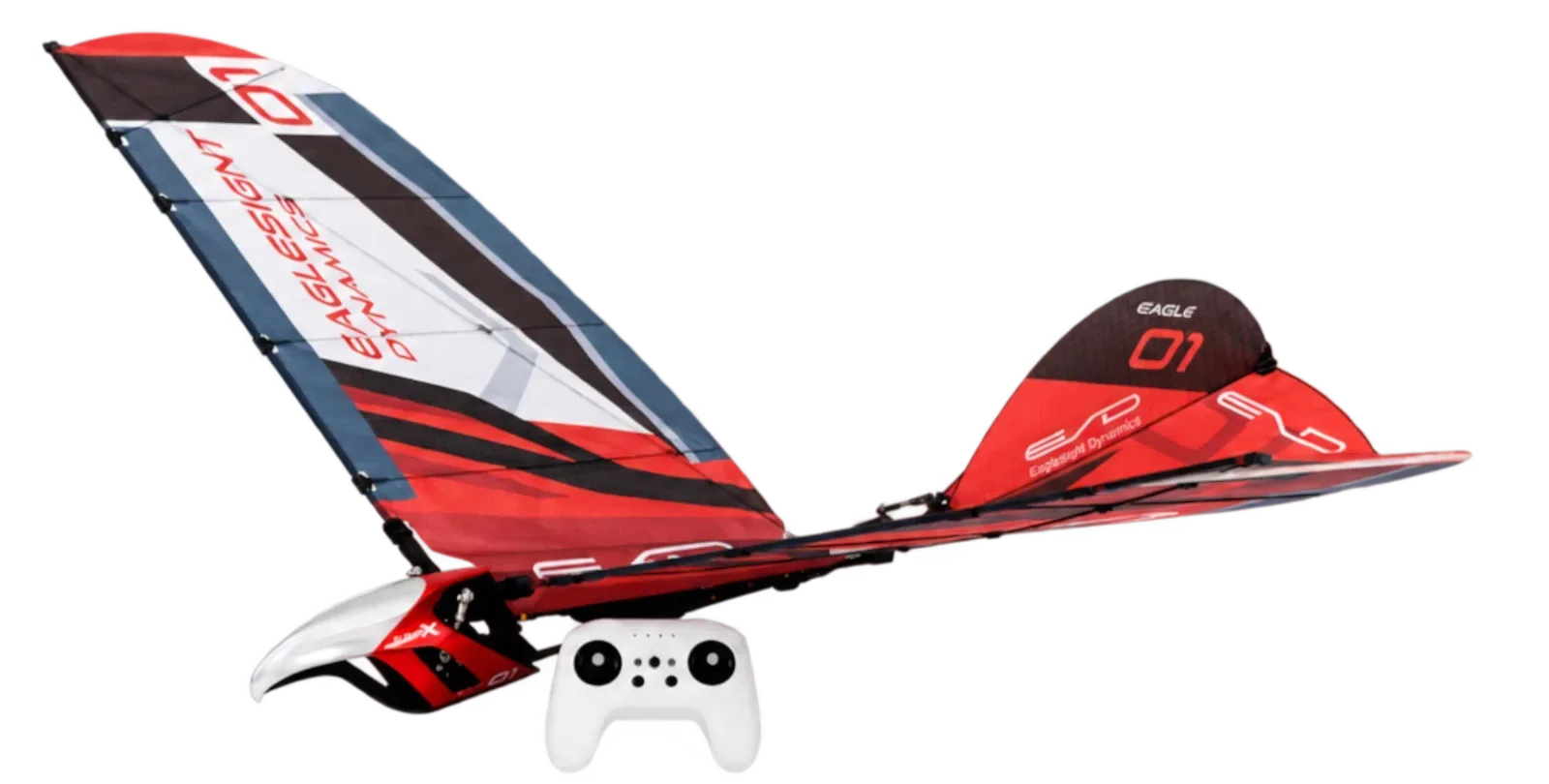
There is outside recognition: IFA’s current awards page lists Eagle X in its emerging-technologies award section, with additional honoree listings for design and sustainability. It dates the ceremony to September 4, 2026. That is a reason to look closer, not evidence that the retail aircraft is durable, easy for beginners, or ready to ship. IFA Innovation Awards
My first step would happen before joining a waitlist: walk the place where I imagine flying. Identify the launch area, landing area, obstacles, people, roads, and wildlife. Check permission and airspace. An attractive patch of grass is only a candidate until those questions are answered.
If I cannot name a suitable, lawful place to fly, I can enjoy the product video without turning it into a purchase.
1. Am I buying something available, or backing something still being developed?
I want a dated campaign page, a defined kit, an estimated delivery window, and clear terms before treating this as a buying decision. I have not verified a final price, Kickstarter launch date, shipping schedule, or regional availability.
My question would be: “What exactly is the production version, and what could still change?” A polished demonstration and a package arriving at my door are different milestones. I would keep any delivery-dependent plans off the calendar until the shipping evidence catches up.
2. What is the cost of my first usable season?
The headline price is only one line on my worksheet. I would total the aircraft, controller, charger, appropriate batteries, spare wings and tail parts, shipping, tax, and any equipment or club access needed for my flying plan.
The product page includes a kit illustration, but I would still confirm the contents of the exact offer before paying. Manufacturer kit information
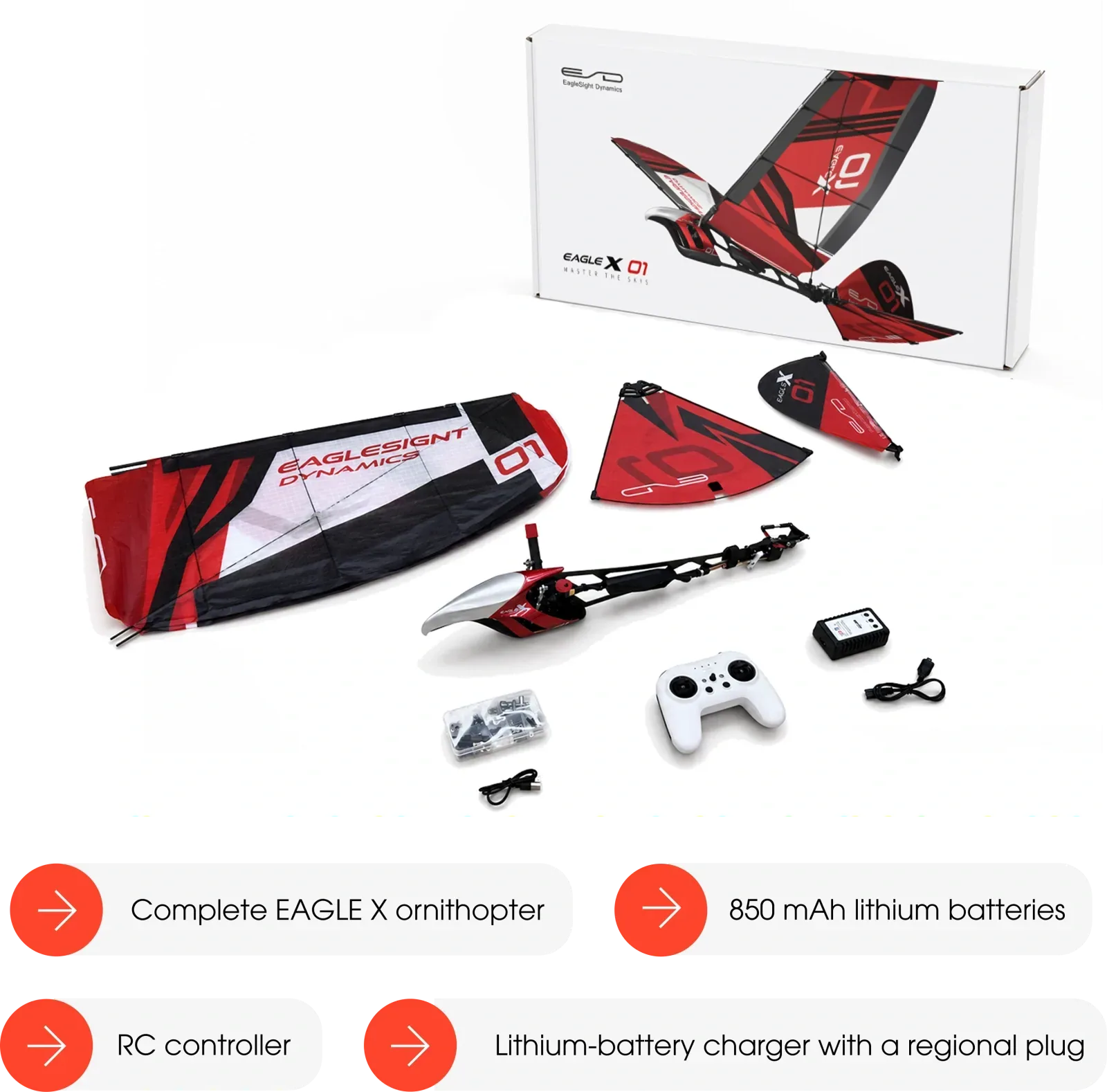
My scratch-pad formula: kit + required extras + spare parts + delivery costs + access costs = the number I need to be comfortable with. An unanswered price stays a question mark. It does not become zero because I really like the eagle.
3. Can I name the field—and explain why it works?
“Somewhere at the park” would not satisfy me. I would want the landowner or site manager’s rules, the airspace check, and enough unobstructed room for this particular aircraft’s launch, turns, approach, and landing.
I do not have a verified minimum field size, turning radius, or wind limit for Eagle X. I would ask for the manual and a beginner demonstration that states the conditions. I would also ask an experienced RC pilot to look at my proposed site. A field can look enormous until the aircraft needs to turn around.
I would identify the practice area on a sketch first, then check it on foot where access is permitted. That sketch is a planning aid, not a flight clearance.
4. Do I want the hobby, including the learning part?
I would ask for an uncut beginner session: preparation, launch, ordinary turns, landing, and the things that went wrong. Who is holding the controller? How much experience do they have? How many attempts did the successful clip require?
For a family project, I would want clear age guidance, an adult who is willing to learn, and a way to get instruction. The shared project could be the best part. It could also turn into one parent becoming the entire flight department.
My test is simple: would I still want this if the first few outings produced no impressive footage?

5. What does the flight assistance actually do?
I would want an explanation of the supported modes and what remains my responsibility. Does assistance stabilize attitude? What happens when the control signal drops or the battery gets low? What is the recovery procedure after a poor launch?
Those are questions, not features I am assuming Eagle X has. I have not verified its control behavior, failsafes, operating limits, or certification details. A phrase like “easy to fly” cannot answer them.
I would also ask whether the recommended beginner setup changes with added equipment. Any extra module needs a supported mounting method and a clear effect on balance and flying weight.
6. Can I fix it after an ordinary bad landing?
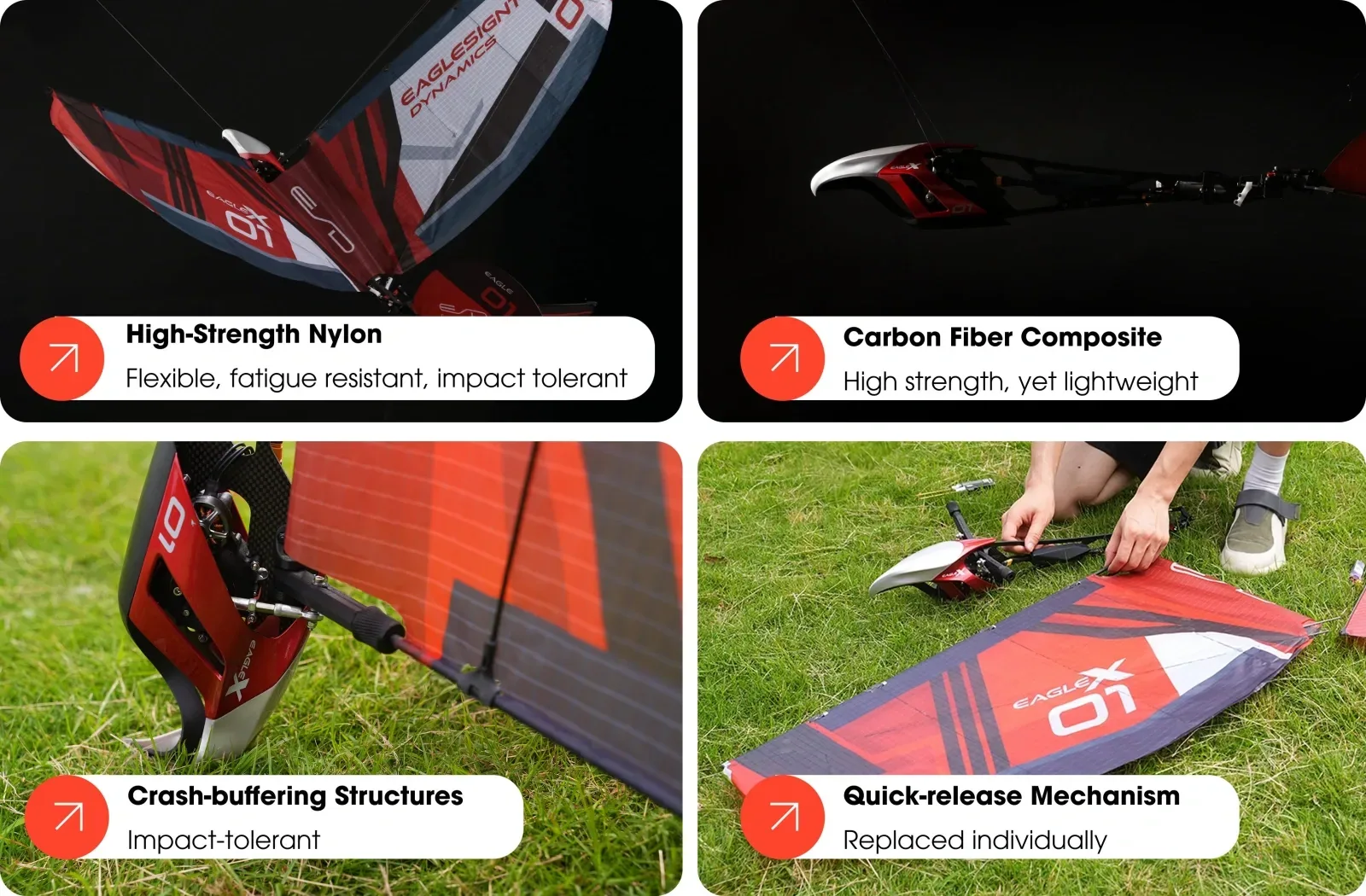
I want to see a replacement wing being ordered, fitted, checked, and flown—not just a promise that parts can be replaced.
Before backing it, I would ask for part numbers, prices, availability in my country, shipping costs, a repair guide, and the support process. I would want to know what a beginner can repair and what needs to go back to the company.
For me, repairability is a practical relationship: an obtainable part, understandable instructions, and someone to contact when the instructions do not solve it. A broken aircraft waiting indefinitely for one small component is still a broken aircraft.
7. What do battery time and “quiet” mean in ordinary use?
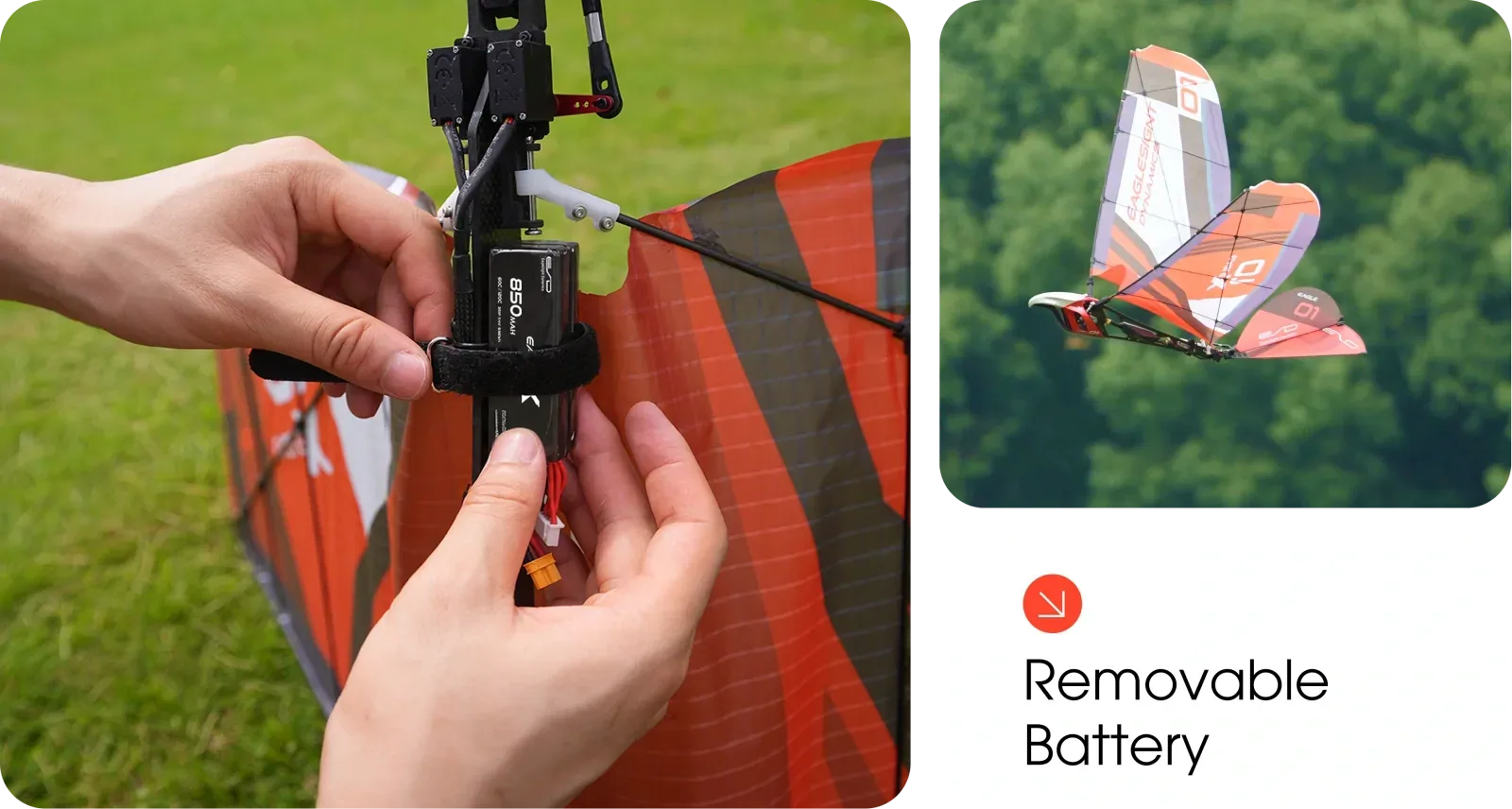
The company promotes low-noise flapping and wildlife-observation uses. I have not measured the sound or verified the endurance. Manufacturer flight and noise claims
I would ask for unedited audio at stated distances and a flight log showing battery, payload, wind, and landing reserve. I would want the charging, storage, inspection, and replacement instructions before my first outing, too.
My useful number is the amount of comfortable practice I can get from a normal outing. That includes preparation and stopping while there is still an appropriate margin. It is not a contest to squeeze every advertised minute out of a battery.
And quiet is a question about the people nearby, too. I would leave room for their afternoon to remain their afternoon.
8. What must I do to fly recreationally in the United States?
A bird-shaped RC aircraft does not get a rules exemption because it has personality. For a purely recreational flight, the FAA’s current guidance includes these requirements:
- Complete the free TRUST safety test and carry proof.
- Follow an FAA-recognized community-based organization’s safety guidelines.
- Maintain visual line of sight, or use a co-located observer in direct communication, and give way to other aircraft.
- Obtain prior FAA authorization for controlled airspace and respect its altitude limit; in Class G airspace, stay at or below 400 feet.
- Check applicable restrictions and avoid dangerous operation.
This is a starting checklist, not the full rules. Read the FAA page for your flight. If the purpose is work, promotion, or another non-recreational activity, do not assume “unpaid” makes it recreational. FAA recreational-flyer guidance
I would confirm the exact aircraft’s ready-to-fly weight, including everything attached. The recreational registration exception is for aircraft under 250 grams; do not assume Eagle X qualifies. Where registration is required, mark the aircraft and carry proof. FAA registration guidance
Remote ID rules apply to aircraft that require registration or are registered. The usual compliance paths are built-in Standard Remote ID, an appropriate broadcast module, or flight within an FAA-Recognized Identification Area under its conditions. A FRIA is a specifically recognized area, not any RC field. For a hardware-based compliance path, verify the exact aircraft or module’s accepted declaration and the operating requirements. I have not verified Eagle X’s Remote ID provision. FAA Remote ID guidance
9. Can I leave the wildlife completely out of this?
For a first hobby flight, my answer needs to be yes. An eagle-shaped machine is not a permission slip to approach real birds, follow animals, or fly near nests. I would choose a different place or postpone if wildlife makes the site unsuitable.
The U.S. Fish & Wildlife Service says there is no known safe distance for observing eagles or their nests with drones, and warns against trailing or pacing an eagle in flight. That is a strong reason to keep wildlife photography out of my beginner plan. Fish & Wildlife Service guidance
Land rules matter separately from airspace. The agency also says launching, landing, or disturbing wildlife by drone on national wildlife refuges is prohibited. A flight app alone does not establish permission to use the ground beneath it. National wildlife refuge drone rules
10. Would I still want it without a camera?
This is the question that would settle the purchase for me.
Before adding a camera, I would need a verified compatibility list, permitted payload, mounting instructions, balance requirements, and evidence of the resulting flight time and image quality. A place to attach something does not answer whether the whole setup makes sense.
If my real goal is dependable aerial footage, I would evaluate the equipment against that goal. If my goal is learning to fly a wonderfully odd mechanical bird, then one controlled, uneventful outing could already be a success.
I do not need every outdoor hobby to become a production company.
My three-line decision card
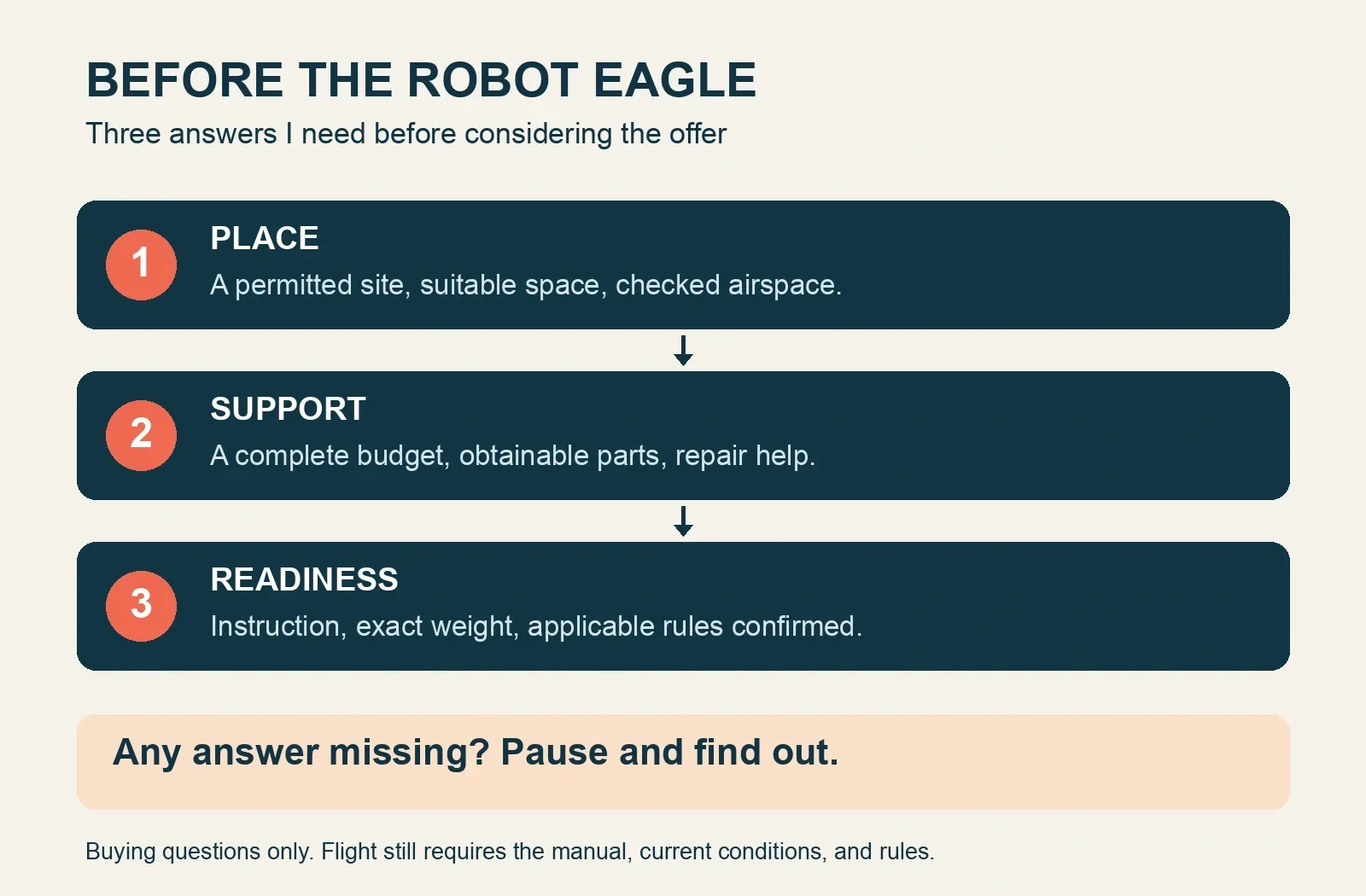
Write down a specific answer for each line:
- Place: My permitted site is ____. I checked its airspace and ground rules with ____.
- Support: My total budget is ____. Parts, battery instructions, and repair help are available from ____.
- Readiness: I will learn with ____. The exact weight, applicable rules, and equipment requirements are confirmed by ____.
A blank line means I have research left to do. Three complete lines mean I am ready to consider the offer more seriously—not that I have automatically cleared a flight. I would still review the manual, current conditions, and all applicable requirements before taking off.
Final Thought
I like the idea of this thing. A mechanical eagle is allowed to be interesting simply because it flaps its wings and makes somebody want to go outside.
But I would let it earn its wow factor with one quiet, lawful, uneventful hobby flight. Quiet is something to verify; lawful is something to establish; uneventful is something I would be delighted to report.
The nature documentary can wait. First, I want a place to fly, parts I can buy, instructions I understand, and a bird that comes home in one piece.
Source check: September 21, 2026. This is a prelaunch assessment, not a hands-on review or purchase recommendation. Product details and flight rules can change; check the linked primary sources and your location’s requirements before buying or flying.