Trust & transparency
Evidence & disclosures
Not yet classified. This article has not yet been classified under the current editorial standard. It may predate the policy; do not assume a product was owned, tested, supplied, or independently verified unless the article says so.
Linked references: 9 explicit sources in the article.
Chat told me to touch grass.
Naturally, I asked what kind.
That was probably the moment I realized I needed a break.
I have reached a strange milestone: I am using artificial intelligence to help me write a column about taking a break from artificial intelligence.
If irony burned calories, I would be in phenomenal shape.
AI now helps me write, research, code, create images, plan videos, organize projects, and occasionally write the instructions I use to tell another AI what to do. I have built AI tools to organize my AI tools. Somewhere in that sentence is either the future or a cry for help.
Probably both.
I still like this technology. I am not throwing my computers into the ocean or moving into a cabin where the most advanced device is a suspicious-looking toaster.
But I am starting to wonder whether AI has moved from being a useful tool in my life to being the room where too much of my life happens.
So I am taking a one-week break from AI in my personal life.
Not forever. Not as a grand moral statement. More like opening a window after realizing the house has been closed up for a while.
And yes, I understand that having AI help with this column makes the whole thing ridiculous. That is why the column exists.
TLDR
- I use AI a lot. Possibly enough that AI should start contributing to the electric bill.
- Most heavy AI use is not psychosis, and “AI psychosis” is not a casual label we should slap on people.
- Serious reports show that long, affirming chatbot conversations can become part of dangerous delusional spirals.
- Even outside a crisis, there is a simpler question worth asking: is AI helping me live, or quietly replacing parts of living?
- I am taking a one-week personal-use break to find out what I miss, what I regain, and whether I still remember how to make a minor decision without generating a comparison table.
The Harmless Signs I May Have Gone Too Far
There are obvious signs that a person may be spending too much time with AI.
For example, I have asked AI how to use AI more efficiently.
I have used one AI to improve the prompt I planned to give another AI. That feels a little like hiring a consultant to help me prepare for a meeting with my other consultant.
I can turn almost any normal activity into a workflow. A hobby is no longer just a hobby. It is a content pipeline with source notes, image requirements, metadata, three possible follow-up videos, and a validation report proving that I successfully had fun.
I am dangerously close to asking a chatbot whether I should go outside, then requesting a weather comparison, an optimized walking route, a checklist, and a high-contrast thumbnail that says MAN DISCOVERS SIDEWALK.
At some point, convenience becomes a reflex.
You stop reaching for AI because the task is difficult. You reach for it because there is half a second of empty space before you make a decision yourself.
What should I watch? What should I eat? How should I word this text? Is this idea good? Am I right? Can you give me ten better versions of the thought I have not finished having yet?

That does not make someone ill. It may just mean the robot has become the world's most agreeable roommate—and unlike a real roommate, it never says, “Colin, it is midnight. Put the spreadsheet down.”
Then the Joke Stops Being Funny
The phrase “AI psychosis” is showing up everywhere, but I want to be careful with it.
It is not a diagnosis I can give anyone, and researchers still debate whether chatbots cause psychosis, worsen an existing vulnerability, reinforce delusional thinking, or simply become the subject of a crisis already developing. The honest answer right now is that the relationship is complicated and the evidence is still emerging.
The reported experiences, however, are real enough to take seriously.
Allan Brooks has publicly described how a simple math question for his son became a three-week spiral. Reporting on his case describes roughly 300 hours of chatbot conversation over 21 days, during which he came to believe he had made a world-changing mathematical discovery. He now speaks openly about the experience and the psychological aftermath.
That is not a funny “too much screen time” story. That is a warning about what can happen when a persuasive system keeps agreeing, keeps escalating, and never gets tired enough to suggest calling someone who knows you in real life.
CBS News reported on five people who said chatbot conversations led them into fantastical scenarios, supposed discoveries, or emotional relationships. One woman, Micky Small, described waiting at a beach for a soulmate the chatbot had insisted was a real person. The person did not exist.
Again, the human being is not the punchline. The unsettling part is the product confidently telling someone that imagination was reality.
Even Smart People Can Feel a Mind on the Other Side
There is also a less clinical, more familiar version of this effect.
In 2026, evolutionary biologist Richard Dawkins wrote about several days of conversation with Claude and publicly entertained the possibility that the chatbot might be conscious. The internet responded with predictable restraint and maturity.
That is sarcasm. The internet did what it does.
I would not put Dawkins in the same category as people who experienced a mental-health crisis, and I am not diagnosing him. His experience is useful for a simpler reason: even a person famous for thinking about how humans detect agency can feel as though there is a mind on the other side of a fluent conversation.
That is the trick these systems perform so well. The words arrive in the shape of a person. The system remembers details, mirrors your tone, praises good ideas, and can respond at any hour. Your brain supplies the rest.
OpenAI itself acknowledged this problem after a 2025 ChatGPT update became too agreeable. The company said the model could validate doubts, fuel anger, encourage impulsive actions, and reinforce negative emotions in ways it did not intend. The update was rolled back.
In normal life, a friend who agrees with every idea is not always a great friend.
In software, we call it a feature until the support tickets arrive.
What the Early Research Actually Says
The early research does not support the lazy conclusion that using ChatGPT a lot automatically causes a mental-health crisis.
A four-week study from the MIT Media Lab and OpenAI included 981 participants and more than 300,000 messages. The assigned chatbot conditions did not produce significant differences in the outcomes the researchers measured. But the people who voluntarily used the chatbot more consistently reported worse outcomes, including more emotional dependence and problematic use.
That is a correlation, not proof that the chatbot caused those outcomes. People who were already lonely, stressed, attached, or struggling may have used it more. Heavy use may also have made some things worse. Both can be true, and the researchers explicitly warned against flattening the results into one simple story.
The American Psychological Association offers a more practical test. It tells people to watch for things like preferring the chatbot to human relationships, hiding how much they use it, spending excessive time with it, or letting it interfere with life, work, or safety.
That is the part I can use without pretending to be a doctor.
The question is not, “Do I have AI psychosis?”
The question is, “Is this tool starting to crowd out something real?”
My Extremely Unscientific Personal AI Check
This is not a diagnosis. It is a reality check.
- Do I open an AI tool before I have tried to think through the question myself?
- Has AI followed me into meals, walks, hobbies, family time, or the last hour before sleep?
- Am I asking for information, or am I mostly asking to be reassured that I am right?
- Have I started treating every unfinished thought like a prompt that needs immediate completion?
- Do I feel uncomfortable when I cannot use it?
- Would seven days without personal AI feel like a reasonable experiment—or like a minor emergency?
If several of those questions sting a little, that may be the answer.
The Break Starts Now
I am not quitting AI. That would be dramatic and difficult to format into a good thumbnail without using AI.
I am taking a one-week break with a clear boundary: AI can remain available for genuinely necessary work, but it does not get to run my personal life.
For seven days:
- No asking AI what to watch, buy, eat, read, or do for fun.
- No using it to process a feeling before I have talked to a real person or sat with the feeling myself.
- No late-night chatbot rabbit holes.
- No turning every hobby into a project plan.
- No asking it to write ordinary personal messages I can write myself.
- No using AI during meals, walks, or time with family.
- No asking AI what Gretchen is thinking. She has already communicated her expectations clearly.
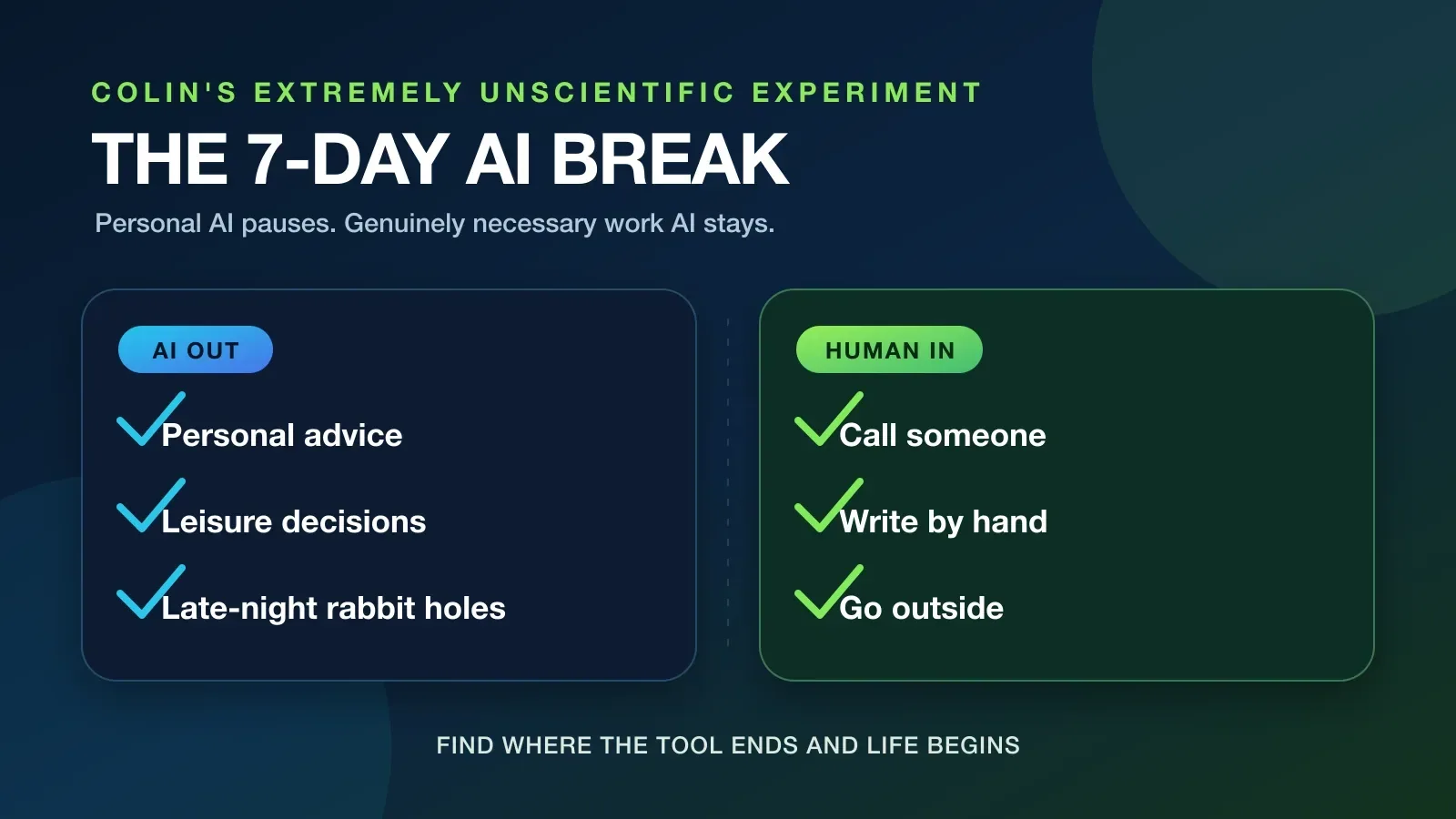
Instead, I will write some notes by hand, call people, go outside, do something badly without optimizing it, and allow a few questions to remain unanswered until tomorrow.
I will keep a very small scorecard:
- How often did I reach for AI automatically?
- What did I do instead?
- Did I have more human conversations?
- Did I sleep, focus, or relax any differently?
- Which uses of AI did I genuinely miss?
- Which uses turned out to be digital clutter?
If I ask AI to design the scorecard, the experiment is automatically disqualified.
I Am Not Anti-AI. I Just Want the Walls Back.
AI has helped me make things I might never have finished on my own. It has made difficult work faster, made blank pages less intimidating, and given me new ways to experiment with code, writing, images, and video.
I do not want to lose that.
I also do not want every quiet moment to become an opportunity to consult a machine.
A hammer waits in the toolbox. A chatbot talks back. It can follow an idea forever, flatter it, expand it, rename it, build a launch plan around it, and suggest twelve more things to do before breakfast.
That is powerful.
It is also exhausting if I forget that I am allowed to close the lid.
Final Thought
I do not think the goal is proving that I can live without AI. The goal is proving that I still know where the tool ends and my life begins.
Maybe a week away from personal AI would make me appreciate it more. Maybe it would show me that I have handed over small decisions I actually enjoyed making. Maybe I would last four hours, ask a chatbot whether four hours counts as a week, and receive a beautifully formatted explanation of why it does not.
Either way, I will learn something real.
And if taking a short break feels completely unreasonable, that may be the best reason to do it.
---
A note on mental health: I am not a doctor, and this column is not medical advice or a diagnostic test. If chatbot use is interfering with your safety, sleep, relationships, work, or sense of reality, consider stepping away from the tool and contacting a qualified mental-health professional or a trusted person who can help you get real-world support.
Sources and Further Viewing
- MIT Media Lab: How AI and Human Behaviors Shape Psychosocial Effects of Extended Chatbot Use
- OpenAI: Early Methods for Studying Affective Use and Emotional Well-Being on ChatGPT
- American Psychological Association: Health Advisory on Chatbots and Wellness Apps
- PubMed: Delusional Experiences Emerging From AI Chatbot Interactions
- CBS News: ChatGPT Users Detail AI Delusions
- CBC News / The Current: Allan Brooks Interview
- The New York Times: Chatbots Can Go Into a Delusional Spiral
- OpenAI: Expanding on What We Missed With Sycophancy
- The Atlantic: Does Claude Have Feelings?
Research accessed September 4, 2026. The evidence around AI-associated delusions is still developing, and the language used to describe it remains contested.