Trust & transparency
Evidence & disclosures
Evidence basis: Mixed evidence. The article combines more than one evidence type; the evidence summary identifies which claims come from which basis.
Combines my own medical-record planning needs with MedlinePlus and HealthIT.gov guidance; it is an organizational template, not medical or legal advice.
Sources checked: Aug 20, 2026
Linked references: 3 explicit sources in the article.
How I Would Build a Personal Health Record Before the Next Appointment Scramble
Medical information has a strange talent for being everywhere except the place you need it.
One doctor has the medication list. Another office has the test result. The hospital has the surgery record. A patient portal has a message you remember seeing but cannot find. Somebody in the family knows the name of the specialist, but only because it is still buried in a text thread from six months ago.
I have spent enough time around appointments, medication lists, surgery, and recovery to know that "it is in the system" does not always feel very reassuring when the system is actually five different systems.
That is why I like the idea behind the MedlinePlus personal health records guidance: keep your own personal health record so the basics are not scattered across offices, portals, paperwork, and memory.
I would start smaller than most people expect. I would build one calm, current medical information sheet before trying to organize every lab result I have ever received.
TLDR
- Start with one page: medicines and supplements, allergies, emergency contacts, chronic conditions, major illnesses or surgeries, important test dates, and the date of the last physical.
- Treat the page as a current snapshot, not a replacement for official medical records or advice from your care team.
- Build it from medication labels, portal records, after-visit summaries, and discharge paperwork. If something is uncertain, mark it for confirmation instead of guessing.
- Put a Last updated date at the top so nobody has to wonder whether the sheet is current.
- Keep one protected digital master, print a copy only when it is useful, and share it deliberately with the people who may need it.
- Review the sheet before appointments and after confirmed changes. The value is not making the document once; it is keeping it usable.
Why One Personal Record Can Help
MedlinePlus points out the obvious problem: a person may have charts at several doctors' offices and another chart at a hospital. Those records may be on paper or electronic, but they are not necessarily sitting together when a patient or caregiver needs the whole picture.
The federal health-record guide at HealthIT.gov makes a similar practical case. Having your records can make it easier to share important information, coordinate care across different providers, and verify that the information is current and correct.
That does not mean I need to rebuild the hospital's electronic chart at home.
It means I want a dependable front page that helps me answer the questions that arrive before I am fully settled in the exam room:
- What medicines and supplements are you taking?
- What are you allergic to?
- When was the surgery?
- Who should we call in an emergency?
- When was your last physical or screening?
- Which conditions are being managed by another doctor?
Those are easy questions on a quiet Sunday afternoon. They are less fun when I am sick, traveling, helping a parent, or filling out the same clipboard for the third time.
What I Mean by a "Calm Medical Info Sheet"
I am not talking about a hundred-page archive.
I am talking about one page that gives a patient, caregiver, or new clinician a useful starting point. Behind that page can be a supporting folder with visit summaries, test results, imaging reports, discharge paperwork, and other records. The first page is the map. The folder is the territory.
MedlinePlus suggests starting with identifying and emergency information, the date of the last physical, tests and screenings, major illnesses and surgeries, medicines and supplements with dosages, allergies, chronic diseases, and relevant family history.
That is already enough to build a very useful first version.
The Five-Line Version I Would Make Today
If I had only ten minutes, I would not use those ten minutes choosing fonts or color-coding tabs. I would write these five lines:
- Medicines and supplements: Name, strength or dose, and how long I have taken each one.
- Allergies: Medicine, food, or other allergies I know about, plus the reaction if I know it.
- Emergency contacts: At least one person, their relationship to me, and a current phone number.
- Major illnesses and surgeries: What happened and the best date I can confirm.
- Last physical: The date, the clinician or office, and any follow-up that still needs to be scheduled.
That first page would also have my full name, birth date, blood type if known, chronic conditions, and a large Last updated line at the top.
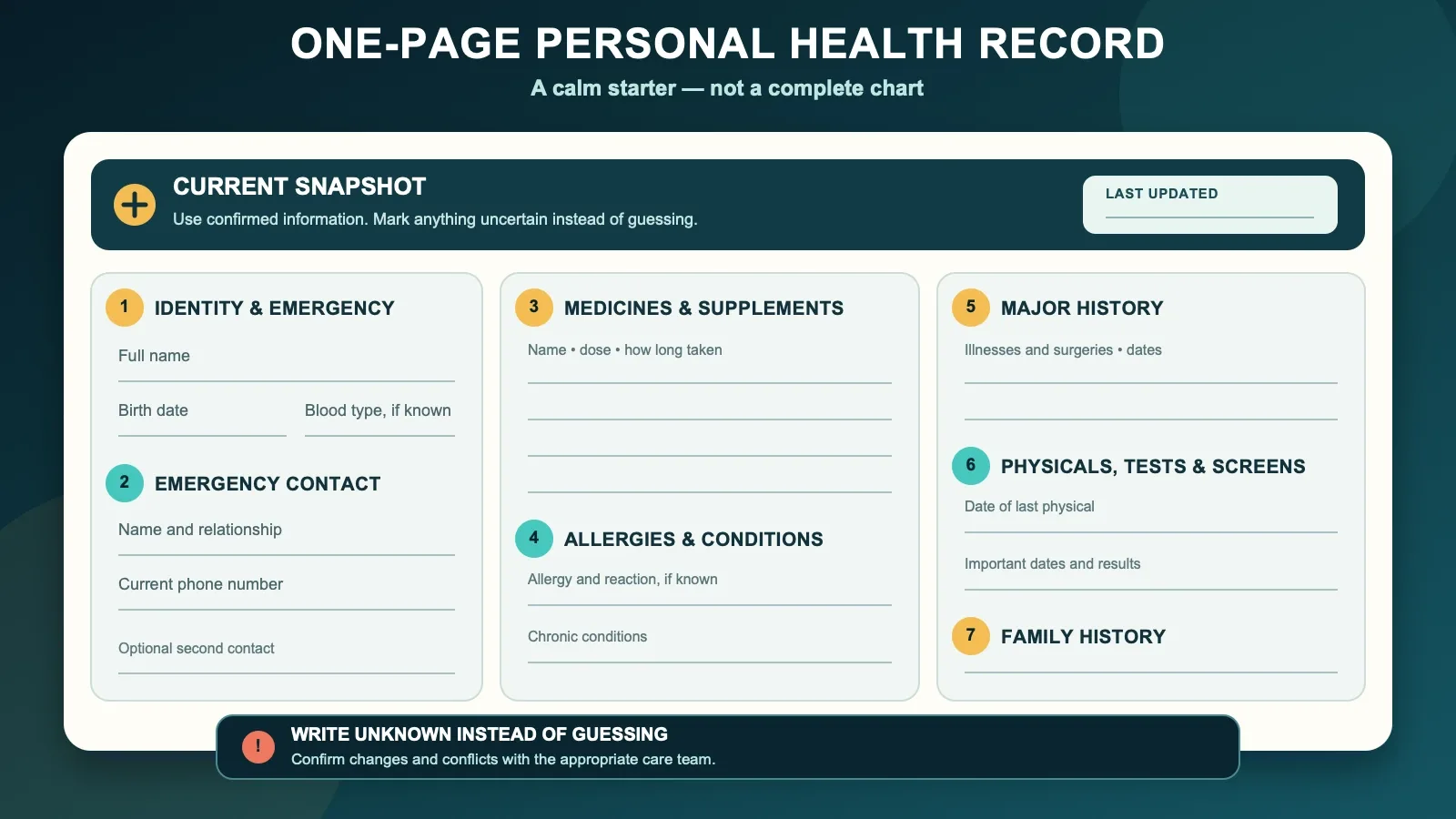
The important phrase there is if known. A personal health record should reduce confusion, not give a guess a professional-looking box.
If I could not confirm a date, dosage, blood type, or diagnosis, I would write Unknown or Needs confirmation. That is more honest and safer than filling the blank with whatever sounds familiar.
Build the First Page, Then the Supporting Folder
Once the one-page snapshot exists, I would create a simple supporting folder. I would not try to collect everything in one sitting.
My folder would start with:
- Recent after-visit summaries.
- Hospital discharge instructions.
- Current test and screening results that matter to ongoing care.
- A list of doctors, clinics, and pharmacies with phone numbers.
- Insurance information needed for appointments.
- Any care-planning or authorization documents the family already uses.
The one-page sheet should stay quick to scan. The supporting folder can hold the detail.
This separation matters. If I cram every result, phone number, appointment note, and insurance explanation onto the first page, I have recreated the scramble in a smaller font.
I Would Build It From Sources, Not Memory
Memory is helpful, but it should not be the only source for a health record.
I would put the medication bottles on the table, sign in to the patient portals I already use, gather the newest after-visit summaries, and compare them. If two sources disagree, I would flag the conflict and ask the appropriate clinician or pharmacist to help confirm the current information.
I would not quietly combine two medication lists and assume the longer list must be better. I would not turn an old diagnosis in a portal into a current conclusion. I would not change a medication because my homemade document looked different from the bottle.
The personal record is an organizing tool. The care team is still the place to resolve medical questions.
Where I Would Store It
There is no single storage choice that works for every household, but I would use one rule: one protected master, a small number of intentional copies, and a clear owner.
For the digital master, I would use a password-protected device or account I already trust and know how to access. I would give the file a boring, obvious name such as Personal Health Record - Lastname - 2026-08-03.pdf instead of new-final-final2.pdf.
For paper, I would print a copy for an appointment or travel only when it would be useful, keep it in a private place, and shred an outdated copy rather than letting old medication lists live forever in a glove box.
For family access, I would choose the person who may realistically need the sheet, tell them where the current version lives, and agree on who updates it. I would not put portal passwords, security-question answers, Social Security numbers, or unrelated financial details on the sheet.
The privacy part deserves attention. Federal privacy rules protect health information held by many health care providers, health plans, and organizations working for them. A federal HealthIT.gov privacy guide also warns that information stored in some consumer apps, devices, or personal health-record services outside a covered provider or plan may not receive the same HIPAA protection.
That does not mean "never use an app." It means read the privacy and security information, use device and account protections, and do not assume every place that stores health information follows the same rules as a doctor's office.
The Caregiver Version Needs Permission and Ownership
Adult children helping parents often become the unofficial keeper of dates, medicine names, and phone numbers. That can be incredibly helpful, but a family role does not automatically answer every access, privacy, or decision-making question.
I would make the organization explicit:
- Whose record is this?
- Who is allowed to see it?
- Who keeps the master copy?
- Who updates it after an appointment?
- Which clinician or pharmacy should be called when something conflicts?
- Where are any existing authorization or care-planning documents stored?
The point is not to turn a family into a compliance department. The point is to stop three well-meaning people from maintaining three different medication lists.
My 20-Minute Build
Here is the version I would actually do instead of promising myself I will organize everything "one weekend."
- Minutes 1-3: Open one blank document. Add the person's name, birth date, emergency contact, and a Last updated line.
- Minutes 4-8: Add medicines and supplements. Copy the names and doses from current labels or confirmed records. Mark conflicts for follow-up.
- Minutes 9-11: Add allergies and chronic conditions. Use confirmed wording. Do not diagnose from memory.
- Minutes 12-15: Add major illnesses, surgeries, and important dates. Include the last physical and the dates of recent tests or screenings when available.
- Minutes 16-17: Add care contacts. List the main doctor, relevant specialists, preferred pharmacy, and emergency contacts.
- Minutes 18-19: Save and protect it. Use a clear filename and store the master in the chosen protected location.
- Minute 20: Set the next review. Add a calendar reminder before the next appointment or for three months from now.
If the timer ends and some boxes are blank, that is fine. A clearly marked incomplete record is more useful than a perfect template that never gets made.
Before the Next Appointment
Two days before an appointment, I would open the sheet and do a short review:
- Did any medicine or supplement change?
- Did a new allergy or reaction get confirmed?
- Was there a hospital visit, surgery, test, or screening since the last update?
- Did a doctor, pharmacy, phone number, or emergency contact change?
- Is there a conflict that needs a question at the appointment?
- Is the Last updated date still honest?
I would keep appointment questions on a separate page. The health record is the stable snapshot. The question list is what I need to discuss today.
After the appointment, I would update the record from the confirmed instructions, medication label, or after-visit summary. If the paperwork and the conversation seemed to disagree, I would call the office or pharmacy rather than guessing which one wins.
What This Sheet Does Not Do
It does not replace a clinician's chart.
It does not prove that every entry is correct simply because it is typed neatly.
It does not authorize a caregiver to access records or make decisions.
It does not tell anyone how to change medication, interpret a test, or treat a condition.
It also should not become a reason to delay emergency help. In an emergency, call 911 or follow the instructions of the emergency professionals involved.
This is organization, not treatment.
Try the One-Page Challenge
Do not start by downloading ten years of medical records.
Start with the five lines: medicines, allergies, emergency contacts, major illnesses or surgeries, and the last physical. Add the date. Save it somewhere protected. Tell one trusted person where the current copy is, if sharing it fits the person's wishes and situation.
Then bring it to the next appointment and notice what is missing.
That real appointment will teach you more about what belongs on the sheet than another hour spent designing the template.
Final Thought
A personal health record is not exciting, and that is part of its charm.
The goal is not to build a command center that looks like a hospital television show. The goal is to make the next ordinary appointment, travel day, caregiver handoff, or unexpected phone call a little less chaotic.
One page will not organize an entire medical life. It can give that life a front door.
Build the calm sheet before the next scramble starts.
Official Sources
- MedlinePlus: Personal Health Records, U.S. National Library of Medicine, accessed August 3, 2026
- HealthIT.gov: The Guide to Getting and Using Your Health Records, accessed August 3, 2026
- HealthIT.gov: How to Keep Your Health Information Private and Secure, accessed August 3, 2026
I am not a doctor, and this is not medical advice. This is an organizational approach to keeping personal health information easier to find and share. Medical questions, medication changes, and conflicting information should be discussed with the appropriate care team.