Trust & transparency
Evidence & disclosures
Evidence basis: Researched analysis. The article compares public evidence and does not claim hands-on testing unless a section says otherwise.
Built from FTC scam guidance and practical family rules; it cannot authenticate a specific message or guarantee that every scam will be caught.
Sources checked: Aug 20, 2026
Linked references: 1 explicit source in the article.
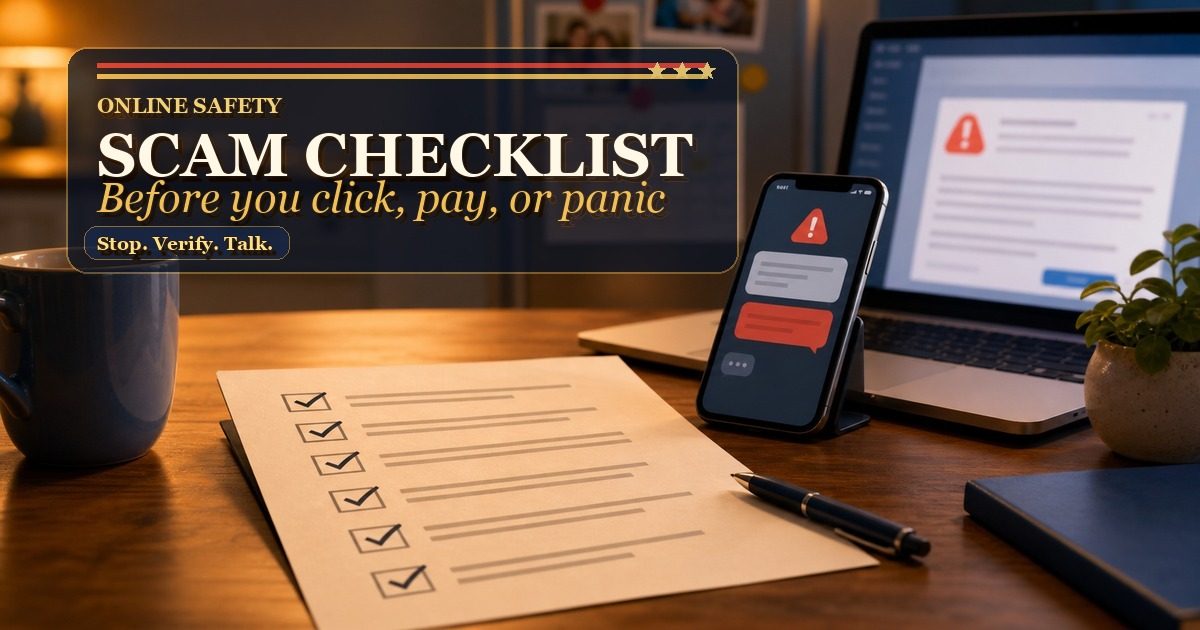
Before You Click, Pay, or Panic: A Simple Scam Checklist for Families
TLDR
AI can make scams look and sound more real, but the basic warning signs have not changed much. If a message creates panic, asks for private information, demands a weird payment method, or tells you not to talk to anyone, pause. Then verify it through a number, website, or person you already trust.
The goal is not to turn everybody in the family into a cybersecurity expert. The goal is to give people one simple habit: stop, check, and talk before money or personal information leaves your hands.
Why This Feels Different Now
Scams used to be easier to laugh off.
The fake emails had obvious typos. The phone calls sounded off. The "official" messages looked like someone built them in a panic using clip art and bad intentions.
Now AI is making the rough edges smoother.
A scam text can sound polite and specific. A fake support email can look like it came from a real company. A voice message can imitate someone enough to make your stomach drop. A fake website can look official for the two minutes it needs to fool someone.
That is the part that worries me most. Not because everyone suddenly became careless, but because the scam itself can feel more believable than it used to.
So I think families need a plain checklist. Something simple enough to put on the fridge, tape near a computer, or send in the family group chat without making it feel like homework.
Because nobody makes their best financial decisions while panicking. I can barely choose dinner under pressure. I definitely do not want anyone wiring money because a stranger in a hurry said so.
The FTC's Basic Scam Pattern Still Holds Up
The FTC's consumer guidance on avoiding scams is useful because it does not depend on the scam being low-tech or high-tech. The same pattern shows up again and again.
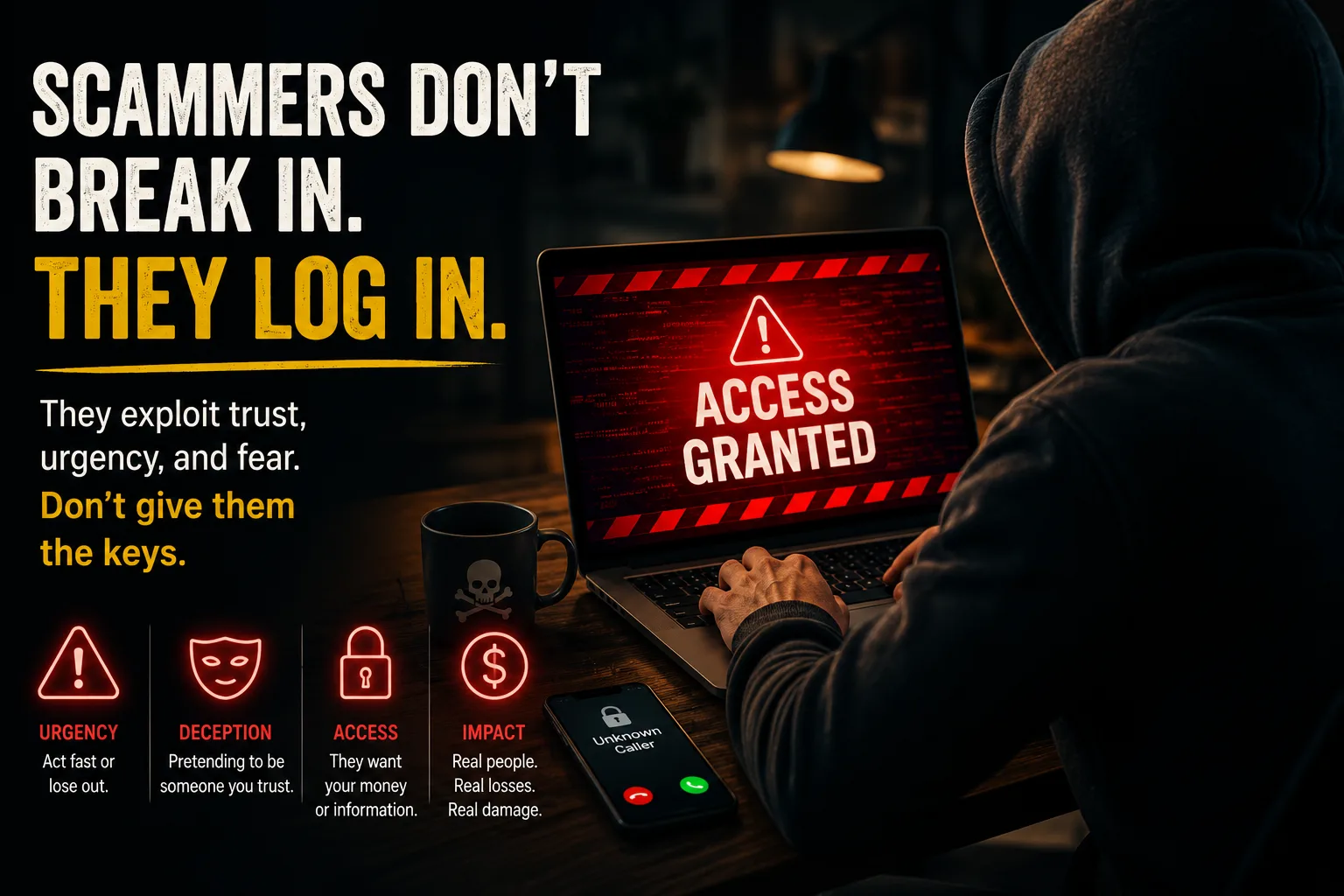
Scammers often pretend to be someone familiar or official. They claim there is a problem, a prize, an emergency, or an account issue. They pressure you to act immediately. Then they tell you to pay or respond in a specific way.
That pattern matters even more in the AI era.
AI can change the costume. It can make the email cleaner, the voice more convincing, the logo sharper, or the message more personal. But the pressure underneath usually looks familiar.
- Someone wants you scared.
- Someone wants you rushed.
- Someone wants you isolated.
- Someone wants money, account access, gift cards, crypto, payment app transfers, verification codes, or personal information.
That is the moment to slow everything down.
The Family Checklist
Here is the version I would actually want people in my family to use.
Before you click, pay, share, or panic, ask these questions:
- Did this message arrive unexpectedly?
- Is it trying to scare me or rush me?
- Is it pretending to be a bank, government agency, tech company, delivery service, family member, or support team?
- Is it asking for a password, verification code, Social Security number, bank number, credit card number, or remote access to a device?
- Is it telling me to pay with gift cards, crypto, wire transfer, payment app, or some other oddly specific method?
- Is it telling me not to hang up, not to call anyone, or not to tell my family?
- Did the link, email address, phone number, or website come from the message itself?
- Can I verify this another way?
If the answer to any of those is yes, pause.
Not "pause for three seconds while still emotionally sprinting toward disaster." Actually pause.
Put the phone down. Step away from the computer. Take a breath. Then check it through a route you already trust.

The Rule I Would Put On The Fridge
If money, passwords, account codes, or fear are involved, do not respond through the message that scared you.
Use a known path instead.
Call the number on the back of the card. Go to the official website by typing it yourself. Open the app directly. Call the family member. Text someone you trust. Ask a neighbor. Ask your adult kid. Ask your parent. Ask the person who usually fixes the printer and therefore has already seen things.
The important part is that you break the scammer's channel.
- If the message says your bank account is frozen, do not click the link in the text. Open your banking app or call the number from your card.
- If someone says they are from tech support, do not let them remote into your computer because a pop-up told you to call. Close the browser or shut the machine down if you need to, then use a trusted support path.
- If a voice says a family member is in trouble and needs money, hang up and call that person or another family member directly.
- If someone says you need to buy gift cards to fix a legal, medical, banking, or tax problem, that is not a payment plan. That is a giant red flag wearing a name badge.
A Quick Script For Family Members
Sometimes the hard part is not knowing what to do. It is knowing what to say when someone is pressuring you.
Here are a few simple lines worth practicing:
- "I do not make payment decisions on the phone."
- "I need to verify this through the official number."
- "I am going to call my family before I do anything."
- "Send it by mail and I will review it."
- "I do not share codes, passwords, or account numbers by text or phone."
- "I am hanging up now."
That last one is underrated.
You do not have to win an argument with a scammer. You do not have to prove they are lying. You do not have to stay polite while someone is manipulating you.
- You can hang up.
- You can delete the message.
- You can close the window.
- You can ask for help.
Why Talking To Someone Helps
One of the best pieces of advice in the FTC guidance is also one of the simplest: talk to someone you trust before doing anything else.
That works because scams are designed to trap people inside the moment.
Panic makes the world small. The scammer wants the only voice in your head to be theirs. They want you thinking about the emergency, the deadline, the fine, the frozen account, the virus, the prize, or the family member supposedly in trouble.
Another person gives you oxygen.
They may notice the weird payment method. They may ask why a bank would need gift cards. They may remind you that the IRS does not need Apple cards, which feels like a sentence we should never need to say and yet here we are.
That outside voice can turn panic back into a decision.
AI Does Not Mean We Trust Less. It Means We Verify More.
I do not think the answer is to become paranoid about every message, phone call, and email.
That sounds exhausting. Also, most of us still need to live our lives, answer normal messages, pay bills, help family, and occasionally click a tracking link because apparently every package now has a dramatic journey.
The better habit is verification.
Trust the people in your life. Trust real institutions when you are using their real contact points. Trust your own instincts when something feels off.
But do not trust urgency just because it arrived with a logo.
- Do not trust a voice just because it sounds familiar.
- Do not trust a link just because the message knows your name.
- Do not trust a payment request just because it sounds official.
AI can make the first impression stronger. Your job is to make the second step slower.
My Family Scam Rule
If I had to boil this whole thing down to one rule, it would be this:
No one in the family sends money, shares private information, gives access to a device, or reads a verification code out loud because of an unexpected message without checking with another trusted person first.
That rule will not stop every scam.
Nothing will.
But it creates friction in the right place. It gives people permission to slow down. It makes asking for help feel normal instead of embarrassing.
That matters because shame is part of how scams keep working. People worry they will look foolish, so they stay quiet. Then the scammer gets more time alone with them.
I would rather make the family rule boring and obvious: if something feels urgent, weird, expensive, or secret, bring someone else into it.
Print This Version
Here is the short version for the fridge, a desk, or a family text thread:
Pause before you click, pay, or panic.
- Unexpected message? Stop.
- Urgent threat or prize? Stop.
- Asking for passwords, codes, money, or account numbers? Stop.
- Gift cards, crypto, wire transfer, or payment app? Stop.
- Telling you not to talk to anyone? Stop.
- Link or phone number came from the suspicious message? Do not use it.
- Verify through a website, app, phone number, or person you already trust.
- When in doubt, call someone before doing anything.
That is it.
Not fancy. Not technical. Not a 47-step security framework with acronyms and laminated anxiety.
Just a pause button.
And honestly, that may be the most useful tool we have.
Source Note
This post is based on the FTC Consumer Advice article How To Avoid a Scam, accessed July 6, 2026. The FTC source is general scam guidance rather than AI-specific guidance. I used it here because the warning signs still apply when AI makes fake messages, fake voices, and fake support requests more believable.