Trust & transparency
Evidence & disclosures
Not yet classified. This article has not yet been classified under the current editorial standard. It may predate the policy; do not assume a product was owned, tested, supplied, or independently verified unless the article says so.
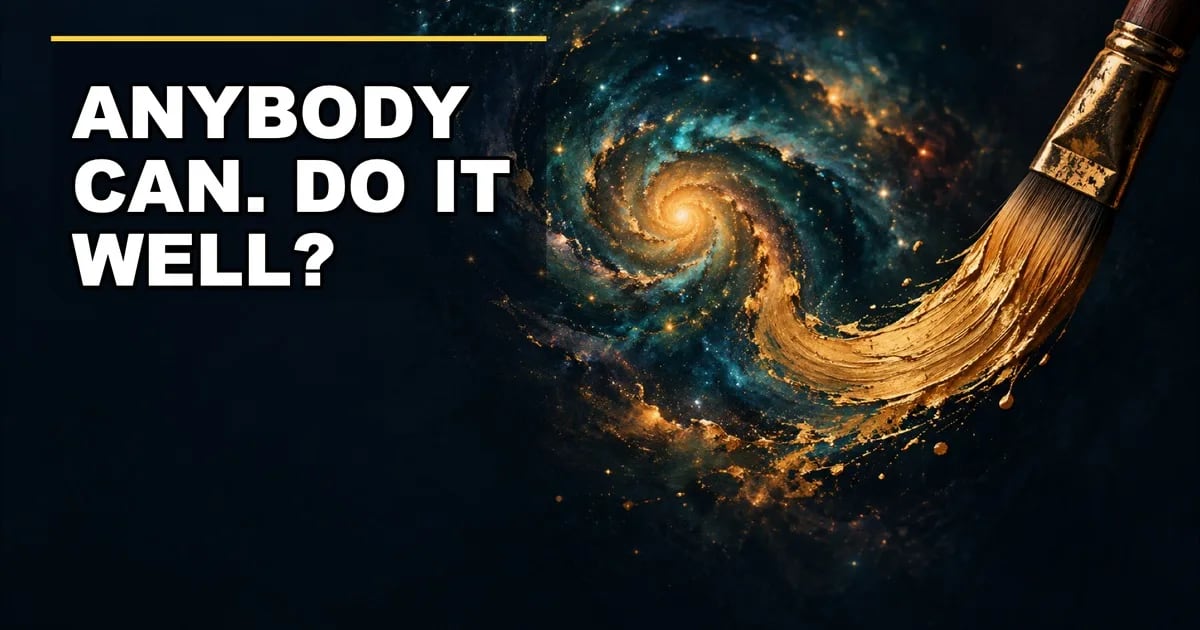
Anybody can do AI. Anybody can do art.
But not everybody can do art well, and not everybody can do AI well. That's really the point I keep coming back to.
Being able to make something doesn't mean you've learned how to make it good. It means you can start. And I think a lot of the argument around AI gets stuck right there, at the starting line.
Yes, AI is amazing. Yes, you can type something in and get something back that would have seemed ridiculous a few years ago. An image. A piece of music. Help working through a problem. That deserves a little amazement.
But then what? What do you do with the thing it gave you?
Getting Started and Getting Good Are Different Things
I can pick up a paintbrush. That doesn't mean you want my painting hanging over your couch.
Although, depending on your couch, maybe we'd be fine.
The brush gives me a way to put something on a canvas. I still have to make decisions about what belongs there. What am I trying to say? What feels right? What needs another pass? At some point, I have to look at what I made and decide whether it actually works.
That's where I think the interesting part of AI begins, too.
Getting an answer is one step. Knowing whether it's useful is another. Getting an image is one step. Knowing why it feels almost right, and what to change, takes something else.
I don't think the first result should automatically be the finish line just because getting there was easy.
The Level Has Been Raised
When I first said this out loud, I said, “The level has just been risen.” Which is probably a good argument for giving your first draft another look.
What I meant was that the level has been raised.
It sounds strange to say the threshold is higher when more people can get through the door. But I'm talking about what happens after we walk in. If making a decent first version becomes easier, I start expecting more from the finished thing. More thought. More intention. A reason for it to exist.
That's my expectation, anyway. I'm not saying every person suddenly has to become a professional artist. Make something because it's fun. Make something terrible. Learn from it. We need room for that, too.
But if the whole defense of something is “Look, AI made it,” I think eventually I'm going to ask, “Okay. What did you want to make?”
The tool can be part of that answer. I still want to hear the person in it.
There Are Things We Can't Comprehend Yet
My mind went from AI to the universe while I was talking about this. That's apparently where we were headed. Paintbrushes, computers, the entire meaning of existence. A normal little thought before moving on with the day.
I feel like the expanding universe and the expanding mind have something in common. The more room there is to explore, the more you realize how much you haven't seen.
I'm using that as a comparison, not a scientific explanation. It's the feeling I'm trying to get at: there are things we don't know, things we haven't encountered, and things we don't even have a good way to think about yet.
AI gives me some of that feeling. Possibility, uncertainty, curiosity. All at once.
I don't know where all of this goes. I don't think being excited requires me to pretend I do.
What About the Things That Could Go Wrong?
In the original thought, I said, “Yes, it may kill us.” That's a pretty sharp turn in a conversation about making art.
I don't know what the future of AI holds. I have no prediction to offer about how this ends. What I was reaching for was the strange way possibility and fear can occupy the same space.
We can imagine amazing things. We can also imagine terrible things. Sometimes we build something useful and then have to figure out problems we didn't understand when we started.
My excitement doesn't answer somebody else's concern. Saying we've faced danger before doesn't prove we'll handle the next danger well. We still have to pay attention to what we're doing and be willing to change course.
I want to leave room for that responsibility without letting fear make every decision for me.
Give the First Result Another Pass
Here's something small to try: make one thing with AI, then spend a little time deciding what you think of it before asking for more.
Pick something you can judge for yourself. A short paragraph. An invitation. An image for a personal project.
Ask yourself what you wanted it to do. Then look at what it actually did. Find one thing that works and one thing that doesn't. Make a specific change. Compare the two versions.
Maybe the first one was better. That's useful to notice, too.
For me, that's a more interesting exercise than generating fifty things and hoping one of them feels finished. It gives your own judgment a job. You have to participate.
And it leaves you with a question worth asking: what did I bring to this?
Final Thought
I ended up talking about life, death, and whether this is the only life we'll ever get. I don't have an answer to that last part. I have questions. I have a little room for “maybe.”
Sometimes I think about life like a game, with another level we haven't figured out how to unlock. That's a way for me to imagine possibility. It doesn't make the time we're living through any less real.
We're all going to die someday, somehow. I don't find that especially comforting, but it does put the afternoon in perspective.
This is our little snippet of time that we happen to get to experience. I want to spend some of mine making things, learning something, and seeing what happens when I try again.
Anybody can do AI. Anybody can do art.
I want to see what I can learn to do well.