Trust & transparency
Evidence & disclosures
Not yet classified. This article has not yet been classified under the current editorial standard. It may predate the policy; do not assume a product was owned, tested, supplied, or independently verified unless the article says so.
Linked references: 10 explicit sources in the article.
Cover illustration: AI-generated editorial artwork. The red line is symbolic, not a plotted market series.
Watching AI stocks fall this week, my concern goes beyond a red number on a screen. I want to know whether America is making it harder to build the next generation of technology here—and whether ordinary people will pay the price if that work goes somewhere else.
Politics belongs in that conversation. Reporting on Thursday’s selloff identified the election results and fears of restrictions on data-center construction as an important catalyst. But the financial doubts were already there. Treating this as a single-cause story would miss both the warning and the opportunity to fix what is going wrong. Reuters market analysis, UOB’s November 2 assessment
My position is straightforward: I want America to remain a place where people can build useful AI, start businesses, and find good work. That requires a workable agreement between the companies building the infrastructure and the communities living with it.
What actually happened this week?
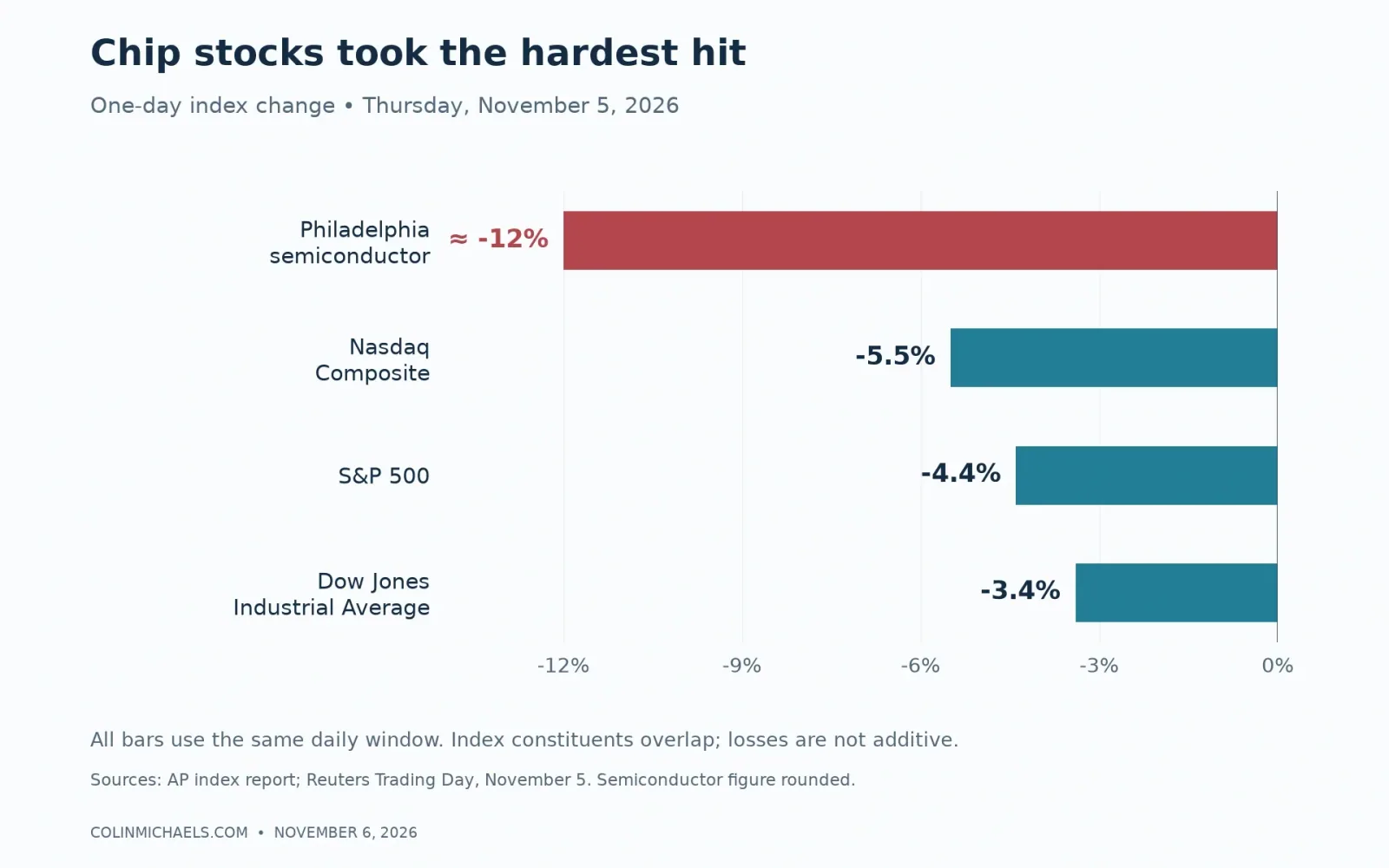
Thursday, November 5, brought a severe market selloff:
Those are different measurements: Thursday’s losses were larger than the week-to-date losses because earlier gains offset part of the damage. AP’s November 5 index report
The pain was especially sharp in chips. Reuters reported a roughly 12% drop in the Philadelphia semiconductor index. That matters because chipmakers sell into the infrastructure boom: less expected construction can mean fewer expected equipment orders. Reuters
There was also a partial rebound Friday. At the 1:50 p.m. Eastern snapshot reported by AP, the S&P 500 was up 0.7% and the Nasdaq Composite was up 1.4%. These were intraday readings, not the week’s final result. AP’s November 6 update
A plunge in stock-market value also does not mean the same amount of money disappeared from company bank accounts. Shares are being repriced. The economic damage depends on what follows: financing problems, canceled projects, reduced hiring, or weaker spending.
Politics was a trigger. Financial pressure made it more dangerous.
Investors were reassessing the data-center boom after Democratic election victories. Reuters connected Thursday’s decline to fears that the new political balance would slow construction. That is evidence of a market reaction to anticipated policy—not proof that every feared restriction has already become law. Reuters
The distinction matters. A campaign promise, a local zoning decision, a proposed federal bill, and an operating facility being shut down are four different things.
Brookings’ November 4 analysis describes several possible policy changes, including permitting rules, construction pauses, changes to tax exemptions, and stronger requirements to protect electricity customers. State and local decisions matter alongside Washington because they shape where projects can actually be built. Its article discusses possibilities and proposals, not a single nationwide policy already in force. Brookings
Meanwhile, UOB’s November 2 briefing—before the November 3 election—already described investor concern about heavy AI spending, uncertain returns, and cash flow. That timing is important. The election landed on a market that was already asking whether the enormous bills would produce enough profitable business. UOB
My interpretation is that political uncertainty amplified an existing financial problem. A stock price built around fast growth becomes vulnerable when investors think projects might take longer, cost more, or earn less.
There is no credible way, from these reports alone, to assign an exact percentage of the decline to politics. Saying that openly makes the argument stronger.
Are America’s tech companies preparing to leave?
There is evidence of companies reconsidering where to build infrastructure. There is not evidence here that all major American tech companies are relocating out of the country.
SBS, summarizing Wall Street Journal reporting, described discussions about overseas data centers, expansion of existing sites, and changes to future construction plans. That is reported strategic consideration, not confirmation of headquarters departures or completed transfers of American operations. The SBS English article is AI-translated, so it should not be used as the sole basis for a precise executive quotation. SBS report
Overseas expansion also predates this election. In March, Anthropic announced an Australian government agreement and said it was exploring Australian data-center and energy investment. That is direct evidence of an international strategy already underway. It cannot logically be blamed on November’s election result. Anthropic’s March 31 announcement
There is domestic investment to consider, too. Microsoft announced a planned two-gigawatt campus in Pecos, Texas, in June. The company projected more than 6,000 construction jobs at peak and hundreds of permanent operating jobs. Those are company forecasts, not verified jobs already delivered, and the announcement does not establish the project’s post-election status. Microsoft’s Pecos announcement
The most immediate question is where the next investment goes. America could lose opportunities without a famous company moving its headquarters at all.
What could America lose if investment moves abroad?
The following are economic scenarios, not predictions of departures already announced.
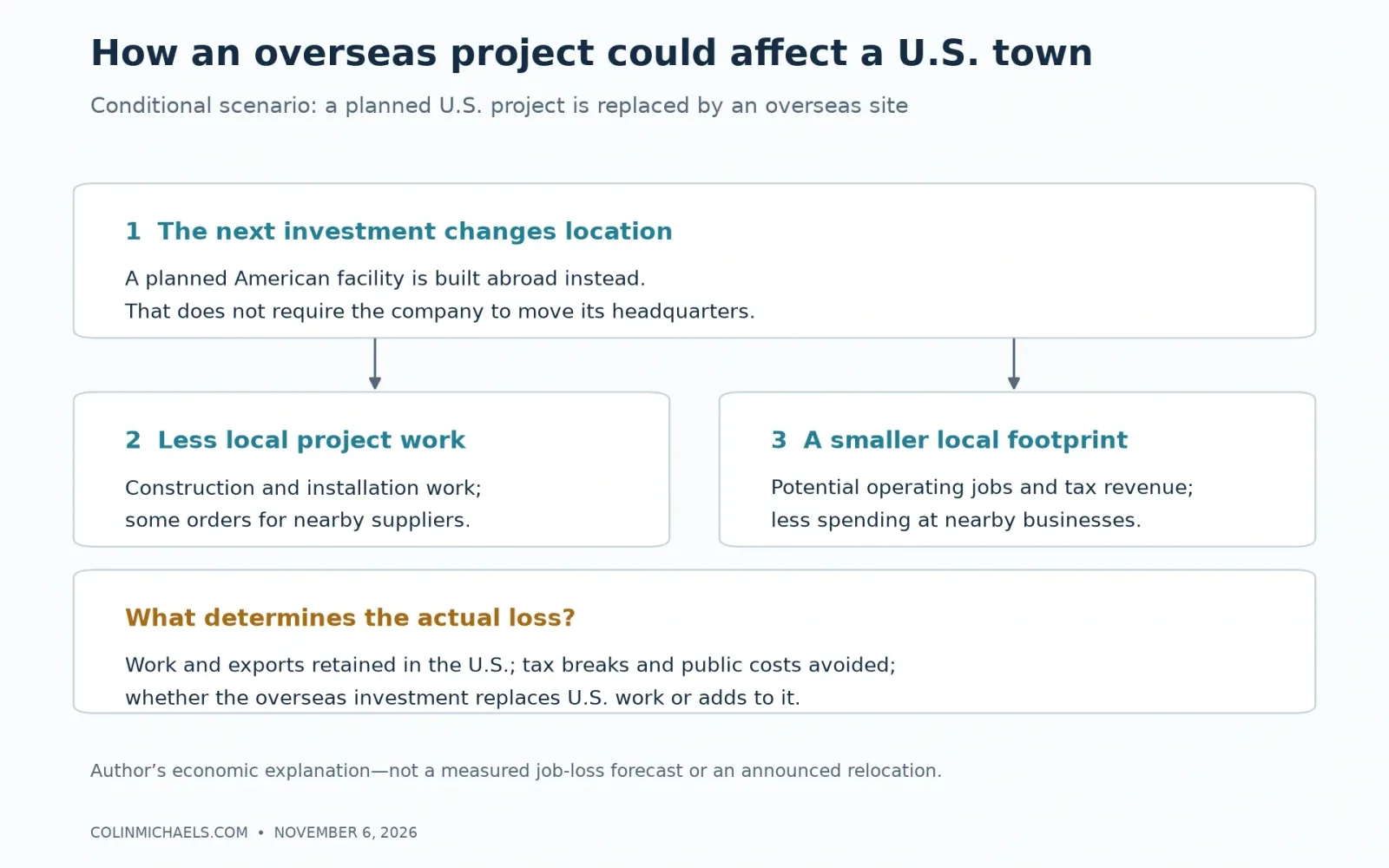
For a community, the effects could extend from electrical contractors to equipment installers, maintenance businesses, and restaurants serving construction crews. But temporary construction jobs and permanent operating jobs must be counted separately. A headline investment figure cannot tell a town whether a project is a good deal.
For the country, a sustained shift of research and advanced production could gradually weaken the networks that help new businesses grow. People learn from nearby colleagues, suppliers follow customers, and universities build partnerships around the work available to them. Losing that activity over years would be more consequential than a bad trading day.
The most extreme scenario—all major technology companies moving substantial operations abroad—would be a serious economic shock. But estimating a credible national dollar loss would require company-by-company information about jobs, domestic production, taxes, ownership, and what activity stayed behind. Adding up their market values would not measure the loss to GDP.
Foreign investment is not automatically an American loss, either. It can serve overseas customers and generate income for American businesses. The warning sign is evidence that viable U.S. projects are being replaced abroad because America has become an unnecessarily difficult place to operate.
Communities have real reasons to demand a better deal
Keeping AI investment here requires taking its physical costs seriously.
The Department of Energy’s United States Data Center Energy Usage Report: 2025 Update estimates data centers used 4.7% of U.S. electricity in 2024. Its reference scenario projects 11.8% in 2030. That future number is a modeled scenario, not a certainty, and it covers data centers broadly—not only AI. DOE report
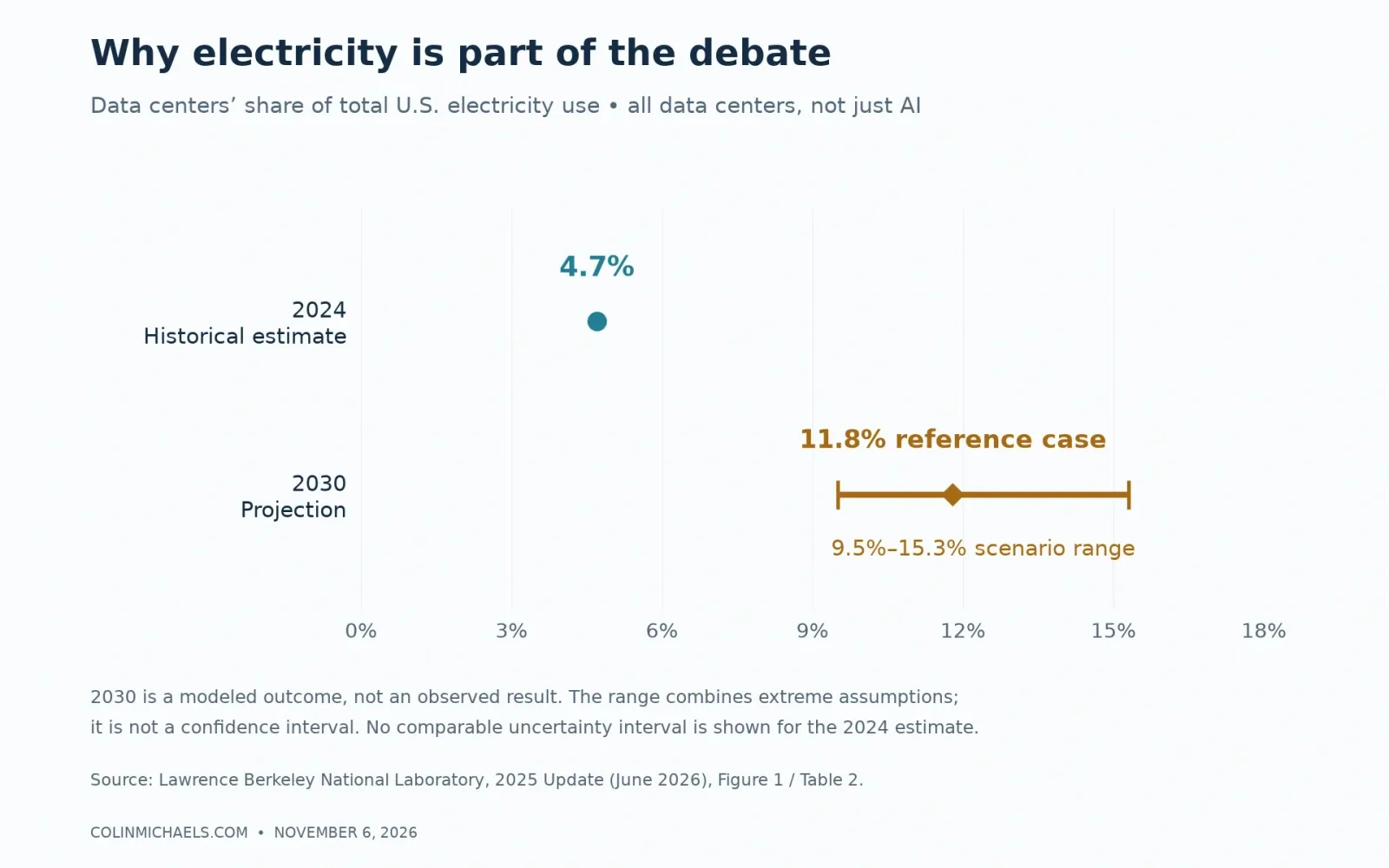
That scale helps explain why residents ask about utility bills, water, noise, and who pays for infrastructure. Those questions deserve answers before the permits are signed.
My view is that dismissing those concerns makes the investment problem worse. If people believe they bear the costs while someone else collects the profits, opposition becomes easier to organize and harder to resolve.
What would help us move forward?
These are my policy recommendations, not claims that any one measure would reverse the stock-market decline.
Give builders clear decisions and communities a real voice. Publish requirements, review deadlines, and appeal procedures. Projects meeting the standards should have a dependable path to approval. Projects that cannot meet them should receive a clear explanation. Endless uncertainty makes planning harder for everyone.
Make developers responsible for the costs they create. Electricity agreements should address generation, grid upgrades, and who pays if a promised project shrinks or disappears. Water use, noise limits, and local infrastructure obligations should be measurable and enforceable.
There is a starting point in the industry’s own commitments. Microsoft’s January initiative says its electricity rates should cover the costs of serving its data centers, including necessary infrastructure, rather than passing those costs to residential customers. The next question is how commitments translate into enforceable agreements and verified results. Microsoft’s community infrastructure commitments
Build the supporting infrastructure deliberately. Coordinate generation, transmission, water planning, and training with credible demand. Require evidence that projects are financed and customers exist before communities take on large obligations. Overbuilding infrastructure for speculative demand creates its own economic risk.
Keep American research and talent competitive. Support basic research, access to computing for universities and smaller businesses, and education that connects people to actual jobs. An AI strategy should create room for new companies as well as established giants.
Protect people without making every useful application impossible. Rules should address concrete harms—such as fraud, misuse of personal information, and unsafe deployment—with obligations appropriate to the risks. Clear protections can help earn public trust. Weak protections can fuel the backlash that companies say threatens their plans.
Measure success in more than stock prices. Track completed projects, permanent jobs, household electricity costs, useful products, and productivity improvements. Rising share prices alone do not establish that communities are benefiting. Falling prices alone do not establish that the technology has failed.
One useful thing we can do now
If a data-center proposal or restriction affects your community, read the actual public planning documents before sharing the most alarming headline. Then ask three questions:
- Which jobs are temporary, which are permanent, and what commitments are enforceable?
- Who pays for electricity and water infrastructure if the project changes or fails?
- What specific requirements would allow a responsible project to proceed?
For the national story, watch for named project cancellations, revised investment budgets, announced research moves, and completed overseas facilities. Those are stronger evidence than a dramatic prediction about companies abandoning America.
Final Thought
I do not want America to discover, years from now, that we made it easier to build the future somewhere else. I also do not want families told that higher bills and less say over their communities are simply the price of progress.
This week’s selloff gives us a reason to take both concerns seriously. Political decisions can affect investment. So can corporate overpromising and a failure to earn public trust.
The future I want is one where building in America makes sense—and where the people living next to that investment can explain how it makes their lives better.