Trust & transparency
Evidence & disclosures
Evidence basis: Researched analysis. The article compares public evidence and does not claim hands-on testing unless a section says otherwise.
Based on published event footage, organizer material, FAA guidance, and reporting; I did not attend the show or participate in the FPV flight.
Sources checked: Aug 20, 2026
Linked references: 14 explicit sources in the article.
2,500 Drones, One FPV Pilot, and America’s 250th Birthday
I have watched plenty of drone-show videos, but this one made me stop scrolling.
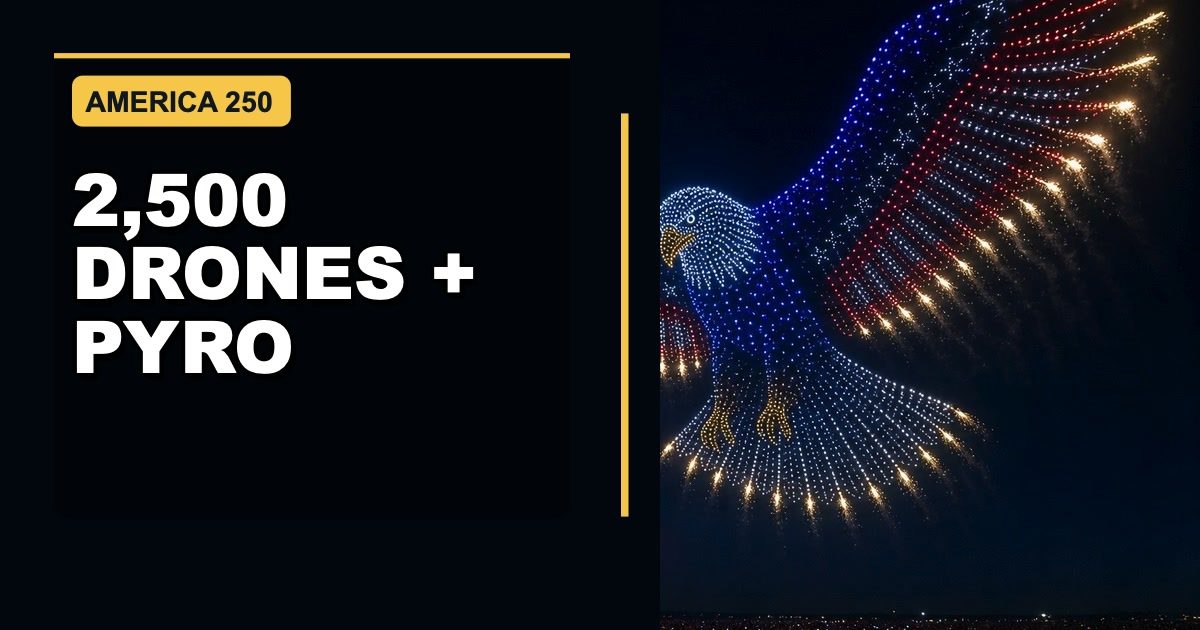
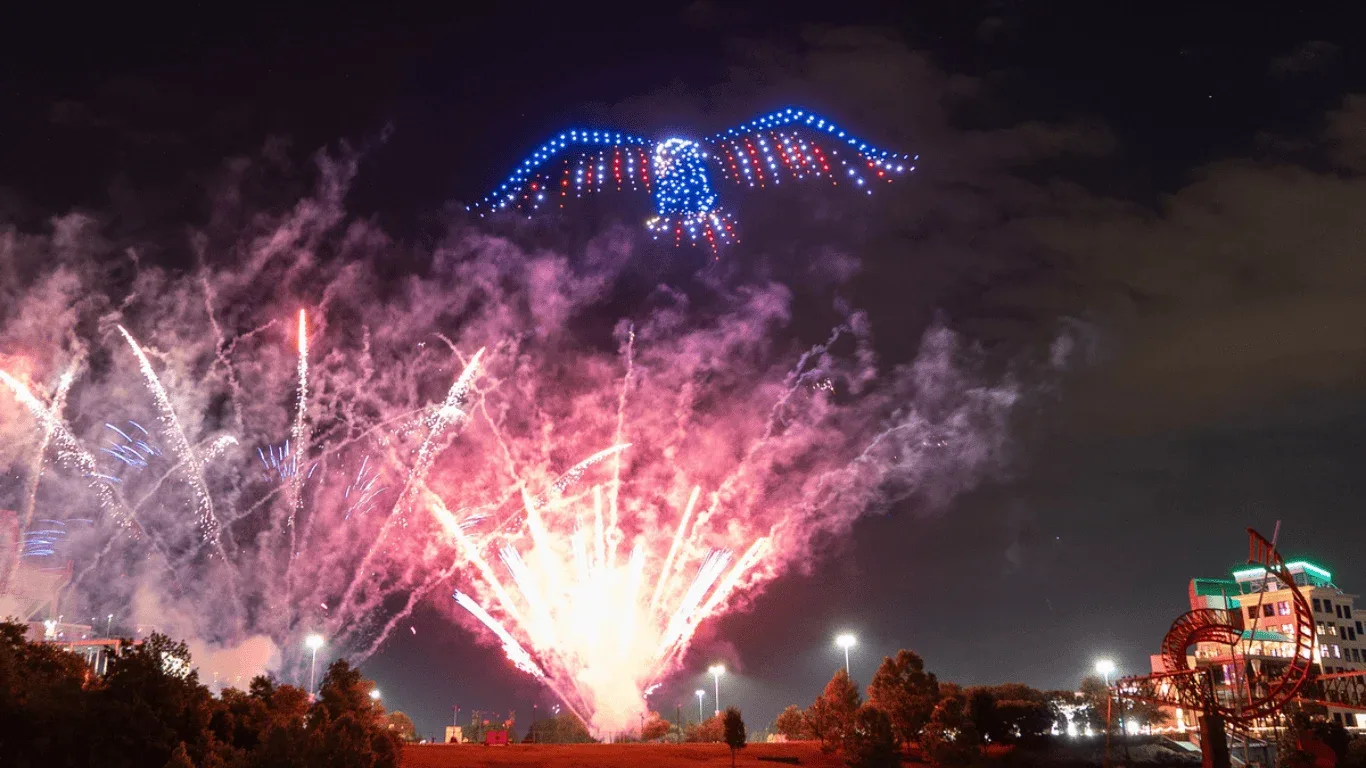
Sky Elements put 2,500 drones over North Richland Hills, Texas, for an early Fourth of July celebration marking America’s 250th birthday. The show turned the sky into a giant animated history book: George Washington, Uncle Sam, the American flag, Artemis II, and a bald eagle made from light and fire.
Then FPV creator Brian Woodward gave the spectacle a completely different kind of energy.
The reel co-posted by Brian and Sky Elements does not just show the formations from a safe, static audience angle. It pulls you toward them. The camera moves with the show, making 2,500 carefully synchronized points of light feel less like a distant display and more like a place you could somehow fly into.
And yes, the finale includes what Brian calls the “Peagle”: a pyro eagle.
That is a sentence worth building an article around.
TLDR
- Sky Elements produced a 2,500-drone Independence Day show in North Richland Hills, Texas, on July 1, 2026, as the United States prepared to celebrate its 250th birthday.
- The show featured large patriotic and historical formations, including George Washington, Uncle Sam, Artemis II, and a bald eagle enhanced with pyrotechnics.
- FPV filmmaker Brian Woodward collaborated with Sky Elements on a short, co-posted reel that turns the huge public spectacle into a fast, immersive camera experience.
- The collaboration works because Sky Elements provides the scale and choreography while Brian’s FPV perspective provides speed, proximity, and a human point of view.
- This was a professional, coordinated production. It is not permission for hobby pilots to launch near major America250 events, many of which are subject to strict drone restrictions.
The Video That Sent Me Down the Rabbit Hole
The first post I saw was Sky Elements’ “2,500 Drone Independence Day” reel. It is exactly the kind of video social media was made for: an enormous illuminated eagle, wings spread across the night sky, with fireworks and sparks turning a technically impressive formation into something that feels alive.
The scale is hard to process on a phone. Each point of light is an aircraft. Each aircraft has a planned position, color, timing, and flight path. Multiply that by 2,500, synchronize it with music and fireworks, and then make the result look clean from the audience area.
That would already be enough.
Brian Woodward’s version adds the missing ingredient: movement.
His reel is co-authored with Sky Elements and describes the show as a celebration of America’s 250th birthday “with 2500 drones and pyro.” He saves the “Peagle” for the end, which is smart editing because once you have promised people a flaming eagle, you probably should not open with it and spend the rest of the video trying to follow that.
The post itself does not publish a detailed production-credit sheet, so I do not want to invent one. What is public is that the reel is credited to both Brian and Sky Elements, and that Brian operates Woodward Drone Productions, a Utah-based drone-video business. The creative fingerprints are clear: Sky Elements built and flew the massive aerial canvas; Brian brought an FPV filmmaker’s eye to the way we experience it online.
Who Is Sky Elements?
Sky Elements is a Texas-based production company specializing in turnkey drone light shows. The company says it operates the largest drone-show fleet in the United States, has earned 17 Guinness World Records titles, and routinely handles more than 100 shows during peak holiday periods.
Its client list ranges from city celebrations to major entertainment and sports brands. The important part is that Sky Elements is not simply selling a fleet of glowing quadcopters. It is selling a complete production system: concept development, animation, music, logistics, pilots, airspace coordination, maintenance, regulatory work, and the performance itself.
The company describes each drone as one illuminated point inside a much larger programmed animation. A central ground system coordinates the fleet while the operations team handles aircraft readiness and airspace safety. In practical terms, the drones become pixels, but pixels that have batteries, motors, GPS, flight limits, maintenance records, and a very real relationship with gravity.
That mix of creative work and operational discipline is what makes these shows fascinating to me. The audience sees a bald eagle. Behind the eagle is a small aerospace operation.
The North Richland Hills Show Was Built for a Milestone
The 2,500-drone performance took place on July 1 at the North Tarrant Chamber’s Family Fireworks event in North Richland Hills. The event listing billed it as a fireworks-and-drone show celebrating the country’s 250th year.
The published show recap identifies formations of George Washington, Uncle Sam, NASA’s Artemis II, and a pyro-drone bald eagle. That selection is more thoughtful than a loop of red, white, and blue clip art.
George Washington points backward to the country’s beginning. Artemis II points toward what comes next. The eagle sits between them as a symbol people recognize instantly. The show becomes a short visual argument: America at 250 is history, identity, invention, and an unfinished future.
I like that. A 250th birthday should remember the past without acting as if the past is the only interesting thing we have left.
Why 2,500 Drones Change the Picture
A smaller drone show can produce clear logos, words, and basic animated shapes. More aircraft give the creative team more resolution.
Think of it like increasing the number of pixels in an image. With 2,500 separate lights, an animator can add smoother curves, more facial detail, layered motion, and larger formations without every edge looking blocky. The George Washington portrait can read as a person instead of an ambitious collection of dots. The eagle can have feathers, depth, and motion instead of looking like a glowing airport logo.
Scale also changes how the performance feels in person. A formation can fill a much larger piece of sky. It can transition across several visual ideas while keeping enough drones available to create particles, trails, accents, or a second layer of animation.
The tradeoff is complexity. More drones mean more batteries, more placement, more inspections, more charging, more data, more chances for something to need attention, and a larger operational footprint. That is why the final video can look almost effortless even though the production behind it is anything but.
The Pyro Drones Are the Part Your Brain Does Not Expect
Drone lights are precise. Fireworks are chaotic. Putting them together creates an interesting tension.
Sky Elements says it became the first U.S. drone-show company to receive FAA approval for attaching pyrotechnics to drones. Instead of keeping the fireworks on the ground and the drones above them, selected aircraft can carry approved pyrotechnic effects as part of the choreography.
That is how you get the Peagle.
The eagle exists first as a controlled formation of lights. Then fire traces and bursts around it, adding motion that LEDs alone cannot reproduce. It does not just glow. It appears to flare into existence.
The effect works because the pyro is not replacing the drone art. It is punctuating it. The drones hold the image long enough for your brain to recognize the eagle, and the fire gives that image a dramatic final beat.
It is also important to say that “fireworks on drones” is not a weekend garage project. This is specialized professional work involving aircraft, pyrotechnics, flight planning, permits, trained crews, safety zones, and FAA coordination. The cool part is not that somebody attached a sparkler to a quadcopter. The cool part is that an entire team made something this wild look controlled.
Why Brian Woodward’s FPV Perspective Matters
Most drone-show footage is filmed from the audience viewpoint for a good reason: that is the designed viewing angle. Put a locked camera in the right place and the images line up exactly as the animators intended.
FPV footage has a different job.
An FPV pilot flies from the aircraft’s camera view, using goggles or a monitor to control the drone as if sitting inside it. For filmmaking, that allows fast, continuous camera moves that would be difficult with a crane, helicopter, or conventional camera drone.
Brian’s reel uses that visual language to make the performance feel physical. The lights are not only a picture in the distance. They become an environment with depth, speed, foreground, background, and changing scale.
That changes the emotional experience. A wide audience shot says, “Look what they built.” An FPV shot says, “Come with me.”
It is a perfect collaboration for social video. Sky Elements creates something enormous enough to be seen across a city. Brian finds a way to make that enormity feel personal on a six-inch screen.
This Is Also a Lesson in How Spectacle Travels Online
The public event happened in Texas, but most people who encounter it will never have stood in the crowd. They will see it as a vertical video on Instagram, TikTok, YouTube Shorts, or whatever platform is trying to steal the next 29 seconds of our attention.
That means the filming and edit are not secondary documentation. They are part of the show’s reach.
A good live production creates one memorable night. A good media collaboration lets that night keep moving. The wide shots prove the scale. The FPV shots supply motion. The close passes show the pyro. The short edit delivers the payoff before somebody’s thumb gets impatient.
Sky Elements understands this well. The company sells a live experience, but its most spectacular formations are designed to become instantly recognizable images online. Brian’s contribution helps bridge the gap between a formation designed for a crowd and a story designed for a feed.
One Necessary Safety Reality Check
Watching an FPV camera move through a professional aerial production can make the whole thing feel wonderfully reckless. It is not.
The show aircraft, flight area, pyrotechnics, camera work, and public viewing areas have to be coordinated as one production. A random pilot launching nearby would not add another cool angle. That aircraft would become an uncontrolled hazard inside carefully managed airspace.
The FAA’s Flight Path to America 250 guidance warns that major America250 events may have strict No Drone Zones and serious penalties for unauthorized operations. The exact restrictions depend on the event and airspace, but the practical message is simple: do not see a professional drone show and decide it needs your Mini 4 Pro in the middle of it.
Enjoy the footage. Hire the professionals. Leave the surprise guest appearance to the bald eagle made of fire.
What This Collaboration Gets Right
There are a few reasons this project works so well:
- The occasion is bigger than the technology. The drones are impressive, but the show is built around a national milestone and a story people already understand.
- The formations mix history with the future. George Washington and Artemis II belong in the same sky because the point is not only where America started. It is what the country still hopes to build.
- The pyro has a purpose. It creates a finale instead of becoming nonstop visual noise.
- The FPV footage adds a second point of view. The live audience sees the full composition; online viewers get speed and immersion.
- The collaboration respects each specialty. Sky Elements handles scale, choreography, and execution. Brian turns the result into a camera experience people want to replay.
That last point may be the most useful lesson for any creative project. Great work does not always come from one person trying to do everything. Sometimes it comes from one team building the impossible object and another creator showing us how it feels.
Final Thought
America’s 250th birthday was always going to produce big flags, big fireworks, and big speeches. Sky Elements and Brian Woodward found a more modern way to tell the story: 2,500 flying lights, a little aerospace-scale choreography, a camera that refuses to sit still, and one gloriously unnecessary pyro eagle.
I love drones because they keep finding new ways to become more than the machine itself. A drone can be a camera, a racing aircraft, a mapping tool, an inspection platform, or—in the hands of a team like this—one pixel in a moving image larger than a building.
The technology is impressive. The collaboration is what makes it memorable.
And the Peagle absolutely sticks the landing.
Watch and Learn More
- Sky Elements’ original 2,500-drone Instagram reel
- Brian Woodward and Sky Elements’ FPV collaboration reel
- Sky Elements: About the company
- Sky Elements: Portfolio
- Sky Elements: Nashville Fourth of July case study
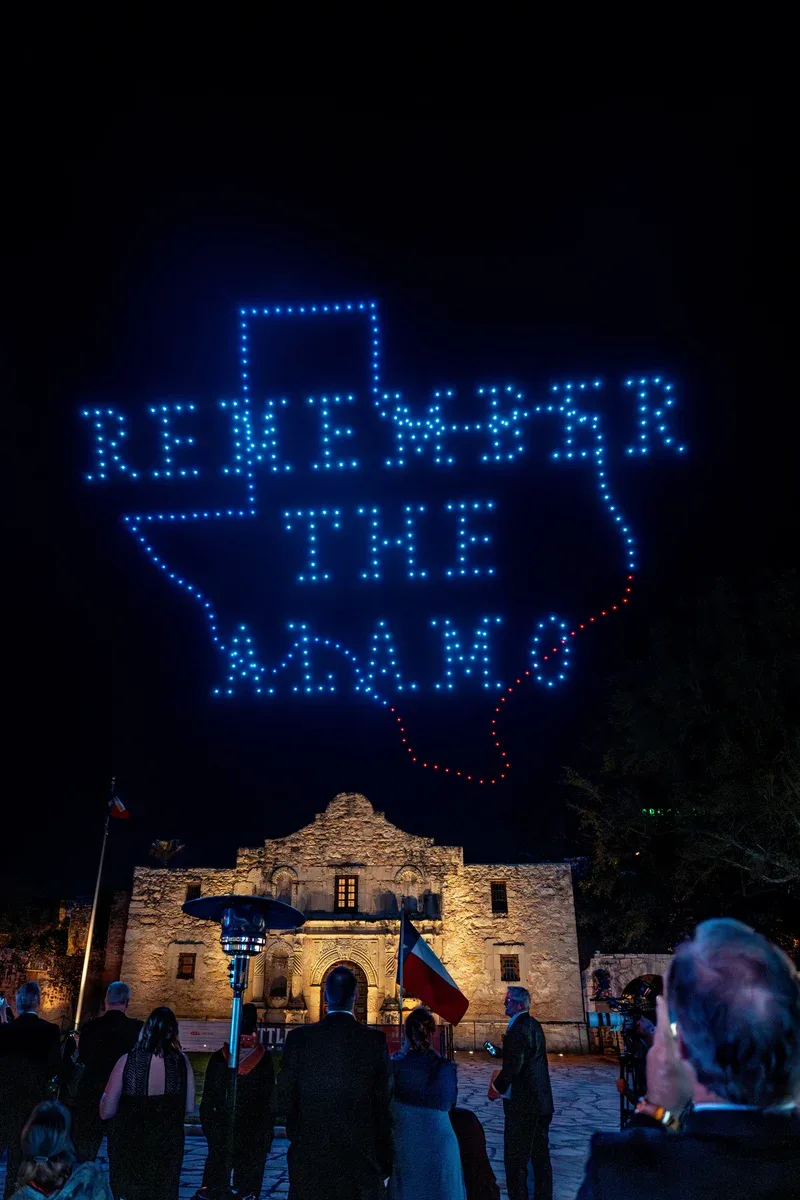
- Sky Elements: The Alamo Drone Show case study
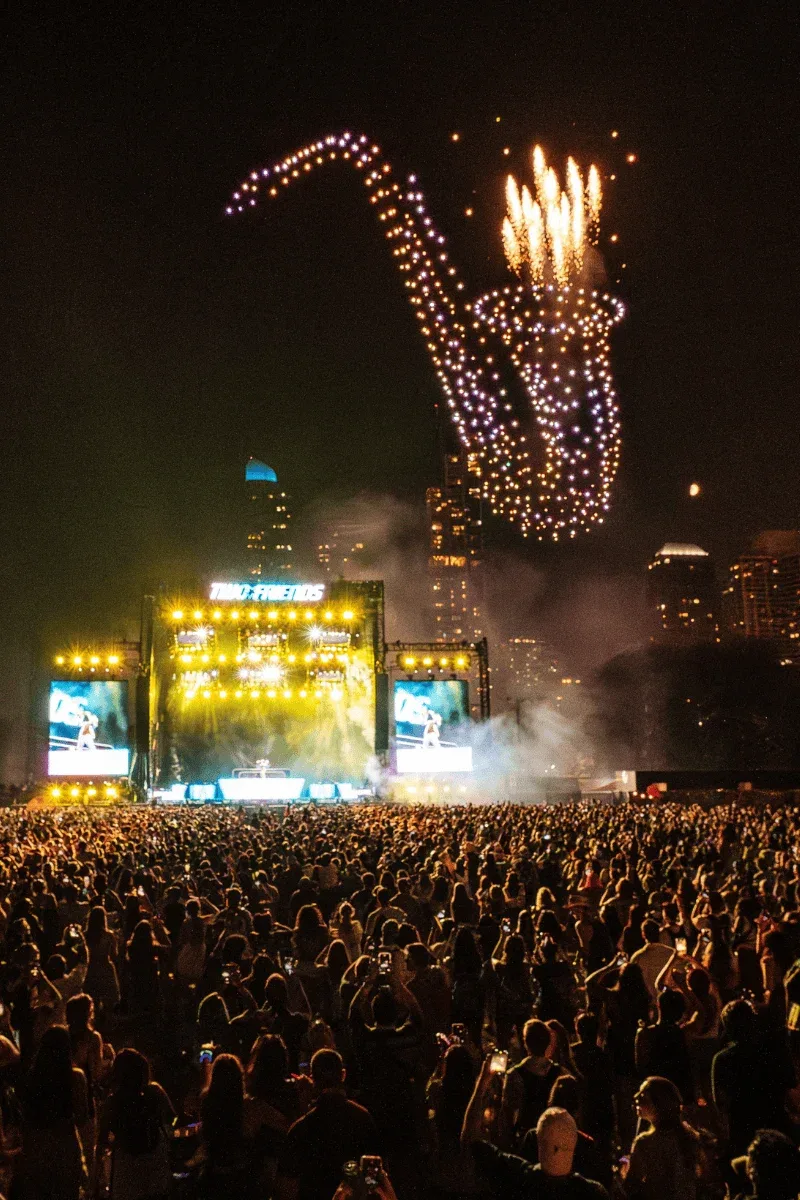
- Sky Elements: Lollapalooza 2025 case study
- Sky Elements: How drone light shows work
- North Tarrant Family Fireworks event listing
- UAS Vision: 2,500 Drone Show in Texas on Fourth of July
- FAA: Flight Path to America 250
Reporting note: This article was researched on July 10, 2026. The Instagram collaboration identifies Brian Woodward and Sky Elements as co-authors but does not provide a detailed production-credit list, so the article does not assign Brian responsibility for the show’s choreography or fleet operations.